

Practicar dictados en Español
Dictados train listening, spelling, and writing all at once, which is why one short session beats an hour of passive listening. To practise dictados in Spanish properly, pick a short interactive dictado, listen once for gist without typing, transcribe on a second pass, then go back for accents and punctuation. Use speed control and repeat playback, and do it daily rather than in occasional long sessions.
TL;DR:
- Using structured passes and daily practice significantly improves dictation skills more effectively than passive listening or long sessions.
- Selecting dictados at your CEFR level helps target relevant grammar and vocabulary, with flexibility to adapt difficulty by speed or content.
- Interactive tools with speed control, strict mode, and immediate feedback support better error analysis and reinforce correct orthography and pronunciation.
- Focusing on accuracy after capturing the flow prevents common mistakes and enhances pronunciation, especially for tricky sounds like rolled rr or inverted punctuation.
- Reinforcing vocabulary through repetitive, integrated lessons accelerates retention and confidence in listening, spelling, and writing in Spanish.
Table of Contents
- A step-by-step routine for practising Spanish dictation
- Which dictado level suits your Spanish right now?
- Which interactive features actually improve your results?
- What tips reduce the most common dictado mistakes?
- Why this routine works: the method behind it
- Where to practise dictados with structured support
- Sources
A step-by-step routine for practising Spanish dictation
Most learners sit down, hit play, and try to catch every word first time. That is the fastest route to frustration, because your ear cannot yet do what your eyes do when reading. A structured pass system fixes this, and it takes no longer than a coffee break — a technique explained in detail in Spanish Listening Comprehension: What Every Learner Must Know.
- Pre-listen without writing. Play the audio once through, 10 to 20 seconds for a short dictado, and just absorb the gist. Don’t touch the keyboard.
- First pass: transcribe for flow. Play it again in short chunks and type what you hear. Ignore accents, ignore commas, ignore whether you’ve written “que” or “Que”. The goal here is momentum, not correctness.
- Second pass: fix the detail. Replay the same chunks and go back through your text adding missing words, tildes, and punctuation. This is where Strict Mode earns its place, scoring you on exact matches so you can see precisely where orthography slipped.
- Read it aloud against the native audio. Compare your pronunciation to what you just heard. This step matters more than most learners realise, because Spanish dictation forces active listening that links pronunciation and spelling in real time rather than treating them as separate skills.
Session length matters less than consistency. A short daily routine of focused dictado practice produces steady improvement without overwhelming learners, and if daily practice isn’t realistic, 30 to 60 minutes two or three times a week still works.
Pro Tip: Keep your first-pass transcription even when it’s messy. Comparing your rough version against your corrected second pass shows you exactly which sounds you’re mishearing, which is far more useful feedback than a final score alone.
Which dictado level suits your Spanish right now?
Dictados scale with you, and choosing the wrong level either bores you or breaks your confidence. Graduated dictados organised by CEFR level let you target the grammar you’re actually working on rather than whatever a random clip throws at you.
- A1 to A2: single words and one-sentence dictados at slow speed, focused on core vocabulary and present-tense verbs. Try short shopping-list style dictations or simple greetings first, then move to one full sentence about daily routine.
- B1 to B2: short paragraph dictados mixing past and present tenses, with connectors like “aunque” or “sin embargo”. Introduce a regional accent once paragraphs feel manageable at standard speed. A weather report or a short diary entry works well here.
- C1: longer passage dictados with Strict Mode switched on throughout, testing punctuation, subordinate clauses, and nuance. News segments or unscripted interview clips push you hardest.
Modify difficulty in either direction: drop from paragraphs back to words when a topic introduces unfamiliar vocabulary, or speed a passage up once you’re transcribing without pausing.
Which interactive features actually improve your results?
Not every dictation tool is built the same, and the settings you ignore are often the ones doing the most work. A capable online dictation tool typically offers multiple modes, speed control, Strict Mode, and immediate error highlighting, and knowing when to use each turns a generic exercise into a targeted one.
- Speed control (0.75× to 1.25×). Slow playback keeps natural rhythm intact while making fast speech intelligible; starting around 0.75× to 1.0× and building up to normal speed as comprehension improves is standard advice, and headphones help you catch subtler sounds like ñ or a rolled rr.
- Repeat, pause, and chunking. Breaking audio into short segments stops you from losing the thread halfway through a sentence.
- Strict versus lenient mode. Strict Mode scores exact matches and suits exam preparation or serious orthography drilling; lenient mode suits early fluency work where you’d rather build confidence than chase a perfect score.
- Custom text upload. Some dictation generators let you build a dictado from your own material, song lyrics, a news article, a form you need to fill in at the town hall, which closes vocabulary gaps faster than generic content because you’re practising exactly the words you need.
- Immediate feedback. Highlighted errors and a misspelt-words list turn a single session into a diagnostic, showing you the same three mistakes before they become habits.
A significant portion of learner errors in strict scoring trace back to accents and punctuation rather than genuine comprehension gaps, which is why the second-pass correction step matters as much as the listening itself.
What tips reduce the most common dictado mistakes?
The single biggest error is chasing perfection on the first listen. Instructors consistently separate the flow pass from the accuracy pass, and trying to nail spelling and meaning simultaneously is what causes most beginners to freeze mid-sentence. Get the words down first. Fix tildes second.
The read-aloud step doubles as a diagnostic. If your pronunciation of a word doesn’t match what you just heard, that mismatch usually explains why you misheard it in the first place, which makes this stage as much a speaking drill as a listening one.
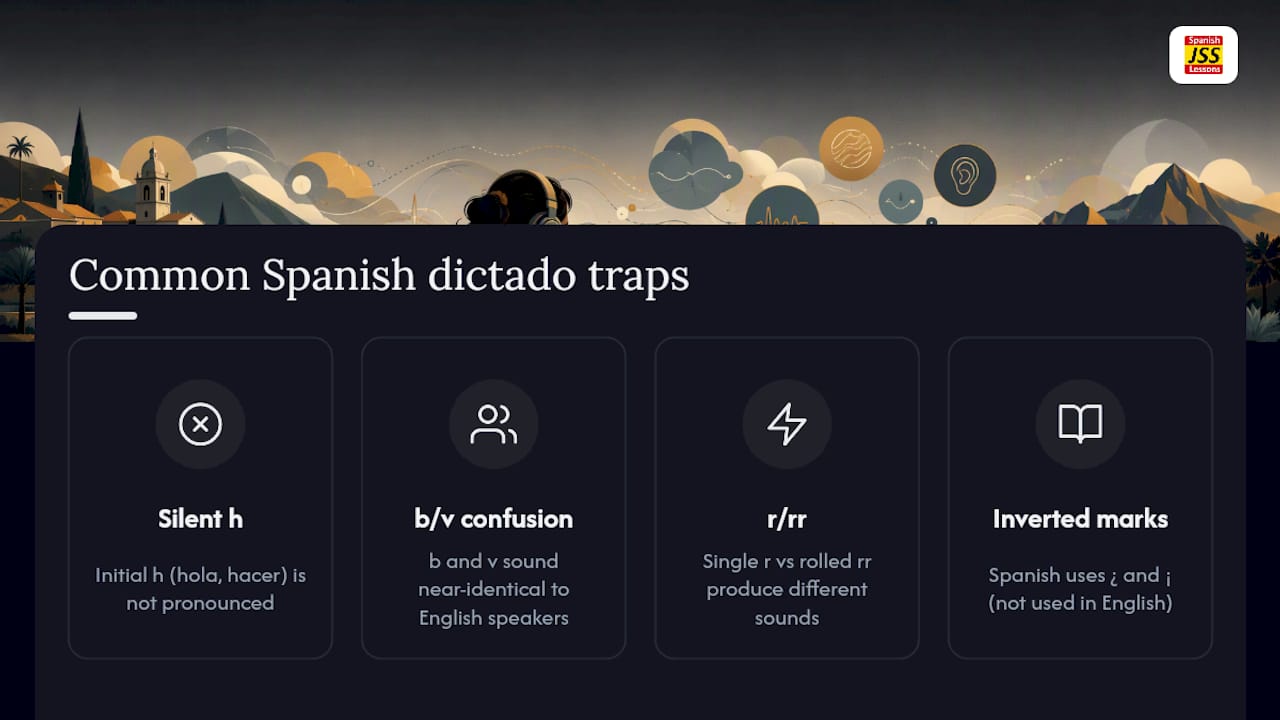
Watch for the classic Spanish traps: the silent h at the start of words like “hola” or “hacer”, confusion between b and v since both sound near-identical to English speakers, the difference between a single r and a rolled rr, and inverted punctuation marks (¿ and ¡) that English simply doesn’t use.
Pro Tip: Grade yourself simply: count errors by category, accents, missing words, punctuation, rather than a single overall score. A running log across sessions shows you which category is actually shrinking.
Why this routine works: the method behind it
James Bretherton has lived in Spain for 40 years as a dual-native speaker, and James Spanish School’s Radical Simplification approach strips out grammar terminology that native speakers never think about, explaining Spanish structure in plain English instead. That same instinct shapes how dictado practice fits into the wider course.
Retention isn’t about intelligence. It’s about a system that supports how memory actually works, cycling the same vocabulary through listening, writing, speaking, and reading until it sticks.
The WordAmigo system applies exactly that repetition loop to dictado work, reinforcing the same words across multiple senses rather than leaving them as a one-off spelling exercise. The 100-lesson course splits time between sentence-building and ear-tuning, so dictation practice sits alongside structured listening work rather than standing alone, with every module available on demand for repeat sessions.
Where to practise dictados with structured support
Everything above works with any dictation tool, but it works faster inside a course built to reinforce the same words repeatedly, rather than a random clip you’ll never hear again. The ear-tuning lessons in the course are designed around that gap: fast native speech that most self-taught learners struggle to decode, paired with a vocabulary and pronunciation system to address the same problem.
The sentence-building side of the course reinforces exactly the material you’ll transcribe in a dictado, so a session that once felt like guesswork starts drawing on vocabulary you’ve already banked. If you’re starting from scratch, the Sentences 1 starter module pairs naturally with short beginner dictados before you move into longer passages. Every lesson is on demand with no expiry date, and the course comes with a guarantee: if a core lesson teaches you nothing new, you may receive extra practice modules.
You can see current course access and starter options through the James Spanish School shop. It’s a practical next step if today’s dictado session left you wanting a structured way to keep the gains rather than losing them by next week.