

Leísmo en España / What is leísmo?
Leísmo is the use of le or les as a direct-object pronoun where standard Spanish would use lo, los, la, or las. It happens across Spain, and the Real Academia Española tolerates the most common form of it, the masculine-person singular, while discouraging the rest. The quick rule for learners: write with standard pronouns, but expect to hear le everywhere once you’re chatting with your neighbours.
TL;DR:
- Masculine-person leísmo is widely accepted in educated speech in Spain, especially for male direct objects, but other forms remain discouraged in formal contexts.
- Leísmo is most common in central and northern regions such as Madrid, Castilla y León, La Rioja, Cantabria, and areas with Basque contact, with regional variation in acceptability.
- Using le for masculine people is generally acceptable in speech, but substituting le for feminine or inanimate objects should be avoided in formal writing and careful speech.
- Leísmo originates from medieval Castilian language evolution, with contact with Basque reinforcing its regional spread, especially in border areas.
- Learners should focus on recognizing verbs that frequently trigger leísmo, like perception and communication verbs, and adapt their usage based on formality and regional context.
Table of Contents
- What is leísmo? The three types explained in plain English
- What does the RAE actually say about leísmo in Spain?
- Where in Spain is leísmo most common?
- Leísmo examples: how sentences actually change
- Leísmo vs laísmo vs loísmo: telling them apart fast
- Where did leísmo come from? A short history
- How should learners handle leísmo day to day?
- Who’s explaining all this, and how James Spanish School approaches it
- Where to check the rules yourself
- Sources
What is leísmo? The three types explained in plain English
To understand leísmo, it helps to know what le and lo were originally built to do. In Latin, the dative case marked an indirect object (the person something was given to) and the accusative marked a direct object (the thing or person directly acted upon). Spanish kept that split with le/les for indirect objects and lo/los/la/las for direct objects. Leísmo happens when speakers blur that line and let le creep into accusative territory, replacing the pronoun that grammar books say should be there.
The RAE’s Diccionario panhispánico de dudas sets out three distinct types, and they are not treated equally:
- Masculine-person leísmo: using le for a male direct object instead of lo, as in “Le vi ayer” (I saw him yesterday) instead of “Lo vi ayer”. This is the version you’ll hear constantly in Spain.
- Feminine-person leísmo: using le for a female direct object instead of la, as in “Le vi en la tienda” instead of “La vi en la tienda”. Far rarer, and it draws more raised eyebrows.
- Leísmo of thing: using le for an inanimate direct object instead of lo or la, as in “El libro, le compré ayer” instead of “El libro, lo compré ayer”. This one strays furthest from the standard and is the least accepted of the three.
There’s a clear prestige gap between these. Masculine-person leísmo has been used by celebrated writers and appears constantly in educated speech across central Spain, so nobody blinks at it. Feminine-person and thing leísmo carry more of a stigma, often flagged as a regional quirk or a slip rather than a legitimate stylistic choice. If you only remember one distinction from this section, remember that: not all leísmo is created equal, and the RAE’s patience runs out fast once you move past the masculine-person singular case.
What does the RAE actually say about leísmo in Spain?
Spain’s language authority doesn’t ban leísmo outright, and it doesn’t wave it through either. The RAE’s guidance in El buen uso del español draws a line that’s genuinely useful for anyone trying to write correct Spanish while still sounding natural in conversation.
Masculine-person singular leísmo (le veo, le llamo for a male person) is so widespread among educated speakers in Spain that it is not considered incorrect, even though the “etymological” form with lo remains the model recommended in careful writing. Plural leísmo, feminine-person leísmo, and leísmo referring to things, by contrast, are advised against in both speech and writing.
The Nueva gramática básica backs this up with the same core message stripped down for learners: singular masculine-person le isn’t strictly wrong, but everything else on the leísmo spectrum should be avoided if you want your Spanish to match the written standard.
For practical purposes, that boils down to two working rules:
- If you’re writing formally (emails to institutions, exam essays, professional documents), default to lo/los/la/las every time, no exceptions.
- If you’re talking to a shopkeeper, a neighbour, or your builder over coffee, don’t panic if le slips in for a male person. It’s normal, it’s accepted, and correcting yourself mid-sentence will make you sound stranger than the leísmo itself.
The gap between the written standard and the spoken reality is exactly why this distinction trips up so many learners. Textbooks teach the “correct” lo, but the street teaches le, and both are right in their own context.
Where in Spain is leísmo most common?
Leísmo isn’t spread evenly across Spain. It clusters heavily in the central and northern parts of the peninsula, and the RAE’s dialectal notes point to specific regions where it’s the dominant pattern rather than an occasional variant.
The core leísta zone includes:
- Madrid and the wider Castilian heartland, where masculine-person leísmo is close to universal in everyday speech.
- Castilla y León, historically the cradle of the phenomenon and still one of its strongholds.
- La Rioja, sitting right in the same dialectal band.
- Cantabria, which shows a distinctive twist: some Cantabrian speakers use le for countable objects and lo for uncountable ones, a split that doesn’t exist in standard Castilian Spanish.
- Areas with historical Basque contact, including parts of the Basque Country and northern Navarra, where language contact appears to have reinforced the pattern over centuries.
That regional weighting isn’t guesswork. Corpus research collected through ASALE’s corpus resources shows leísmo turning up far more often in central-northern peninsular texts than in southern Spanish or Latin American ones, and it appears in the work of respected historical writers, not just casual speech. That’s worth sitting with for a moment: leísmo isn’t a modern sloppiness creeping into Spanish. It’s a centuries-old feature of Castilian speech that happened to become the prestige dialect the rest of the country learned to write in, carrying its own irregularity along for the ride.
Why does the pattern hold together geographically? Two forces seem to be doing most of the work. First, leísmo originated in medieval Castilla and spread outward with Castilian as it became the administrative and literary language of Spain, so areas closest to that historical core kept the feature strongest. Second, contact with Basque, a language with no grammatical gender and a different pronoun system entirely, appears to have reinforced le as a catch-all object pronoun in border regions, independent of the person or gender of what it refers to.
One more thing worth flagging for learners: leísmo shows up far more in speech than in writing, even within leísta regions. Radio interviews, market conversations, and family chatter are full of it. Newspaper articles and novels dial it back toward the standard lo. That register split matters more than geography once you’re deciding how to write your own Spanish.
Leísmo examples: how sentences actually change
Seeing the swap in real sentences makes the whole thing click faster than any rule ever will. Here are paired examples, each with a leísta version, a standard counterpart, a literal gloss, and a natural English translation.
- Perception verb, masculine person.
Leísta: “Le vi en el bar.” (literally: “To-him I-saw at the bar.”)
Standard: “Lo vi en el bar.”
Natural English: “I saw him at the bar.” Both are heard constantly in Madrid; only the second appears in careful writing. - Perception verb, feminine person.
Leísta (discouraged): “Le vi en la calle.”
Standard: “La vi en la calle.”
Natural English: “I saw her in the street.” This swap is far less accepted, even in leísta regions, and tends to sound like a mistake rather than a regional flavour. - Communication verb, masculine person.
Leísta: “Le dije que viniera.”
Standard: “Lo dije… “ (note: with decir, le is actually the historically correct dative form when the direct object is a clause, so this pair needs care.)
Natural English: “I told him to come.” This is one of the trickiest cases for learners, because decir genuinely takes le in many constructions, which isn’t leísmo at all. It’s the real dative use, and mixing it up with true leísmo is a common learner error. - Warning/alert verb, thing.
Leísta (discouraged): “El coche, le avisé al mecánico.”
Standard: “El coche, lo avisé al mecánico” is itself awkward. Better standard: “Avisé al mecánico sobre el coche.”
Natural English: “I warned the mechanic about the car.” - Mixed sentence, same speaker.
Real spoken Spanish: “A Pedro le vi ayer, pero a su hermana la vi hace una semana.”
Natural English: “I saw Pedro yesterday, but I saw his sister a week ago.”
That last example is the one to remember. Notice the speaker uses le for the man and la for the woman in the same breath, without a flicker of inconsistency. This is exactly what corpus researchers mean when they describe leísmo as register and person-sensitive rather than a blanket habit.
Native speakers in Spain routinely mix le and lo within a single conversation, sometimes within a single sentence, choosing based on the person, gender, and formality of the moment rather than a fixed personal rule.
Perception verbs (ver, mirar, oír) and communication verbs (decir, avisar, llamar) are where you’ll hear leísmo most consistently, which is a genuinely useful thing to know if you’re trying to train your ear efficiently rather than trying to absorb every verb at once.
Leísmo vs laísmo vs loísmo: telling them apart fast
Leísmo has two siblings, and both carry a far worse reputation. Laísmo is the use of la/las where the dative le/les belongs, as in the disapproved “La dije que viniera” instead of “Le dije que viniera”. Loísmo is the mirror case with lo/los replacing a dative, as in “Lo dije que viniera” for the same sentence.
Neither laísmo nor loísmo enjoys anything like the tolerance the RAE extends to masculine-person leísmo. Both are consistently flagged as errors in RAE guidance, largely because they’re geographically rarer and carry no comparable literary pedigree. Where leísmo has centuries of prestigious use behind it in central Spain, laísmo and loísmo read more like isolated slips, even in the regions where they do occur.
Three quick checks to run when you’re unsure which one you’re hearing or writing:
- Ask what role the pronoun plays. Is it standing in for a direct object (leísmo territory) or an indirect object (laísmo/loísmo territory)?
- Ask whether le has replaced lo/la, or whether la/lo has replaced le. The direction of the swap tells you which phenomenon you’re looking at.
- Ask if the sentence would survive an exam. If you’re not certain, default to the etymological form: lo/la for direct objects, le for indirect ones.
Pro Tip: Keep a tiny mental flashcard: “le replacing lo/la = leísmo, la replacing le = laísmo, lo replacing le = loísmo.” Say it out loud a few times and the direction of each swap stops being confusing.
Where did leísmo come from? A short history
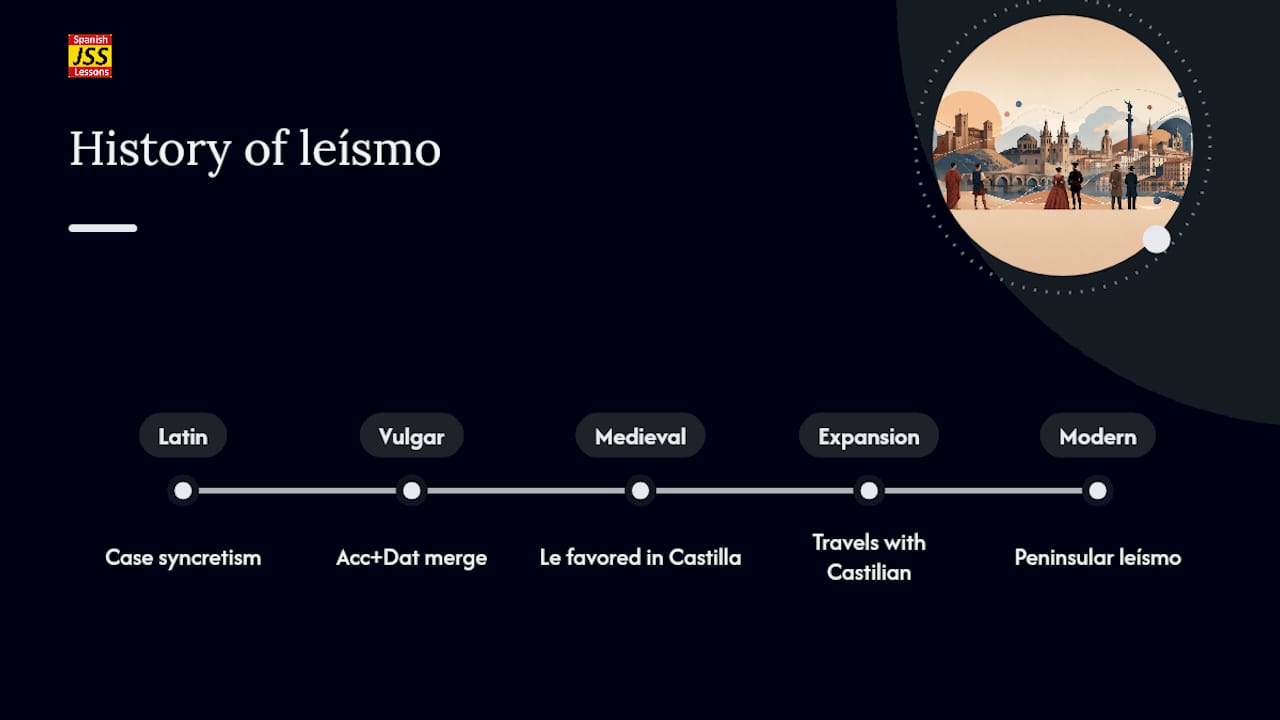
Leísmo isn’t a modern mistake; it’s a case ending that lost its grip centuries ago. Latin’s accusative and dative cases began collapsing into each other as Vulgar Latin evolved into early Castilian, a process linguists call case syncretism. By the medieval period, the pronoun system in the Castilla region had already started favouring le for masculine objects regardless of their original grammatical case, a pattern that then travelled with Castilian as it spread and eventually became the basis of standard Spanish.
The RAE’s Nueva gramática traces this spread and notes why it didn’t reach every Spanish-speaking region evenly. Some dialects, particularly those further from the Castilian core or shaped by different contact languages, held onto the older accusative/dative split more faithfully. That’s part of why leísmo remains a peninsular feature rather than a universal one, and why you’ll hear it far less in Latin American Spanish, a contrast worth exploring further if you’re curious how Spain Spanish compares with Latin American Spanish more broadly. Because the pattern took hold in Castilla before Castilian became Spain’s literary standard, masculine-person leísmo simply travelled into “correct” usage alongside everything else the region contributed to the modern language.
How should learners handle leísmo day to day?
Getting comfortable with leísmo is less about memorising rules and more about training your ear, and that’s genuinely good news if grammar terminology makes your eyes glaze over. Here’s a practical approach:
- Listen for verb type first. Perception verbs (ver, mirar, oír) and communication verbs (decir, avisar, llamar) are where leísmo shows up constantly. Once you can spot those verbs in real time, you’ll start hearing the le swap automatically.
- Repeat paired examples out loud. Say “le vi” and “lo vi” back to back until both feel natural in your mouth, rather than treating one as “correct” and the other as “wrong.”
- Match your register to the situation. Imitate local speech freely in shops, cafés, and casual chats. Switch to standard lo/la the moment you’re writing something formal or sitting an exam.
- Watch for your own overcorrection. A common learner mistake is forcing lo into every single slot out of nervousness, which can sound stilted next to native speakers who mix forms naturally depending on context.
Pro Tip: When you catch yourself hesitating between le and lo mid-sentence, just finish the sentence. Native speakers hesitate too, and a natural-sounding leísmo beats a stumbling correction every time in casual conversation.
If you want a broader map of the small errors English speakers tend to make in spoken Spanish, this practical guide to common mistakes is a useful companion to the leísmo-specific advice above.
Who’s explaining all this, and how James Spanish School approaches it
This explanation comes from James Bretherton, a dual-native speaker of English and Spanish who has lived in Spain for 40 years, watching leísmo operate in real conversations rather than just reading about it in grammar references. That kind of long-term immersion is exactly what separates a textbook rule from a lived understanding of when le sounds natural and when it doesn’t.
The course is built around a method called Radical Simplification, which strips out grammar terminology that native speakers never actually think about while talking, replacing it with plain English explanations of how sentences actually get built. For a feature like leísmo, that means less time memorising the words “accusative” and “dative,” and more time hearing the pattern in context until it sinks in naturally.
The school’s WordAmigo system uses structured repetition across reading, listening, speaking, and writing, which is precisely the kind of exposure that helps learners internalise a regional variant like leísmo rather than just recognising it on a page. Hearing le used correctly by real speakers, repeatedly, does more for your ear than any rule ever will.
Where to check the rules yourself
For anyone who wants to verify the details directly, the RAE’s own pages are the authoritative starting point, and they’re genuinely readable even without a linguistics background.
- The DPD entry on leísmo for the core definitions and regional notes.
- El buen uso del español for the RAE’s prescriptive recommendations.
- The Gramática básica entry for a learner-friendly summary.
- ASALE’s DAMER resource for deeper morphosyntactic background.
Ready to train your ear on real spoken Spanish, leísmo included? James Spanish School’s course on Spanish as spoken in Spain focuses squarely on the peninsular features you’ll actually hear in Madrid, Castilla, and beyond, and you can browse the full range of lessons through the James Spanish School shop.
Sources
- leísmo | Diccionario panhispánico de dudas | RAE – ASALE
- Leísmo, laísmo y loísmo | El buen uso del español | RAE – ASALE
- 10.5.1 el leísmo | Nueva gramática básica de la lengua española | RAE – ASALE
- Corpus ASALE (ASALE)