

Understanding Spanish directness guide
Spanish directness is real, consistent, and almost always a signal of warmth rather than hostility. For English speakers, the core adjustment is this: when a Spanish speaker says “Ponme un café” instead of “Could I possibly have a coffee, please?”, they are not being rude. They are being efficient and treating you as an equal. Understanding that single shift in perspective changes everything.
Here is what that means in practice, straight away:
Three quick implications for English speakers:
- Imperatives are not aggression. “Dame eso” (Give me that) or “Ven aquí” (Come here) are normal, everyday requests. The tone of voice carries the warmth that English speakers load into hedging words.
- Interruptions signal interest. When someone cuts across you mid-sentence in a Spanish conversation, they are usually showing engagement, not dismissal. Waiting for a polite gap can make you seem disinterested.
- Fewer ritualised “please” and “thank-you” exchanges. Spanish speakers use por favor and gracias, but not as a verbal reflex attached to every transaction the way many English speakers do. Absence of these words does not mean absence of respect.
Quick dos and don’ts:
- Do match the directness level of the person you are speaking with.
- Do use tú with most adults you meet socially; defaulting to usted can create unnecessary distance.
- Don’t read a bare imperative as an insult; read it as a shortcut between people who trust each other.
- Don’t over-hedge with stacked softeners (“I was just wondering if perhaps…”); it can read as evasive or uncertain.
- Do let your tone do the work that English speakers put into polite phrasing.
Key takeaways
Spanish directness is a solidarity-based communication style, not a sign of rudeness, and English speakers who understand this shift their interactions from guarded to genuinely connected.
| Point | Details |
|---|---|
| Directness signals solidarity | Bare imperatives and fewer hedges mean closeness and trust, not aggression or impoliteness. |
| Positive politeness drives the pattern | Peninsular Spanish privileges solidarity over distance, making direct forms the culturally normal choice. |
| Regional variation is real | Spain and Latin America differ significantly in formality level, address forms, and pace of speech. |
| Tone carries the warmth | A rising intonation on a direct request does the work that “please” does in English; words alone are not the whole message. |
| Drills accelerate adaptation | Practising bare imperatives and overlapping speech before real immersion shortens the adjustment period considerably. |
Table of Contents
- What does Spanish directness actually look like in speech?
- Why do Spanish speakers favour directness?
- How does directness vary across regions and contexts?
- Everyday phrase pairs that show the difference clearly
- Why English speakers so often misread Spanish directness
- Practical dos and don’ts for social and business settings
- Phrases and micro-scripts to use in the moment
- What 40 years in Spain teaches you about directness
- Ready to take this further with James Spanish School?
- Sources
What does Spanish directness actually look like in speech?
The technical term linguists use is positive politeness, and it describes a communication style that builds closeness rather than maintaining distance. Spanish, particularly peninsular Spanish, leans heavily on this approach. Rather than softening a request to protect the listener’s autonomy (what linguists call negative politeness), Spanish speakers tend to pull the listener in, treating directness as a marker of solidarity.
Linguistic markers you will hear:
- Bare imperatives for requests: “Tráeme la cuenta” (Bring me the bill) rather than “Could you bring the bill when you have a moment?”
- Conditional forms used sparingly: “¿Me puedes ayudar?” (Can you help me?) is common; the elaborate “I was wondering whether you might possibly be able to…” simply does not have a natural Spanish equivalent.
- Omission of hedges: Phrases like “sort of”, “kind of”, “a bit”, and “perhaps” appear far less frequently as padding. When Spanish speakers hedge, they mean it.
- Solidarity terms woven into speech: Tío, hombre, mujer, venga — these are not filler. They are positive politeness moves that soften a direct statement by signalling closeness.
- Tú as the default: Peninsular Spanish reserves usted for genuinely formal or older-person contexts; tú is the standard between most adult peers. Over-using usted creates distance where none was intended.
Pragmatic markers — what you see and hear beyond the words:
- Overlapping speech. Two people talking at once is not a sign that one is ignoring the other. It is a sign that both are engaged.
- Physical proximity. Spanish speakers stand closer than Northern European norms suggest is comfortable. Stepping back can read as coldness.
- Expressive gestures and volume. A raised voice in a Spanish conversation is often enthusiasm, not anger.
- Eye contact held longer. Breaking eye contact quickly can seem evasive.
Phrase pairs — English phrasing versus typical Spanish:
| Situation | Typical English phrasing | Typical Spanish phrasing |
|---|---|---|
| Ordering a coffee | “Could I have a coffee, please?” | “Ponme un café” |
| Asking for help | “I was wondering if you could help me?” | “¿Me ayudas?” |
| Asking someone to wait | “Would you mind waiting a moment?” | “Espera un momento” |
| Declining an offer | “That’s very kind, but I really couldn’t…” | “No, gracias” |
| Getting attention | “Excuse me, sorry to bother you…” | “Oye” / “Perdona” |
The Cultural Atlas notes that direct forms like “Ponme un café” are pragmatic norms, not impoliteness. The request lands perfectly well socially; it is the English ear that adds a layer of sharpness that was never there.
Why do Spanish speakers favour directness?
The answer lies in how Spanish communication is structured around solidarity rather than distance. Brown and Levinson’s face theory, one of the most widely applied frameworks in cross-cultural pragmatics, distinguishes between two kinds of politeness: positive face (the desire to be liked and included) and negative face (the desire for autonomy and not to be imposed upon). Peninsular Spanish consistently privileges positive face, which means speakers invest in closeness, shared identity, and inclusion rather than in protecting each other’s personal space.

A bare imperative, in this framework, is not an imposition. It is a solidarity move. It says: “We are close enough that I do not need to perform elaborate deference rituals with you.” Stacked hedges, by contrast, can read as evasion or as a signal that the speaker does not feel comfortable being direct, which in a positive-politeness culture can itself feel slightly cold.
Cultural and historical factors that shaped this:
- Mediterranean social norms. Across much of southern Europe, social life is conducted at close quarters, loudly, and with high physical expressiveness. Communication style mirrors that social texture.
- Regional identity and community. Spain’s 17 autonomous communities each carry strong local identities. In many of these communities, particularly smaller towns and rural areas, social bonds are tight and communication is correspondingly informal and direct.
- High-context interaction. Spain is a high-context, relationship-oriented culture where confianza (trust) is built through shared time, meals, and informal contact. Once that trust exists, elaborate verbal formality would feel out of place.
- Pragmatic efficiency. In fast-paced service environments — a busy bar, a market stall, a building site — direct phrasing is simply faster and clearer. The social meaning is carried by tone and context, not by hedging words.
A note on face theory in practice: solidarity markers like tío or hombre do exactly what “mate” or “love” do in British English — they signal that the directness is friendly. The difference is that Spanish uses them alongside bare imperatives, whereas British English tends to pair them with softer phrasing.
How does directness vary across regions and contexts?
Spanish is not one monolithic communication style. Spain’s 17 autonomous communities bring real variation in formality, pace, and social norms, and the differences between peninsular Spanish and Latin American varieties are even more pronounced.
Peninsular Spain versus Latin America:
- Vosotros versus ustedes. In Spain, vosotros is the informal second-person plural; in Latin America, ustedes covers both formal and informal plural address. This is not just grammar — it signals a different default formality level.
- Formality baseline. Many Latin American varieties, particularly in Colombia, Mexico, and parts of the Southern Cone, use usted more widely and in more casual contexts than peninsular Spanish does. What reads as normal directness in Madrid can feel abrupt in Bogotá.
- Pace and interruption norms. Peninsular Spanish conversations, especially in cities like Madrid and Seville, tend to be faster and more overlapping. Many Latin American varieties are somewhat more measured in pace.
- Diminutives as softeners. Both peninsular and Latin American Spanish use diminutives (momentito, favorcito), but their frequency and social function vary. In some Latin American varieties, they are a primary politeness tool; in Spain they appear more selectively.
Within Spain:
- North versus south. Andalusia and Madrid tend toward louder, more expressive, and more overlapping conversation styles. The Basque Country and Catalonia often show somewhat more measured, formal registers, partly reflecting distinct regional identities and partly reflecting the influence of co-official languages.
- City versus small town. Urban registers, particularly in Madrid and Barcelona, are faster and more informal with strangers. In smaller towns, the social warmth is just as present but the pace may be slower and the community context more visible.
- Age and generation. Younger speakers use tío/tía and informal registers very broadly. Older speakers, and particularly those in professional or institutional settings, may shift to more formal registers more readily.
Directness by context:
| Context | Expected directness level | Typical markers |
|---|---|---|
| Social (friends, bar, market) | High | Bare imperatives, tú, solidarity terms, overlap |
| Workplace (colleagues) | Medium-high | Direct requests, first names, some overlap in meetings |
| Business (formal meeting) | Medium | Conditional requests, usted possible, structured turns |
| Public service (office, health) | Medium | Polite but direct; usted common with older staff |
| Professional email | Lower | Formal salutation, conditional phrasing, full sentences |
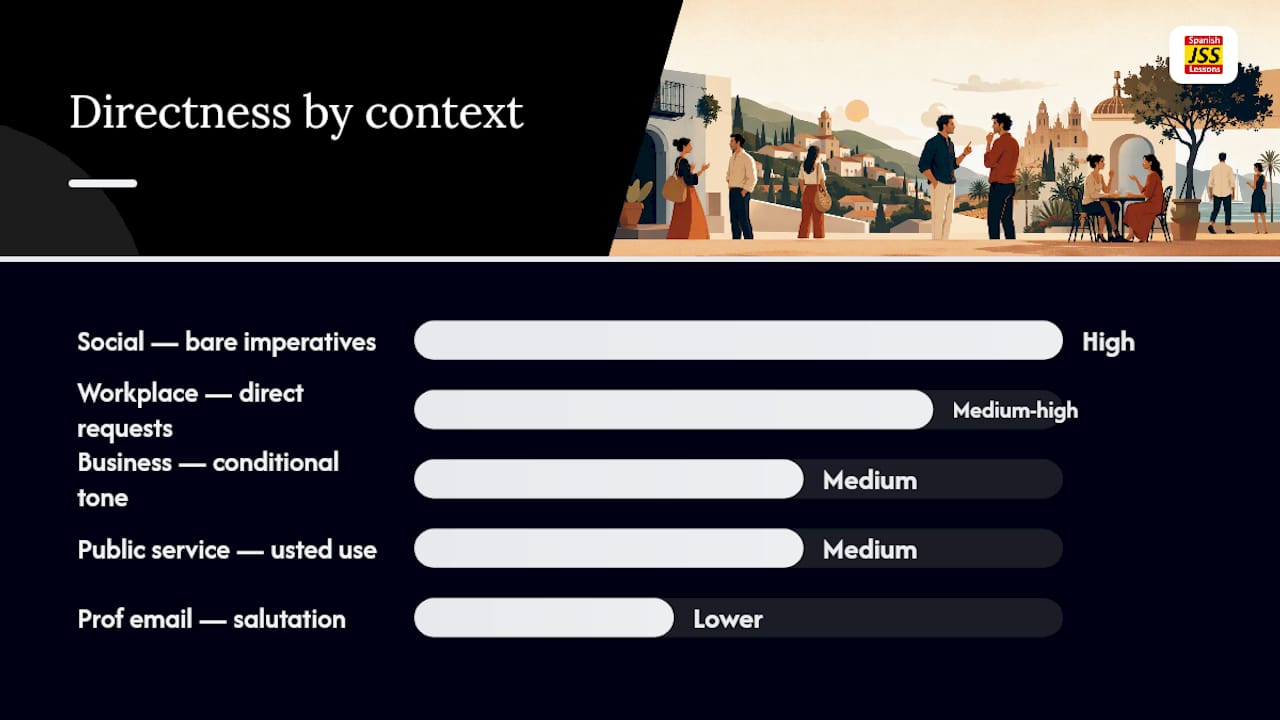
Spain’s workplace communication reflects this layered picture: meetings are fluid and relationship-driven, but formal written communication follows more structured conventions. Building confianza over lunch or informal time is often what unlocks the more direct, productive working relationship.
Everyday phrase pairs that show the difference clearly
Seeing the contrast written out is useful. Hearing it is better. These pairs are drawn from real conversational contexts, with notes on where intonation changes the social meaning.
Requests:
| English | Spanish equivalent | Note |
|---|---|---|
| “Could you pass the salt, please?” | “Pásame la sal” | Rising intonation softens it; flat tone is neutral, not rude |
| “Would you mind opening the window?” | “Abre la ventana, anda” | Anda adds warmth; equivalent to “go on” in British English |
| “I was wondering if you could help me” | “¿Me echas una mano?” | Literally “throw me a hand”; casual and warm |
Refusals and soft nos:
- “No puedo” (I can’t) — clean, no apology required.
- “No me viene bien” (It doesn’t suit me) — slightly softer, used when declining an invitation.
- “Ahora mismo no” (Not right now) — leaves the door open without a lengthy explanation.
Small talk and commands:
- “Venga, vamos” — “Come on, let’s go.” Not impatient; it is an energising nudge.
- “¡Hombre, qué sorpresa!” — “Wow, what a surprise!” The word hombre here is pure warmth, regardless of the listener’s gender.
- “¿Qué tal?” — “How are things?” Expects a brief, genuine answer, not a reflexive “Fine, thanks.”
A short dialogue showing overlap and tone:
A: “Oye, ¿has visto a María?”
B: “Sí, sí, estaba en el —”
A: “¡En el bar de siempre, claro!”
B: “Exacto.”
B does not finish the sentence because A already knows the answer. This is not rudeness; it is the conversational shorthand of people who share context. Polite Spanish in daily life often works exactly like this: warmth is carried by shared knowledge and tone, not by formal phrasing.
Pronunciation note: In Spanish, a rising intonation at the end of an imperative is the primary softener. “Ponme un café” said with a slight upward lilt at café lands as a friendly order. Said with a flat or falling tone to a stranger, it can read as curt. The words are identical; the music is different.
Why English speakers so often misread Spanish directness
The most common mistake is applying English pragmatic rules to Spanish speech. In English, a bare imperative from a stranger is almost always either an emergency or a social transgression. So when a Spanish speaker says “Siéntate” (Sit down) or “Dame eso” (Give me that), the English-speaking brain flags it as aggressive. It almost never is.
The most frequent misreadings:
- Imperatives read as commands. In English, “Sit down” from a stranger is confrontational. In Spanish, “Siéntate” from a host is an invitation. The same grammatical form carries opposite social weight.
- Interruptions read as dismissal. When a Spanish colleague starts talking before you have finished, the instinct is to feel talked over. The reality, as Spain Handbook’s workplace research confirms, is that interruption usually signals engagement and enthusiasm.
- Absence of “please” read as impoliteness. “Ponme un café” at a bar contains no por favor. The Cultural Atlas documents this as a pragmatic norm, not a lapse in manners. The waiter does not feel slighted; the English observer does.
- Directness in disagreement read as hostility. “No, eso no es así” (No, that’s not how it is) said firmly is a normal conversational correction. It is not an attack on the person; it is a comment on the idea.
- Over-formal address read as warmth. Using usted with a Spanish peer of similar age can actually create awkwardness. It signals distance or even mild condescension, the opposite of the intended respect.
The corrective reframe for all of these is the same: ask yourself whether the behaviour makes sense as a solidarity move. If someone is treating you as a peer, speaking directly, and not performing elaborate deference rituals, that is usually a good sign. It means they are comfortable with you.
For a fuller picture of Spanish politeness rules, including the specific contexts where more formal registers genuinely are expected, the James Spanish School guide covers the full range.
Practical dos and don’ts for social and business settings
These are the adjustments that make the biggest difference fastest, drawn from classroom experience and real-world interaction in Spain.
- Match the register of the person you are speaking with. If they use tú and bare imperatives, mirror that. If they shift to usted, follow.
- Let your tone carry the politeness. A warm, slightly rising intonation on a direct request does the work that “please” does in English.
- Do not apologise before asking a question. “Sorry to bother you, but…” is not a Spanish conversational opener. “Oye, perdona” (Hey, excuse me) is direct and perfectly polite.
- Stay in the conversation when someone overlaps. Do not stop and wait; continue at a slightly lower volume and let the exchange find its natural rhythm.
- Use diminutives to soften when needed. “Un momentito” (just a moment) or “¿Te viene bien?” (Does that work for you?) are the natural Spanish softeners for situations where English speakers would reach for elaborate hedging.
- In business, invest in relationship time. Spanish business culture places high value on confianza. A direct working relationship becomes possible after trust is established, often over lunch or informal conversation, not before.
- Do not confuse a direct “no” with a closed door. “No me viene bien ahora” is not a rejection; it is a scheduling issue.
- In formal or public service contexts, usted is still appropriate. With older people, officials, and in written communication, the more formal register shows respect without creating distance.
Non-verbal adjustments:
- Stand closer than you normally would; stepping back reads as discomfort.
- Maintain eye contact longer than feels natural to a British speaker.
- Allow your hands to move; stillness can read as stiffness.
Pro Tip: The fastest single drill for adapting to Spanish directness is to practise making requests in Spanish without any opening hedge. Record yourself saying “Ponme un café”, “Abre la ventana”, and “¿Me ayudas?” with a warm, rising intonation. Play it back. When it sounds natural to your own ear, it will land naturally in conversation.
Phrases and micro-scripts to use in the moment
These are ready to use. Each one comes with a context label so you know exactly when to reach for it.
Spanish-language softeners and clarifiers:
- “¿Cómo dices?” (What did you say?) — Casual. The most natural way to ask someone to repeat themselves. Never sounds rude.
- “No te he entendido bien, ¿puedes repetirlo?” (I didn’t quite catch that, can you repeat it?) — Any context. Polite and clear without being apologetic.
- “¿Te viene bien si…?” (Does it work for you if…?) — Workplace/social. Softens a proposal without burying it in hedges.
- “Entiendo lo que dices, pero…” (I understand what you’re saying, but…) — Workplace. Acknowledges the other person before pushing back. The Spanish equivalent of the sandwich feedback opener.
- “Un momentito, por favor” — Public service/workplace. The diminutive does real work here; it is noticeably warmer than “un momento”.
- “Preferiría que…” (I would prefer that…) — Formal/workplace. Sets a boundary without confrontation.
English-language strategies when staying in English:
- Calm clarification: “Just to check I understood you correctly…” followed by a paraphrase. This works in bilingual or international settings and signals you are engaged, not offended.
- Reflective paraphrase: Repeat the core of what was said in your own words before responding. It slows the pace without shutting down the directness.
- Neutral acknowledgement: “Right, understood” rather than “Oh, okay, sorry, I see” — the latter loads the exchange with unnecessary apology that can confuse a Spanish speaker about whether something went wrong.
Direct-to-English Spanish is worth understanding here too: when Spanish speakers translate their direct phrasing literally into English, it can sound abrupt to English ears even when the Spanish original was perfectly warm. Knowing this prevents misreadings in both directions.
What 40 years in Spain teaches you about directness
James Bretherton, founder of James Spanish School, has lived in Spain for 40 years as a dual-native speaker. The cultural observations in this guide are not drawn from textbooks alone; they come from four decades of daily life, from market conversations and neighbourhood disputes to professional meetings and classroom teaching.
Typical classroom errors and how they get corrected:
- A learner hears “Dame el libro” from a teacher and assumes they have done something wrong. The correction: the teacher is modelling natural speech, not expressing frustration.
- A learner adds “por favor” to every single request and sounds, to native ears, slightly anxious. The correction: use por favor when you genuinely want to add warmth or when the context is formal; otherwise let tone carry it.
- A learner uses usted with a 30-year-old colleague and creates an awkward pause. The correction: tú is almost always right between adult peers in a modern Spanish workplace.
Two practice drills you can do alone or with a partner:
- The imperative swap drill. Take five everyday requests you make in English and translate them into bare Spanish imperatives. Say each one aloud with a warm, rising intonation. The goal is to make the direct form feel natural, not aggressive, in your own mouth.
- The interruption drill. With a partner, practise a short conversation where both people speak simultaneously for two or three seconds before one yields. The aim is to get comfortable with overlap so that when it happens in real life, you do not freeze or apologise.
Understanding cultural nuances in Spanish at this level — not just the words but the social logic behind them — is what separates a learner who can order a coffee from one who can hold a real conversation.
Ready to take this further with James Spanish School?
Understanding Spanish directness is one piece of a much larger picture. James Spanish School’s 100-lesson online course is built specifically for English-speaking adults who want to use European Spanish in real life, not pass an exam. The course covers sentence-building, ear-tuning for fast native speech, and cultural context of exactly the kind covered in this guide. The WordAmigo system embeds vocabulary and pronunciation through strategic repetition, so the phrases you learn here actually stay with you.
Everything is available on demand, 24/7, with no expiry date and no countdown clock. Repeat any lesson as many times as you need. James’s cast-iron guarantee: if a core lesson does not teach you anything new, you receive extra practice modules at no cost.
Explore the James Spanish School course and start building the cultural fluency that makes Spanish directness feel like home rather than a puzzle.
Sources
These are the primary sources drawn on throughout this guide, each worth reading in full for deeper study.
- Elon
- Spanish culture core concepts — communication | Cultural Atlas (SBS)
- Spanish workplace communication: meetings, feedback, and tone – Spain Handbook
- Business culture in Spain: All you need to know in 2026 – italki
- Business etiquette in Spain | Cultural tips for success 2026 — Altios