

Spanish gift giving customs guide
When visiting a Spanish home, always bring a modest, shareable host gift, quality wine, pastries, or chocolates, rather than anything personal or expensive. Spanish social life runs on warmth and connection, not price tags, so a thoughtful, shareable item says more than a lavish one ever could. This guide covers the customs behind every occasion you’ll meet.
Your safest go-to options:
- A good bottle of wine or cava
- A box of pastries or turrón
- Local chocolates
- Artisanal olive oil
Key Takeaways
Successful gift giving in Spain depends on choosing shareable, modest items suited to the relationship and reading each occasion’s expected timing correctly.
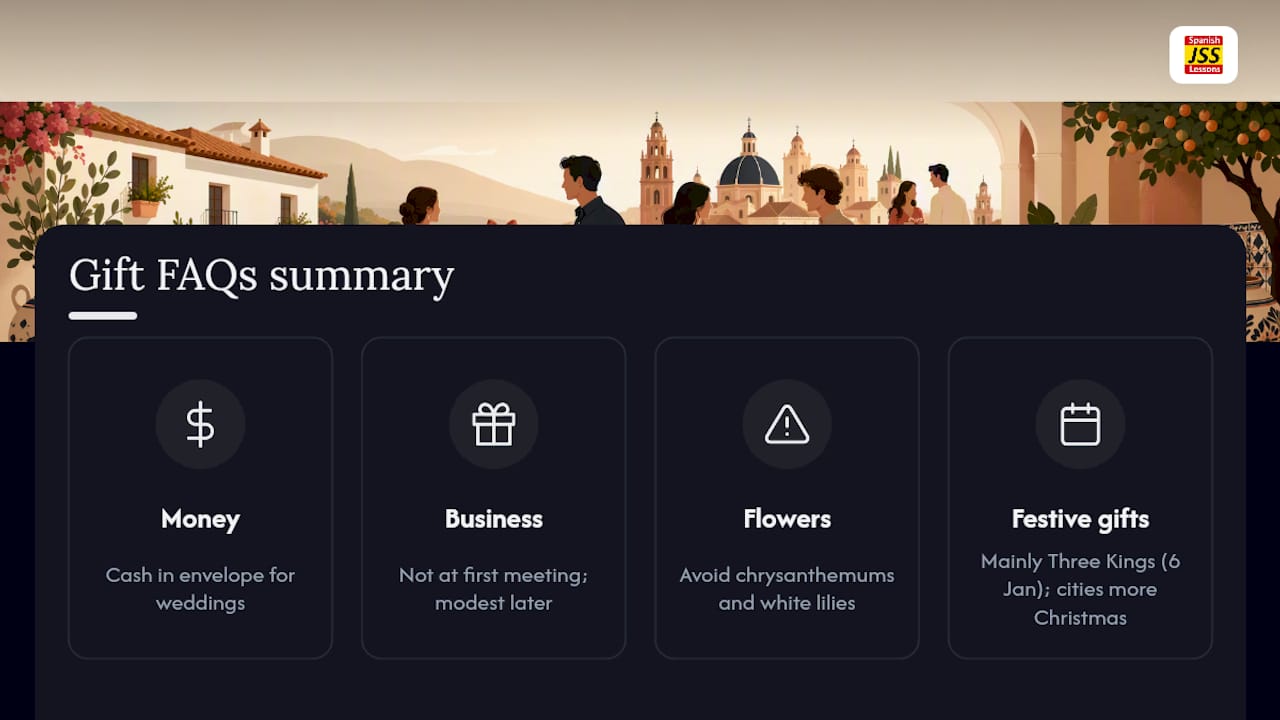
| Point | Details |
|---|---|
| Default to shareable gifts | Wine, pastries, or chocolates work for nearly any home visit or casual occasion. |
| Avoid floral faux pas | Skip chrysanthemums, white lilies, and red roses unless the relationship is romantic. |
| Business gifts wait | Never gift at a first meeting; keep later gifts modest and present them at the meeting’s end. |
| Weddings mean envelopes | Cash gifts in envelopes remain the standard, though some couples now use registries. |
| Watch the regional calendar | Three Kings on 6 January still anchors festive gifting for many families nationwide. |
Table of Contents
- Which occasions call for a gift in Spain?
- What should you bring when invited to a Spanish home?
- Do you need to bring a gift to a business meeting in Spain?
- How are wedding gifts handled in Spain?
- When and how should you actually hand over a gift?
- How do regional traditions change gift giving?
- What should English speakers and expats know before buying?
- What’s a simple checklist for choosing the right gift?
- Frequently asked questions
- Sources
Which occasions call for a gift in Spain?
Birthdays, weddings, baptisms, First Communion, Christmas, and housewarmings all trigger some form of gift exchange, though the scale shifts dramatically depending on how close you are to the person. Close family and children receive more formal gifts. Casual friends and colleagues warrant something lighter, often just a round of drinks or a shared celebration rather than a wrapped present.
Adult birthdays tend to favour shared experiences over stacks of presents. Many Spanish etiquette guides note that friends often treat the birthday person to drinks or a meal instead of buying gifts, while children’s birthdays and First Communion remain far more structured, with formal presents expected from family.
Timing matters too. For many families, 6 January, Three Kings’ Day, is still the main event, not Christmas Day, though that’s shifting in cities. Weddings usually involve money gifts in envelopes rather than registry items.
Occasions to keep on your radar:
- Birthdays (children get more formal gifts than adults)
- Weddings (envelope gifts are standard practice)
- Baptisms and First Communion
- Christmas Eve/Day and Three Kings (6 January)
- Housewarmings and work promotions
According to the ING International Christmas Survey, 58% of Spaniards receive practical gifts at Christmas, while only 24% get cash or gift cards, a strong hint that thoughtful, useful items beat generic vouchers.
What should you bring when invited to a Spanish home?
Bring something the whole household can enjoy: a decent bottle of wine, a box of pastries, good chocolates, or a regional speciality. Expatica’s guide to Spanish etiquette confirms shareable gifts are the norm, and whether your host opens it there and then depends entirely on the household, so don’t take it personally either way.
Wrap the gift neatly rather than lavishly, add a short handwritten note if you can manage a line or two in Spanish, and hand it over as soon as you arrive rather than waiting until you’re leaving.
Pro Tip: Ask a mutual friend what the host actually likes before you buy. A well-chosen regional delicacy, a specific olive oil from Jaén, a cheese from Asturias, lands far better than a generic supermarket bottle.
Quick do’s and don’ts:
- Do bring something shareable and food-based
- Do wrap it tidily, not extravagantly
- Don’t bring chrysanthemums or white lilies, both associated with funerals
- Don’t bring red roses unless the relationship is romantic
- Don’t push your host to unwrap it immediately
Businessculture confirms this floral caution applies socially and professionally alike.
Do you need to bring a gift to a business meeting in Spain?
No. Gifts are not expected at a first meeting, and offering one too early can read as an attempt to buy favour rather than build trust. Once a relationship is established, a modest, tasteful gift becomes appropriate, and corporate gift guides for Spain recommend presenting it at the end of a meeting or having it delivered to the office rather than handing it over at the opening handshake.
Suitable options include:
- Good quality food the whole team can share
- A well-chosen book relevant to the person’s interests
- Understated branded items around the festive season
Avoid anything expensive or flashy. A gift that looks like it’s trying to influence a decision damages trust rather than building it, and larger firms often have strict compliance limits on what staff can accept, so a quick check before you buy an impressive gift saves everyone an awkward conversation.
How are wedding gifts handled in Spain?
Cash is king at Spanish weddings. Guests commonly give money in an envelope rather than buying items from a registry, and this is handed to the couple directly, given to a family member, or left in a designated box at the reception. Uniplaces’ guide for expats confirms envelope gifts remain the standard practice, though some younger or more international couples do set up registries instead.
If you’re unsure which approach a couple prefers, ask a close mutual friend rather than guessing.
- Envelopes are typically given at the reception or through a family member
- Some couples now list registries, particularly in cities or with international guests
- Group gifts from friends are common for larger contributions
Pro Tip: If several of you are attending together, pooling contributions into one larger envelope from the group is entirely normal and saves everyone the awkward maths of working out “enough”.
When and how should you actually hand over a gift?
Timing depends on the setting. At a home visit, hand your gift over as soon as you arrive. At a party, wait for a natural lull rather than interrupting. In business, present it at the close of the meeting, never at the opening handshake.
Wrapping should be neat and tasteful, not showy. A short phrase like “esto es para vosotros” (“this is for you all”) works well when handing something over.
- Do let your host decide whether to open the gift in front of you
- Do say a short, simple phrase in Spanish when giving it
- Don’t give sets of 13 items, considered an unlucky number in many households
- Don’t over-wrap or make a fuss over presentation
- Don’t take offence if a gift is set aside to open later
Pro Tip: If you receive a gift yourself, a warm thank you and a genuine comment about the item matters more than any elaborate reaction.
BusinessCulture.org notes hosts vary widely on immediate opening, so take your cue from them rather than a fixed rule.
How do regional traditions change gift giving?
Three Kings’ Day dominates nationally, but regional gift-bringers add their own flavour. Catalonia has Tió de Nadal, a log that “delivers” small presents; the Basque Country has Olentzero, a coal-worker figure; Galicia has O Apalpador, a chestnut-roasting character. Each of these shifts when and how families exchange gifts, according to Enter Spain’s overview of Reyes Magos traditions.
Coastal and international towns tend to blend traditions, with Santa or Papá Noel increasingly popular alongside older customs. Local products carry extra weight as gifts in these areas.
Regional gift-bringers like Tió de Nadal and Olentzero aren’t quaint footnotes. They actively shift the calendar date families expect presents, so a gift that lands perfectly in Madrid might arrive a week too early in Barcelona.
- Three Kings (6 January) remains dominant nationally
- Tió de Nadal (Catalonia), Olentzero (Basque Country), O Apalpador (Galicia)
- Coastal towns often blend Santa Claus with local customs
What should English speakers and expats know before buying?
Ask a mutual contact about preferences before you buy, and lean towards regionally respected products, a good local cheese or cured meat beats a bottle of wine bought at the airport. Giftsenda’s guide for sending gifts to Spain makes the same point: local prestige matters more than international brand names.
Pairing your gift with a simple Spanish phrase goes a long way. Practising a few lines through James Spanish School’s resources builds the confidence to say something warm rather than fumbling in English at the exact moment it counts.
Pro Tip: Memorise one line before any visit: what to buy, what to avoid, and a short phrase like “espero que os guste” (“I hope you like it”).
- Ask a mutual friend about preferences first
- Choose regional specialities over generic imports
- Practise one short phrase to say when handing the gift over
What’s a simple checklist for choosing the right gift?
Match the gift to the recipient and the occasion rather than defaulting to the same bottle of wine every time.
By recipient:
- Host at a home visit: wine, pastries, or a boxed selection of chocolates
- Adult friend: shared experience, a meal out, or a small thoughtful item
- Child: a toy or book tied to their interests
- Business contact: shareable food, a relevant book, or a subtle branded item
- Wedding: a cash contribution in an envelope
Reliable product choices include cava, turrón at Christmas, artisanal olive oil, boxed pastries, a neutral scarf, or a well-chosen book.
- Keep your budget proportional to the closeness of the relationship
- Bring tape and simple wrapping paper if travelling with a gift
- Write a short card, even two lines in Spanish makes an impression
- Confirm transport rules if carrying liquids like wine or oil by air
Building real confidence with the language pays off here too. James Spanish School’s self-paced course, built around the WordAmigo retention system, helps English-speaking adults practise exactly these everyday phrases, ear-tuning included, so a gift comes with the right words attached. Explore the course options if you’d like that confidence before your next visit, wedding, or business trip.
Frequently asked questions
Is it rude to give money instead of a wrapped gift in Spain?
No, quite the opposite for weddings. Cash in an envelope is the standard wedding gift, though for birthdays or home visits a shareable item like wine or pastries is more typical.
Do Spaniards open gifts immediately?
It varies by household. Some open gifts as soon as they receive them, others set them aside for later, so let your host lead rather than assuming either way.
Are business gifts expected in Spain?
Not at a first meeting. Once a relationship is established, a modest, tasteful gift is welcome, ideally presented at the end of a meeting rather than at the start.
What flowers should I avoid giving in Spain?
Avoid chrysanthemums and white lilies, both linked to funerals, and be cautious with red roses unless the relationship is romantic.
When do Spanish families typically exchange festive gifts?
Many families still centre gift giving on Three Kings’ Day, 6 January, though Christmas Eve and Christmas Day gifts have become more common in cities.
Sources
- Businessculture
- Corporate gifts to Spain: a complete guide | SendGiftsInEurope
- Spanish etiquette: the ultimate guide for expats | Uniplaces
- Etiquette in Spain | Expatica