

Correos formales en español
A correct formal email in Spanish needs seven things in this order: a concise subject, a formal greeting followed by a colon, an opening line stating your purpose, a short body of one or two paragraphs, a clear call to action, a formal farewell, and a full signature. Modern Spanish business correspondence favours plain, direct phrasing over ornate language. The templates below give you working examples you can copy today.
TL;DR:
- The subject line should be concise, specific, and accurately reflect the email’s purpose to improve open rates.
- Always use a colon after the greeting and keep the opening sentence clear about the email’s intent.
- Keep the body brief, one or two paragraphs, with a clear call to action on a separate line for visibility.
- End with a specific next step or deadline, and include a full signature with contact details and role.
- Before sending, verify the recipient’s name, attachment presence, subject clarity, and that the call to action is explicitly stated.
Table of Contents
- The structure of correos formales en español, step by step
- Six email templates you can copy and adapt
- Phrases that make formal emails easier to write
- Getting the tone and punctuation right
- Mistakes that undermine an otherwise good email
- What forty years in Spain teaches you about writing these emails
- Your pre-send checklist
- Sources
The structure of correos formales en español, step by step
Every formal Spanish email follows the same skeleton, whether you’re chasing an invoice or applying for a job. Universities that teach professional writing, including the ULPGC’s guidance on email structure, converge on five core parts: subject, greeting, opening line, body, and closing. Add the signature and you have the full formula.
Subject line. Keep it to three to seven words that describe exactly what the email is about. “Solicitud de información sobre el curso” beats “Consulta” every time. Brevo’s data on formal emails shows that around 47% of recipients decide whether to open a message based on the subject line alone. Vague subjects get buried, especially given how many emails land in a typical inbox each day, as Statista’s figures on daily email traffic suggest.
Greeting. Use “Estimado/a [Nombre]:” or “Estimados señores:” and always close the greeting with a colon, never a comma.
Opening line. State your purpose in the first sentence. If the recipient doesn’t know you, introduce yourself in a short clause within that same line rather than a separate paragraph.
Body. This is where most learners overwrite. Keep each paragraph under 150 words. Use bullet points only when listing genuinely separate items, such as documents required or dates offered, and make sure your call to action stands on its own line so it’s impossible to miss.
Closing and signature. End with a specific next step, not a vague “espero su respuesta”. Something like “Quedo a la espera de su confirmación antes del viernes” tells the reader exactly what you need.
A well-formed message typically includes:
- A subject that names the topic, not just the sender’s mood (“Consulta” tells nobody anything)
- A colon after the greeting, never a comma
- One sentence, right at the top, that says why you’re writing
- A body kept to one or two tight paragraphs
- A closing line naming a concrete next step or deadline
- A full signature block with name, role, and contact details
Six email templates you can copy and adapt
1. Requesting information
Subject: Solicitud de información sobre matrícula
Greeting: “Estimados señores:”
Opening: “Me pongo en contacto con ustedes para solicitar información sobre el proceso de matrícula.”
Body: One paragraph naming the specific details you need.
CTA: “Quedo a la espera de su respuesta.”
Farewell: “Un saludo cordial,” then your full name.
Adapt the greeting to “Estimada Sra. [Apellido]:” once you know who’s replying.
2. Scheduling a meeting
Subject: Propuesta de reunión, semana del 12
Opening states two possible dates and a proposed format (video call or in person).
Offer two time slots rather than one open question. This halves the back and forth.
3. Job application cover note
Subject: Candidatura para el puesto de [rol]
Opening names the role and where you saw it advertised.
Body: One paragraph on relevant experience, one line pointing to the attached CV.
Keep this under 120 words. Recruiters skim.
4. Following up after a meeting
Opening thanks the recipient by name and references one specific point discussed.
Never open with “Como comentamos” alone. Name the topic so there’s no ambiguity if several meetings happened that week.
5. Formal complaint or query
Opening states the issue and reference number immediately.
Stay factual. Avoid words that sound accusatory; state the discrepancy and ask for resolution.
6. Sending documents
Subject: Envío de documentación solicitada
Body names each attachment explicitly.
When addressing several recipients, use “Estimados/as:” and confirm in the body who needs to action what.
Phrases that make formal emails easier to write
Building a small phrase library removes the hesitation that slows most learners down. Try these:
- Greetings: “Estimado/a [Nombre]:”, or “Estimados señores:” when you don’t know the gender or name of the recipient
- Opening purpose: “Le escribo para…”, “Me pongo en contacto con usted para…”, “En relación con…”
- Polite requests: “¿Sería tan amable de…?”, “Le agradecería que…”, “Si no es molestia…”
- Farewells: “Quedo a la espera de su respuesta.”, “Un saludo cordial,”, “Atentamente,”
A guide to greeting in Spanish expands this list with cultural context for each formula.
Pro Tip: Write your five favourite opening lines and five farewells on a card and keep it by your desk. Most formal emails only need combinations of the same dozen phrases.
Getting the tone and punctuation right
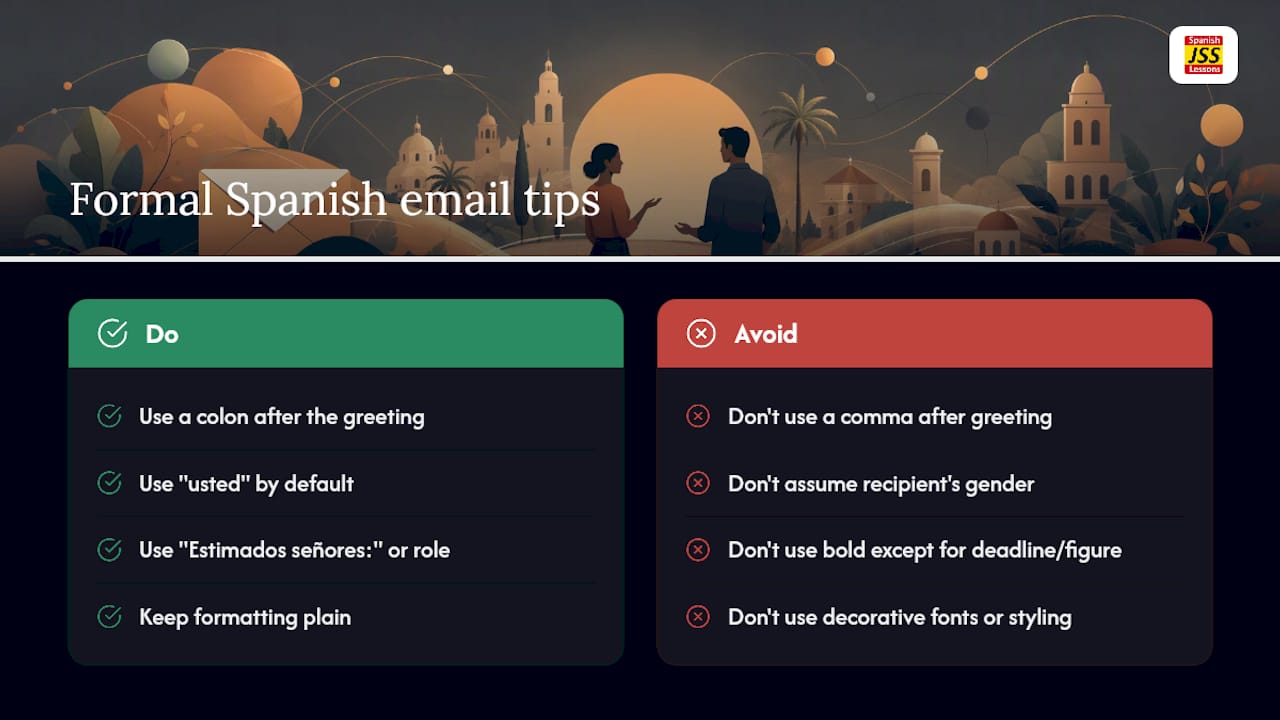
Use a colon after the greeting in formal letters and emails; a comma in that position is an anglicism that doesn’t belong in formal Spanish usage.
That’s the guidance from the Real Academia Española on greeting punctuation, and it’s the single most common mechanical error English speakers make. The RAE’s style guide for different channels confirms the same rule applies across letters and digital correspondence.
Use “usted” by default with anyone you don’t know personally, including colleagues senior to you. When you’re unsure of a recipient’s gender, “Estimados señores:” or naming their role (“Estimado/a responsable de admisiones:”) avoids the guesswork. Keep formatting plain: a standard font, bold used only for a genuine deadline or figure, and attachments named clearly before you hit send. Learn the wider rules of formality in James Spanish School’s guide to Spanish politeness.
Mistakes that undermine an otherwise good email
The errors below crop up constantly, even among fluent speakers writing in a second language:
- Comma instead of colon after the greeting
- Mixing “tú” and “usted” within the same message
- A subject line so vague it gets skipped
- Mentioning an attachment that isn’t actually attached
- Misspelling the recipient’s surname, especially compound Spanish surnames
Before sending, run through this: recipient address correct, subject specific, attachments present, call to action stated once and clearly, signature complete. Most professional contexts consider a reply within 24 to 48 hours reasonable, so don’t chase sooner unless the matter is urgent.
What forty years in Spain teaches you about writing these emails
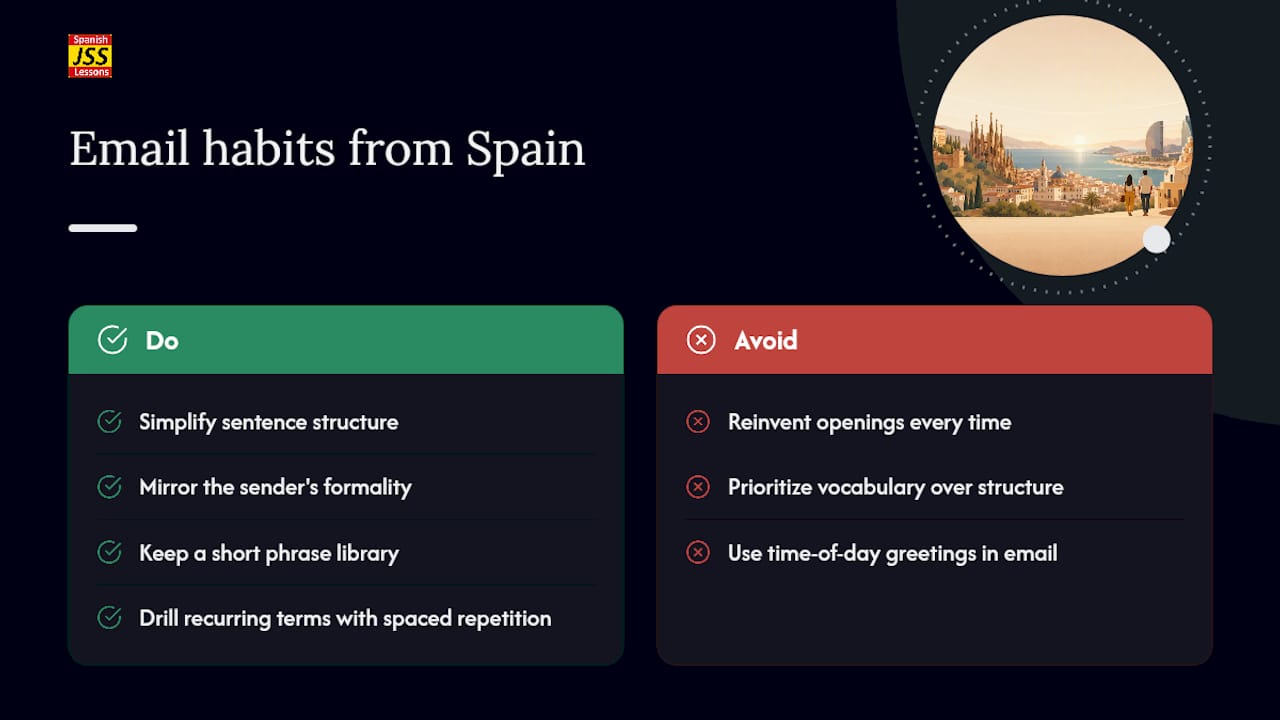
Simplify your sentence structure before you worry about vocabulary. Mirror the formality level of whoever wrote to you first. Keep a short phrase library rather than reinventing openings every time. Rehearse the recipient’s name aloud so you don’t stumble if you end up on a call. And drill recurring terms like “adjunto” or “quedo a la espera” with spaced repetition rather than hoping they stick after one use.
One surprise for English speakers: time-of-day greetings (“Buenos días”) are optional in email and easily skipped in favour of the timeless “Estimado/a”. If building this kind of instinct for Spanish appeals to you, James Spanish School’s self-paced course uses the WordAmigo repetition system to lock in exactly this sort of recurring vocabulary and pronunciation.
Your pre-send checklist
Keep this on your phone for the next twenty formal emails you send:
- Recipient name and address correct
- Subject read aloud, does it make sense alone?
- Attachments actually attached
- Call to action stated once, clearly
- Signature complete with role and contact details
Read your opening line aloud before sending. If it sounds stiff or the name trips your tongue, fix both before you hit send.