

Spanish opening hours explained
Spain runs on its own clock, and it rarely matches what newcomers expect. Lunch peaks around 2 or 3pm, dinner rarely starts before 9pm, and small shops vanish behind shutters between roughly 2pm and 5pm. Official timetables, from trains to town hall appointments, use the 24-hour clock, while everyday speech sticks to the 12-hour system with “de la mañana” or “de la tarde” tacked on. The Canary Islands run an hour behind the mainland all year. Once you know these patterns, “cerrado” signs stop being a surprise.
TL;DR:
- Spanish shops generally close between 2pm and 5pm due to the long lunch break and hot afternoon weather, especially in small towns.
- Restaurants serve dinner late, often starting after 9pm and lasting until midnight in summer, with weekends extending even later.
- Most businesses, including banks and offices, operate split shifts or only morning hours, which can require planning errands around the midday closure.
- Mainland Spain follows CET and CEST time zones, while the Canary Islands are one hour behind, due to historical time zone decisions and geographic alignment.
- Conversational time is usually spoken in 12-hour format with qualifiers, but official schedules use 24-hour clock; switching fluently between both is essential.
Table of Contents
- Typical daily schedule: breakfast to late dinner in Spain
- Business and service opening hours: why shops close mid-afternoon
- Spain’s time zones and daylight saving explained
- How to tell the time and talk about schedules in Spanish
- Public holidays and what actually stays open in Spain
- A quick checklist to avoid getting caught out by “cerrado”
- Learning the rhythm from someone who’s lived it
- Turn what you’ve read into spoken fluency
- Sources
Typical daily schedule: breakfast to late dinner in Spain
Spanish daily life is built around later, longer meals, and once you know the rough windows, the whole day starts to make sense. Breakfast, or desayuno, tends to be light: a coffee and pastry standing at a bar counter somewhere between 7am and 9am. It’s rarely the main event.
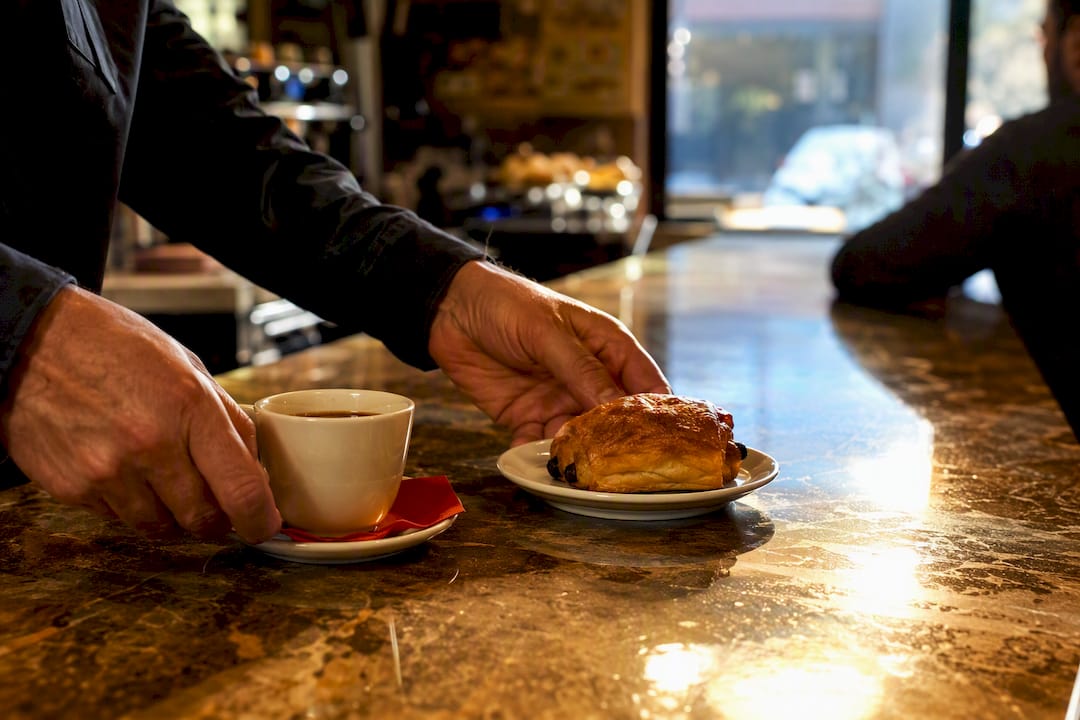
The real rhythm shift comes at midday. Many people take an almuerzo, a small second breakfast or snack around 11am, because the main lunch, comida, doesn’t usually happen until 1pm at the earliest and often stretches to 3pm or even 4pm. This is the biggest meal of the day, and it’s when restaurants roll out the menú del día, a fixed-price set lunch that typically includes a starter, main, dessert, and a drink, all for a fraction of the à la carte price. Streets and squares are at their busiest during this window, then fall quiet again once the plates are cleared.
By late afternoon, hunger creeps back in, so Spaniards bridge the gap with merienda, a light snack around 5pm or 6pm, often something sweet or a coffee with friends. This is also prime time for the paseo, the unhurried evening walk that fills plazas and seafronts once the day’s heat eases off. Dinner, cena, follows much later than most English-speaking visitors expect, generally starting from 9pm and running past midnight in cities during summer. Restaurants commonly serve dinner from around 8pm through to 11:30pm, with the latest sittings in Madrid and Barcelona on weekends.
- Desayuno (breakfast): 7am to 9am, light and quick
- Almuerzo (mid-morning snack): around 11am
- Comida (main lunch): 1pm to 4pm, peaking 2pm to 3pm
- Merienda (afternoon snack): 5pm to 6pm
- Cena (dinner): 9pm onwards, later on weekends and in summer
Village and small-town life tends to follow these windows fairly strictly, while big cities stretch them further, especially in August when the heat pushes everything back an extra hour. If you’re travelling and want a late dinner without hunting on arrival, guides like La Condesa’s neighbourhood breakdown of Barcelona’s late-dining scene are worth checking before you land.
Pro Tip: If you’re used to eating dinner at 6pm, don’t fight the shift all at once. Push your evening meal back by half an hour every few days and lean on a proper merienda to fill the gap, that’s exactly how most long-term expats adjust without going hungry.
Business and service opening hours: why shops close mid-afternoon
Spain’s commercial hours follow a national framework with plenty of regional variation layered on top, and that combination explains most of the confusion newcomers feel. National law sets a baseline for weekly opening hours, but Autonomous Communities decide the details, including which zones qualify as high-tourist areas with looser Sunday and holiday trading rules.
Small independent shops, the bakery, the hardware store, the family-run boutique, generally still run a jornada partida, a split shift. Expect something like 10am to 2pm, then closed until they reopen around 5pm to 8pm or 9pm. This isn’t laziness; it’s a working pattern tied to that long lunch and the heat of the early afternoon.
- Small independent shops: roughly 10:00 to 14:00, then 17:00 to 21:00
- Large supermarkets and shopping centres: continuous hours, often 9:00 or 10:00 through to 21:00 or 22:00
- Banks: typically 8:30 to 14:00, Monday to Friday, with limited or no weekend opening
- Public administration offices (town halls, tax offices): morning-only, usually 9:00 to 14:00
Small businesses frequently close between 2pm and 5pm, while larger retail chains and shopping centres tend to operate continuous hours from around 10am to 9pm. That gap is exactly why supermarkets and malls, which don’t close for siesta, become the sensible fallback when you need something urgently mid-afternoon.
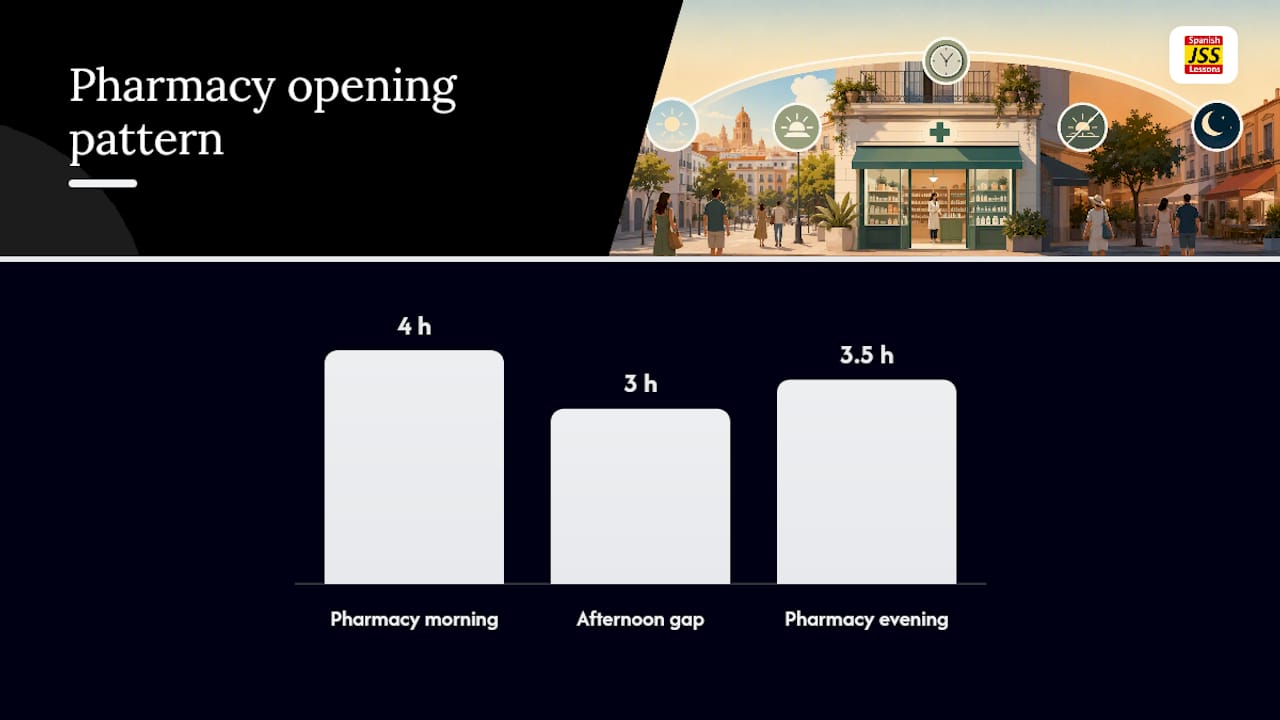
Pharmacies add another layer: most follow the split-shift pattern too, but every town maintains a farmacia de guardia, an on-duty pharmacy that stays open outside normal hours, often overnight, on a rotating basis. The rota is usually posted in every pharmacy window and on the local town hall website, so it’s always findable even at 11pm on a Sunday. For the vocabulary you’ll need to navigate all this at the counter, a resource like James Spanish School’s practical shopping vocabulary guide covers the exact phrases shopkeepers expect to hear.
Spain’s time zones and daylight saving explained
Mainland Spain, including the Balearic Islands, Ceuta and Melilla, runs on Central European Time (CET) in winter and Central European Summer Time (CEST) once the clocks go forward. The Canary Islands sit a full hour behind on Western European Time (WET) and WEST in summer. Mainland Spain observes CET at UTC+1 and CEST at UTC+2 in summer, while the Canary Islands use WET and WEST, one hour earlier.
Clocks move forward in spring and fall back in autumn each year, in line with the rest of the European Union. In software, calendars, and booking systems, the canonical reference is the IANA identifier Europe/Madrid, which automatically alternates between CET and CEST, so it’s the label to trust if you’re setting up a shared calendar or checking a flight confirmation against local time.
| Region | Standard time | Summer time | Offset vs mainland |
|---|---|---|---|
| Mainland Spain, Balearics, Ceuta, Melilla | CET (UTC+1) | CEST (UTC+2) | None (reference zone) |
| Canary Islands | WET | WEST (UTC+1) | One hour behind |
There’s a quirk behind all this that explains a lot about Spanish daily life. Spain switched to Central European Time in 1940, largely for political reasons, even though its geography aligns more naturally with UK and Portuguese time. That mismatch between the clock and the sun means the sun rises and sets later relative to the numbers on the clock, which is a real part of why lunch lands at 2pm and dinner at 9pm rather than the other way round. It’s not just culture, it’s geography colliding with a decades-old political decision.
How to tell the time and talk about schedules in Spanish
Two systems run in parallel here, and mixing them up is the single most common source of confusion for new arrivals. Everyday conversation uses the 12-hour clock with time-of-day qualifiers, while official timetables for transport and public administration stick to the 24-hour clock. Get comfortable switching between the two and most confusion disappears.
In conversation, Spaniards say the hour and minutes, then add a qualifier if it’s not obvious from context:
- 12:30 becomes “doce y media” (twelve and a half), or “doce y media de la tarde” if you need to be specific about the afternoon.
- 6:30pm becomes “las seis y media de la tarde,” using “tarde” (afternoon/evening) rather than “noche,” which is reserved for later at night.
- 10:00pm shifts to “las diez de la noche,” since “noche” kicks in once it’s properly dark and social life is in full swing.
- Midday, a useful standalone word, is “mediodía”; midnight is “medianoche,” both used constantly in scheduling small talk.
- On official boards and printed timetables, you’ll see “18:30” or “22:00” directly, no conversion needed, that’s the 24-hour format doing its job.
The rule of thumb: if it’s written on a train departure board, a museum sign, or a government appointment slip, read it as 24-hour time. If someone’s telling you when to meet for dinner, they’re almost certainly using the 12-hour form with a qualifier. Learning to read both instantly, without pausing to do the maths, is one of the quicker wins in adjusting to life here, and a structured phrase resource like James Spanish School’s everyday situations guide builds exactly this kind of fluency through repetition rather than rote memorising.
Useful phrases worth learning early: “¿Qué hora es?” (What time is it?), “¿A qué hora abren?” (What time do you open?), and the more formal “¿Podría decirme la hora, por favor?” (Could you tell me the time, please?) for situations where politeness matters, like addressing an older shopkeeper or a government official.
Pro Tip: When booking anything by phone or in person, always repeat the time back using the 24-hour form, “vale, las dieciocho treinta”, even if they said it conversationally. It removes any doubt about morning versus evening and locals will appreciate the precision.
Public holidays and what actually stays open in Spain
Spain layers three levels of public holiday on top of each other: national, regional, and local, and any one of them can shut a town down without warning if you’re not checking a calendar. National holidays include New Year’s Day, Epiphany (6 January), Good Friday, Labour Day, Assumption (15 August), National Day (12 October), All Saints’ Day, Constitution Day, and Christmas. Each Autonomous Community then adds its own regional dates, and individual towns often tack on a local patron saint’s day for good measure.
Public holidays are observed at national, regional and local levels, and many non-hospitality services close entirely while transport often runs a reduced timetable. Banks, town halls, and most offices simply don’t open. What typically survives:
- Bars, cafés, and restaurants, usually busier than normal, not less
- The on-duty farmacia de guardia in every town
- Some larger supermarkets in tourist zones, though hours may shrink
- A reduced bus, metro, or train service, worth confirming rather than assuming
Public holidays often produce near-total shutdowns of non-hospitality services, and tourists shouldn’t expect banks or municipal offices to open on these days, even for something that feels urgent. Before planning a bank visit, a residency appointment, or a delivery collection, check your town hall’s website or the regional tourism board’s calendar. A holiday that’s a normal Tuesday in Madrid might be a full closure day in Valencia, and vice versa.
A quick checklist to avoid getting caught out by “cerrado”
Most scheduling frustration in Spain comes down to timing errands against the siesta window rather than around it. Handle your banking, pharmacy runs, and municipal appointments in the morning, ideally before midday, since most of these close by 2pm and don’t reopen. Save grocery shopping for either the morning rush or the evening after 5pm, and if you’re caught mid-afternoon, head straight for a large supermarket or shopping centre rather than wasting time at a shuttered corner shop.
- Mornings (9am to 2pm): Banks, town hall appointments, pharmacy prescriptions, and any paperwork that needs a signature.
- Midday (2pm to 5pm): Lunch, rest, or use a grande superficie (big-box store) if you absolutely must buy something.
- Late afternoon (5pm to 8pm): Small shop errands, merienda, casual socialising, browsing markets.
- Evening (8pm onwards): Dinner reservations, the paseo, and most tourist attractions winding down for the day.
Adapting to Spain’s later rhythm is easier when you plan for a mid-afternoon pause rather than fighting it, using merienda and tapas culture to bridge the gap between lunch and a genuinely late dinner. Sleep adjusts too, most people go to bed later here, and forcing an early-to-bed routine against the local tempo tends to leave you eating alone while every restaurant around you is still empty. Before any errand that really matters, cross-check timings against the relevant official transport site, your town hall’s festivo calendar, or the local pharmacy guard rota rather than guessing from habit. For the cultural background behind these habits, James Spanish School’s guide to must-know Spanish cultural habits is a solid next read.
Pro Tip: *Keep a note of your nearest large supermarket’s exact hours in your phone.
Learning the rhythm from someone who’s lived it
James Bretherton has lived in Spain for 40 years, and the time habits covered here aren’t textbook theory, they’re what daily life actually looks like once you’re settled. Lessons focus on practical everyday Spanish for dealing with shopkeepers, pharmacists, and town hall staff, not passing an exam. Short phrase modules paired with a retention system help the specific vocabulary of time, booking, and scheduling stick fast, reducing the need to translate at the pharmacy counter. For more on the culture behind the clock, the school’s blog and resource pages are worth a browse.
Turn what you’ve read into spoken fluency
Reading about “de la tarde” versus 24-hour timetables is one thing, saying it correctly and fast enough to keep a real conversation moving is another. A program exists to build skills around sentence construction and “ear-tuning” to help learners follow conversations, such as understanding when a shopkeeper says the pharmacy closes at “las dos,” without needing to translate.
The course offers lifetime access for a one-time payment, with no time limits on progress. Lessons include sentence-building and use of strategic repetition techniques to help lock in everyday vocabulary such as times, greetings, and common phrases, aiming to make them instinctive rather than needing to reconstruct on the spot. If you’d like to see the current course options and any active offers, visit the James Spanish School shop and pick the format that suits how you learn.