

Elisiones en español hablado are the sounds native speakers drop when talking fast: hablado becomes “hablao,” todo becomes “too,” para becomes “pa.” This deletion of unstressed sounds, mostly consonants between vowels and final -s, happens in casual speech across every Spanish-speaking country. The grammar and meaning are still there. Context, verb endings, and surrounding words let you reconstruct what was actually said, once you know what to listen for.
TL;DR:
- Master the intervocalic /d/ reduction in -ado endings, as it occurs over 90% in casual speech across Spanish dialects, making it the most frequent pattern to recognize.
- Expect final -s to soften or disappear mainly in Andalusian, Caribbean, and Canary Island dialects, shifting grammatical cues to articles and verb forms for clarity.
- Be aware that regional and sociolinguistic factors influence elision rates, with casual, fast speech showing more reductions than formal or professional registers.
- Recognize that most elision does not alter grammatical meaning because context, articles, and verb endings usually clarify the message despite sound drops.
- Engage in daily listening exercises like transcribing and shadowing unscripted conversation clips, focusing on patterns such as -ado to -ao, to improve comprehension of natural, fast Spanish.
Table of Contents
- What is elision in spoken Spanish?
- Common rules and predictable patterns you can actually learn
- Regional and sociolinguistic variation: who elides what
- Worked examples: turning fast speech into readable sentences
- How elision affects comprehension, and how to train around it
- Five exercises to practise elision starting today
- Key takeaways and your seven-day plan
- Where elision came from in the history of Spanish
- How Spanish elision compares with French, Italian, and Portuguese
- Why elision rarely shows up in Spanish spelling
- Does elision ever change meaning or grammar?
- Ready to train your ear on real spoken Spanish?
- Sources
What is elision in spoken Spanish?
Elision is the systematic deletion of a sound, or sometimes a whole syllable, in connected speech. It’s different from assimilation, where one sound changes to resemble a neighbouring sound (like n becoming m before b, as in un beso sounding closer to “um beso”). Elision simply removes something that would exist in a slow, careful reading of the word.
Two types matter for learners. Internal elision happens inside a word, most famously the loss of intervocalic /d/ in words like hablado → “hablao” or cansado → “cansao.”” Boundary elision happens between words, where a vowel at the end of one word merges with a vowel at the start of the next, a process linguists call sinalefa: la idea becomes something closer to “laidea,” pronounced almost as one word.
A few patterns show up constantly once you start listening for them:
- Intervocalic /d/ loss: hablado → “hablao,” nada → “naa” (in very casual registers), cansado → “cansao.”
- Vowel linking across words: la idea → “laidea,” lo he visto → “loevisto.”
- Final -s weakening: los amigos → “lo(h) amigo(h),” where the -s softens to an aspirated “h” sound or disappears entirely, depending on the region.
- Preposition reduction: para → “pa,” heard everywhere from Madrid to Mexico City in relaxed conversation.
Written Spanish keeps every letter. Spoken Spanish, especially outside the classroom, drops what fluent speech doesn’t need to be understood. That gap between the page and the street is exactly what trips up learners who’ve only ever practised with textbook audio.
Common rules and predictable patterns you can actually learn
The good news: elision isn’t chaos. It follows patterns tight enough that corpus linguists can measure them, which means you can learn to predict them rather than treat every fast sentence as noise.
The clearest pattern involves the intervocalic /d/ in -ado endings. Research into Spanish spoken in Seville found elision rates for this sound climb above 90% in -ado contexts among many speakers in casual registers. That’s not a regional quirk limited to one city. It’s a near-universal tendency in relaxed speech across the Spanish-speaking world, strong enough that entire verb forms like cansado, terminado, and complicado routinely surface as “cansao,” “terminal,” and “complicate.”
Pro Tip: If you only master one pattern this month, make it -ado → -ao. It’s the single highest-frequency reduction in casual Spanish, and once your ear locks onto it, dozens of past participles and adjectives suddenly become recognisable.
Final -s behaves differently depending on where you’re listening. In parts of Andalusia, the Canary Islands, and much of the Caribbean, -s at the end of a syllable or word gets aspirated (softened to a breathy “h” sound) or dropped altogether: los amigos becomes “lo(h) amigo(h).” This matters grammatically because -s usually marks plural nouns and second-person verb forms. When the -s disappears, number marking shifts onto other cues: the article (los vs el), the verb agreement, or plain context.
Other consonants weaken too, though less dramatically than /d/. Intervocalic /b/ and /g/ soften in fast speech, and word-final vowels frequently merge across boundaries through sinalefa, the same linking process that makes la casa and la amiga run together as fluid phrases rather than separate words.
A handful of factors reliably predict when elision happens:
- Stress position: unstressed syllables lose sounds far more readily than stressed ones.
- Register: casual, unscripted conversation shows heavy elision; formal speech (news broadcasts, presentations) shows much less.
- Word frequency: common words (para, nada, todo) reduce more often than rare or technical vocabulary.
- Speech rate: faster speakers elide more, which is exactly why native speech feels like a wall of sound to learners used to slow classroom audio.
Regional and sociolinguistic variation: who elides what
Elision rates aren’t uniform across the Spanish-speaking world, and knowing the regional map helps you calibrate expectations before you press play on a podcast.
Variationist studies using statistical models such as GoldVarb have compared elision patterns across cities including Seville, Caracas, Medellín, and Las Palmas. The findings show that internal phonological and semantic factors, such as the sound environment around the target consonant, whether the reduced word becomes homophonous with another word, and how many syllables the word has, strongly predict whether a speaker elides a sound in any given sentence. This holds true across dialects, even though the overall rate of elision varies by community.
Comparative corpus research across cities including Seville, Las Palmas, Madrid, and Caracas shows that different communities favour elision in different grammatical categories. Caraqueño speech, for instance, shows particularly strong intervocalic /d/ reduction in certain word classes, while other communities concentrate their reductions elsewhere, such as in determiners or verb endings.
Broadly, you’ll notice these tendencies:
- Andalusia and the Canary Islands: heavy -s aspiration and dropping, plus strong intervocalic /d/ loss.
- Caribbean Spanish (Cuba, Dominican Republic, coastal Venezuela): frequent final -s weakening and consonant softening generally.
- Highland and Andean varieties (much of Colombia, Ecuador, Peru): comparatively more conservative consonant retention, with elision concentrated in specific high-frequency words rather than across the board.
- City sociolects: within any single city, working-class and casual registers typically show higher elision rates than formal, educated registers speaking in professional contexts.
If your goal is understanding a retirement community in southern Spain, prioritise Andalusian audio. If you’re aiming for Latin American media or conversation, Caribbean and Mexican sources will train your ear differently. Matching your listening material to your actual target accent saves months of frustration.
Worked examples: turning fast speech into readable sentences
Nothing builds confidence faster than seeing the written form, the likely spoken form, and the reconstruction side by side. Here are three examples graded from straightforward to trickier.
- Written: Está cansado de trabajar todo el día.
Spoken: “Etá cansao de trabajá too el día.”
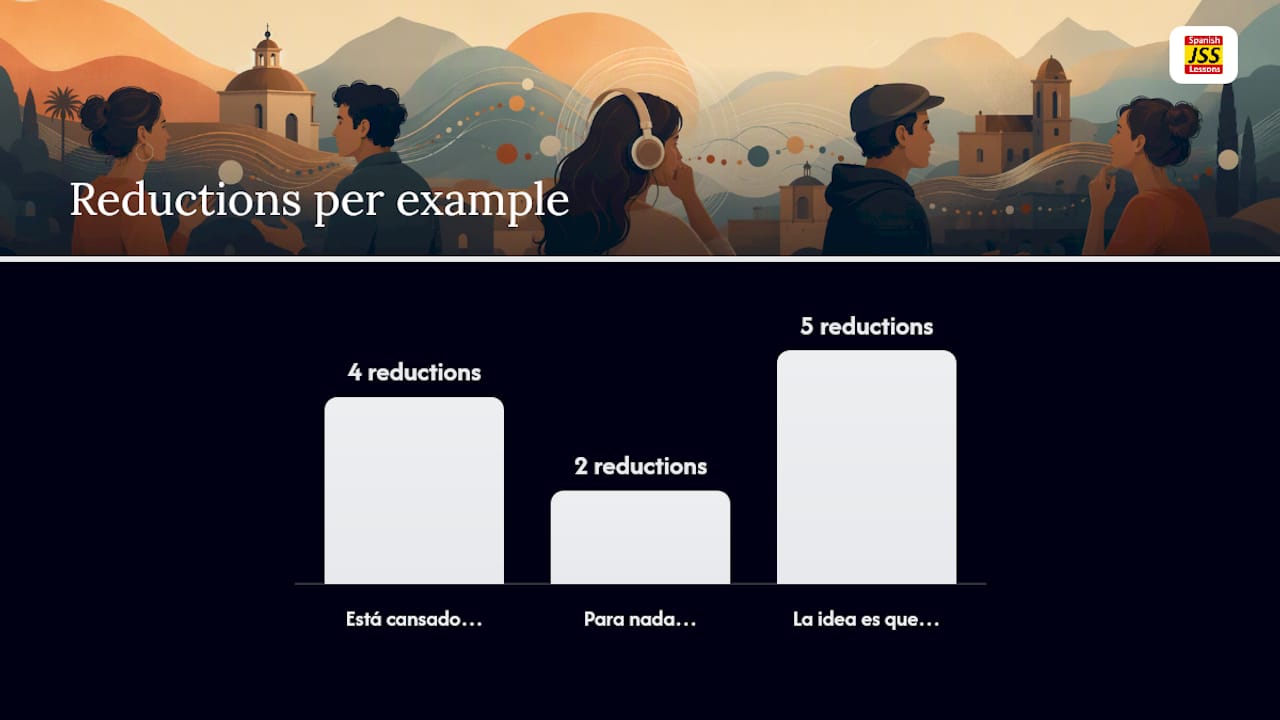
Reconstruction: The -d in cansado drops, todo loses its final -d, and even the infinitive trabajar can lose its final -r in very casual speech. Context (the subject, the verb estar, the topic of tiredness) makes the meaning obvious despite four separate reductions in one short sentence. - Written: Para nada, no pasa nada.
Spoken: “Pa naa, no pasa naa.”
Reconstruction: Para becomes “pa” and nada loses its intervocalic /d/ twice. This exact phrase, a common way of saying “no problem at all,” is worth memorising in its reduced form because you’ll hear it constantly in casual conversation. - Written: La idea es que los amigos vengan el sábado.
Spoken: “Laidea es que lo(h) amigo(h) vengan el sábao.”
Reconstruction: Sinalefa joins la and idea; the -s in los amigos softens or vanishes; sábado loses its intervocalic /d/. Five distinct reductions in one sentence, which is a realistic density for natural speech.
A simple three-step drill turns these examples into a repeatable habit:
- Transcribe: listen to a short clip (15 to 30 seconds) and write down exactly what you hear, reductions included, even if it looks strange on paper.
- Compare: check your transcription against the official script or subtitles, if available, and mark every place a sound was dropped or merged.
- Classify: label each difference as vowel elision, consonant loss, or linking across a word boundary. Over time, you’ll notice the same handful of patterns recurring.
Pro Tip: Unscripted podcasts and informal interviews train your ear far better than audiobooks or news broadcasts, because scripted speech is read more carefully and elides less. Look for conversational formats where two native speakers are chatting naturally, not reading from a page.
Guidance on how Spanish connected speech changes what learners hear confirms that comparing unscripted audio against written transcripts is one of the most effective ways to close the gap between classroom Spanish and the real thing.
How elision affects comprehension, and how to train around it
Once you recognise that -ado usually becomes “-ao” and that final -s often softens or disappears in certain dialects, fast speech stops sounding like a blur and starts sounding like a small, learnable set of shortcuts. That shift, from panic to pattern recognition, is the single biggest jump most learners make in listening comprehension.
A few strategies speed that shift along:
- Chunking: listen for whole phrases rather than individual words. Pa naa is one chunk, not two separate reductions to decode from scratch each time.
- Prediction: use grammar knowledge to anticipate what’s coming. If you hear a subject and está, you’re probably about to hear an adjective ending, so “cansao” reads instantly as cansado.
- Shadowing: repeat audio aloud, matching rhythm and reductions, which trains your mouth and ear simultaneously.
- Repeated short exposures: hearing the same clip several times in a single sitting, rather than once and moving on, cements pattern recognition faster than fresh material every time.
The teaching method behind this approach was designed to bridge the gap between textbook Spanish and the reduced, connected speech you actually hear in shops, surgeries, and conversations with neighbours. The course’s WordAmigo system applies strategic, spaced repetition to vocabulary and pronunciation, the same repeated-exposure principle that listening drills rely on for training recognition of reduced forms.
Five exercises to practise elision starting today
You don’t need hours of study time to make progress here. Ten to twenty minutes a day, done consistently, moves the needle more than one long weekend session ever will.
- Transcription drill: pick a 20-second clip of unscripted conversation and write exactly what you hear, then check it against a transcript.
- Slowed playback: use a video player’s speed control to drop audio to 0.75x and listen for the reductions you missed at full speed.
- Shadowing: play a sentence, pause, and repeat it aloud immediately, matching the reduced pronunciation rather than the “correct” written form.
- Minimal-pair contrasts: practise saying and hearing pairs like hablado versus hablao, or todos versus too, until both feel equally natural to your ear.
- Targeted repetition: take one pattern (say, -ado → -ao) and hunt for five examples in a single podcast episode, marking each one you catch.
Grade the difficulty by starting with slow, clear audio and working up to fast, unscripted conversation over a few weeks. Track progress with a simple daily micro-goal, such as “catch three reductions today,” rather than an abstract aim like “get better at listening.” For a broader framework on building this skill, how to understand fast Spanish for real conversations lays out how to structure a weekly routine around it.
Key takeaways and your seven-day plan
- Elision is a predictable deletion of sounds, mostly the intervocalic /d/ and final -s, not random slurring.
- The -ado → -ao pattern is the single most useful reduction to learn first, given how frequently it appears.
- Regional variation is real: Andalusian and Caribbean speech elide -s heavily, while highland varieties are more conservative.
- Grammar survives elision. Context, verb agreement, and articles carry the meaning even when sounds disappear.
- Seven-day plan: spend 10 to 15 minutes daily transcribing one short unscripted clip, comparing it against the script, and marking every reduction you find.
Where elision came from in the history of Spanish
Elision isn’t a modern shortcut born of texting or fast talking. Sound loss between vowels has shaped Spanish for centuries, tracing back to changes already under way in Vulgar Latin before Spanish existed as a distinct language. Intervocalic consonants, particularly /d/, /t/, and /g/, were already weakening in the spoken Latin of the Iberian Peninsula, a process that eventually produced core Spanish vocabulary: Latin vita became vida, and further colloquial weakening of that same /d/ is what’s happening again today when vida itself starts to slip toward “vía” in ultra-casual speech.
Final -s has a longer and more contested history. Its aspiration and loss in southern Spain and parts of Latin America likely developed through centuries of regional dialect contact, plus, in the Caribbean and Canary Islands specifically, sustained historical contact between Andalusian settlers and local populations from the colonial period onward. The pattern spread and settled into what’s now a stable, generation-spanning feature of those dialects rather than a recent innovation.
What’s happening in spoken Spanish now is largely a continuation of processes that have been running for well over a thousand years. Elision isn’t sloppy modern speech corrupting a purer written standard. It’s the same sound-simplifying tendency that built much of the vocabulary in Spanish dictionaries today, still active in every casual conversation.
How Spanish elision compares with French, Italian, and Portuguese
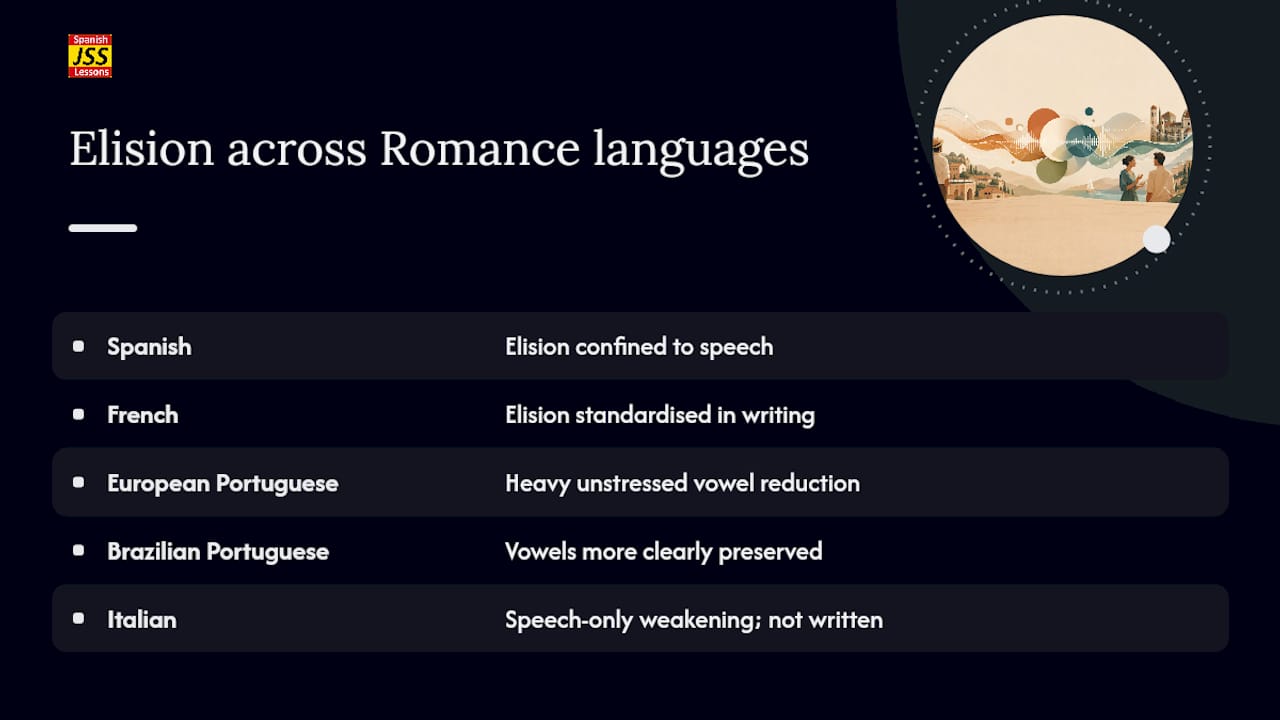
Every major Romance language reduces sounds in casual speech, but each does it differently, which is worth knowing if you’ve studied another Romance language before Spanish.
French formalised elision into its writing system centuries ago: le ami became l’ami, with the vowel drop marked by an apostrophe as standard, correct spelling. Spanish never went that far. Its elisions stay confined to speech and informal writing, never crossing into the standard orthography taught in schools.
European Portuguese arguably goes further than Spanish in everyday reduction, dropping and merging unstressed vowels so heavily that learners of Spanish often find spoken Portuguese harder to parse at first, despite the two languages sharing much of their vocabulary. Brazilian Portuguese, by contrast, tends to preserve vowels more clearly, closer to how most Spanish dialects behave.
Italian sits closer to Spanish in spirit: informal speech shows consonant weakening and vowel linking between words, but nothing approaching the systematic apostrophe-marked contractions of French. Elision in Italian, much like in Spanish, stays a spoken-register phenomenon that the written standard mostly ignores.
The throughline across all four languages is the same: frequent, unstressed grammatical words (articles, prepositions, common verb endings) reduce first and hardest, while stressed content words resist reduction far longer. Spanish learners who’ve dabbled in French or Italian already have useful intuition here, even if the specific sounds differ.
Why elision rarely shows up in Spanish spelling
Standard Spanish orthography is remarkably conservative given how much sound gets dropped in speech. You’ll almost never see “hablao” or “pa” in a novel, a newspaper, or a formal email. Spanish spelling represents the full, careful pronunciation of a word regardless of how casually it’s actually said, which is precisely why relying only on reading practice leaves such a large gap in listening comprehension.
Informal writing tells a different story. Text messages, social media, and online chat frequently mimic spoken reductions on purpose, as a way of signalling a casual, conversational tone in writing. Research into phonetic markers in chat language found that elisions such as -ado → -ao appear regularly in informal digital writing, functioning as deliberate orthographic markers of oral, relaxed register rather than typing errors.
That split matters practically. If you only ever read formal Spanish, prose, news articles, textbooks, you’ll never encounter these reductions on the page, which is exactly why listening practice has to run alongside reading practice rather than substitute for it. The written language and the spoken language have quietly drifted into two related but distinct systems, and fluency requires comfort with both.
Does elision ever change meaning or grammar?
Most elision is grammatically harmless. Sounds disappear, but the underlying grammatical information survives elsewhere in the sentence. Linguistic documentation on Spanish grammatical features confirms that even when a feature like plural Number gets phonetically reduced or dropped at the surface (the classic case being -s loss), the grammatical category itself remains intact and recoverable from other cues in the sentence, such as articles or verb agreement.
Ambiguity does creep in occasionally, though, and it’s worth knowing where. When final -s disappears entirely, singular and plural forms of a noun can become identical in speech: el amigo and los amigo(h) might sound dangerously close if the article itself is also swallowed in very rapid, casual speech. Native listeners resolve this instantly using context, but it’s a genuine trap for learners relying purely on the sound of the word itself.
A subtler consequence involves verb endings. Second-person plural forms and certain past tense conjugations lean on -s or -d sounds that elision can weaken, occasionally making two different verb forms sound momentarily similar. In practice, native speakers rarely misunderstand each other, because the surrounding sentence, subject pronouns, time markers, and shared context almost always disambiguate the message. For learners, this is exactly why chunking and prediction matter more than trying to catch every individual sound.
Ready to train your ear on real spoken Spanish?
Reading about elision is one thing. Actually training your ear to catch “cansao” instead of freezing at an unfamiliar sound is a different skill entirely, and it’s the one most classroom courses skip. James Spanish School built its 100-lesson course around exactly this gap, splitting lessons between sentence-building and dedicated ear-tuning practice designed for the fast, reduced speech you’ll actually hear from Spanish neighbours, shopkeepers, and officials.

The ear-tuning work is combined with a system applying repetition techniques to lock in vocabulary and pronunciation, including the reduced forms covered in this article, helping learners recognise sounds like “pa” and “too” more easily. This approach suits English-speaking adults seeking practical listening skills for everyday conversation rather than exam-focused grammar drills. Lessons are available on demand with no expiry date, allowing repetition of modules as needed until patterns click. Explore course details and current offers at James Spanish School’s shop.
Sources
- Elisión de la /d/ intervocálica en hablantes de nivel sociocultural bajo de Sevilla (Redalyc)
- Variationist analysis of phonological processes of elision and substitution (Preseea‑Medellín)
- How Spanish connected speech changes what learners hear | SpanishStep
- Contraction and elision in fast speech — Disciple’s Handbook
Working through the corpus studies builds your theoretical grasp of why reductions happen; the learner-facing drills turn that theory into an ear that actually catches them in real time.