

Role of flexibility in language courses
TL;DR:
- Flexible language courses adapt to individual schedules, boosting learner engagement and language retention. They combine on-demand access, personalized content, and strategic structure to reduce anxiety and improve outcomes. James Spanish School offers a customizable, accessible program designed for busy adults seeking real proficiency.
Flexibility in language courses is defined as the capacity of a course to adapt its schedule, pacing, content, and delivery mode to the individual learner’s life and goals. For adult learners working to build European Spanish proficiency around busy routines, this adaptability is not a convenience. It is the primary driver of whether learning actually sticks. Personalised, flexible tutoring improves test scores by 12% and leads to grade improvement in 80% of learners by targeting individual weaknesses and reducing anxiety. Those numbers tell a clear story: when a course bends to fit your life, you learn more. James Spanish School was built on exactly this principle, offering on-demand access, no expiry dates, and a method designed around how adults genuinely acquire language.
How does flexibility in language courses improve acquisition outcomes?
Flexible learning models produce measurable gains, and the evidence is specific. Blended learning environments report a flexibility satisfaction mean score of 3.73 out of 5, with learners citing better time and place management as the primary benefit. That score reflects something practical: when learners control when and where they study, they show up more consistently.
The HyFlex model, which allows learners to choose between in-person, online synchronous, or online asynchronous participation, produces even stronger results. HyFlex learning increases oral fluency by 18% in secondary EFL students and delivers a statistically significant reduction in speaking anxiety. Reduced anxiety matters enormously for adult learners, who often carry years of self-consciousness about speaking a new language in front of others.
Learner agency is the mechanism behind these gains. Flexible models transform passive recipients into active decision-makers, which significantly increases engagement and long-term investment in the learning process. When you decide how to participate, you take ownership of the outcome.
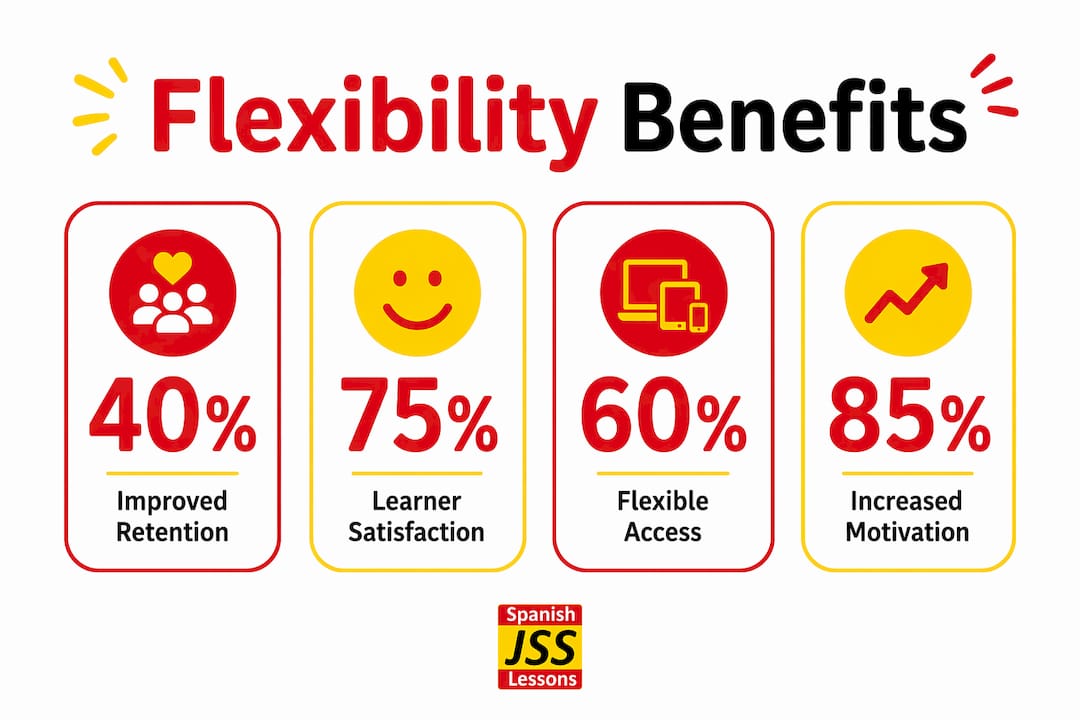
The table below summarises the key evidence on flexibility benefits in language courses.
| Model | Key benefit | Evidence |
|---|---|---|
| Personalised flexible tutoring | 12% test score improvement | 80% of learners show grade gains |
| Blended learning | Better time and place management | Flexibility satisfaction score 3.73/5 |
| HyFlex model | 18% oral fluency improvement | Statistically significant anxiety reduction |
| Learner agency approach | Higher engagement and retention | Qualitative findings on autonomy |
The pattern across all three models is consistent. Flexibility reduces friction, lowers anxiety, and puts the learner in control. Those three factors combine to produce better outcomes than rigid, fixed-schedule instruction.
- Flexible scheduling removes the “I missed a session, so I’ve fallen behind” problem that derails adult learners.
- Personalised content targets the specific gaps that matter to each learner, rather than covering ground already mastered.
- On-demand access means a 20-minute window on a Tuesday evening is as productive as a two-hour Saturday class.
- Reduced anxiety creates the psychological safety needed to practise speaking, which is where fluency is actually built.
What does flexibility look like in practice?
Adaptive learning in language education takes several concrete forms, and understanding each one helps you choose the right course structure.
- Flexible scheduling. The most obvious form of adaptability is timing. A course that runs on demand, 24 hours a day, seven days a week, removes the single biggest barrier for busy adults: the fixed class slot that clashes with work, family, or travel. Flexible tutoring removes friction for busy adults by adapting to their schedules, which directly increases motivation and enjoyment.
- Personalised content. Effective adaptive learning targets individual weaknesses rather than delivering the same material to every learner. If your listening comprehension is strong but your sentence construction is weak, a good flexible course redirects resources accordingly. This is the difference between a course that teaches Spanish and a course that teaches you Spanish.
- Adaptive pacing. Language acquisition is not a race. Allowing learners to revisit lessons, slow down on difficult structures, and accelerate through familiar territory reflects how memory actually works. James Spanish School’s 100-lesson course has no expiry date and no countdown clock, so learners can repeat any lesson as many times as needed without penalty.
- Hybrid human and AI tutoring. The most effective flexible courses combine the consistency of AI-driven repetition with the judgement of an experienced teacher. James Spanish School’s WordAmigo system uses AI-powered strategic repetition to permanently embed vocabulary and pronunciation, while the course content itself is shaped by 40 years of lived experience in Spain.
- Metacognitive training. Metacognitive training combined with personalised tutoring enhances the effectiveness of flexible learning by teaching learners how to study effectively. This means understanding your own learning patterns, recognising when you need to revisit a topic, and managing your study time without external pressure.
Pro Tip: Set a fixed minimum study window each day, even if it is only 15 minutes. Consistency beats duration. A flexible course gives you the freedom to choose when; you supply the habit.

Balancing flexibility with structured progress
Total flexibility without structure is not a learning method. It is a recipe for drifting. The most effective adaptive language courses build structure into their flexibility rather than abandoning it.
Language progress is non-linear by nature. Good language teachers rarely teach in straight lines; effective learning requires spiralling, connection, and revisiting topics to build genuine understanding. A course that moves rigidly from lesson one to lesson one hundred, never looping back, misunderstands how the brain builds language networks.
Flexibility signals a curriculum adapting to how the brain processes language, rather than a weakness in teaching design. The non-linear nature of language acquisition means that revisiting a topic at a higher level of understanding is not repetition for its own sake. It is the mechanism by which knowledge becomes permanent.
The risks of unstructured flexibility are real. Without clear progression pathways, learners lose direction. Without formative checkpoints, they cannot tell whether they are making progress. Flexible learning environments may increase stress without a structured approach, and learner self-regulation and reliable technology access are critical for success. That finding is a useful corrective to the idea that more freedom always means better outcomes.
The solution is a course that offers flexibility within a clear framework. Learners should be able to see where they are, where they are going, and what they have already consolidated. Experienced teachers play a central role here, dynamically adjusting content based on learner performance rather than following a fixed syllabus regardless of progress.
- Clear module progression gives learners a map, even when they choose their own pace.
- Formative checkpoints confirm understanding before moving to more complex structures.
- Spiralling content revisits earlier topics at greater depth, reinforcing rather than repeating.
- Native language support reduces anxiety and makes new structures accessible without overwhelming the learner.
Allowing native language use in flexible Spanish learning lowers anxiety and burnout, making the target language more accessible. James Spanish School’s method of Radical Simplification applies this directly: James explains Spanish structure through plain English, removing the grammar jargon that creates unnecessary barriers for adult learners.
How can adult learners maximise flexibility benefits in Spanish courses?
Knowing that a course is flexible is one thing. Knowing how to use that flexibility well is another. The benefits of tailored language courses for adult learners are well documented across languages, and the strategies that work are consistent.
Pro Tip: Lower your affective filter by choosing your learning environment deliberately. Studying in a quiet, comfortable space where you feel relaxed produces better retention than forcing yourself through a lesson when you are stressed or distracted.
The following approaches give adult learners the best return from a flexible course structure.
- Build self-regulation skills first. Tech self-regulation and time management are the foundation of success in any flexible model. Decide in advance when you will study, for how long, and what you will cover. Treat those decisions as commitments rather than intentions.
- Prioritise real-time feedback. Select courses or tutors that offer targeted feedback on your specific errors. Generic corrections do not build fluency. Feedback that addresses your particular pronunciation or sentence construction errors does. James Spanish School’s feedback-driven approach is built around this principle.
- Use blended and hybrid formats. Mixing on-demand lessons with live practice sessions, even informal ones with native speakers, accelerates the transition from understanding Spanish to producing it. A flexible way to learn at your own pace works best when it includes varied modes of exposure.
- Integrate varied materials. Supplement structured lessons with authentic Spanish content: radio, television, conversations with neighbours or tradespeople. James Spanish School’s ear-tuning lessons are specifically designed to help learners follow the machine-gun speed of native Spanish speech, which no textbook alone can replicate.
- Use native language support strategically. Native language scaffolding lowers affective filters and improves target language accessibility. Do not treat English as the enemy of Spanish learning. Use it as a bridge, then gradually reduce your reliance on it as confidence grows.
The adult learners who succeed in flexible Spanish courses are not necessarily the most talented. They are the most consistent, the most self-aware, and the most willing to use the structure within the flexibility rather than ignoring it.
James Spanish School: flexible Spanish learning for busy adults
James Spanish School offers a course structure built specifically for the realities of adult life. The 100-lesson programme is available on demand, 24/7, with no expiry date and no pressure from a countdown clock.
The WordAmigo system uses AI-powered strategic repetition to embed vocabulary and pronunciation permanently, addressing the two frustrations that stop most adult learners: words that will not stay in memory and pronunciation that native speakers struggle to follow. Every lesson is accessible on a phone, tablet, or laptop, so learning fits around work, family, and travel rather than competing with them. James Bretherton’s 40 years of living in Spain inform every cultural insight in the course, from Spanish cultural habits for expats to the everyday conversations that matter most. Adult learners ready to build real European Spanish proficiency can view the full course and choose the option that fits their schedule and goals.
Key takeaways
Flexibility in language courses works because it aligns course structure with how adult brains actually acquire language, reducing anxiety, increasing consistency, and enabling personalised progress.
| Point | Details |
|---|---|
| Flexibility drives measurable gains | Personalised flexible tutoring improves test scores by 12% and benefits 80% of learners. |
| Structure within flexibility is essential | Unstructured freedom increases stress; clear progression pathways keep learners on track. |
| Learner agency accelerates progress | Choosing participation mode transforms passive learners into active, motivated ones. |
| Native language support reduces barriers | Using English strategically lowers anxiety and makes Spanish structures more accessible. |
| Self-regulation determines success | Time management and consistent study habits are the foundation of flexible learning outcomes. |
FAQ
What is the role of flexibility in language courses?
Flexibility in language courses means adapting schedule, pacing, and content to the individual learner. Research shows this approach improves test scores by 12% and leads to grade gains in 80% of learners.
Does flexible learning work for adult Spanish learners specifically?
Flexible learning is particularly effective for adults because it removes the scheduling conflicts and anxiety that most commonly disrupt adult language study. On-demand access and personalised content address the two barriers adults face most often.
How does flexibility affect language retention?
Flexible courses that allow learners to revisit topics and spiral back through earlier material reflect how memory consolidates language. Language progress is non-linear, and courses that accommodate this produce stronger long-term retention than linear, fixed-pace programmes.
Can too much flexibility hinder language learning?
Flexibility without structure can increase stress and reduce direction. Learners need clear progression pathways and self-regulation skills to benefit fully from adaptive course formats.
What makes James Spanish School’s approach flexible?
James Spanish School’s 100-lesson course is available on demand with no expiry date, no fixed class times, and the freedom to repeat any lesson as often as needed. The no-deadline approach is designed specifically for adult learners who cannot commit to a fixed weekly schedule.