

TL;DR:
- Cultural tips are essential for making language skills truly effective and socially appropriate. They connect vocabulary and grammar to real-life situations, improving confidence and communication accuracy. James Spanish School integrates decades of cultural knowledge with AI-driven retention tools to help learners speak Spanish naturally and confidently in Spain.
Cultural tips are not a bonus layer you add once you have mastered the grammar. They are the reason the grammar starts to make sense in real life. When you understand why a Spaniard greets a stranger with two kisses, why the word “mañana” carries a different weight than its dictionary translation, or why interrupting someone mid-sentence is often a sign of enthusiasm rather than rudeness, your Spanish shifts from technically correct to genuinely communicative. That is the core of why cultural tips boost language skills: they connect the words you learn to the social world those words actually live in.
James Spanish School, founded by James Bretherton, a dual-native speaker with 40 years of living in Spain, has built its entire teaching philosophy around this principle. Dr Nika White, author of Inclusion Uncomplicated, puts it plainly: “Just like any other relationship, you must understand their culture to truly understand someone’s lived experiences and how they show up to the world.” For adult learners focused on real-life communication in Spain, that insight is not abstract. It is the difference between being understood and being tolerated.
Purely grammatical learning versus culturally enriched learning:
- Grammar-only: you construct correct sentences that still confuse or alienate native speakers.
- Culturally enriched: you read the room, match the register, and communicate with appropriate warmth or directness.
- Grammar-only: vocabulary is memorised in isolation and forgotten quickly.
- Culturally enriched: words are embedded in social contexts, making them far easier to recall.
- Grammar-only: you pass a test but freeze in a real conversation.
- Culturally enriched: you recover from mistakes gracefully and keep the exchange moving.
Cultural understanding is not optional. It is foundational to language acquisition.
Table of Contents
- How cultural awareness sharpens Spanish communication
- Practical cultural tips for English speakers in Spain
- How James Spanish School and the WordAmigo System embed culture in learning
- How cultural awareness builds your confidence in Spain
- James Spanish School: real Spanish for real life in Spain
- Key takeaways
How cultural awareness sharpens Spanish communication
Spanish in Spain is not a neutral, context-free code. The same phrase can signal warmth, sarcasm, or impatience depending on tone, setting, and relationship. Culture shapes tone, politeness, and social expectations in ways that no grammar textbook captures.
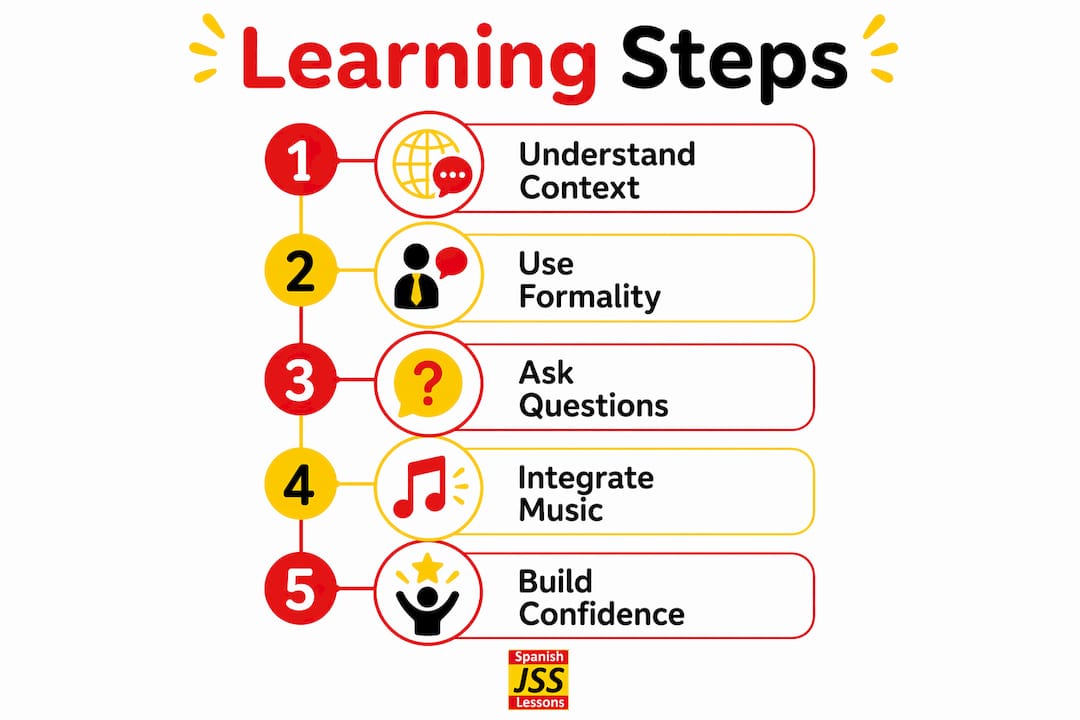
Consider the formal and informal “you”: knowing when to use usted versus tú requires cultural judgement, not just vocabulary. Misjudging it in a conversation with a doctor or a government official can make you seem either disrespectful or oddly stiff. Similarly, Spanish communication in Spain tends toward directness that can read as bluntness to British ears, yet the same directness is paired with genuine warmth and physical closeness that softens it entirely.
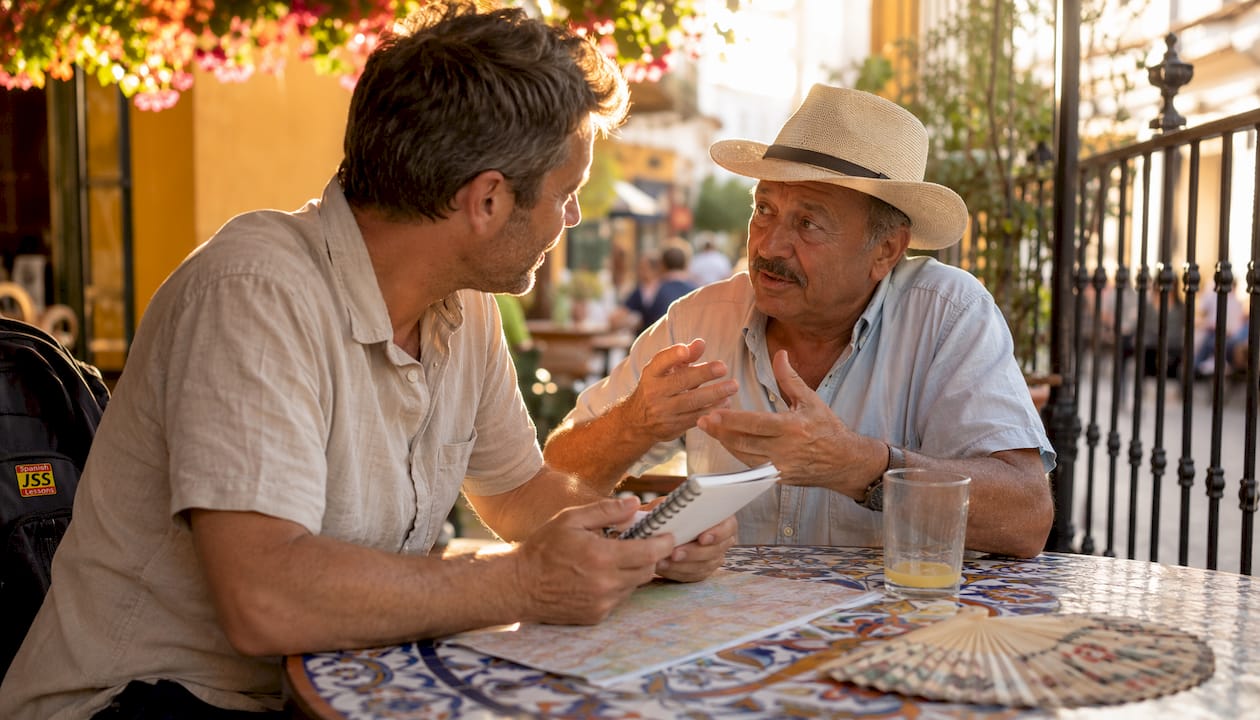
Cultural awareness also affects how you listen. When you understand that Spaniards often speak simultaneously in animated conversation, you stop interpreting overlapping voices as conflict and start hearing them as engagement. That shift alone reduces anxiety and helps you follow fast spoken exchanges far more effectively.
Cultural impacts across communication domains:
- Speaking: matching register, directness, and warmth to the social context.
- Listening: interpreting overlapping speech, regional accents, and implied meaning.
- Reading: grasping idioms, proverbs, and culturally loaded references.
- Writing: adjusting formality in messages to neighbours, tradesmen, or officials.
Practical cultural tips for English speakers in Spain
The most useful cultural knowledge is not a rulebook. It is a set of observations that help you read situations and respond with respect. As cultural etiquette experts note, when locals sense genuine effort and curiosity, they become far more open and willing to help.
Here are the habits worth building:
- Greetings matter enormously. Two kisses on the cheek (left first) is standard between women and between men and women in social settings. A firm handshake works in formal or professional contexts. Getting this right immediately signals that you are paying attention.
- Meal times are non-negotiable. Lunch is the main meal, typically between 2 PM and 4 PM. Dinner rarely starts before 9 PM. Turning up at a restaurant at 6 PM and expecting a full service is a reliable way to mark yourself as a tourist.
- Queuing is fluid. In busy bars and markets, the unwritten rule is that everyone knows who arrived before whom. Jumping in aggressively causes friction; waiting patiently while making eye contact with the server works.
- Silence is not awkward. Unlike British conversational norms, a pause in Spanish conversation does not always need filling. Letting a moment breathe shows confidence.
- Humour is cultural, not translatable. Understanding jokes and wordplay in Spanish requires cultural immersion and social knowledge, not just vocabulary. Shared laughter is one of the fastest routes to genuine connection with native speakers.
- Use authentic media. Spanish television, radio, and local newspapers expose you to real registers, regional expressions, and current references that no coursebook replicates. Even 20 minutes of a Spanish chat show teaches more about conversational rhythm than an hour of drills.
Pro Tip: When you are unsure about a custom, ask directly and with genuine curiosity. Most Spaniards find the question flattering rather than intrusive, and the answer will stick in your memory far longer than anything you read in a guide.
Learning through cultural context also applies to music, which carries regional identity, slang, and emotional register in a form that is easy to revisit and enjoy.
How James Spanish School and the WordAmigo System embed culture in learning
James Bretherton’s 40 years of living and working in Spain give James Spanish School a depth of cultural knowledge that most language courses simply cannot replicate. The school’s method, Radical Simplification, strips away the grammar jargon that clutters traditional teaching and explains Spanish structure through plain English, making space for cultural context to take centre stage rather than being squeezed into a footnote.
The 100-lesson course weaves genuine insider knowledge throughout: the builder’s mid-morning break, queuing habits, how to speak to a pharmacist versus a neighbour, the rhythm of a Spanish working day. These are not anecdotes. They are the social scaffolding that makes vocabulary and sentence patterns stick.
The WordAmigo System takes retention further. Built by James Bretherton alongside IT experts and long-term English expats fully immersed in Spanish society, it uses AI-driven strategic repetition to permanently embed vocabulary and pronunciation. The five-step retention loop covers reading, listening, speaking, and writing, ensuring that words are not just recognised but recalled under the pressure of a real conversation.
What the course delivers:
- Cultural insights woven into every lesson, not treated as an add-on.
- Authentic contexts drawn from everyday life in Spain: neighbours, shop staff, tradesmen, health workers, and government officials.
- WordAmigo’s AI repetition system targeting the two biggest adult learner frustrations: words that will not stay in memory and pronunciation that native speakers struggle to follow.
- Ear-tuning lessons specifically designed to help you follow the machine-gun speed of native replies.
- A cast-iron guarantee: if a core lesson teaches you nothing new, James credits you with extra practice modules at no cost.
Cultural learning is most effective when integrated from the start, building social awareness alongside vocabulary and grammar. That is precisely how James Spanish School structures its course.
How cultural awareness builds your confidence in Spain
The practical effect of cultural competence is confidence, and confidence changes everything about how you communicate. Learners with cultural understanding recover more gracefully from mistakes and engage more fully in conversations, rather than retreating into silence after a stumble.
Understanding a culture’s history and traditions reveals the “why” behind expressions and social norms, which makes those norms feel logical rather than arbitrary. Once you understand why Spaniards eat late, why the siesta exists, or why a local might seem brusque at first but warm up quickly, you stop second-guessing yourself in social situations.
Confidence-building effects of cultural awareness:
- Fewer misunderstandings with neighbours, tradesmen, and officials.
- Ability to read a room and adjust your tone without overthinking it.
- Reduced anxiety when conversations move fast or go off-script.
- Stronger relationships built on genuine mutual respect rather than polite distance.
- Richer day-to-day experiences: markets, fiestas, local bars, and community events become accessible rather than intimidating.
For practical Spanish fluency in Spain, cultural confidence and linguistic confidence grow together. You cannot fully have one without the other.
James Spanish School: real Spanish for real life in Spain
Forty years of living in Spain, a cast-iron teaching method, and an AI-powered vocabulary system built specifically for English-speaking expats. That is what James Spanish School brings to adult learners who want Spanish that actually works when the plumber arrives, when the town hall sends a letter, or when the neighbours invite you for a drink.
The course is available on demand, 24/7, on any device, with no expiry date and no countdown pressure. Cultural insights are built into every lesson, not bolted on at the end. The WordAmigo System handles vocabulary and pronunciation retention so that words stay with you when you need them most. Whether you are preparing to move to Spain, already living there, or simply determined to communicate properly rather than just get by, the course is designed for exactly your situation.
Take a look at the full course options and see which fits your stage of learning.
Key takeaways
Cultural awareness is the single most effective way to convert grammar knowledge into real, confident communication in Spain.
| Point | Details |
|---|---|
| Culture shapes communication | Tone, register, and social expectations in Spain go far beyond what grammar rules can teach. |
| Context embeds vocabulary | Learning words within cultural situations leads to stronger, faster recall than isolated drills. |
| Confidence follows cultural knowledge | Learners who understand Spanish customs recover from mistakes more easily and engage more fully. |
| Humour and personality require culture | Jokes, idioms, and warmth in Spanish cannot be learned from a textbook; they need social context. |
| James Spanish School | Integrates 40 years of cultural expertise and the AI-powered WordAmigo System into every lesson. |