

Role of tradesmen Spanish
In Spain, the word “tradesman” translates most naturally as obrero cualificado (skilled worker) or artesano (craftsman), depending on context. Cambridge Dictionary confirms the term covers skilled, hands-on building trades, while WordReference notes that comerciante means shopkeeper, not tradesman, so the distinction matters when you are trying to hire the right person. Understanding the role of tradesmen in Spanish life, and knowing how to speak with them confidently, is one of the most practical skills any English-speaking homeowner or renter in Spain can develop.
Before you agree any work, do three things straight away:
- Ask for the trade name in Spanish and a one-line description of what they do.
- Request a factura (official invoice) or proof of qualifications before work begins.
- Check references, ideally from a neighbour or local contact who has used them recently.
Table of Contents
- What are the common trades in Spain and what does each one do?
- How are trades organised in Spain and how do you check qualifications?
- Ready-to-use Spanish phrases for phone, WhatsApp, and on-site
- How to build a good working relationship with Spanish tradesmen
- Payments, facturas, permits, and safety checks before work starts
- How to find reliable tradesmen and red flags to watch for
- Key takeaways
- James Spanish School: faster phrase recall for real conversations
- Useful resources and next steps
What are the common trades in Spain and what does each one do?
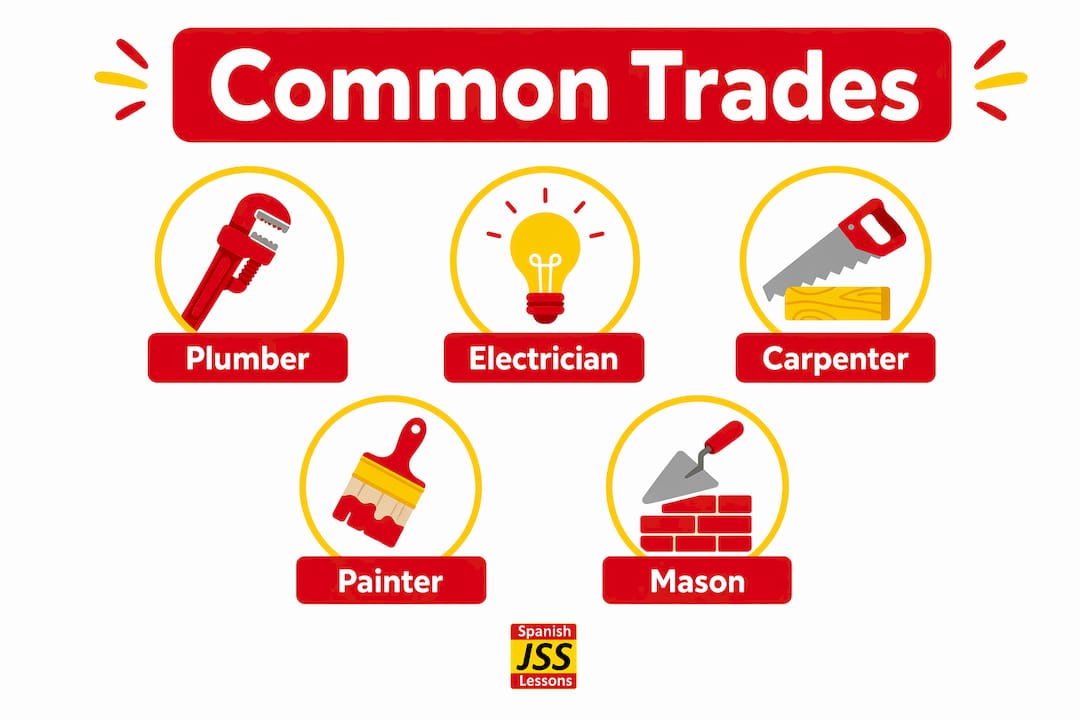
Matching the English term to the correct Spanish one saves real confusion when you are standing in front of a problem and need to call the right person. SpanishDict notes that Spanish trade nouns are gendered, so you will see el fontanero or la fontanera depending on who you are speaking about.
| English trade | Spanish term | Scope of work |
|---|---|---|
| Plumber | El fontanero | Water supply, drainage, leaks, boilers |
| Electrician | El electricista | Wiring, fuse boards, sockets, lighting |
| Carpenter | El carpintero | Doors, windows, fitted furniture, woodwork |
| Tiler | El alicatador | Wall and floor tiles, grouting, waterproofing |
| Plasterer | El yesero | Plastering, rendering, patching walls |
| Roofer | El tejador | Roof repairs, waterproofing, guttering |
| Locksmith | El cerrajero | Locks, security doors, emergency entry |
| Painter/decorator | El pintor | Interior and exterior painting, preparation |
| Builder/general | El albañil | Brickwork, extensions, structural repairs |
A practical rule: water leak goes to el fontanero first; no power goes to el electricista; a door that will not close properly is a job for el carpintero or el cerrajero, depending on whether the problem is the frame or the lock.
How are trades organised in Spain and how do you check qualifications?
Trades in Spain follow an apprenticeship-to-master structure that has deep historical roots. Skilled trades require specialised training and offer clear progression, and in Spain that progression typically runs from apprentice (aprendiz) through journeyman (oficial) to master (maestro). Confirming where someone sits on that ladder for the specific task you need is standard practice, not rudeness.
For electrical and gas work, a formal licence is required by law. For most other trades, experience and references carry the most weight. Before you hire anyone, ask for:
- Their trade certificate or proof of training (certificado de formación profesional).
- Two or three recent references (referencias) you can actually contact.
- Examples of similar recent work, ideally with photos.
- Their tax identification number (NIF or CIF) if they are operating as a business.
- Confirmation that they will issue a factura for all work.
Pro Tip: Frame the verification conversation respectfully. Something like “¿Tiene referencias de trabajos similares?” (Do you have references from similar jobs?) lands far better than a blunt demand. Most experienced tradesmen expect the question and will answer confidently.
Skilled labour on site often determines the durability and finish of a job more than the design or materials, so this check is worth the two minutes it takes.
Ready-to-use Spanish phrases for phone, WhatsApp, and on-site
You do not need perfect grammar to communicate clearly. Short, direct sentences work well, and a polite tone goes a long way. Save these templates to your phone.
Phone script (calling to describe a problem and request a quote):
WhatsApp message to set an appointment:
Send a photo of the problem with the message. It saves a wasted visit and shows you are organised.
On-site phrases:
- “El problema está aquí.” (The problem is here.)
- “¿Qué recomienda usted?” (What do you recommend?)
- “¿Cuánto tiempo tardará?” (How long will it take?)
- “¿Cuánto costará en total?” (How much will it cost in total?)
- “¿Me puede dar la factura, por favor?” (Can you give me the invoice, please?)
Pro Tip: Pronunciation matters more than vocabulary when a native speaker is listening fast. Focus on clear vowels: Spanish vowels are short and consistent, unlike English. For a deeper guide to getting your pronunciation right, the Spanish pronunciation guide at James Spanish School is a practical starting point.
How to build a good working relationship with Spanish tradesmen
The word artesano carries genuine pride in Spain. Treating a tradesman as a maestro of their craft, rather than a generic pair of hands, tends to produce a more engaged and accountable approach to the job. Ask for their recommendation rather than dictating the solution, and you will often get better work as a result.
Moreover, Spanish trades adapt plans to site conditions rather than following blueprints rigidly. Expect on-the-spot judgement calls, and ask for a brief explanation if anything changes: “¿Por qué ha cambiado el plan?” (Why has the plan changed?) is a perfectly reasonable question, asked politely.
A few practical courtesies that make a real difference:
- Clear the work area before they arrive. A tidy site signals respect for their time.
- Offer a coffee at the start of the day. It is a small gesture that sets a cooperative tone.
- Respect the mid-morning break (el almuerzo), typically around 10:00–10:30 AM. Trades stop for 20–30 minutes; plan your questions around it, not through it.
- Keep your brief clear and simple. Changing your mind mid-job costs everyone time and goodwill.
Pro Tip: A neighbour’s introduction is worth more than any online review in Spain. Local trades rely heavily on word-of-mouth, and arriving with a personal recommendation from someone they already know builds trust before you have said a word. Ask around before you call.
For a broader look at Spanish customs for expats, the cultural context behind these habits makes them much easier to navigate.
Payments, facturas, permits, and safety checks before work starts
Always agree the total price, payment schedule, and invoice terms in writing before any work begins. A verbal agreement is hard to enforce if something goes wrong.
Typical payment practice in Spain involves a deposit (señal) paid upfront to secure the booking, with the balance paid on completion. Avoid paying more than a third upfront for any job. Staged payments for longer projects are normal and reasonable.
A factura is not optional. It is your proof of payment, your warranty record, and your protection if a dispute arises. Any legitimate tradesman operating legally will issue one without hesitation. If they resist, treat that as a serious warning sign.
For electrical work, gas installations, and any structural changes, a permit (licencia de obras) or certified sign-off may be required. Check with your local ayuntamiento (town hall) before work starts. Gas engineers must hold a specific licence (instalador autorizado de gas); the same applies to certain electrical work. Ask to see the certificate before they touch anything.
Basic safety checks before work starts: confirm the tradesman knows where the mains water, electricity, and gas shut-offs are. If work affects any utility, agree who is responsible for isolating it safely.
How to find reliable tradesmen and red flags to watch for
The most reliable route to a good tradesman in Spain is a personal recommendation from a neighbour, a local hardware shop (ferretería), or a trusted community contact. Expat WhatsApp groups and local Facebook communities are useful secondary sources, though always verify independently.
“Un buen fontanero se encuentra por el boca a boca.” (A good plumber is found by word of mouth.) This is not just a saying in Spain; it reflects how the local trades economy actually works.
Red flags that should make you pause:
- No references and evasive answers when you ask for them.
- Refusal to issue a factura or vague answers about permits.
- A quote significantly below every other estimate you have received.
- Pressure to pay the full amount upfront before work starts.
- No tax number or business registration when asked.
A quick vetting checklist for the first call or message: ask for their full name, trade, a recent reference, and confirmation they will issue a factura. Four questions, two minutes, and you will filter out most unreliable operators immediately.
If work turns out to be unsafe or a payment dispute arises, your first step is the local Oficina Municipal de Información al Consumidor (OMIC), which handles consumer complaints. For serious safety issues involving gas or electricity, contact the relevant regional authority directly.
For a practical guide to chatting with Spanish tradesmen, including more phrase examples and real-life scenarios, James Spanish School has a dedicated resource worth bookmarking.
Key takeaways
Knowing the right Spanish terms and cultural habits puts you in control before the tradesman even arrives.
| Point | Details |
|---|---|
| Core Spanish terms | Use obrero cualificado or artesano; match the specific trade name (fontanero, electricista, etc.) to the job. |
| Always request a factura | A factura is your legal proof of payment and warranty; no legitimate tradesman will refuse to issue one. |
| Verify before you hire | Ask for a trade certificate, two references, and a tax number before agreeing any work. |
| Respect cultural rhythms | Acknowledge the mid-morning break, treat the tradesman as a maestro, and keep your brief clear. |
| James Spanish School | Offers a 100-lesson course with the WordAmigo pronunciation system, built for expats who need real-life Spanish fast. |
James Spanish School: faster phrase recall for real conversations
Knowing the phrases is one thing. Saying them confidently, at the speed a native speaker expects, is where most expats struggle.
James Spanish School was built specifically for English-speaking adults living in Spain. James Bretherton, a dual-native speaker with 40 years of life in Spain, designed the 100-lesson course around the conversations you actually need: tradesmen, neighbours, shop staff, health workers. The WordAmigo system uses strategic repetition to lock vocabulary and pronunciation into memory, so the right word comes out at the right moment rather than disappearing under pressure. There are no grammar tables to memorise, no countdown clocks, and no expiry dates. You learn on your phone, repeat any lesson as often as you like, and build real spoken confidence at your own pace. If you are ready to move from phrase-hunting to genuine communication, start with the course today.
Useful resources and next steps
Practical steps you can take right now:
- Save the phrase templates from this article to your phone’s notes app before your next call.
- Take a clear photo of the problem before contacting any tradesman.
- Ask for a simple written quote (presupuesto escrito) covering materials and labour separately.
- Check your local ayuntamiento website for permit requirements before structural or utility work begins.
- Bookmark the James Spanish School resources page for on-demand phrase practice and pronunciation drills.
- For translation checks, WordReference and Cambridge Dictionary are the most reliable free references for trade vocabulary.
- If you want a structured course option in Europe, Bogaers Taleninstituut offers Spanish language training as an alternative format for learners based on the continent.
This article provides general information for English-speaking homeowners and renters in Spain. For permit requirements, legal obligations, and safety regulations specific to your property and region, always confirm the current rules with your local ayuntamiento or a qualified professional.