

Spanish do’s and don’ts
TL;DR:
- Getting Spanish right involves mastering greetings, mealtime rhythms, and common language pitfalls for cultural fluency.
- Practicing key phrases and understanding social expectations help avoid awkward misunderstandings in Spain.
Get these right and Spain opens up. Get them wrong and you’ll spend your first month accidentally offending shopkeepers, arriving at dinner two hours early, and wondering why nobody seems to understand you. Here is the short version:
Do: greet everyone when you enter a room or shop; use dos besos in social settings; stay for sobremesa after a meal; default to tú in most everyday situations; ask ¿Quién es el último? when joining an informal queue.
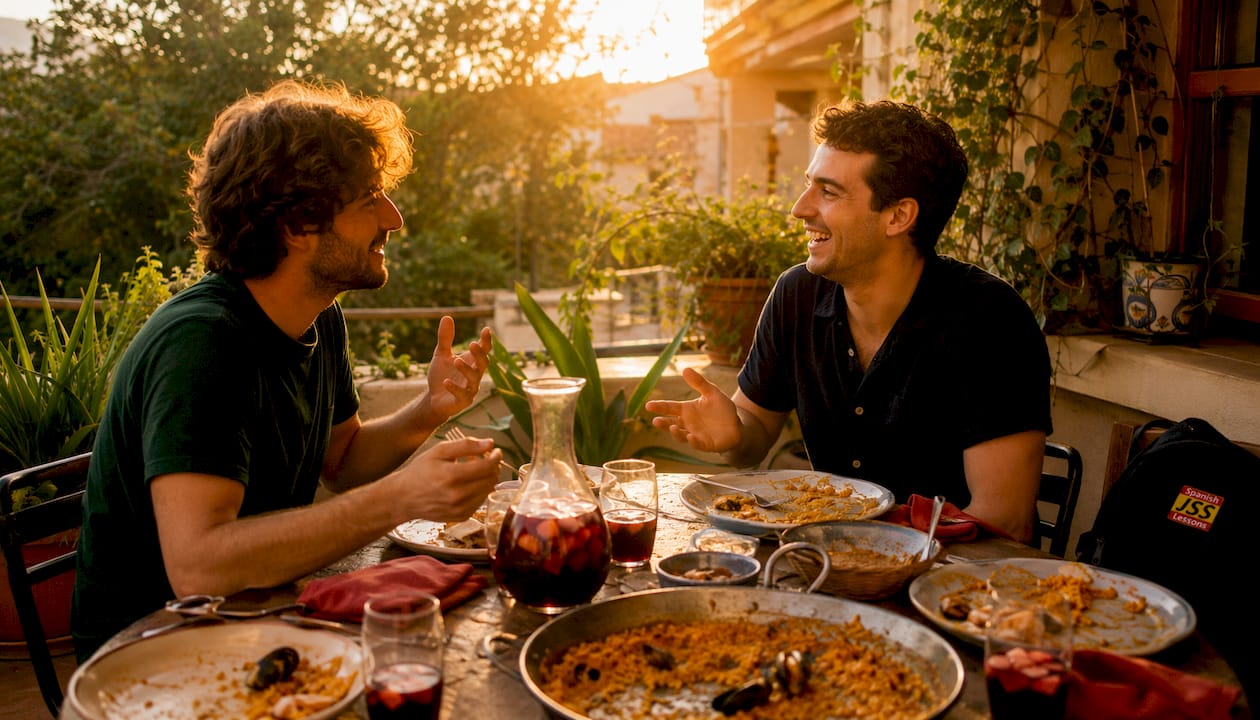
Don’t: suggest dinner before 9 pm; leave the table immediately after eating; tip routinely in casual places; bring chrysanthemums as a gift; dive into Catalan independence or the Civil War with people you’ve just met.
A few numbers worth pinning to your phone: lunch runs 2–4 pm and dinner rarely starts before 9 pm; tipping is optional, with 5–10% considered generous only at high-end restaurants. Social events commonly start 15–30 minutes late, while professional appointments demand punctuality.
Start here: practise the dos besos rhythm and the tú/usted switch before anything else. Two minutes of practice now saves a dozen awkward moments later.
Table of Contents
- How do you greet people in Spain and when should you use tú, usted or vosotros?
- What are the real rules for mealtimes, sobremesa and tipping in Spain?
- How do Spaniards actually talk, and which topics should you avoid?
- What do you need to know about gestures, personal space and queuing?
- Which language mistakes trip up English speakers most often?
- When do you need to be on time in Spain, and when is it fine to be relaxed?
- Why trust this guide — James Bretherton and James Spanish School
- Key takeaways
- Real cultural fluency starts with guided practice
How do you greet people in Spain and when should you use tú, usted or vosotros?
The default greeting in social settings is the dos besos: left cheek first, then right, between women and between a man and a woman who know each other. Men meeting for the first time usually shake hands; close male friends often add an abrazo and a pat on the back. The key is to let the Spanish person lead. If you pause and smile, they will show you what is expected.
For address, modern Spain leans informal. Tú works in most everyday situations, including many workplaces. Reserve usted for older people, formal officials, and first-time professional encounters. Overusing usted can create distance rather than respect.
“Modern Spain leans informal. Tú is widely used, even in many workplaces. Usted still appears in very formal settings or when addressing much older people, but overusing it can create distance rather than respect.” — idealista/news
Vosotros is the informal second-person plural used across Spain for addressing a group of friends or peers. It does not exist in Latin American Spanish, so UK learners studying European Spanish should learn it actively. The conjugation differs from ustedes, and mixing them up signals immediately that you have been learning from a Latin American course.
Pro Tip: To switch registers politely mid-conversation, simply ask: “¿Te puedo tutear?” (“May I use tú with you?”). It takes three seconds and earns immediate goodwill.
For deeper practice on Spanish small talk and polite conversational openings, it is worth building these phrases into your daily drills early.
What are the real rules for mealtimes, sobremesa and tipping in Spain?
Lunch is the main meal, eaten between 2 pm and 4 pm. Dinner is lighter and rarely before 9 pm, often later in summer. Plan social invitations around this rhythm, not the UK one.
At the table, wait until the host signals to start, keep your hands visible, and share tapas communally. Say ¡Buen provecho! when the food arrives and offer ¿Quieres más? to your neighbours. These small phrases signal that you understand the social contract.
La sobremesa is the conversation that continues after the plates are cleared. It is not lingering out of politeness; it is a social ritual for building and deepening relationships. Leaving immediately after eating signals disinterest. Budget an extra 30–60 minutes and treat it as part of the meal, not an optional extra.
| Behaviour | Do | Don’t |
|---|---|---|
| Timing | Arrive for lunch at 2–3 pm, dinner at 9 pm+ | Suggest dinner before 9 pm |
| Table manners | Keep hands visible; share tapas | Start eating before the host signals |
| After the meal | Stay for sobremesa | Leave immediately after eating |
| Gifts when visiting | Bring wine, chocolates or a pastry | Bring chrysanthemums (funeral association) |
| Tipping | Leave small coins in casual places; 5–10% at high-end restaurants | Tip routinely as you would in the UK |
How do Spaniards actually talk, and which topics should you avoid?
Spanish conversational style is direct, lively, and frequently overlapping. What sounds like interruption to a British ear is usually a sign of engagement, not rudeness. Joining in is often interpreted as enthusiasm. Prepare short interjections such as claro, ya, exacto, and a ver to show you are following along without waiting for a full pause that may never come.
“While it may seem odd at first, it’s common practice in Spain for people to speak over each other, especially when there are more than two people in the conversation. No one will take offence, so neither should you.” — idealista/news
Directness is valued. Over-softening criticism or relying on heavy sarcasm can confuse rather than smooth things over. That said, avoid blunt contradiction in hierarchical or professional settings; soften with puede ser, pero… or no estoy tan seguro before offering a different view.
Sensitive topics to handle carefully include the Spanish Civil War, Francisco Franco, Catalan independence, Gibraltar, and regional politics. These are not light small-talk subjects with people you have just met. Listen first, speak later. Similarly, avoid criticising Spain or making derogatory remarks about someone’s family.
Pro Tip: If a sensitive topic comes up and you want to redirect, try: “Es un tema complicado, ¿verdad? Cuéntame más sobre…” (“It’s a complicated topic, isn’t it? Tell me more about…”). It acknowledges the subject without taking a position.
What do you need to know about gestures, personal space and queuing?
Expect closer personal space than you are used to in the UK. People stand nearer in bars, on public transport, and in conversation. Maintaining eye contact shows interest and attention; looking away repeatedly or checking your phone while someone speaks is considered poor manners.
“Eye contact is very important when communicating in Spain, and maintaining it shows that you are interested and paying attention. Conversely, it is bad etiquette to start looking around at other things when someone is speaking to you.” — Expatica
Hand gestures accompany speech naturally and increase with excitement. Avoid excessive pointing at people, and be aware that some gestures vary by region. What reads as neutral in one part of Spain can carry a different weight in another. When in doubt, keep gestures moderate and observe before mirroring.
Queuing in informal shops often has no visible line. The system is to ask ¿Quién es el último? (“Who is last?”) on arrival, identify that person, and wait your turn. Pushing in is noticed and frowned upon, even when no queue is visible. For a fuller picture of how this works in practice, the dedicated guide to Spanish queuing culture is worth a read before your first trip.
Which language mistakes trip up English speakers most often?
Literal translation is the fastest route to confusion. Spanish sentence structure does not map onto English, and several common words are false friends that will mislead you at exactly the wrong moment.
- Embarazada means pregnant, not embarrassed. Use avergonzado/a instead.
- Sensible means sensitive, not sensible. Use sensato/a for the English meaning.
- Éxito means success, not exit. The exit is la salida.
- Constipado means having a cold, not constipated. Use estreñido/a for the latter.
- Actual means current or present-day, not actual. Use real or verdadero instead.
Pronunciation matters more than most learners expect. The Spanish v and b are near-identical in speech; the ll and y sounds have merged in most of Spain; and the Castilian c (before e or i) and z produce a th sound that Latin American courses do not teach. Mispronouncing these does not just sound foreign — it can change the word entirely.
Pro Tip: Record yourself saying a short sentence, play it back, and compare it to a native speaker. The WordAmigo system at James Spanish School uses AI-powered strategic repetition to embed both vocabulary and correct pronunciation, so the right sounds become automatic rather than something you have to consciously recall mid-conversation.
Regional variation adds another layer. Andalusian Spanish drops final consonants; Catalan speakers may use different vocabulary; the Canary Islands sound closer to Latin American Spanish than to Castilian. Understanding regional education differences in Spain helps explain why the Spanish you hear in Seville sounds quite different from what you practise in a standard European Spanish course.
When do you need to be on time in Spain, and when is it fine to be relaxed?
Professional appointments require punctuality. Arriving late to a job interview, a business meeting, or an official appointment is considered disrespectful, regardless of Spain’s reputation for a relaxed pace of life. Be on time, or slightly early.
Social events operate differently. Dinner invitations, casual meet-ups, and parties commonly start 15–30 minutes after the stated time. Arriving exactly on the dot for a dinner party can catch the host still cooking.
“If you have arranged to meet someone in Spain, don’t be surprised if they turn up several minutes late. However, you shouldn’t take this as a cue to turn up late to a job interview or important meeting as this will be seen as rude.” — Expatica
A practical guide for arrival:
- Work meeting or interview: arrive on time or 2–3 minutes early.
- Dinner invitation at someone’s home: arrive 15–20 minutes after the stated time.
- Casual bar meet-up: 10–15 minutes late is perfectly normal.
On paying the bill, Spanish hospitality often means someone will insist on paying. Accept graciously the first time and reciprocate on a future occasion. Splitting the bill (a escote) is common among friends, but fighting over who pays in front of a host can feel awkward. Read the room.
Why trust this guide — James Bretherton and James Spanish School
James Bretherton is a dual-native English and Spanish speaker who has lived in Spain for 40 years. He founded James Spanish School to give English-speaking adults a practical, no-nonsense route into real European Spanish, not textbook grammar exercises.
The 100-lesson course uses Radical Simplification: grammar terms are replaced with plain English explanations, so you build sentences the way a child absorbs a first language, through structure and repetition rather than rules. Half the lessons focus on sentence-building; the other half on ear-tuning, training you to follow Spanish at the machine-gun speed of native replies.
The WordAmigo system, built with IT experts and long-term English expats fully immersed in Spanish society, automates a five-step retention loop across reading, listening, speaking, and writing. Vocabulary and pronunciation are embedded through strategic repetition, not willpower. The course carries a cast-iron guarantee: if a core lesson teaches you nothing new, James credits you with extra practice modules at no cost. Lifetime access, no expiry date, no countdown clock.
Pro Tip: The cultural do’s and don’ts in this guide are woven directly into the course dialogues at James Spanish School. You practise the phrases in context, not in isolation, which is how they actually stick.
Key takeaways
Mastering Spanish do’s and don’ts comes down to three things: greet people properly, respect the rhythm of mealtimes and conversation, and learn the handful of language traps that catch English speakers off guard.
| Point | Details |
|---|---|
| Greetings and address | Use dos besos in social settings; default to tú in most situations; save usted for formal or intergenerational contexts. |
| Mealtimes and sobremesa | Lunch runs 2–4 pm; dinner rarely before 9 pm; stay for sobremesa after eating — leaving immediately signals disinterest. |
| Tipping | Optional in Spain; small coins in casual venues; 5–10% only at high-end restaurants. |
| Conversation and topics | Join overlapping talk as engagement; avoid the Civil War, Catalan independence and Gibraltar with new acquaintances. |
| James Spanish School | James Bretherton’s 100-lesson course embeds cultural do’s and don’ts into real-life Spanish dialogues, with WordAmigo for pronunciation and vocabulary retention. |
Real cultural fluency starts with guided practice
Knowing the rules is one thing. Producing the right phrase under pressure, at the right speed, in the right register, is another. That gap is exactly what James Spanish School is built to close.
The course gives you cultural do’s and don’ts embedded inside real conversational drills, not listed in a separate chapter you forget by Tuesday. James Bretherton’s 40 years of living in Spain mean the cultural guidance is genuine insider knowledge, not a summary of other summaries. The WordAmigo AI system locks in vocabulary and pronunciation through strategic repetition, so ¿Quién es el último? and ¿Te puedo tutear? become automatic. And if a lesson teaches you nothing new, you get extra practice credited at no cost.
Browse the full course options at James Spanish School and start with the phrases that matter most for real life in Spain.