

Role of listening in language mastery
Listening is the single most important skill you can develop as a language learner. Before you can speak, read, or write with any confidence, you need to understand what you hear. Research confirms that listening is prerequisite to all other language skills, and that promoting listening comprehension leads directly to stronger acquisition across the board. Put simply: you cannot produce language well unless you first comprehend it deeply.
Here is what that means in practice for adult learners:
- Listening provides the comprehensible input your brain needs to map out grammar and vocabulary naturally, without rote drilling.
- It trains your ear to decode phonemes, connected speech, and word boundaries before you ever attempt to produce them yourself.
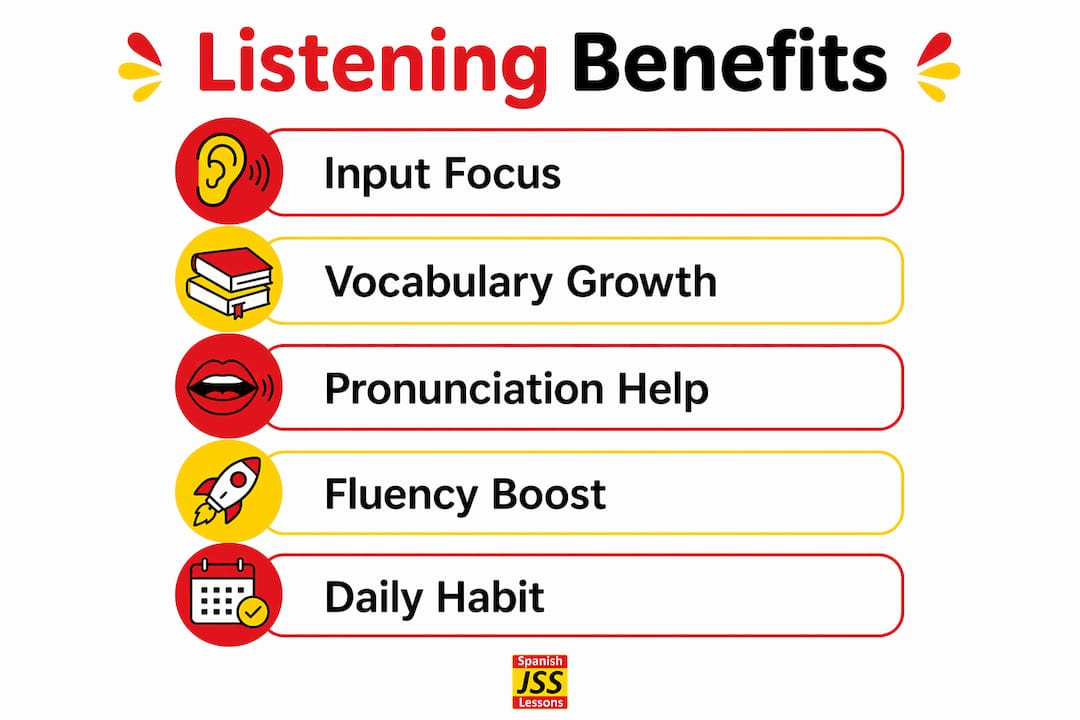
- It builds vocabulary, sharpens pronunciation, and accelerates spoken fluency, all at once.
- It is the most accessible skill to practise: no classroom, no partner, no pressure.
- Active listening is a demanding cognitive process, not passive background noise. The distinction matters enormously for how you approach your study time.
The term “ear-tuning” captures this well. It describes the deliberate, repeated exposure to authentic spoken language that moves you from merely hearing sounds to genuinely understanding meaning. That shift is where real language mastery begins.
1. Why listening should come first among all language skills
The human brain acquires language in a fixed sequence, and listening always leads. Children spend months absorbing spoken language before producing a single word. Adult learners who try to skip that stage and speak immediately tend to plateau quickly, because they are attempting output without sufficient input to draw from.
The research is clear on this point. Emphasising aural comprehension training in the early stages, while relaxing the pressure to speak immediately, produces better results than intensive oral practice from day one. Comprehension must precede reproduction. That is not a pedagogical preference; it reflects how the brain actually builds language competence.
There are several concrete reasons why listening deserves priority:
- It lays the blueprint for speaking. You cannot replicate pronunciation patterns, intonation, or natural rhythm unless you have heard them repeatedly first.
- It reduces anxiety. Listening asks nothing of you in terms of production. You absorb without performing, which keeps motivation high in the early weeks.
- It transfers to other skills. Studies show that promoting listening skills results in positive transfer to speaking, reading, and writing. The gains are not confined to comprehension alone.
- It aligns with Krashen’s Input Hypothesis. Stephen Krashen’s foundational theory holds that comprehensible input drives acquisition. Listening is the primary vehicle for that input.
- It builds confidence before social interaction. Adult learners who invest time in listening report feeling better prepared for real conversations, because they recognise speech patterns before they need to respond to them.
For adult learners in the UK who are learning Spanish for life in Spain, this is especially relevant. The machine-gun speed of native conversation is one of the biggest barriers. Tackling listening first, rather than last, is the practical solution.
2. How listening improves speaking, pronunciation, and vocabulary
Listening and speaking are not separate skills that develop in parallel. They are deeply intertwined, with listening doing most of the foundational work.

When you listen repeatedly to authentic spoken language, you internalise the rhythm, stress, and intonation of the target language without consciously studying any of it. Speaking well depends on listening well; pronunciation develops when learners absorb native rhythm and intonation through sustained auditory exposure. You begin to mimic patterns naturally, the same way a child picks up an accent from their environment rather than from a textbook.
The vocabulary gains are equally well documented. Research has identified a statistically meaningful positive correlation between listening proficiency and vocabulary size. Hearing words in context, with natural stress and collocations intact, embeds them far more durably than flashcard drilling.
“Listening is vital in the language classroom because it provides input for the learner. Without understanding input at the right level, any learning simply cannot begin. Listening is thus fundamental to speaking.”
— Rost (1994), cited in JALT Publications
The table below summarises how listening input contributes to each productive skill:
| Language skill | How listening supports it |
|---|---|
| Speaking | Internalises rhythm, intonation, and natural phrasing for spontaneous use |
| Pronunciation | Provides phonetic models that learners unconsciously replicate |
| Vocabulary | Embeds words in context, with collocations and stress patterns intact |
| Reading | Builds phonological awareness that supports word recognition on the page |
| Writing | Exposes learners to grammatical structures and natural sentence patterns |
Combining listening with reading amplifies these gains further. Reading while listening produces the greatest vocabulary gains of any single study mode, particularly for learners at lower proficiency levels who struggle to segment words from the speech stream on audio alone.
Pro Tip: When you encounter a new word in a listening session, do not pause to look it up immediately. Let context do the work first. Return to the word after the session and check it then. This trains your brain to tolerate ambiguity, a skill native speakers use constantly.
3. Practical reasons listening is the easiest skill to start with
Listening has a practical advantage that no other language skill can match: you can do it anywhere, at any time, with nothing more than a phone and a pair of earphones. There is no partner required, no performance anxiety, and no grammar exercise to complete. You simply listen.
For adult learners juggling work, family, and the demands of daily life, that accessibility is not a minor convenience. It is the difference between consistent practice and no practice at all. A twenty-minute commute, a walk, a lunch break: all of these become study sessions without any additional effort.
Here is why listening is the most learner-friendly skill to prioritise early:
- Low production pressure. You are receiving language, not producing it. That removes the fear of making mistakes in front of others, which is one of the most common barriers for adult learners.
- Flexible scheduling. Unlike speaking practice, which requires another person, or writing, which demands focused desk time, listening fits around your life.
- Exposure to varied accents and registers. Authentic audio materials, from recorded conversations to podcasts to news segments, introduce you to the full range of how a language is actually spoken. Approximately 90% of participants in one structured study reported that authentic materials were the most engaging and beneficial part of their listening activities.
- Gradual difficulty scaling. You can start with slow, clear speech and move progressively to faster, more colloquial material. The challenge grows with your ability.
- Repetition without embarrassment. You can replay the same audio ten times without anyone noticing. That repetition is exactly what the brain needs to consolidate new patterns.
Effective listening practice is not simply pressing play and hoping for the best, though. Research supports a three-phase approach: pre-listening activation, focused attention during the listening itself, and post-listening reflection. Preparing your brain for what it is about to hear, by thinking about the topic or predicting vocabulary, measurably improves comprehension. Reflecting afterwards on what you understood and what you missed reinforces retention.
Good teaching practices for listening consistently emphasise this structured approach over passive exposure. The difference between a learner who improves quickly and one who stagnates often comes down to whether they are listening with intent or simply filling time.
4. What recent research says about listening and adult language learning
The scientific case for prioritising listening has grown considerably stronger over the past decade. Studies now quantify benefits that language teachers have long observed anecdotally, and the numbers are persuasive.
A six-week structured listening programme produced a 25% improvement in listening comprehension scores among participants, alongside measurable gains in pronunciation and speaking confidence. That is a substantial return for a relatively short investment of focused effort. The same study found that a substantial proportion of participants reported feeling more effective and confident after dedicating specific time to listening practice.
“Listening is the Cinderella skill in second language learning. All too often, it has been overlooked by its elder sister: speaking.”
— David Nunan, Listening in Language Learning
The “Cinderella skill” framing captures something real. Listening is frequently the last thing language programmes address systematically, yet it is the first thing learners need. The cognitive demands involved are considerable: active mental decoding of phonemes, recognition of connected speech, segmentation of word boundaries, and simultaneous meaning construction. All of this happens in real time, under time pressure, with no opportunity to rewind the speaker.
The table below summarises key research outcomes relevant to adult learners:
| Study focus | Key finding | Source |
|---|---|---|
| Listening and vocabulary | Positive correlation between listening proficiency and vocabulary size | Ciencia y Reflexión |
| Structured listening programme | 25% improvement in comprehension over six weeks | AGHEL Journal |
| Learner confidence | 75% of learners reported greater confidence after dedicated listening practice | AGHEL Journal |
| Reading while listening | Greatest vocabulary gains compared to either mode alone | TESL Canada Journal |
| Bottom-up and top-down processing | Effective listening requires both phoneme decoding and contextual interpretation | JALT Publications |
Learners must develop both bottom-up and top-down listening skills to reach mastery. Bottom-up processing means decoding sounds accurately, recognising individual phonemes and word boundaries. Top-down processing means using context, topic knowledge, and situational clues to fill gaps and construct meaning. Neither alone is sufficient. A learner who only decodes sounds will struggle with fast, colloquial speech. One who only guesses from context will miss precision.
This is precisely why ear-tuning, as James Spanish School describes it, is not optional for adult learners of Spanish. Many learners can read Spanish reasonably well but freeze when a native speaker replies at full conversational speed. The gap between reading comprehension and listening comprehension is real, and it closes only through deliberate, repeated auditory exposure. James Spanish School’s 100-lesson course dedicates a substantial portion of its structure to this exact challenge, with ear-tuning lessons designed specifically to train adult ears for the pace and patterns of real spoken Spanish.
5. Strategies that genuinely develop your listening ability
Knowing that listening matters is one thing. Knowing how to practise it well is another. The strategies below are grounded in research and adapted for adult learners who want results without wasted effort.
Focus on comprehensible input, not difficulty. Material that is slightly above your current level, where you understand most but not all, produces the greatest acquisition gains. Listening to content that is entirely beyond you builds frustration, not fluency. Start with graded audio and move up gradually.
Use authentic materials as soon as you can tolerate them. Scripted audio teaches you idealised language. Authentic recordings, conversations between native speakers, radio programmes, podcasts, teach you how the language actually sounds. The gap between the two is where most learners get stuck. Exposure to authentic spoken Spanish from early in your learning closes that gap far faster than staying with scripted content indefinitely.
Practise selective listening. Do not try to understand every word. Native speakers do not process every word either; they extract meaning from key phrases, stress patterns, and context. Practising this selective approach reduces cognitive overload and builds the kind of flexible comprehension you need for real conversations.
Repeat the same audio multiple times with different goals. First listen for general meaning. Second listen for specific details. Third listen while reading a transcript if one is available. Each pass activates a different level of processing and deepens retention.
Address the fast-speech problem directly. Spanish in particular is spoken at a pace that catches most learners off guard. Understanding why Spanish listening is hard and training specifically for fast connected speech is a separate skill from understanding slow, clear audio. Both matter, but the fast-speech skill is what determines whether you can hold a real conversation.
Build a daily listening habit, however short. Consistency outperforms intensity. Twenty minutes every day produces better results than two hours once a week, because the brain consolidates language patterns during sleep and rest. Short, regular sessions keep the language active in your working memory.
Pro Tip: Pair your listening sessions with a brief written note afterwards: three words you heard clearly, one phrase you want to look up, and one thing you understood from context alone. This post-listening reflection, even done in thirty seconds, measurably improves retention over time.
Key takeaways
Listening is the foundational skill that drives vocabulary growth, pronunciation accuracy, and spoken fluency, and it remains the most accessible skill for adult learners to practise consistently.
| Point | Details |
|---|---|
| Listening comes first | Comprehension must precede production; promoting listening leads to gains in speaking, reading, and writing. |
| Vocabulary and listening are linked | Research records a positive correlation between listening proficiency and vocabulary size. |
| Structured practice delivers results | A six-week listening programme produced a 25% improvement in comprehension scores, and 75% of participants reported greater confidence after dedicating time to listening practice. |
| Authentic materials accelerate progress | Exposure to real spoken language trains learners for natural, unscripted conversation. |
| Ear-tuning is a learnable skill | Deliberate, repeated auditory exposure moves learners from hearing sounds to understanding meaning. |