James Spanish School

Categories
Insights

How to master Spanish pronunciation: a practical guide


TL;DR:

  • Mastering Spanish pronunciation emphasizes pure vowels, proper stress, and distinct ‘r’ sounds for clear understanding. Consistent practice with shadowing, recording, and accurate stress placement accelerates fluency, making everyday conversations more natural. Focus on vowels and stress rules first; perfecting ‘r’ and rhythm can follow gradually for effective communication.

Getting your Spanish pronunciation right is not just about sounding polished. It is about being understood. For English speakers learning European Spanish, the gap between how you think you sound and how natives actually hear you can be surprisingly wide. This guide tackles how to master Spanish pronunciation by breaking down the five areas that matter most: vowels, the famous rolling ‘r’, word stress, smart practice habits, and the most common errors English speakers make. Work through these systematically and everyday conversations with neighbours, shop staff, and health workers will feel dramatically more natural.

Table of Contents

Key takeaways

Point Details
Pure vowels are non-negotiable Spanish vowels never reduce or change quality, so practise each one in isolation before combining into syllables.
Tap and trill ‘r’ carry different meanings Confusing the single tap with the trilled ‘rr’ changes word meanings, so drill them separately first.
Stress rules are largely predictable Learn three simple rules for word endings and you will place stress correctly in the vast majority of Spanish words.
Shadowing builds natural rhythm Imitating native audio almost simultaneously trains your mouth, ear, and brain to work together.
Mindful daily practice beats marathon sessions Short, focused drills repeated consistently do more for pronunciation than occasional long study blocks.

How to master Spanish pronunciation: start with vowels

If there is one thing that separates an authentic Spanish accent from an English-tinged one, it is the vowels. Spanish vowels are pure and do not diphthongise or reduce the way English vowels do. In English, the letter ‘a’ in an unstressed syllable often becomes a soft, lazy “uh” sound (the schwa). In Spanish, that same ‘a’ stays crisp and clean no matter where it appears in the word.

There are exactly five vowel sounds to learn: a, e, i, o, u. Each one has a single, fixed quality.

  • A sounds like the ‘a’ in “father”. Mouth open, tongue flat.
  • E sounds like the ‘e’ in “bed”, but slightly more closed. Lips slightly spread.
  • I sounds like the ‘ee’ in “feet”, but shorter. Corners of lips pulled back.
  • O sounds like the ‘o’ in “more”, but rounder and more forward. Lips form a circle.
  • U sounds like the ‘oo’ in “moon”, but tighter. Lips push forward into a small circle.

The key physical discipline here is consistency. Explicit training is needed to maintain full vowel quality regardless of stress position, because English-speaking brains are wired to reduce unstressed vowels automatically. You have to consciously override that habit.

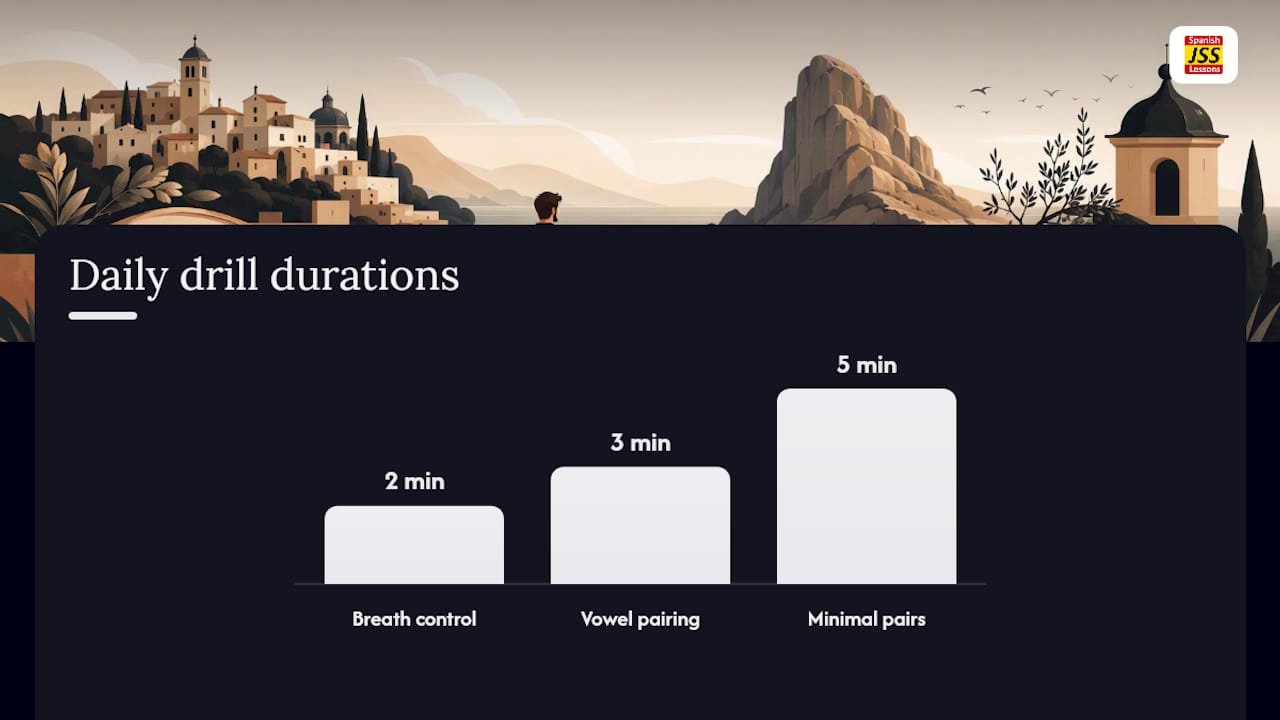
Start by drilling each vowel in isolation: say a ten times slowly, focusing on mouth shape. Then move to syllable combinations: ba, be, bi, bo, bu. Then try minimal pairs where a vowel change changes the meaning, such as pero (but) versus puro (pure).

Pro Tip: Record yourself saying a string of five pure vowels back to back: “a, e, i, o, u”. Play it back and compare with a native speaker recording. If any vowel sounds “woolly” or shifts in quality, that is your schwa habit showing up. Isolate and repeat until all five sound equally crisp.

Mastering the Spanish ‘r’ sounds

The Spanish ‘r’ causes more anxiety among English learners than almost any other sound. The good news is that there are really only two sounds to master, and they follow clear rules. There are two distinct Spanish ‘r’ sounds: the tap (a single ‘r’ in the middle of a word) and the trill (‘rr’ or any ‘r’ at the start of a word).

Man practicing Spanish r sound in living room

The tap is actually easier than most learners expect. It is the same quick flick of the tongue that many British English speakers use for the ‘t’ in “butter” or “water” in casual speech. The tongue tip touches the ridge just behind your upper teeth for a fraction of a second and bounces away. Think pero (but): one soft, quick tap.

The trill is a different matter. It requires the tongue tip to vibrate rapidly against that same ridge while a stream of air passes through. The word perro (dog) uses the trill, and getting it wrong would leave listeners confused about whether you mean “but” or “dog”.

Here is a step-by-step approach that works:

  1. Relax your tongue completely. Tension is the enemy of the trill. Let your tongue sit loosely in your mouth.
  2. Start with a ‘d’ or ‘t’ position. Place your tongue tip on the ridge behind your upper teeth.
  3. Blow a steady stream of air. Do not force it. Think of the sound a purring cat makes, aimed forward through the tongue tip.
  4. Try the word drr. English speakers often find the trill emerges naturally when preceded by a ‘d’ sound. Use this as a launching pad.
  5. Practise minimal pairs daily. Drill caro (expensive) versus carro (cart) until the difference feels automatic.

Pro Tip: If the trill simply will not come, try lying on your back and relaxing your jaw completely before attempting it. Gravity helps release the tongue tension that blocks most learners.

Rolling every ‘r’ sound is a very common learner error that actually removes the meaning contrast between tap and trill. Drill each sound separately before you attempt conversational use. The phonemic contrast between tap and trill is meaning-bearing, so treating them as interchangeable will genuinely confuse native speakers.

Spanish word stress and intonation

Get word stress wrong in Spanish and even perfectly pronounced individual sounds will not save you. Misplaced stress makes words harder to recognise for native listeners, even when every consonant and vowel is correct. The good news is that Spanish stress follows predictable rules based on word endings.

The three rules break down like this:

  • Words ending in a vowel, ‘n’, or ‘s’ are stressed on the second-to-last syllable. Example: ha-BLO, ca-SA, co-MEN.
  • Words ending in any other consonant are stressed on the last syllable. Example: ha-BLAR, pa-RED, es-PA-ñol.
  • Any word with a written accent ignores both rules and is stressed on the accented syllable. Example: ca-FÉ, MÚ-si-ca, ta-xi-STÁS.
Word ending Stress rule Example
Vowel, n, or s Second-to-last syllable hablan (HA-blan)
Other consonant Last syllable hablar (ha-BLAR)
Written accent Accented syllable café (ca-FÉ)

Beyond individual word stress, European Spanish has a fairly level intonation pattern compared to British English. Statements tend to start mid-pitch and fall gently at the end. Questions in Spanish often rise at the end, but not as dramatically as in English. One practical exercise is to listen to short clips of native Spanish speech (Spanish radio or television news works well) and hum along to the melody without worrying about the words. This trains your ear and your voice to match the natural rhythm of the language.

Understanding rhythm matters as much as individual sounds. For a deeper look at why fast native speech feels overwhelming and how to work with it, this guide on fast Spanish explains the patterns that trip up most English speakers.

Effective practice techniques

Knowing the rules is one thing. Getting your mouth to follow them automatically is another. These techniques move pronunciation knowledge from your head into your muscle memory.

  1. Shadowing. This is the single most effective pronunciation technique available to independent learners. Shadowing involves imitating native audio almost simultaneously to build mouth, ear, and brain coordination. Choose a short clip of native Spanish (ten to fifteen seconds), listen once, then play it again and speak along at the same pace. You are not translating. You are copying rhythm, pitch, and sound in real time. Do this for ten minutes daily and your intonation will shift noticeably within weeks.
  2. Record and compare. Most learners are shocked the first time they hear a recording of their own Spanish. Use WordAmigo to record yourself reading a short paragraph aloud, then listen to a native speaker read the same text. Compare the two honestly. Note where your vowels drift, where your stress lands in the wrong place, and how your rhythm differs.
  3. Use pronunciation feedback tools. WordAmigo is by far the best tool for this. It provides instant feedback by listening to your spoken Spanish and identifying errors.
  4. Read aloud daily. Take any short Spanish text, a recipe, a news headline, a shop sign, and read it aloud slowly with deliberate attention to vowel purity and stress placement. Five minutes of this each morning builds habits faster than you might expect.

Pro Tip: When shadowing, slow the audio down to 75% speed using a podcast app or YouTube’s playback settings. This gives you time to match sounds accurately before building back up to full speed. It is far more effective than struggling at full pace from the start.

The role of regular, structured feedback in accelerating progress is something many learners underestimate. Feedback accelerates Spanish fluency in ways that solo practice simply cannot replicate, particularly for catching errors you have normalised.

Infographic showing five steps to Spanish pronunciation mastery

Common Spanish pronunciation mistakes

Understanding where English speakers typically go wrong is half the battle. Here are the most frequent errors and how to correct them:

  • Schwa substitution. Most English speakers unconsciously apply English vowel reduction, turning unstressed Spanish vowels into a soft “uh”. The word problema becomes something like “pruh-BLEH-muh” instead of “pro-BLE-ma”. The fix is deliberate vowel drilling until clean vowels feel natural in unstressed positions.
  • Over-rolling every ‘r’. Rolling all ‘r’ sounds when only ‘rr’ and initial ‘r’ require a trill is extremely common. It sounds theatrical to native ears and, more seriously, it removes the meaningful contrast between words like caro and carro.
  • Adding English diphthongs. English speakers tend to turn the Spanish ‘o’ into a two-part “oh-oo” glide, as in the English word “go”. Spanish ‘o’ is a single, steady sound. Train yourself to stop the vowel before it glides.
  • Incorrect stress placement. When unsure, English speakers often default to stressing the first syllable, which is the most common stress position in English. In Spanish, most words stress the second-to-last syllable. Applying the three stress rules above eliminates most of these errors quickly.
  • Ignoring written accents as stress guides. Many beginners treat written accents as decorative. They are not. They are explicit pronunciation instructions. When you see an accent mark, that syllable takes the stress, full stop.

The fastest way to self-correct is a combination of visual and audio feedback. Record yourself, compare to a native model, and note the specific pattern of error rather than just “I sound wrong”. Precision in identifying the mistake leads to precision in correcting it. For a broader look at how listening difficulties connect to pronunciation habits, Spanish listening challenges are often the flip side of the same coin.

My honest take after 25  years teaching in Spain

I have worked with hundreds of English-speaking adults who arrived in Spain with textbook Spanish and were genuinely baffled when locals struggled to understand them. The culprit, almost every single time, was vowels. Not the ‘r’. Not the accent. The vowels.

In my experience, the moment a learner genuinely commits to pure vowels, their Spanish clarity improves more in two weeks than it did in the previous two months. It is not glamorous work. It feels almost too simple. But the results are undeniable.

What surprised me most over the years is how much rhythm matters relative to individual sounds. A learner with slightly imperfect consonants but correct stress and clean vowels is almost always understood. A learner with perfect consonants but wrong stress or wobbly vowels often is not. The melody of the language carries more meaning than most learners realise.

The ‘r’ is worth practising, certainly. But I would not let frustration with the trill stall your overall progress. Start with vowels, then stress, then the ‘r’. In that order. That sequence, in my 40 years of experience, delivers results faster than any other approach I have seen.

Persistence matters more than perfection. Every week of honest practice brings you closer to the moment a Spanish neighbour stops and says “you speak well”. That moment is worth everything.

— James

Take your pronunciation further with James Spanish School

If this guide has highlighted how much precision goes into speaking Spanish clearly, the structured lessons at James Spanish School are built to take you the rest of the way. James Bretherton’s 100-lesson course includes dedicated ear-tuning modules and audio-led pronunciation drills designed specifically for English-speaking adults living in or moving to Spain.

https://jamesspanishschool.com

The WordAmigo system within the course uses AI-powered strategic repetition to permanently embed both vocabulary and correct pronunciation, so words stay in memory and come out sounding right. Everything is available on demand, on any device, with no expiry date. You can explore the full range of pronunciation and audio lessons in the James Spanish School shop, or browse the complete starter course options to find the right starting point. Real conversations with real Spanish people, that is the goal.

FAQ

What are the hardest sounds for English speakers in Spanish?

The trilled ‘rr’ and pure vowel sounds are typically the greatest challenges. English speakers naturally reduce unstressed vowels to a schwa sound, which does not exist in Spanish.

How long does it take to improve Spanish pronunciation noticeably?

Most learners notice a clear improvement within two to four weeks of daily, focused practice on vowels and word stress. Consistent short sessions produce faster results than occasional longer ones.

What is the best way to practise Spanish pronunciation at home?

Use WordAmigo to shadow native audio is one of the most effective home practice methods. Combine it with daily reading aloud and a pronunciation feedback tool to accelerate self-correction.

Does incorrect word stress really affect understanding?

Yes, significantly. Misplaced stress affects intelligibility even when individual sounds are correct, because native listeners rely heavily on stress patterns to recognise words in fast speech.

Do I need a perfect accent to communicate in everyday Spanish?

No. Clean vowels, correct stress placement, and the basic ‘r’ distinction are sufficient for clear communication in most everyday situations. Perfection is not the goal. Being understood confidently is.

Categories
Insights

What is native-like Spanish listening?


TL;DR:

  • Native-like Spanish listening involves understanding fast, natural speech through rhythm and overall meaning rather than decoding every word.
  • Practicing shadowing, targeting 70–80% comprehension, and exposing yourself to regional accents accelerates progress effectively.

You live in Spain. You study Spanish. You can read a menu, follow a classroom dialogue, even hold a polite exchange at the panadería. Then a neighbour starts chatting at full speed and your brain shuts down. What is native-like Spanish listening, really, and why does it feel so different from anything you practised before? The honest answer is that it is not about catching every word. It is about training your ear to process the rhythm, blending, and pace of real speech until meaning lands without conscious decoding. That shift in understanding changes everything.

Table of Contents

Key takeaways

Point Details
Speed is genuinely faster Native Spanish runs at roughly 7.82 syllables per second, well above English, so blending is not a flaw in your listening.
Perfect word recall is the wrong goal Aiming for global comprehension, not word-for-word accuracy, reduces panic and improves understanding.
The 70–80% zone is your training sweet spot Materials at this comprehension level challenge without overwhelming and accelerate real progress.
Shadowing rewires your ear Repeating speech simultaneously trains rhythm and intonation far more effectively than passive listening alone.
Daily short sessions beat occasional marathons Consistent brief practice builds the auditory muscle memory that native-like listening depends on.

What native-like Spanish listening actually means

Before you can improve your Spanish listening skills, you need to understand what distinguishes native comprehension from classroom comprehension. They are genuinely different things.

The most striking difference is speed. Native Spanish speakers produce around 7.82 syllables per second, compared with English at 6.19. That gap sounds modest until you experience it in real conversation. It translates to words arriving before your brain has finished processing the previous ones.

Infographic comparing Spanish and English speaking speeds

Spanish is also a syllable-timed language, which means each syllable carries roughly equal weight and duration. English, by contrast, is stress-timed, with some syllables stretched and others swallowed. When you hear Spanish at full pace, the even rhythm creates the impression of machine-gun delivery, a continuous stream with no obvious breathing space between words.

Then there is connected speech. In natural conversation, native speakers do not pronounce each word as a separate unit. Words blend at their boundaries. ¿Cómo estás? does not arrive as three distinct words. It arrives as something closer to comoestás, a single flowing sound. Understanding native Spanish means recognising those blended patterns rather than searching for textbook pronunciation.

Several other features shape native-like listening comprehension in Spanish:

  • Content words carry the message. Skilled listeners focus on nouns, verbs, and key adjectives rather than tracking every article, preposition, and conjunction. Function words often blur and disappear at speed.
  • Intonation signals intent. A question, a command, and a statement can use nearly the same words. Native comprehension relies heavily on pitch contours and stress patterns to distinguish them.
  • Regional variation is real and significant. Accents across Spain differ considerably. Castilian, Andalusian, and Canarian Spanish sound markedly different, and even native speakers from one region occasionally struggle to follow another. If you have only practised one accent, you have only half the picture.

Developing native-like listening comprehension in Spanish is not about decoding perfection. It is about building a mental model of Spanish rhythm, sound patterns, and likely meaning so that your brain fills gaps automatically, just as a native speaker’s does.

Common challenges for English-speaking adults in Spain

Living in Spain gives you extraordinary exposure to real Spanish. It also means the gaps in your listening skills become apparent very quickly. Here are the obstacles that come up most often.

Speed and blending are the primary culprits. When words run together at pace, learners who were taught to listen for distinct words simply cannot keep up. The problem is not intelligence or effort. It is that the training method did not match the reality.

Regional accents multiply the difficulty. An English speaker who has learned largely neutral Castilian Spanish may find Andalusian speech almost incomprehensible at first. Dropped consonants, merged vowels, and regional vocabulary all require separate exposure to understand fully.

Man listens to Spanish in café

Native speakers do not naturally adjust their pace. Unlike a teacher, your neighbour, the plumber, or the woman at the health centre is not thinking about your comprehension. They speak at the speed that feels normal to them. Asking for clarification is entirely acceptable, and most Spanish people respond warmly to a polite request to repeat something, but you cannot ask every few seconds without the conversation collapsing.

The panic response is real and self-reinforcing. When you miss a phrase, anxiety spikes. That anxiety consumes cognitive resources you needed for the next phrase, and suddenly you have missed two sentences. Many learners recognise this pattern immediately.

The wrong definition of success creates unnecessary pressure. If you believe native-like Spanish listening means understanding every syllable, you will feel like a failure in almost every real conversation. Releasing that standard is not giving up. It is adopting the same approach a native listener actually uses.

Pro Tip: When you lose the thread in a real conversation, resist the urge to backtrack mentally. Keep listening forward. Global meaning accumulates across a whole exchange, not sentence by sentence.

Effective techniques for developing native-like listening

The good news is that Spanish listening skills are trainable through specific techniques. Here are the methods that produce the fastest, most durable results.

  1. Shadowing. This is the single most powerful technique for developing native-like listening comprehension. You listen to a native speaker and repeat what you hear simultaneously, not after. Shadowing activates listening, speaking, breathing, and articulation at the same time, which creates stronger memory traces than passive listening alone. The goal is not to produce perfect pronunciation. The goal is to lock in the rhythm, pace, and intonation patterns of real Spanish so your ear begins to anticipate them automatically.
  2. Gist listening before detail listening. Approach any new audio by listening first for the overall topic and general meaning, with no pressure to catch specifics. On a second pass, listen for particular details. This replicates how native listeners actually process speech and prevents the panic that comes from chasing every word on first exposure.
  3. Targeting the 70–80% comprehension zone. The ideal training window sits at roughly 70 to 80 per cent comprehension. Too easy (above 95 per cent) and your brain is not being challenged to fill gaps or process speed. Too hard (below 60 per cent) and frustration overtakes learning. Selecting material at this level keeps the brain alert and builds resilience efficiently.
  4. Exposing yourself to varied regional accents. Broad accent exposure prevents the brittle comprehension that collapses the moment you encounter an Andalusian speaker after only practising Castilian. Include podcasts, radio programmes, and television from different Spanish regions in your listening diet.
  5. Combining passive and active listening. Passive and active listening together build different parts of your comprehension system. Passive exposure, such as background radio while cooking, familiarises your ear with natural rhythm and register. Active practice, such as dictation and shadowing, builds precision and processing speed.
  6. Using social repair phrases in real conversations. Phrases like ¿Puedes repetirlo, por favor? or No te he entendido bien are not admissions of failure. They are the tools that keep conversation going while your skills are still developing. Native speakers use them too.

Pro Tip: Record yourself shadowing a 30-second native audio clip. Play both back together. The mismatch between your rhythm and the speaker’s rhythm will show you exactly where your ear is still behind, which is far more informative than a grammar exercise.

Applying native-like listening in daily life in Spain

Theory matters far less than what you actually do on Tuesday morning when the gas engineer arrives and starts explaining a fault at full conversational speed. Translating listening skills into real integration requires a practical mindset and consistent habits.

Consider building these practices into your daily routine:

  • Short daily sessions of ten to fifteen minutes produce better long-term results than occasional long practice sessions. Consistency is what builds the auditory muscle memory that native-like listening depends on.
  • Use conversations with your neighbours, shopkeepers, and tradespeople as training, not tests. Remove the internal grading and treat each exchange as exposure. The more volume you accumulate, the faster your processing speed develops.
  • Build a toolkit of conversational repair phrases and use them without embarrassment. Managing comprehension gaps gracefully is a skill in itself. Spanish speakers genuinely appreciate the effort you are making and will almost always adjust or repeat when asked politely.
  • Track your progress by revisiting audio you found difficult. A podcast that was largely incomprehensible three months ago may now feel manageable. That shift is real evidence of growth, and noticing it matters for motivation.
  • Gradually widen the range of speakers you listen to. Start with clear, slower speakers and progressively include faster ones, regional accents, informal registers, and background noise. Each new layer strengthens the whole system.

The mental shift that makes the biggest difference is accepting that understanding the shape and intent of a conversation is a genuine success. You do not need the exact words to know whether your neighbour is complaining about the council, recommending a restaurant, or asking a favour.

Listening skill stages and realistic progression targets

Understanding where you are helps you choose the right material and set goals that actually motivate rather than deflate.

Stage Comprehension target What to focus on Indicator of progress
Beginner 40–60% Familiar topics, slow delivery, clear speakers Recognising repeated words and phrases
Intermediate 60–80% Natural pace, varied topics, graded podcasts Following the gist without losing the thread
Upper-intermediate 75–90% Regional accents, informal registers, fast speech Catching main points and most detail
Near-native 90–95% Unscripted conversation, background noise, multiple speakers Rarely needing clarification in daily exchanges

The optimal challenge window sits at 70 to 80 per cent comprehension across most of the intermediate and upper-intermediate range. Aiming for perfect understanding at any stage other than near-native is counterproductive. It signals your materials are too easy, not that you are succeeding.

One insight worth holding onto: communication effectiveness matters far more than sounding or processing exactly like a native speaker. Integration into daily life in Spain does not require a perfect score. It requires confident, functional comprehension in the situations that actually arise. That is an achievable target with consistent, well-directed effort.

My honest perspective on this

After 40 years in Spain, I have watched hundreds of English-speaking adults go through the same cycle. They study hard, they feel confident reading Spanish, and then a real conversation floors them. The frustration is genuine, and I have a lot of empathy for it.

Here is what I have come to believe: the biggest obstacle is not speed, and it is not accents. It is the expectation that listening should feel like reading. In reading, you control the pace. In listening, the language comes at you on its own terms. The moment you stop trying to catch every word and start riding the rhythm, something shifts. I have seen it happen in lesson after lesson.

The learners who progress fastest are the ones who accept early that fast spoken Spanish is a different skill from textbook Spanish, and who treat every real conversation as practice rather than performance. They ask for repetition without shame. They listen to the radio even when they only catch half of it. They shadow speakers who are too fast for them, because that discomfort is exactly where the growth is.

Native-like is a useful direction, not a rigid destination. Get good enough that your neighbours feel comfortable talking to you naturally, and you are already where you need to be.

— James

How Jamesspanishschool can help you get there

If you recognise the frustration described in this article, Jamesspanishschool has built its entire programme around solving it. The 100-lesson course from James Spanish School is split between sentence building and dedicated ear-tuning sessions designed specifically to train your comprehension of fast, natural Spanish. There are no grammar terms to memorise and no countdown clocks to stress you out.

https://jamesspanishschool.com

The WordAmigo system handles vocabulary and pronunciation retention through a five-step loop covering reading, listening, speaking, and writing. Everything is available on demand, 24/7, on any device. Whether you want to follow your doctor, chat with your neighbour, or simply stop dreading the phone ringing in Spanish, the course meets you where you are. Explore the current course options and find the right starting point for your level.

FAQ

What is native-like Spanish listening?

Native-like Spanish listening means understanding fast, naturally spoken Spanish through rhythm and global meaning rather than word-for-word decoding. It involves processing blended speech, regional accents, and intonation patterns the way a native speaker does.

Why do native Spanish speakers sound so fast?

Native Spanish runs at approximately 7.82 syllables per second, faster than English at 6.19. Combined with syllable-timed rhythm and connected speech blending, this creates the impression of machine-gun delivery to untrained ears.

How much Spanish do I need to understand to hold a real conversation?

Functional daily conversation in Spain is achievable at around 75 to 80 per cent comprehension, provided you use social repair strategies such as asking for repetition when needed. Perfect understanding is not required.

Does shadowing really improve listening comprehension?

Yes. Shadowing trains rhythm, intonation, and connected speech recognition simultaneously by engaging listening, speaking, and articulation at the same time. Research consistently shows it produces stronger auditory processing than passive listening alone.

How long does it take to develop native-like Spanish listening skills?

Progress depends on daily consistency and material quality. Short sessions of ten to fifteen minutes practised daily produce faster and more durable gains than occasional longer sessions, with noticeable improvement in real conversations typically appearing within a few months of consistent, targeted practice.

Categories
Insights

How to sound like a native Spanish speaker


TL;DR:

  • Mastering European Spanish pronunciation involves understanding the language’s syllable-timed rhythm, five pure vowels, and pitch patterns. Effective practice includes shadowing, native media exposure, and self-recording to develop natural intonation and avoid fossilized errors. Consistent, focused effort over several months, supported by expert guidance, accelerates achieving native-like fluency.

You know the vocabulary. You have studied the grammar. Yet the moment a Spaniard replies at full speed, your carefully prepared phrases dissolve into confusion. Knowing how to sound like a native Spanish speaker is a different skill from knowing the language on paper, and it is one that most learners never deliberately practise. This guide focuses on European Spanish specifically, covering the vowel sounds, stress patterns, intonation, and rhythm that separate a textbook student from someone who genuinely fits in at a Madrid bar or a Seville market. Every technique here is practical, actionable, and built for adult English speakers.

Table of Contents

Key Takeaways

Point Details
Master stress rules Most European Spanish words stress the penultimate syllable unless marked otherwise, which helps you sound natural.
Practice with shadowing Repeating native speech daily using shadowing trains your brain for native rhythm and intonation.
Focus on unique sounds Castilian Spanish features distinct sounds like the rolled r and the ‘th’ (theta) sound requiring dedicated practice.
Record and compare Regularly recording your speech and comparing it with natives helps identify and correct pronunciation issues.
Use filler words Incorporating filler words like ‘pues’ and ‘vale’ enhances naturalness and fluency in conversation.

Understanding the foundation: European Spanish sounds and stress

Let’s begin by understanding the sounds and stress patterns that form the foundation of European Spanish pronunciation, because this is where most learners go wrong before they even open their mouths.

English is a stress-timed language, meaning stressed syllables arrive at roughly regular intervals and unstressed syllables get squashed in between. Spanish is syllable-timed. Every syllable gets roughly equal weight. When you carry English timing into Spanish, the result sounds immediately foreign, no matter how accurate your vocabulary is.

Infographic comparing Spanish and English stress patterns

The five pure vowels

Spanish has just five vowel sounds: /a/, /e/, /i/, /o/, and /u/. Each one is short, clean, and consistent. English, by contrast, has around 20 vowel sounds and we naturally stretch and slide between them. The word “no” in English slides from /n/ toward a /w/. In Spanish, the “o” in no is a single, held note. Train yourself to cut vowels cleanly and you will instantly sound more Spanish.

  • /a/ as in casa: open, front of the mouth, never the English “ay”
  • /e/ as in mesa: mid-tongue, lips slightly spread, never the English “ee”
  • /i/ as in : shorter and sharper than the English “ee”
  • /o/ as in poco: rounder than English, no glide toward /w/
  • /u/ as in : tight and rounded, no glide toward /w/

Stress and accent marks

In European Spanish, stress falls on the penultimate syllable for 80 to 90% of words ending in a vowel, -n or -s, with written accent marks overriding that rule for exceptions. So hablan is stressed on the first syllable (HAB-lan), while hablé carries an accent to signal the final syllable is stressed instead.

Sound Example word English equivalent
Pure /a/ hablar Shorter than “father”
Castilian /θ/ (th) cerveza, zapato Same as “think”
Rolled /r/ (rr) perro No English equivalent
Single tap /r/ pero American “butter” (flap t)
Guttural /x/ (j/g) jefe, gente Scots “loch”

Intonation basics

Declarative sentences in European Spanish fall in pitch at the end. Questions rise. This sounds obvious, but English speakers habitually end statements with a slight rise, which in Spanish makes everything sound like a question. That habit needs active correction from day one.

Pro Tip: Record one sentence in English and one in Spanish and compare the pitch at the end. You will hear your English habit immediately. Catching it is the first step to fixing it.

Mastering these phonological building blocks is essential. If you want to understand more about why Spanish accent differences trip up English learners even at an intermediate level, it is worth exploring how perception and production are connected.

Gathering your tools: resources and techniques for practice

With the basics understood, you need the right methods and resources to start practising effectively. Three tools dominate the field for good reason: shadowing, native media exposure, and self-recording.

Shadowing is the practice of repeating native speech immediately as you hear it, milliseconds behind the speaker, matching their rhythm, speed, and intonation. It is physically demanding at first. Your mouth simply is not trained for Spanish sounds, and the effort shows. That is exactly the point.

Why native media matters

Passive exposure to authentic spoken Spanish, through films, radio, and podcasts, trains your ear to accept the sounds as normal before your mouth attempts them. The ear comes first. Daily 30 to 60 minutes of shadowing combined with native media exposure over 3 to 6 months yields native-like rhythm in syllable-timed Spanish.

Self-recording is non-negotiable. Most people hate hearing their own voice. Do it anyway. Your brain corrects errors automatically when you speak, so you rarely notice them in the moment. A recording does not lie.

Method Pros Cons Best for
Shadowing Builds rhythm, intonation, and speed simultaneously Tiring; errors can fossilise without transcripts Active practice sessions
Native media Natural exposure; improves ear-tuning Passive; easy to zone out Background listening
Self-recording Reveals real errors; tracks progress Requires courage and consistency Weekly review sessions
Dictation Sharpens listening and spelling Slow; does not train speaking directly Vocabulary and ear work

Getting started: a simple setup

  1. Choose a native Spanish podcast or YouTube channel aimed at Spaniards, not learners.
  2. Download or print the transcript if one is available.
  3. Listen once without stopping to absorb the overall rhythm.
  4. Shadow a single paragraph, reading the transcript simultaneously.
  5. Record your attempt and play it back against the original.

Accessing authentic spoken Spanish materials built for real-life conversations rather than classroom Spanish makes a significant difference at this stage.

Pro Tip: Commit to one short clip of two to three minutes rather than attempting long sessions. Intensity beats duration. Five focused minutes of shadowing outperforms an hour of half-hearted listening.

Consistent practice also requires the right outlets. Exploring structured approaches to practising Spanish conversation will help you convert drill skills into real dialogue.

Executing the practice: step-by-step pronunciation and intonation drills

Now that you have the right tools, let’s apply them through specific pronunciation and intonation exercises targeting the sounds that genuinely separate European Spanish from everything else.

Drilling the hard sounds

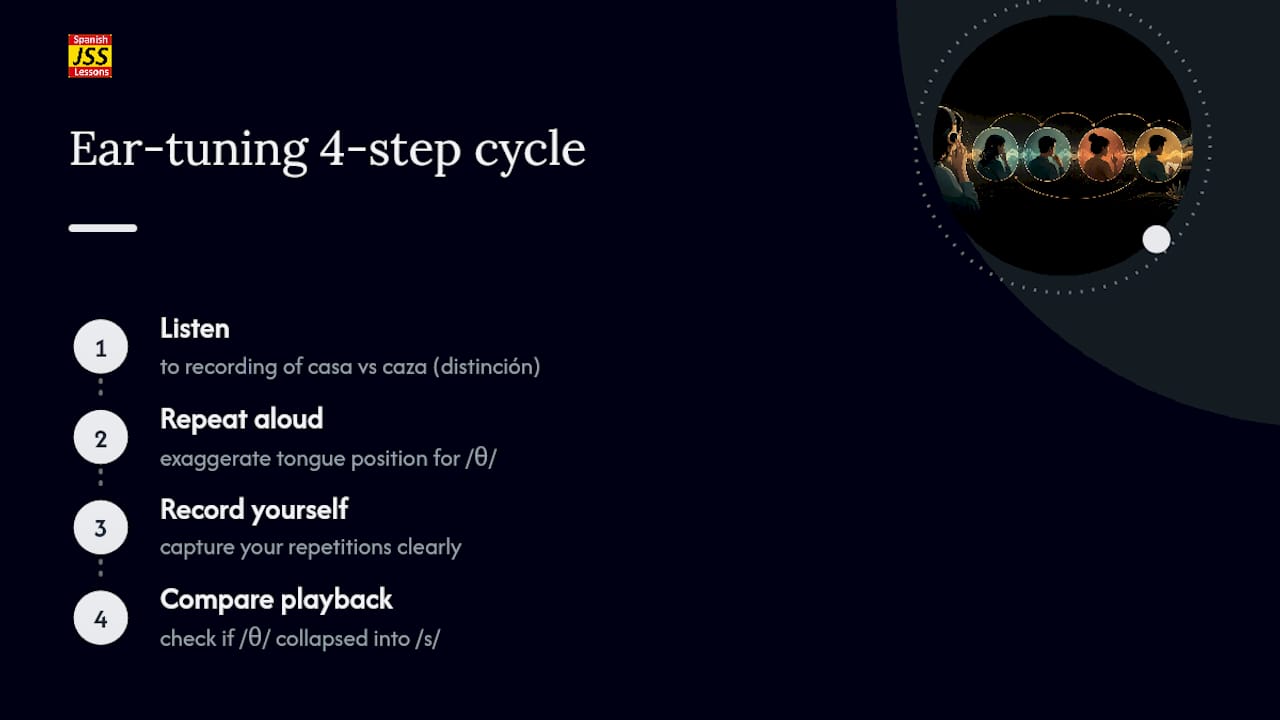
The Castilian theta requires 20 to 30 minutes of daily tongue practice to become automatic. This is the “th” sound you produce in English with “think” or “thumb,” applied to the letters c (before e or i) and z. Words like cerveza, ciudad, and zapato all carry this sound in Castilian Spanish. Say “this” then “think” out loud and notice the tongue position. Hold it there and practise gracias, Barcelona, hacer.

Man practicing Castilian Spanish pronunciation alone

The rolled rr is a trill produced by rapid tongue-tip vibrations against the alveolar ridge (the bony shelf just behind your upper front teeth). Practise the sound “dr” as in “dream” and then replace the “d” with a sustained tongue flutter. It takes weeks. Expect that and keep going.

Step-by-step shadowing routine

  1. Read the transcript silently first and make sure you understand every word.
  2. Listen to the clip at 50% speed (most podcast apps allow this) and shadow aloud.
  3. Increase to 75% speed once the shapes of the sounds feel natural.
  4. Move to full speed and shadow without looking at the transcript.
  5. Record the full-speed attempt and compare it directly with the original.

Stress placement exercise

Take any word and divide it into syllables: ha-blar, ca-mi-nar, a-bri-go. Mark the stressed syllable with a capital letter: ha-BLAR, ca-mi-NAR, A-bri-go. Read the word aloud, exaggerating the stressed syllable slightly. Do ten new words every day.

Natural filler words

Native speakers use filler words constantly: pues (well/so), vale (okay), o sea (I mean), venga (come on/alright). Using them at natural pause points buys thinking time and makes your speech sound far less stilted. They signal to your conversation partner that you are a real participant, not a learner reading from a script.

Pro Tip: Exaggerate your falling intonation in statements until it feels theatrical. Your brain will overcorrect and land somewhere closer to native pitch than your default English pattern.

Building these skills into genuine conversation takes support. Structured guidance on reinforcing conversational Spanish skills helps you transfer drill-room progress into real dialogue with real people.

Common pitfalls and how to avoid them on your path to sounding native

Having drilled effectively, it is important to recognise and overcome the key obstacles that could block your progress.

The transcript trap

Jumping straight into shadowing without reading the transcript first is the single most common mistake. When you mimic sounds you do not fully understand, errors embed themselves deep into muscle memory. Those errors are called fossilised mistakes, and they are genuinely difficult to undo once set.

  • Always read and understand the transcript before shadowing.
  • Look up every word you are unsure about.
  • Only then listen and shadow.

English intonation carryover

English rising intonation in statements is deeply wired. It signals uncertainty or friendliness in English. In Spanish it signals a question. Skipping transcripts during shadowing leads to fossilised errors; recording yourself weekly and comparing to native speakers is the most reliable way to catch persistent English intonation habits.

“Most learners plateau not because they lack ability but because they never systematically compare their output to native speech. Weekly recording reviews accelerate improvement faster than any other single habit.” — James Bretherton, James Spanish School

Vowel purity drift

Even learners who nail the vowels in isolation drift back to English vowel shapes when speaking at speed. Slow down. Accuracy at 70% speed beats inaccuracy at full speed. Build speed gradually once the vowel shapes are automatic.

  • Record yourself once a week.
  • Listen specifically for vowel slides and intonation rises at sentence ends.
  • Mark the errors and target them in the next session.

Recognising the broader common Spanish listening challenges helps you understand why certain sounds are hard to hear as well as produce.

Measuring your progress and achieving natural fluency

Finally, let’s explore how you can actively measure your improvement and maintain motivation on your journey toward mastering Spanish sounds.

Progress in accent work is invisible day to day. You will not notice small improvements as they happen. Structured measurement solves that problem.

A simple weekly review routine

  1. Record yourself speaking for two minutes on any topic in Spanish.
  2. Play it back alongside a two-minute native clip on a similar topic.
  3. Note three specific differences: pitch at sentence end, vowel clarity, and stress placement.
  4. Target those three points in the following week’s practice.
  5. Keep all recordings so you can compare yourself now to yourself six weeks ago.

Milestone targets by month

Aiming at vague fluency is discouraging. Set specific, observable targets instead.

  • Month one: all five vowels consistently pure in slow speech
  • Month two: stress placement automatic in familiar vocabulary
  • Month three: rolled rr present in at least 50% of attempts
  • Month four: falling intonation consistent in statements
  • Month five: shadowing at full native speed without transcript
  • Month six: native speakers comment positively on your accent

The neuroscience behind why this works

Humans unconsciously converge accents via mirror neurons activated when mimicking native speakers, which explains why consistent shadowing builds native intonation naturally within 4 to 8 weeks. This is not motivational language. It is how auditory-motor learning actually functions. Your brain is physically rewiring itself every time you shadow correctly.

Accessing authentic Spanish speech examples aligned to real-life situations gives your mirror neurons exactly the input they need.

Pro Tip: Celebrate the small wins openly. Tell someone when you nailed the rolled rr for the first time. Positive reinforcement is not indulgent, it is neurologically useful. It keeps you returning to practice when progress feels slow.

Why conventional wisdom on Spanish pronunciation often misses the mark

Most pronunciation advice focuses almost entirely on individual sounds. Get the rr right. Learn the Castilian theta. These matter, but they are not what actually makes the difference between sounding like a learner and sounding like someone who lives there.

The real gap is prosody: the music of the language. Rhythm, intonation, pace, and stress working together. A person with a slightly imperfect rr but perfect rhythm sounds more native than someone with a technically perfect rr firing at English timing.

The second blind spot is what I call the inner voice. Most learners still think in English and translate. The shift happens when you begin to rehearse in Spanish internally, silently forming sentences in Spanish before you speak them. That rehearsal sharpens pronunciation because your inner voice does not fall back on English muscle memory. It is awkward at first. It is also the fastest route to automatic, natural-sounding speech.

There is also a structural reason why European Spanish sounds like a machine gun to English ears. The syllable timing means no syllable is sacrificed for speed. Everything fires at equal weight. Mirror neurons activated during mimicry help your brain adapt to this timing pattern within 4 to 8 weeks of daily shadowing, but only if you are shadowing syllable by syllable, not word by word.

Shadowing with transcripts is genuinely the fastest method available to adult learners. The risk is going too fast too soon. Learners who push to full speed before the sounds are secure end up training their mouth to reproduce a foreign approximation of Spanish rather than the thing itself. Slow is smooth. Smooth is eventually fast.

The practical spoken Spanish skills built on this approach are different from anything you get in a classroom, because classrooms optimise for correctness rather than naturalness. Real-life Spain optimises for speed and familiarity. Closing that gap is the real work, and it rewards those who take it seriously with practical spoken Spanish skills that hold up in real conversations with real people.

Accelerate your journey with professional Spanish courses and resources

You now have a clear path forward. The techniques above will take you a long way on their own, but structure and expert guidance make the journey significantly faster.

https://jamesspanishschool.com

At James Spanish School, the entire curriculum is built around the kind of Spanish you actually encounter in Spain: your neighbours, the builder, the receptionist at the health centre, the market stallholder. James Bretherton’s 40 years of living in Spain as a dual-native speaker shape every lesson. The WordAmigo system embeds vocabulary and pronunciation through a five-step retention loop, tackling the two problems that frustrate adult learners most. Explore professional online Spanish lessons designed specifically for English-speaking adults, browse the Spanish learning resources shop for targeted pronunciation tools, or check out the special offers currently available for new learners.

Frequently asked questions

How long does it take to sound like a native Spanish speaker?

With consistent daily practice, 30 to 60 minutes of shadowing combined with native media exposure over 3 to 6 months yields native-like rhythm in syllable-timed European Spanish. Individual results depend on consistency and starting level.

What is the most challenging Spanish sound for English speakers?

The rolled rr and the Castilian theta requiring daily tongue practice of 20 to 30 minutes are consistently the hardest for English speakers, as neither sound exists in standard British or American English.

Why is shadowing effective for improving Spanish pronunciation?

Shadowing activates mirror neurons that converge accents and intonation patterns unconsciously, producing measurable improvement in native-like speech within 4 to 8 weeks of consistent daily practice.

How can I avoid fossilising bad pronunciation habits?

Always read and understand the transcript before shadowing, then record and compare weekly against native speakers to catch persistent errors, particularly English rising intonation in statements, before they become permanent.

What role do filler words play in sounding more native?

Filler words like pues and vale add natural flow to speech and give you thinking time at pauses, signalling to native speakers that you are a genuine conversational participant rather than someone reciting rehearsed phrases.

Categories
Insights

What is genuine Spanish culture, really?


TL;DR:

  • Spain’s authentic culture is deeply regional, shaped by diverse influences like Moorish, Romani, and Catholic traditions. Social customs such as sobremesa and late-night dining highlight the country’s emphasis on human connection and leisure. Modern shifts in religious identity and regional pride reflect Spain’s dynamic, layered societal identity.

Spain gets flattened into a handful of postcards. Bullfights, flamenco, late-night tapas, siesta. Those images are not wrong exactly, but they are so incomplete they become a kind of fiction. What is genuine Spanish culture goes far deeper than any tourist brochure will tell you. It is a living, regionally varied, historically layered way of being in the world. This article unpacks the real thing: the social values, the artistic heritage, the shifting religious identity, and the everyday rhythms that shape life for millions of Spanish people today.

Table of Contents

Key takeaways

Point Details
Spain is deeply regional Cultural identity varies sharply between Catalonia, Andalusia, the Basque Country, and beyond.
Sobremesa defines social life Lingering after meals is a deliberate cultural practice that prioritises people over schedules.
Flamenco is UNESCO heritage It reflects a fusion of Romani, Moorish, and Andalusian history, not just a dance style.
Religious identity is shifting Only 55% of Spanish adults identified as Catholic in 2025, down from 90% in the late 1970s.
Culture is dynamic, not frozen Younger generations are reshaping Spanish traditions while core social values remain strong.

What genuine Spanish culture is built on

Most people arrive in Spain expecting one country. What they find is closer to several, stitched together under one flag. Understanding Spanish heritage begins with this single fact: Spain is a nation of autonomous communities, each with its own festivals, language variants, education priorities, and cultural rhythms. Catalonia, the Basque Country, Galicia, and Andalusia are not just geographic regions. They are distinct cultural worlds.

This decentralisation is not a modern invention. It runs all the way back through centuries of conquest, coexistence, and conflict. The Moorish presence in Spain lasted nearly 800 years and left architectural, culinary, linguistic, and musical fingerprints that are still visible today. The Romani people, who arrived in the Iberian Peninsula in the 15th century, contributed directly to what would eventually become flamenco. The Catholic Church shaped everything from the calendar to the layout of town squares. No single thread defines Spanish cultural identity. It is a weave.

Here are the key historical influences that shaped authentic Spanish culture:

  • Moorish heritage: Visible in Andalusian architecture, Arabic loanwords in Spanish, and geometric decorative traditions across southern Spain.
  • Romani culture: Central to the development of flamenco, cante jondo (deep song), and musical improvisation traditions.
  • Catholic tradition: Shaped public festivals, family values, the rhythm of the working week, and social norms around community and generosity.
  • Jewish heritage: Present in the Sephardic musical tradition and the architectural layers of cities like Toledo and Girona.

Pro Tip: If you want to understand a Spanish town or city properly, ask a local which regional festival matters most to them. The answer will tell you more about their cultural identity than any guidebook entry.

Social customs and family life

One of the most misunderstood elements of authentic Spanish culture is the relationship with time. Spain does not run on a tight clock. It runs on events and people. Dinner at 8pm is widely considered early, even touristy. Locals in Madrid or Seville might not sit down until 10pm on a weekday. This is not disorganisation. It reflects a deliberate approach to time that places the quality of experience above the efficiency of the schedule.

At the centre of this is sobremesa. The word literally means “over the table,” and it refers to the Spanish tradition of staying at the table after a meal is finished, talking, laughing, arguing gently, and simply being together. Average sobremesas last 45 minutes on weekdays and well over two hours at weekends. Sunday family lunches can stretch to three hours or more without anyone considering that unusual.

“Rushing to leave the table after a meal in Spain is not just odd. It is considered rude. The meal is not over when the food is gone. It is over when the conversation is ready to end.” — Spanish cultural etiquette, widely held

This mindset shapes life well beyond the dining room. Here is how it plays out across everyday Spanish social customs:

  1. Family gatherings are events, not obligations. Three or four generations around one table is normal, not remarkable. Grandparents are not sidelined to a different room or a separate schedule.
  2. Meals take precedence over meetings. Many Spanish businesses still observe extended midday breaks to protect sobremesa time, particularly outside large cities.
  3. Elders receive visible respect. Terms of respect are used naturally in conversation, and older family members are included rather than managed.
  4. Conversation is considered productive. Talking at length over food is not wasted time. It is how relationships are maintained and how social trust is built.

The siesta, though far less universal than it once was in urban Spain, reflects the same underlying value: life should accommodate human needs, not the other way around.

Flamenco and Spain’s artistic heritage

Spanish family enjoying sobremesa at home

Few art forms carry the weight of a culture’s entire history. Flamenco does. Recognised by UNESCO as Intangible Cultural Heritage since 2010, it is a fusion of Romani, Moorish, Jewish, and Andalusian influences that developed over centuries in the south of Spain. It is not one thing. It contains dozens of distinct palos (styles), ranging from the raw, sorrowful soleá to the joyful bulerías, each carrying its own emotional register and social context.

What makes flamenco particularly revealing as an element of authentic Spanish culture is how it is transmitted. It was not born in academies or conservatoires. Flamenco originated in family gatherings and courtyards, passed from parents to children, from neighbours to neighbours, through listening and watching rather than formal instruction. That oral, family-based transmission is itself a reflection of broader Spanish cultural values: the primacy of personal connection, the trust in lived experience over institutional learning.

Flamenco element Cultural significance
Cante (singing) Expresses deep emotion, historical memory, and personal struggle
Baile (dance) Communicates feeling through body language and improvisation
Toque (guitar) Provides the harmonic and rhythmic foundation; deeply linked to Moorish musical heritage
Palmas (clapping) Audience participation; reinforces communal nature of the art form

Pro Tip: Avoid tablaos aimed purely at tourists in major cities. If you want to experience flamenco as a living cultural practice, look for a peña flamenca, a local flamenco club, where the audience is Spanish and the atmosphere is genuine.

How Spanish culture is changing today

Culture is never static, and Spain is no exception. One of the most striking shifts in contemporary Spanish identity is the decline in Catholic affiliation. In 2025, only 55% of Spanish adults identified as Catholic, compared with roughly 90% in the late 1970s. The non-religious population has risen to 42%. This is a profound cultural shift in a country where the Church once governed the rhythm of public and private life.

Hierarchy pyramid of Spanish cultural foundations

Yet the picture is more textured than a simple turn towards secularism. Around 40% of Spanish agnostics still report believing in some form of spiritual reality or force. A further 15% describe themselves as spiritual but not affiliated with any religion. Spain is not abandoning meaning. It is reorganising where meaning comes from.

For English speakers trying to grasp what defines Spanish culture today, this matters practically. Key aspects of Spanish culture to understand in a contemporary context include:

  • Religious festivals persist as social, not purely spiritual, events. Semana Santa processions in Seville draw enormous crowds from people of all beliefs. The cultural and aesthetic experience is the draw, not doctrinal observance.
  • Younger Spaniards are reshaping tradition. Urban millennials and Gen Z Spaniards may eat later, embrace international influences, and reject some older social expectations. But the value placed on family, community, and genuine social connection remains remarkably consistent.
  • Regional identity is strengthening, not weakening. In Catalonia and the Basque Country especially, local cultural identity has intensified in recent decades, making regional context more important than ever when understanding Spanish heritage.

How to engage respectfully with Spanish culture

Knowing about a culture and knowing how to move within it are two different things. These practical steps will help you engage authentically with Spanish social life, whether you are visiting, relocating, or simply deepening your understanding.

  1. Stay at the table. When you eat with Spanish people, do not reach for your phone or signal that you are ready to leave the moment the plates are cleared. Sobremesa is an invitation, not a formality.
  2. Adjust your time expectations. If a Spanish friend invites you to dinner at 9pm, they mean 9pm. Arriving at 7:30pm would be genuinely confusing. Dinner at 10pm on a Friday is not unusual.
  3. Learn some Spanish, even the basics. Speaking even a few phrases of local Spanish, including everyday slang, shifts how people respond to you. It signals respect and genuine interest.
  4. Engage with regional culture specifically. Ask which local festival is the most important, which dish the region is known for, which dialect feature marks a local. Spanish people take pride in this specificity.
  5. Avoid defaulting to clichés. Asking a person from Barcelona whether they enjoy bullfighting is the cultural equivalent of asking someone from Edinburgh whether they wear a kilt every day. It flattens identity rather than engaging with it.

Understanding living in Spain as a practical reality, rather than a fantasy built from holiday memories, is the foundation of genuine cultural engagement.

My perspective on what makes Spain genuinely different

I have lived in Spain for 40 years. I speak Spanish as a native. And I will tell you honestly: the thing that still surprises outsiders most is not the food, the weather, or the architecture. It is the social seriousness of leisure.

In my experience, the English-speaking world tends to treat relaxation as a reward for productivity. You earn your rest. In Spain, the relationship is reversed. The meal, the conversation, the time with family: these are not what you do after the real business of the day. They are the real business. I have watched newly arrived expats fidget through a three-hour Sunday lunch because they could not shake the feeling that they should be doing something. They were doing something. They just had not learnt to recognise it yet.

What I have also learnt is that Spain resists generalisation more than almost any other country I know. The cultural gulf between a village in Extremadura and a neighbourhood in central Barcelona is genuinely vast. Anyone who tells you they understand Spanish culture after a fortnight in Málaga is, kindly put, just getting started.

The richness is in the regional detail, in the social rituals, and in the willingness to sit still long enough to let a culture show you who it actually is. That takes time. But it is worth every minute.

— James

Deepen your cultural understanding with Jamesspanishschool

https://jamesspanishschool.com

Language and culture are not separate subjects. Every word you learn in Spanish comes loaded with social context, regional flavour, and cultural meaning. At Jamesspanishschool, the 100-lesson course taught by James Bretherton, a dual-native speaker with 40 years of life in Spain, goes well beyond grammar. You learn practical conversational Spanish rooted in real situations: talking to neighbours, understanding tradesmen, following local news, and holding your own during a two-hour sobremesa.

The WordAmigo system locks vocabulary and pronunciation into memory through a five-step retention loop, so the words you learn stay with you. Everything is available on demand, with no deadlines and no pressure. If you are ready to move from understanding Spanish culture intellectually to living it with confidence, explore the full course here.

FAQ

What is the most important social custom in Spanish culture?

Sobremesa, the practice of lingering at the table after a meal, is one of the most defining social customs in Spain. Average weekday sobremesas last around 45 minutes, with weekend gatherings often extending well beyond two hours.

Is flamenco genuinely part of everyday Spanish culture?

Flamenco is authentic cultural heritage, but it is specific to certain regions, particularly Andalusia. Recognised by UNESCO since 2010, it remains a living art form passed down through families and community gatherings rather than formal institutions.

Is Spain still a Catholic country?

Spain’s religious identity has shifted significantly. In 2025, only 55% of Spanish adults identified as Catholic, down from around 90% in the 1970s. Religious festivals still carry strong cultural significance even among non-religious Spaniards.

How does Spain’s regional diversity affect its culture?

Spain’s autonomous communities control their own education, festivals, and languages, meaning cultural experiences can differ dramatically from one region to the next. Authentic engagement with Spanish culture requires attention to where in Spain you actually are.

Why do Spaniards eat so late?

Spain’s relationship with time is event-based rather than clock-based. Meals are social occasions that happen when people are ready and together, not because a schedule dictates it. Evening meals at 9pm or later are entirely normal for most Spanish households.

Categories
Insights

Top 5 linguaschools.com Alternatives 2026


Top 5 Linguaschools.com alternatives

Finding Spanish language learning software that balances spoken fluency with flexible practice and real-world cultural context is often more complicated than expected. Many well-known apps restrict advanced listening material, enforce rigid lesson paths, or require ongoing subscriptions while offering minimal feedback on pronunciation and daily usage. This guide compares pricing models, feedback mechanisms, and lesson structure so you can pick the platform that best develops your conversational Spanish without wasting months on trial plans.

Table of Contents

James Spanish School

https://jamesspanishschool.com

At a Glance

The vendor advertises a 100-lesson course split between sentence building and “ear tuning” to help learners follow fast spoken Castellano. James Bretherton, a dual native speaker, structures the course for English speaking adults who want practical conversation skills.

The course pairs on demand lessons with a vocabulary retention system and lifetime access so you can revisit material whenever you need to reinforce it.

Core Features

The syllabus centres on core lessons that build sentence construction and listening agility. The vendor advertises over 75 hours of listening material designed for immersion and ear training.

Cultural essentials and practical navigation tips are woven through lessons so you learn how Spanish is used in shops, health centres, and local bureaucracy.

The platform includes an AI powered vocabulary system called WordAmigo that automates spaced exposure across reading, listening, speaking, and writing.

Key Differentiator

A teaching method called Radical Simplification removes grammar terminology that native speakers rarely use and explains Spanish structure in plain English. That focus on adult learning principles and cultural context sets the course apart from traditional grammar first approaches.

Pros

  • Focused on spoken Spanish and everyday use rather than exam preparation. Lessons are oriented to the interactions expats actually have with neighbours, shop staff, and tradespeople.
  • Extensive listening practice helps you recognise native speed and rhythm. The listening content is designed to make fast speech less opaque over time.
  • Cultural and navigation tips are practical. Simple advice about queuing, appointment routines, and builder breaks reduces everyday friction in Spain.
  • WordAmigo provides a retention loop that combines pronunciation practice with targeted repetition to help words stick and improve intelligibility with native speakers.
  • Lifetime access and the ability to repeat lessons removes the pressure of expiry dates or countdowns common in other online courses.

Cons

  • Not aimed at learners who want intensive grammar drills; the course sacrifices heavy grammar theory for immediacy in spoken communication.
  • Not suitable for people looking to pass official exams.

Notable Integrations

  • WordAmigo. The platform integrates this AI backed vocabulary system for spaced repetition and pronunciation practice. It is the primary retention tool inside the course.

Who It’s For

Adult learners, especially expats and older adults planning to live in Spain, who need functional conversational Spanish and cultural orientation. It fits learners who prefer self paced study and want to build confidence in everyday interactions.

Unique Value Proposition

Lifetime access plus an AI based retention loop means your study is an investment rather than a subscription treadmill. You can revisit weak points without extra cost and the retention system focuses on long term recall and pronunciation clarity.

Real World Use Case

A retired expat uses the course to handle medical appointments and local paperwork. Regular ear tuning sessions and WordAmigo drills reduce misunderstandings with staff and help the learner feel comfortable in everyday exchanges.

Pricing

The product data lists pricing as informational only and does not show public tiers or a purchase price. Prospective learners will need to visit the site for current fees and any promotions.

Website: https://jamesspanishschool.com

Babbel

https://babbel.com

At a Glance

Babbel reports over 25 million subscriptions sold worldwide, a figure the vendor uses to underscore broad adoption. The app focuses on practical conversation and cultural content across 14 languages, pairing short, structured lessons with spoken practice for rapid familiarity.

Core Features

  • Interactive courses designed by linguists and educators, arranged into short, repeatable lessons that focus on speaking and listening.
  • Speech recognition exercises that give immediate pronunciation feedback during dialogue practice.
  • Progress tracking and visualisations to monitor course completion and streaks.
  • Cultural media such as videos and podcasts to reinforce listening in context.
  • Real-life dialogues and simulated conversations to practise everyday phrases.

Key Differentiator

The vendor advertises that over 200 language experts contribute course material, blending classroom-informed explanations with recorded dialogues. That content mix, paired with speech recognition technology, is aimed at moving learners from recognition to confident speaking sooner than passive vocabulary drills.

Pros

  • Structured lessons and clear grammar explanations make daily study efficient for busy schedules; learners report the course design reduces decision fatigue.
  • The interface supports a self-paced approach that suits irregular timetables and short practice sessions.
  • Exercises combine listening, speaking and writing, which helps embed phrases in usable contexts rather than as isolated words.
  • The vendor’s materials include cultural notes and multimedia, useful if you want to understand situational language beyond textbook examples.
  • The company’s marketing cites a 92% improvement in two months, a self-reported metric that some users reference when choosing an app.

Cons

  • Several users describe navigation friction when revisiting past lessons or tracking long-term progress, which can interrupt revision routines.
  • Speech recognition and occasional audio quality problems appear in certain languages, reducing the usefulness of pronunciation drills for some learners.
  • Vocabulary depth is limited for advanced learners; the course pace and scope are geared more towards functional fluency than specialist language.
  • Subscription auto-renewal policies have led to refund disputes for a minority of users.

When It May Not Fit

If you need advanced vocabulary for professional or academic specialisms, Babbel’s scope is narrow and will feel repetitive after intermediate level. If you dislike subscription auto-renewals or need enterprise billing and seat management, the consumer subscription model will feel limiting.

Who It’s For

Solo learners who want short, practical lessons that prioritise spoken ability will get most value. It suits travellers, professionals preparing for short-term assignments, and English speakers who prefer a guided, lesson-based routine rather than an open sandbox of resources.

Real World Use Case

A project manager preparing for a three-month secondment in Spain uses Babbel nightly to lock down greetings, meeting phrases and small talk. Short dialogues, speech recognition practice and cultural notes mean they arrive with usable phrases and greater confidence in meetings and cafés.

Pricing

The product data does not list specific price tiers. Babbel operates on a subscription model and the limitations note potential frustrations with subscription auto-renewal. Visit the vendor for current plans, trial offers and refund terms.

Website: https://babbel.com

Busuu

https://busuu.com

At a Glance

Busuu reports a community of over 120 million learners and has won App Store App of the Year and Google Play Editor’s Choice, according to its marketing materials. The platform pairs short, self‑paced lessons with native speaker exchanges and automated pronunciation checks.

Core Features

Short, self‑paced lessons and scenario‑based dialogues form the lesson backbone. Multimedia content includes videos, interactive exercises and recorded speech tasks that feed into speech recognition and personalised pronunciation feedback for targeted correction.

Key Differentiator

The platform focuses on direct practice with native speakers and rapid audio feedback, which accelerates conversational readiness. Compared with Jamesspanishschool, Busuu leans more on peer corrections and automated tuning rather than teacher‑led cultural coaching and sentence‑building through Radical Simplification.

Pros

  • Good initial explanations that get beginners moving quickly; lessons are bite sized and designed for daily repetition.
  • Rich multimedia content, including videos and interactive exercises, which keeps listening and reading practice varied and engaging.
  • Speech recognition helps you spot habitual pronunciation errors and gives immediate correction prompts during speaking drills.
  • An accessible, uncluttered interface makes it straightforward to practise on phone or tablet during short breaks.
  • Community support from native speakers provides real conversational examples and informal corrections you will not find in closed, course‑only systems.

Cons

  • Later lessons can introduce unfamiliar materials in ways that interrupt a clear progression, which can confuse learners used to strict linear paths.
  • Some listening and recognition exercises are not perfectly aligned with earlier lessons; the mismatch can make review harder than necessary.
  • The reliance on crowd corrections means feedback quality varies; you will sometimes get conflicting suggestions from different native speakers.

When It May Not Fit

If you need a tightly structured, teacher‑guided syllabus that explains every grammatical choice, Busuu may feel loose. Advanced learners chasing precise, linear progression or consistent instructor feedback will probably prefer a classroom or tutor model.

Who It’s For

Learners who want flexible, multimedia‑rich practice and quick conversational gains. It suits beginners, travellers preparing essential phrases, students who need supplementary listening work and professionals building practical business vocabulary.

Real World Use Case

A professional prepares for client meetings in France by using short speaking drills and native speaker exchanges on the commute. Speech recognition flags recurring pronunciation issues, and peer corrections highlight everyday phrasing that formal classes often miss.

Pricing

Pricing details are not provided in the supplied product data. Consult the vendor site for current plans and subscription tiers before committing.

Website: https://busuu.com

Lingoda

https://lingoda.com

At a Glance

Lingoda advertises 24/7 live classes with certified native-level teachers across multiple languages, which makes booking outside office hours straightforward for busy professionals. The vendor positions its offering around a CEFR-aligned curriculum plus AI-powered class reports to track progress and set personalised practice.

Core Features

  • Live classes taught by certified, native-level teachers in group or private formats.
  • A curriculum aligned to CEFR that focuses on practical, real-world situations.
  • AI-powered class reports and personalised exercises after each lesson to reinforce learning.
  • Downloadable class materials and quizzes for revision and offline study.

Key Differentiator

The company promotes a blend of a CEFR-aligned pathway with AI-driven feedback and flexible scheduling as its defining strength. That combination suits learners who want measurable progression and immediate post-class practice rather than purely ad hoc conversation sessions.

Pros

  • Helpful teachers and patient instruction are frequently mentioned in user feedback, which supports consistent conversational practice.
  • Flexible scheduling and small class sizes make it easy to fit lessons around shift work or irregular calendars.
  • The structured CEFR pathway provides a clear sequence of topics so you rarely wonder what to study next.
  • Post-class exercises and downloadable materials help transfer classroom phrases into active use.
  • Options for private lessons mean targeted work on pronunciation or Business English when you need it.

Cons

  • Subscription rules are strict; the vendor enforces credit policies that can result in lost classes if you miss or reschedule late.
  • Group classes occasionally contain mixed proficiency levels, which reduces the value for learners who need tight level matching.
  • Technical or teacher connectivity issues happen sometimes and disrupt a live lesson.
  • Some learners find booking inflexible under certain plans, especially during promotional periods.

When It May Not Fit

If you have unreliable internet at home, this platform will frustrate you because live delivery requires a stable connection. If you prefer fully self-paced video courses without scheduled sessions, the live-class model will feel constraining.

Who It’s For

Learners who prioritise live interaction and a clear progression framework. Ideal for busy professionals seeking Business English, students preparing for exams, and companies wanting structured employee training with measurable class reports.

Real World Use Case

A project manager takes weekly private Business English lessons and uses the AI class reports to focus revision on recurring grammar gaps. Over months the manager gains confidence in negotiations and reduces reliance on notes during international meetings.

Pricing

Pricing varies by plan and intensity. The vendor advertises discounts of up to 35% during promotional periods and offers both self-paced and intensive course options. Plans are subscription based with different credit allowances for group or private classes.

Website: https://lingoda.com

LanguaTalk

https://languatalk.com

At a Glance

AI voices cloned from native speakers deliver convincing intonation and make practice feel like a real conversation rather than a scripted drill. The platform pairs that audio realism with on-demand chats and optional human tutors for extra correction and guidance.

Core Features

The vendor states it supports over 20 languages, including dialect options for many European languages.

  • AI-powered chat with native-like voices for role-play and scenario practice.
  • Instant feedback on pronunciation and grammar with corrections during or after dialogue.
  • Save-and-recall flashcards that extract vocabulary from your conversations for spaced repetition.
  • Mobile and web access so you can practise anytime without scheduling a live lesson.

Key Differentiator

The standout is the combination of AI voices cloned from real natives and immersive scenario modes. That pairing makes pronunciation cues and rhythm feel authentic, which helps you recognise and reproduce natural prosody more quickly than with plain text or robotic TTS.

Pros

  • Engaging conversation practice that reduces hesitation. The native-like audio makes it easier to mirror timing and stress in speech.
  • Personalised, context-aware feedback helps you correct recurring errors on the spot rather than waiting for a tutor review.
  • Broad language and dialect selection lets you practise the specific variety you will actually use when travelling or working abroad.
  • 24/7 availability supports short, frequent sessions which aid retention better than infrequent long lessons.
  • Option to layer human tutoring on top of AI practice gives a clear path from automated drills to guided correction.

Cons

  • Some Trustpilot reviews point out that AI voice recognition can be unreliable, which interrupts the flow of practice.
  • The AI sometimes repeats phrases or produces unnatural responses during longer, complex interactions, which reduces realism for advanced drills.
  • A number of users report occasional app bugs and login problems that disrupt study streaks or session continuity.
  • Focus on conversational fluency means absolute beginners who need stepwise grammar instruction may find the approach thin.

When It May Not Fit

If you want a highly structured beginner syllabus with grammar explanations in small steps, this will feel too loose. The product favours immersion and speaking practice over progressive grammar drills.

If consistent voice recognition is mission critical for your workflow, the variable recognition quality listed above may cause friction in daily practise.

Who It’s For

Learners aiming to build speaking confidence for travel, work, or social life who prefer flexible practice times. It suits beginners who already have some basics and intermediate learners focused on fluency and pronunciation.

Real World Use Case

A learner preparing for a trip runs short role-plays about hotel check-in and ordering in restaurants. The AI reproduces native rhythm, the flashcards capture new vocabulary, and a later one-to-one tutor session polishes recurring pronunciation errors.

Pricing

Free access is available with limited sessions and features. Optional subscription plans unlock unlimited conversations, expanded voice options, and enhanced feedback features for a recurring fee.

Website: https://languatalk.com

Comparing Spanish Language Learning Platforms

In evaluating five notable Spanish language learning platforms, learners can select an option that aligns with both their goals and learning styles. Each platform offers distinct methods and advantages, making this comparison instrumental in identifying the best fit for diverse preferences.

Lesson Structure and Methodology

Jamesspanishschool.com stands out with its “Radical Simplification” approach, tailored to adult learners eager for direct conversational skills without a heavy focus on grammar technicalities. This diverges from competitors like Lingoda, which adheres to a CEFR curriculum for structure-oriented learners. Meanwhile, Babbel incorporates interactive and speech-recognition-based methods, catering to travellers and professionals preparing for specific social or situational engagements. The choice hinges on a learner’s need for practical immersion versus formal progression.

Support in Pronunciation and Fluency Development

Platforms emphasise distinct strategies for speaking fluency. Busuu integrates peer corrections and rapid pronunciation feedback from its community-focused approach, whereas LanguaTalk employs AI-driven native speaker imitations for prosody and natural rhythm recognition. Jamesspanishschool.com’s WordAmigo uniquely blends AI-driven retention with pronunciation drills, offering focused reinforcement.

Best Fit for Different Preferences

  • Choose Jamesspanishschool.com if seeking lifetime-access materials specifically oriented toward conversational Spanish relevant to life in Spain.
  • Opt for Babbel for linguist-designed lessons that combine cultural exposure with functional everyday phrases and speech recognition.
  • Explore Busuu if forming community interactions with native speakers is crucial to your learning process through peer-validation systems.
  • Prefer LanguaTalk for its AI-powered immersion tools that simulate native conversations effectively.
  • Select Lingoda for learners prioritising a structured syllabus guided by CEFR standards with certified teaching professionals.

Our Pick

Jamesspanishschool.com is particularly suited for adult learners focusing on culturally relevant conversational applications. While other platforms excel in structured approaches or AI-driven tools, those who anticipate frequent social and practical engagements with Spanish speakers in day-to-day settings will gain significant benefits. However, learners preferring advanced grammatical theory or large community support may evaluate alternatives for their suitability.

Spanish Language Learning Platforms Comparison

This comparison highlights Spanish learning platforms, focusing on who they are best suited for and their distinctive features.

Platform Best For Key Differentiator Notable Limitation Pricing
Jamesspanishschool English-speaking adults seeking practical Spanish skills Radical Simplification methodology Not aimed at intensive grammar drills Not disclosed
Babbel Solo learners preferring guided, structured lessons 200+ language experts in material Limited scope for advanced vocabulary Not disclosed
Busuu Beginners and casual learners needing native speaker input Peer corrections and speech tools Feedback quality varies between peers Not disclosed
Lingoda Professionally-driven learners needing live classes Live 24/7 classroom with curricula Subscription scheduling limits flexibility Not disclosed
LanguaTalk Practical immersion via AI voices AI-driven native-mirroring voices Variable recognition accuracy affects practice quality Not disclosed

Discover a Practical Alternative to Linguaschools.com with Jamesspanishschool

If you find traditional language platforms overwhelming or too grammar-heavy, Jamesspanishschool offers a focused solution designed for English-speaking adults eager to master conversational Spanish naturally. The course uses Radical Simplification to explain Spanish structure in clear English and offers 100 on-demand lessons dedicated to sentence-building and ear-tuning — helping you understand fast spoken Spanish without confusion.

https://jamesspanishschool.com

Take advantage of Jamesspanishschool’s innovative WordAmigo system, an AI-powered vocabulary retention and pronunciation tool built to fix common expat challenges like forgotten words and mispronounced speech. Ready to leave behind complicated theory and embrace practical, everyday communication? Visit Jamesspanishschool now to explore the course and experience lifelong learning with no expiry dates or pressure.

Frequently Asked Questions

How does Jamesspanishschool’s focus on practical conversation skills benefit learners?

Jamesspanishschool is designed for learners wanting to develop functional conversational Spanish for everyday interactions. The course emphasises real-life dialogue and cultural context which helps you navigate daily situations in Spain more effectively. This practical approach means you can feel more confident in conversations right from the beginning.

What is the difference between Jamesspanishschool and Babbel?

Babbel provides structured lessons designed by over 200 language experts, offering clear grammar explanations which make study efficient for busy schedules. In contrast, Jamesspanishschool prioritises spoken Spanish and cultural tips over heavy grammar theory, making it ideal for learners focused on everyday conversational skills. If your goal is practical communication rather than grammar drills, Jamesspanishschool may suit you better.

Which platform offers a better retention system for vocabulary?

Jamesspanishschool features an AI-powered vocabulary system called WordAmigo that automates spaced exposure across all learning aspects. This system helps you retain vocabulary through pronunciation practice and targeted repetition, making it a compelling choice for long-term language retention. Engaging with this system ensures you reinforce what you’ve learned over time.

Can I benefit from Jamesspanishschool if I have already mastered basic Spanish?

Jamesspanishschool is geared more toward those who need to build confidence in everyday conversations and may not suit advanced learners seeking intensive grammar drills. Existing Spanish speakers wanting to enhance their conversational skills and navigate cultural nuances can still find value in Jamesspanishschool’s emphasis on practical usage.

What are the long-term access benefits of using Jamesspanishschool?

Jamesspanishschool offers lifetime access to its course materials, allowing you to revisit lessons whenever needed. This flexible access is particularly beneficial for learners who want to reinforce their knowledge or catch up on aspects they’ve previously struggled with. You can approach your learning without worrying about expiration dates or deadlines.

Categories
Insights

Examples of polite Spanish language for daily life


TL;DR:

  • Politeness in Spain relies on specific words, verb forms, and social context to show respect.
  • Mastering respectful phrases like por favor, disculpe, and using formal address enhances social interactions.

Living in Spain as an English speaker, you quickly discover that knowing a few polite Spanish phrases is not a nicety — it is a necessity. The examples of polite Spanish language covered in this article are the ones that actually come up in daily life: ordering coffee, asking for directions, apologising to a neighbour, or navigating a government office. Get these right and people treat you warmly. Get them wrong and you can come across as rude without ever meaning to. Here is exactly what you need to know, phrase by phrase.

Table of Contents

Key Takeaways

Point Details
Core polite words Por favor, gracias, and de nada form the foundation of politeness in Spanish.
Attention phrases Use disculpe for formal and perdón for casual situations when getting someone’s attention.
Softened requests Conditional forms like ¿Podría…? and phrases like quisiera sound more polite than direct commands.
Context matters Politeness depends on tone, verb form, social relationship, and situation, not just words.
Cultural reassurance No pasa nada is the common way to say ‘no problem’ and calm social tension in Spain.

Basic polite expressions everyone should know

The first examples of polite Spanish language most learners encounter are the short, high-frequency words that appear in virtually every conversation. Think of them as the basic polite expressions in Spanish that underpin everything else you will say.

Core polite vocabulary in everyday European Spanish includes por favor (“please”), gracias (“thank you”), and de nada (“you’re welcome”), and you will use them in almost every social interaction in Spain. Simple as they appear, their impact is enormous.

Here is what each one covers and how to use it:

  • Por favor (“please”): Place it at the end of a request to soften the tone immediately. Un café, por favor is perfectly natural in any café or bar.
  • Gracias (“thank you”): Used constantly. You can intensify it with muchas gracias (many thanks) or muchísimas gracias (thank you so very much) when genuine appreciation is needed.
  • De nada (“you’re welcome”): The standard polite reply to thanks. In some regions of Spain you may also hear no hay de qué, which carries a similar meaning.
  • Buenos días / buenas tardes / buenas noches: These greetings signal respect before any request. Walking into a shop without one can feel abrupt to Spanish ears.
  • Con mucho gusto: Less common in Spain than in Latin America, but still understood as a warm, formal acknowledgement.

Pro Tip: When you enter a small shop in Spain and greet the assistant with buenos días before anything else, you signal social awareness. That five-second investment can change the entire tone of the interaction.

Polite ways to get attention and apologise

Once you have the core vocabulary in place, the next challenge is catching someone’s attention or stepping back with a polite apology. This is where English speakers often stumble, reaching for a plain “excuse me” and not knowing which Spanish word fits.

Perdón versus disculpe tells you a lot about Spanish social register: perdón is a bit more casual, while disculpe is more formal and works particularly well when addressing someone with usted.

The practical breakdown looks like this:

  • Disculpe: Use this in shops, offices, banks, or with strangers you address formally. It signals respect before you even state your request.
  • Perdón: Reach for this when you nudge someone in a queue, interrupt a friend mid-sentence, or step around someone on the pavement. It is polite but relaxed.
  • Disculpe, ¿podría ayudarme?: A complete, respectful phrase meaning “Excuse me, could you help me?” It is the kind of politeness and context in Spanish that James Bretherton stresses for real-world use.
  • Perdona (informal singular) vs perdone (formal singular): In spoken Spain, perdona is common among friends; perdone shows deference to strangers or older adults.

The distinction matters more than most learners realise. Using perdón with a senior bank official when you meant to use disculpe does not cause offence, but it does reduce your register. Over time, getting it right makes you sound genuinely polished rather than merely functional.

Pro Tip: When entering a busy pharmacy or government office, lead with disculpe rather than just stating your need. It frames you as someone who respects the social protocol, which often speeds up the service you receive.

Softening requests with conditional phrases and modal verbs

This is the area where learners make the biggest gains in perceived politeness. Most beginners default to the present tense: Quiero un vaso de agua (“I want a glass of water”). It is grammatically correct but sounds blunt. The fix is elegant and not as difficult as it first appears.

Man politely making request at Spanish café

To make requests more polite in Spain, use softened forms such as ¿Podría…? or ¿Podrías…? and choose quisiera or me gustaría instead of the direct quiero. These conditional polite requests are the engine room of courteous conversation.

Here is how to build polite requests step by step:

  • ¿Podría ayudarme? (“Could you help me?”): The conditional of poder softens the request without making it sound uncertain or weak.
  • Quisiera reservar una mesa (“I would like to book a table”): Quisiera is the imperfect subjunctive of querer, but you do not need to know the grammar label. Just learn that it sounds softer and more respectful than quiero.
  • Me gustaría hablar con el director (“I would like to speak to the manager”): Ideal for formal or professional settings.
  • ¿Le importaría…? (“Would you mind…?”): A very polite construction for asking someone to do something, especially with usted.

Combine these polite request phrases for shopping with por favor at the close and you have a phrase that any Spanish speaker will respond to warmly. Quisiera una barra de pan, por favor is a small sentence with a large amount of social intelligence built into it.

Pro Tip: Think of the conditional as a politeness dial you can turn up when needed. You do not always need it with close friends, but in shops, restaurants, offices, and formal conversations, it is the difference between acceptable and impressive.

Everyday polite phrases for transactions and social interactions

Beyond single words, everyday life in Spain calls for short, culturally loaded phrases that show you understand how social exchange works here. These are the common polite expressions that Spanish people use without thinking and that instantly mark you as someone who has made the effort.

Daily transaction phrases include asking for things in restaurants and shops with por favor plus the request, such as Un café, por favor or ¿Podría traernos la cuenta?, and asking for permission with Con permiso when passing or entering a space.

Here are the phrases worth learning for everyday situations:

  • Con permiso: Used when you need to pass someone in a narrow aisle, enter a room, or squeeze past at a market stall. It is not optional in Spain; skipping it can feel rude.
  • No pasa nada: Literally “nothing is happening” but used to mean “no problem” or “don’t worry.” When someone apologises to you, this is the culturally common response in Spain that puts people at ease.
  • ¿Me pone un café, por favor?: A natural and polite way to order in a bar. ¿Me pone…? is specific to Spain and sounds far more local than simply saying quiero.
  • ¿Puede repetir más despacio, por favor?: “Could you repeat that more slowly, please?” Invaluable when native speakers talk at machine-gun speed.
Phrase Meaning Best used when
Con permiso Excuse me / may I pass Moving past someone
No pasa nada No problem / don’t worry Responding to an apology
¿Me pone…? Could you give me… Ordering in bars or cafés
¿Podría traernos la cuenta? Could you bring us the bill? At a restaurant
Muchas gracias Many thanks After any service

These polite Spanish for shops and restaurants situations are exactly where confidence grows fastest.

Comparing polite phrases: when and how to use each appropriately

Understanding that politeness in Spanish depends on combining the right words with the right verb forms and social context brings everything together. Choosing between disculpe and perdón, or between gracias and le agradezco mucho, is not guesswork — it follows clear logic.

Here is a practical comparison to help you choose polite phrases in Spain with confidence:

Phrase Register Typical setting
Perdón Informal, casual Friends, acquaintances, light interruptions
Disculpe Formal, respectful Shops, offices, strangers, elderly people
Gracias Neutral Any setting
Le agradezco mucho Very formal Professional, official interactions
No pasa nada Informal, warm Everyday reassurance after apologies
Con permiso Neutral to formal Passing someone, entering a space

Follow this numbered approach to match phrases to situations:

  1. Identify your relationship with the person: stranger, colleague, friend, or authority figure.
  2. Assess the setting: shop, office, bar, neighbour’s doorstep, or health centre.
  3. Choose your verb form: usted for formal situations, for familiar ones.
  4. Select the opening: disculpe for formal attention, perdón for casual.
  5. Build your request: add ¿podría…? or quisiera rather than a direct command.
  6. Close with por favor and gracias: always end politely, regardless of register.

This six-step thought process becomes automatic quickly. Within weeks of practising in real situations in Spain, you will find it feels natural rather than calculated.

What most learners miss about politeness in Spanish

After years of observing English speakers in Spain, one pattern stands out above all others. People learn the polite phrases but miss the system behind them. They memorise por favor and gracias but then fire off requests like commands, wondering why interactions feel cold. The truth is that politeness in Spanish is not a list of words — it is a layered architecture of word choice, verb form, social context, and tone working together.

The most effective habit you can develop is the two-step politeness pattern: attention or permission first, then the request. Disculpe, ¿podría ayudarme? lands far better than jumping straight to the request. It mirrors exactly how Spanish speakers navigate social interactions and it signals that you understand the importance of context in Spanish politeness.

Small differences in formality carry real social weight here. Calling a shop assistant when usted is expected is not catastrophic, but it does alter how you are perceived. Using usted consistently with strangers and older adults, on the other hand, signals cultural intelligence. Spanish people do not expect perfection from learners. What they do notice and appreciate is the effort to engage on their terms.

Genuine warmth matters too. A well-pronounced buenos días with eye contact will open more doors in Spain than a grammatically flawless sentence delivered while staring at your phone. Politeness in any language is ultimately about attention and respect. Spanish just has specific tools for expressing it, and learning those tools changes how you experience life here.

How James Spanish School can help you master polite Spanish

Ready to move from isolated phrases to genuinely confident, contextually correct Spanish? James Spanish School is built specifically for English-speaking adults living in Spain, with learning designed around real interactions rather than academic exercises.

https://jamesspanishschool.com

The shop polite Spanish learning resources at James Spanish School include structured modules covering the social situations you actually face: cafés, pharmacies, government offices, and conversations with neighbours. James Bretherton draws on 40 years living in Spain to explain not just what to say but why it works. The context-based Spanish learning approach means you understand tone and register, not just vocabulary. You can also practise polite phrases in shops with on-demand lessons available 24/7, at your own pace, with no expiry date and no pressure.

Frequently asked questions

What is the most common way to say please politely in Spanish?

Por favor is the standard term for “please” in Spanish and works in virtually any situation, from formal offices to casual café orders.

How do I politely get someone’s attention in Spanish?

Use disculpe for formal settings and perdón for more casual situations; both are polite, but disculpe carries more deference, especially when using usted.

How can I make requests sound softer and more polite in Spanish?

Replace the direct quiero with quisiera or me gustaría, or frame your request using ¿Podría…? to add courtesy without complexity.

What phrase do Spanish speakers use to say ‘no problem’ or ‘it’s okay’ politely?

No pasa nada is the natural, culturally warm response to an apology in Spain and means “no problem” or “don’t worry about it.”

How important is using usted versus for politeness in Spanish?

Usted is essential in professional, official, or first-contact situations with business transactions, while is reserved for friends and familiar relationships.

Categories
Insights

What is spaced repetition in Spanish? Your complete guide


TL;DR:

  • Most Spanish learners make the mistake of relying on cramming and passive recognition, which impairs long-term memory. Spaced repetition schedules vocabulary reviews at increasing intervals combined with active recall to strengthen recall and embed words into long-term storage. Implementing this method through apps or manual flashcards enhances conversational fluency and makes language learning more efficient and adaptable.

Most Spanish learners make the same mistake. They read through vocabulary lists, feel confident, then discover three days later that the words have completely vanished. This is not a memory problem. It is a method problem. Understanding what is spaced repetition in Spanish learning is the single most valuable shift you can make to your study routine. Rather than cramming everything into one sitting, spaced repetition reviews vocabulary at increasing intervals versus re-reading everything repeatedly, working with your brain’s natural memory processes rather than fighting them. The result is vocabulary that actually stays.


Table of Contents

Key Takeaways

Point Details
Spaced repetition explained It schedules reviews at increasing intervals to embed Spanish vocabulary in long-term memory.
Active recall matters Producing Spanish words from memory strengthens pathways better than passive recognition.
Adapt your schedule Adjust review intervals according to word difficulty and your learning pace for best results.
Consistency over cramming Regular short review sessions beat occasional long study marathons for retention.
Use tech wisely Apps can automate spaced repetition schedules for efficiency but manual systems also work well.

What is spaced repetition and how does it work?

Spaced repetition is a learning technique that schedules your vocabulary reviews at carefully timed intervals. Instead of reviewing a word once and hoping it sticks, you revisit it multiple times over days and weeks, each time just before your brain is about to forget it. That timing is not accidental. It is the entire engine of the method.

Vertical infographic showing spaced repetition process

Here is how the memory mechanism works in practice. When you first learn a Spanish word, the memory trace is weak. If you review it the next day, that trace is reinforced before it fades completely. If you wait too long, the trace disappears and you are back to square one. Spaced repetition reviews at gradually increasing intervals, such as after 1 day, 3 days, 7 days, and 14 days, catching the memory at exactly the right moment.

Man reviewing Spanish words at kitchen island

The second ingredient is active recall. This is where many learners go wrong. Passive recognition, which is seeing a word and thinking “yes, I know that one,” creates a false sense of mastery. Active recall means covering the answer and forcing your brain to retrieve the Spanish word from scratch. This retrieval effort is what strengthens memory pathways and makes words accessible in real conversation.

The practical effect for spaced repetition for Spanish learners is significant. Words move from fragile short-term memory into long-term storage, where they become available automatically. That is the difference between laboriously translating in your head and speaking with genuine fluency.

The core mechanics at a glance:

  • Review is scheduled before the memory fades, not after it is gone
  • Each successful recall extends the next interval
  • Failed recall shortens the next interval so the word gets more attention
  • Over time, well-known words require less frequent review, freeing up your time

Variations in spaced repetition methods for Spanish learners

Having understood the basic mechanism, let us compare various practical ways you can apply spaced repetition and tailor it to your Spanish learning needs.

Spaced repetition can be applied using either a fixed manual schedule or through apps that adapt intervals based on your actual recall performance. Both approaches work. The question is which suits your lifestyle and learning style.

Manual methods involve physical flashcards sorted into boxes (a classic system called the Leitner box), or a simple spreadsheet where you record review dates. Words you know well move to later boxes with longer intervals. Words you struggle with stay in the early boxes for more frequent review.

App-based spaced repetition software handles the scheduling automatically. When you rate how easily you recalled a word, the app adjusts the next review date accordingly. Words you find easy are pushed further out; harder ones come back sooner.

Feature Manual flashcards Spaced repetition apps
Setup effort Low Moderate
Scheduling You decide Automated
Adaptability High (your choice) High (algorithm-driven)
Cost Free Free to paid
Portability Physical cards needed Phone/tablet
Ideal for Disciplined self-starters Busy adult learners

Adjusting review intervals based on difficulty is critical. A word like agua (water) needs far less attention than aunque (although/even though). Shortening intervals for tricky words and lengthening them for solid ones improves overall learning efficiency considerably.

What works best for most adult Spanish learners:

  • Start with app-based tools to get the interval timing right automatically
  • Add manual flashcards for high-priority vocabulary such as practical words for a spaced repetition workflow in everyday Spain situations
  • Review learning vocabulary with spaced repetition in themed batches, such as food, health, or transport
  • Keep your total daily card count manageable so reviews do not pile up

Pro Tip: Set a firm daily time limit of 20 minutes for spaced repetition reviews. If cards pile up beyond that, reduce how many new words you introduce each day. Consistency over many weeks beats marathon cramming sessions every time.


How to optimise spaced repetition for real Spanish conversation skills

To get the most from your spaced repetition practice, it is crucial to align it with your goal of speaking real Spanish confidently.

The most common mistake adult learners make is designing flashcards for recognition rather than production. Seeing the Spanish word farmacia and knowing it means pharmacy is useful. But in a real conversation, you need to go the other way: think “I need a pharmacy” and immediately produce farmacia. Those are two very different cognitive skills, and only one of them helps you speak.

Effective flashcards prompt you to produce the Spanish word or phrase from an English cue rather than simply recognise the Spanish. Set up your cards with the English on the front, Spanish on the back. Then cover the Spanish and speak it aloud before checking your answer. This single adjustment moves your practice much closer to real Spanish conversation practice.

Five practical tips for conversation-ready spaced repetition:

  • Write full phrases on flashcards, not just isolated words. ¿Dónde está la farmacia? is more useful than farmacia alone.
  • Say the Spanish out loud during every review, not just in your head.
  • Include the sound of the word, not just the spelling. Pronunciation is part of the memory.
  • Review in short bursts rather than long sessions to keep recall sharp.
  • If you miss a session, shorten the interval and retest soon rather than trying to catch up by rereading everything.

Pro Tip: When you encounter a new Spanish word in a real-life situation, such as on a sign, in a conversation with a neighbour, or at the market, add it to your spaced repetition deck that same day. Real-world words carry emotional context, which makes them stick faster.


Setting up your spaced repetition schedule: tips and example timelines

Let us now break down a practical timetable you can follow daily to embed your Spanish vocabulary firmly into memory.

The most important review is the first one. Starting your first review within 24 hours of learning, then repeating at increasing gaps such as 72 hours and one week, is what separates spaced repetition from ordinary study. Miss that first 24-hour window and the memory trace weakens considerably.

How to set up your schedule in five steps:

  1. Learn new words in a session of no more than 15 minutes. Introduce 5 to 10 new words or phrases maximum.
  2. Review within 24 hours. Even five minutes the following morning is enough to reinforce the initial memory.
  3. Review again after 3 days. At this point you are testing whether the memory has begun to consolidate.
  4. Review after one week. Successfully recalled words now move to a two-week interval.
  5. Continue extending the interval for well-known words, reducing it immediately for anything you struggle with.
Review session Interval Purpose
Session 1 Day of learning Initial encoding
Session 2 24 hours later First consolidation
Session 3 3 days later Strengthening the trace
Session 4 7 days later Moving to medium-term memory
Session 5 14 days later Long-term storage
Ongoing 30+ days Maintenance review

Capping daily review time at 15 to 30 minutes prevents the dreaded pile-up of overdue cards, which tempts learners into cramming. A shorter, consistent session every day is worth far more than an occasional two-hour marathon. For setting your spaced repetition schedule, treat it as a daily habit, like brushing your teeth, not as an exam revision sprint.

Pro Tip: If life gets in the way and you miss two or three days, do not panic. Simply pick up where you left off. Any spaced review is better than none, and the method is forgiving of the occasional gap as long as you return to it promptly.


Benefits and long-term impact of spaced repetition for Spanish learners

Having explored how to implement spaced repetition, let us summarise the tangible benefits that make this method indispensable for Spanish learners.

The science behind this is well established. Spaced repetition combats the forgetting curve by reviewing just before you forget, maximising retention and making recall easier each time. Each successful retrieval strengthens the neural pathway slightly more than the last, so the word eventually becomes automatic.

What consistent spaced repetition delivers over time:

  • Vocabulary that surfaces instantly in conversation, without conscious translation
  • Reduced total study time because you only review words when they need it
  • Greater confidence when speaking, because words are genuinely there when you need them
  • A growing bank of phrases available for spontaneous use, not just recognition
  • Less frustration from forgetting words you thought you had already learnt

Studies show spaced repetition can significantly improve learning efficiency and reduce the total time required to reach fluency. For adult learners with busy lives, that is not a minor benefit. It is the difference between making real progress and feeling stuck.

The spaced repetition benefits also compound over time. The more vocabulary you consolidate, the easier it becomes to acquire new words, because your brain starts to recognise patterns in Spanish structure and sound.

“The goal is not to review more. It is to review smarter. Spaced repetition turns time into an ally rather than an obstacle.”


Why typical study habits fall short and how spaced repetition truly changes things

Let us reflect on why merely spending time on Spanish is not enough and how shifting to spaced repetition can transform your language journey.

Here is an uncomfortable truth: most adult learners feel busy but are not actually learning efficiently. Re-reading a vocabulary list, watching Spanish television passively, and highlighting phrases in a notebook all feel productive. They are not. Re-reading and highlighting do not stick. Retrieval practice combined with spacing study is what actually builds durable memory.

The reason cramming feels effective is that it creates a short-term sense of familiarity. Walk into a conversation 48 hours later and that familiarity has largely evaporated. Spaced repetition with active recall works differently. It builds retrieval pathways that get stronger with each use, which is exactly what conversation demands.

Expanding the time between recall sessions alongside active recall produces significantly better retention than equal-interval reviews or passive methods. This is not opinion. It is consistently supported by memory research.

What this means practically is that the effort of retrieval is the point. When your brain has to work slightly harder to pull up a Spanish word, the memory becomes stronger, not weaker. The slight difficulty you feel is the learning happening. This is why effective Spanish learning tips consistently point toward active methods over passive ones.

The other dimension worth addressing is flexibility. Spaced repetition does not require a rigid timetable. Miss a day and simply continue. Travel, work, and family life will occasionally interrupt your schedule, and that is fine. The method tolerates gaps far better than cramming-based approaches, which demand unbroken study blocks to function at all. For adult learners, particularly those managing a move to Spain or retirement alongside their studies, that flexibility is not a luxury. It is essential.


How James Spanish School can support your spaced repetition journey

Knowing what spaced repetition is and actually applying it to your Spanish learning are two different things. The approach works brilliantly when paired with the right vocabulary, real-life context, and structured conversation practice.

https://jamesspanishschool.com

At James Spanish School, the WordAmigo system is built precisely around this principle. It is an AI-powered vocabulary and pronunciation tool that uses strategic repetition to permanently embed words into long-term memory, automating a full loop of reading, listening, speaking, and writing exposure. James Bretherton, a dual-native speaker with 40 years of life in Spain, designed the module-based Spanish learning approach around exactly the conversations adult learners need: with neighbours, tradespeople, health workers, and local officials. Browse the Spanish learning resources shop to see what fits your current level, or explore the learner reviews to find out how other adult learners are making consistent progress.


Frequently asked questions

What is spaced repetition in Spanish learning?

Spaced repetition is a method that schedules reviews of Spanish words or phrases at increasing time intervals to improve long-term memory retention, working with the brain’s natural forgetting curve rather than against it.

How often should I review Spanish vocabulary using spaced repetition?

Start your first review within 24 hours of learning, then repeat after approximately 3 days, one week, and two weeks, with typical schedules following those exact gaps and adjusting based on how confidently you recall each word.

Can I use apps to help with spaced repetition for Spanish?

Yes, apps adapt review intervals based on how well you recall each item, meaning scheduling adjusts automatically to make your learning more efficient and personalised without manual tracking.

Is spaced repetition better than cramming for memorising Spanish?

Yes. Spaced repetition is proven to improve retention and reduce forgetting far more effectively than one-time cramming, because it combats the forgetting curve by reviewing at the optimal moment rather than overloading memory in a single session.

How do I handle missed review sessions in spaced repetition?

Do not try to catch up by rereading. Instead, shorten the interval and retest soon to reinforce the memory pathway, which is far more effective than passively going back through material you have already seen.

Categories
Insights

Essential Spanish vocabulary for expats: speak easily in Spain


Essential Spanish vocabulary for expats


TL;DR:

  • Most English-speaking expats in Spain struggle due to limited local English, especially outside tourist zones.
  • Focusing on practical phrases for greetings, directions, shopping, and emergencies helps build confidence in daily interactions.
  • Using contextual, culturally polite expressions and practicing real-life conversations enables smoother integration into Spanish life.

Imagine standing at a pharmacy counter, a worried look on your face, trying to explain what you need to a pharmacist who speaks no English. Or picture yourself on a rural bus, unsure whether you have missed your stop because you could not understand the driver’s rapid announcement. For most English-speaking expats in Spain, only about 25% of Spaniards speak any English at all, and that figure drops sharply once you step away from coastal tourist zones. The good news is that a well-chosen set of Spanish words and phrases, practised properly, transforms those moments of anxiety into confident everyday exchanges.

Table of Contents

Key Takeaways

Point Details
Prioritise survival vocabulary Focus on greetings, requests, directions, shopping, and emergency phrases for a smooth start.
Phrase context matters Using words in full sentences ensures you are understood and helps with cultural integration.
Practice over memorisation Engage in real conversations to build confidence rather than relying only on vocabulary lists.
Politeness is powerful Key phrases like ‘por favor’ improve interactions and open doors with locals.

How to choose which words matter most

Now that you understand why vocabulary matters, let us clarify which words to focus on first. Not all vocabulary is created equal. A beginner learner who spends weeks memorising the names of exotic vegetables will struggle far more than someone who has mastered a core set of practical phrases used in real daily life.

The most effective approach is to build your vocabulary around what specialists call “survival scenarios.” These are the predictable situations every expat faces, regardless of where they live in Spain. Think of them as the recurring scenes in the film of your daily life. Essential vocabulary for expats clusters naturally into these six categories:

  • Greetings and farewells (buenos días, hola, adiós, buenas tardes)
  • Polite expressions (por favor, gracias, perdón, de nada)
  • Directions and locations (¿Dónde está…?, a la derecha, a la izquierda)
  • Shopping and money (¿Cuánto cuesta?, la cuenta, efectivo, tarjeta)
  • Transport (el autobús, la parada, el tren, el taxi)
  • Medical and emergency (médico, farmacia, ayuda, necesito ayuda)

Working through these categories in order gives you maximum practical return for the time you invest. Covering practical spoken Spanish in each of these areas means you are ready for the situations that come up most often, not just the ones that appear in textbooks.

“Learning single words is like buying individual bricks without a plan. What you need are ready-built phrases you can use immediately.” — James Bretherton, James Spanish School

One important cultural point: Spaniards place real value on polite, formulaic language. Mastering requests with ¿Podría… por favor? (“Could you… please?”) signals respect and dramatically increases the likelihood that people will slow down, repeat themselves, or go out of their way to help you. It is not just politeness for its own sake; it is a practical tool.

Pro Tip: Always learn phrases in context rather than isolated words. “Water” alone tells you nothing, but “Un vaso de agua, por favor” (A glass of water, please) gets you a drink. Check the Spanish situations list for a full set of real-life contexts to build around.

Everyday essentials: greetings, politeness, and daily life

Once you know which types of words matter most, start with essential everyday interactions. These are the phrases that open doors, literally and figuratively. Spanish people genuinely warm to foreigners who make the effort, and a well-timed “buenos días” can change the entire tone of a conversation before it has even properly begun.

Core greetings to learn immediately:

  • Hola — Hello (informal, universally used)
  • Buenos días — Good morning (use until around lunchtime)
  • Buenas tardes — Good afternoon/evening (from around 2pm onwards)
  • Buenas noches — Good night (evening farewell or late greeting)
  • ¿Cómo está usted? — How are you? (formal, respectful)
  • ¿Cómo estás? — How are you? (informal, with people you know)
  • Adiós / Hasta luego — Goodbye / See you later

Polite phrases that make a real difference:

  • Por favor — Please
  • Gracias — Thank you
  • De nada — You’re welcome
  • Perdón / Disculpe — Excuse me / Sorry
  • ¿Podría ayudarme, por favor? — Could you help me, please?
  • No entiendo — I don’t understand
  • ¿Puede repetir más despacio? — Can you repeat more slowly?

Here is a quick reference table for building polite everyday exchanges:

English phrase Spanish equivalent Context note
Good morning Buenos días Use until approximately 2pm
Please Por favor Always add to requests
Thank you very much Muchas gracias Warmer than gracias alone
Excuse me (to get attention) Disculpe Polite, formal register
I don’t understand No entiendo Opens the door to slower repetition
Could you help me? ¿Podría ayudarme? Very polite; adds por favor at end
See you later Hasta luego Casual but widely used farewell

Polite formulaic expressions like ¿Podría… por favor? are essential for cultural integration; they signal that you respect local norms rather than expecting people to adapt to you. This matters more than many expats realise when they first arrive.

Pro Tip: In Spain, tips for Spanish fluency always emphasise tone as much as vocabulary. A warm, unhurried delivery of even a simple phrase lands far better than a technically correct sentence delivered with stress or impatience. Slow down, smile, and let the words do their work.

Building comfort with these basic Spanish conversations is the first real milestone for any expat. Once daily greetings feel natural, everything else becomes easier to layer on top.

Greeting barista in Spanish café

Getting around: directions and transport phrases

Having established polite basics, let us address travel and finding your way. Getting lost is frustrating in your own language. In a foreign country, it can feel genuinely alarming, particularly in rural towns where English signage is essentially non-existent.

Step-by-step guide to asking for directions:

  1. Start with a polite opener: Disculpe, perdone… (Excuse me…)
  2. Ask where something is: ¿Dónde está…? (Where is…?)
  3. Confirm you are looking for the right thing: ¿Es por aquí? (Is it this way?)
  4. Listen for key direction words: a la derecha (to the right), a la izquierda (to the left), recto or todo recto (straight ahead)
  5. Ask for repetition if needed: ¿Puede repetir más despacio, por favor?
  6. Thank them warmly: Muchas gracias, muy amable (Thank you very much, very kind)

This six-step framework keeps you in control even when the reply comes at the machine-gun speed of a native speaker.

Only 1 in 4 Spaniards speak English, and that proportion falls sharply outside tourist zones. Knowing your direction phrases in Spanish is not optional — it is one of the most practical investments you can make.

Here is a comparison table for common transport and location terms:

English Spanish Usage context
Bus stop La parada de autobús Ask “¿Dónde está la parada?”
Train station La estación de tren Ticketing and platform queries
Airport El aeropuerto Arrivals, departures, transfers
Town hall El ayuntamiento Official paperwork and queries
Chemist / Pharmacy La farmacia Medicine and basic health needs
Hospital El hospital Urgent medical attention
Taxi rank La parada de taxis Locating taxis in town centres
Return ticket Un billete de ida y vuelta Booking train or bus travel

For navigating common transport scenarios like boarding a local bus or negotiating a taxi fare, having these terms ready dramatically reduces the chance of a costly or stressful misunderstanding. Knowing how to ask for the next stop (“¿Es la próxima parada?”) or confirm a departure time (“¿A qué hora sale?”) turns an intimidating experience into a routine one.

Shopping, food, and emergencies: vocabulary for life’s key moments

With navigation sorted, expats need to master everyday shopping and respond to emergencies quickly. These two areas cover opposite ends of the emotional spectrum — the pleasant routine of buying food and the urgent pressure of a crisis — yet both demand clear, confident Spanish.

Key shopping and food vocabulary:

  • ¿Cuánto cuesta? — How much does it cost?
  • La cuenta, por favor — The bill, please
  • Efectivo — Cash
  • Tarjeta — Card (payment)
  • ¿Tiene…? — Do you have…?
  • El menú del día — The set daily menu (a genuine Spanish institution)
  • Pan — Bread
  • Agua — Water (ask for “agua del grifo” for tap water)
  • Sin gluten / sin lactosa — Gluten-free / lactose-free
  • La tienda — The shop
  • El mercado — The market

Emergency and medical phrases to know before you need them:

  • ¡Ayúdame! — Help me!
  • Llame a una ambulancia — Call an ambulance
  • Necesito un médico — I need a doctor
  • ¿Dónde está la farmacia más cercana? — Where is the nearest chemist?
  • Me duele… — …hurts (e.g., “Me duele la cabeza” — I have a headache)
  • Soy alérgico/a a… — I am allergic to…

Key stat: Spanish is essential in most everyday interactions outside major tourist centres. For shopping, medical appointments, and financial transactions, fluency in even a basic set of phrases is the difference between independence and relying on someone else to speak for you.

Pro Tip: Practise money amounts out loud before you go shopping. Saying “son veinte y tres euros” (that’s twenty-three euros) and counting change in Spanish might feel awkward at first, but it builds the automatic recognition you need when a shopkeeper calls out your total quickly at a busy market. Explore practical spoken Spanish resources to sharpen these real-world skills, and use tools designed to reinforce Spanish skills between lessons so the vocabulary actually sticks.

Using full sentences in emergencies also matters. “¡Ayúdame!” alone works in a crisis, but “Necesito ayuda, soy británico/a y no hablo bien español” (I need help, I’m British and I don’t speak Spanish well) gives people the context to respond usefully and sympathetically.

Why vocabulary lists alone aren’t enough for expats

Here is the perspective many language guides quietly avoid: a list of words, no matter how well chosen, will not make you comfortable in Spanish conversation. And that gap between knowing words and actually using them fluently is exactly where most expats stall.

Consider what happens when you try to use a memorised word in a real exchange. A shopkeeper responds quickly, uses slang, changes the subject, or asks a follow-up question you did not anticipate. Suddenly your neatly memorised list is useless because language does not arrive in neat, predictable order. Real communication is messy, fast, and full of cultural shortcuts.

This is why context beats lists every single time. Words that you have only read on a flashcard live in isolation in your memory. Words that you have heard in a conversation, used in a sentence, and associated with a real moment of connection live somewhere far deeper and more accessible.

There is also the cultural layer that no vocabulary list captures. Tone, timing, and body language carry enormous weight in Spanish communication. A flat, mechanical delivery of “gracias” lands very differently from a warm, natural one. Spaniards read social cues fluently, and an expat who responds with appropriate warmth and good humour will always be met with more patience and generosity than one who appears tense or dismissive.

The lesson from decades of working with expats in Spain is this: knowing words is power; using them naturally is freedom. The path from one to the other runs directly through practising phrases in real scenarios, with real people, in the actual rhythm of Spanish life. Memorisation is the starting point, not the destination. The expats who integrate most successfully are not necessarily the most academically gifted; they are the ones who use what they know, make mistakes cheerfully, and keep showing up for the conversation.

Master Spanish for real life with James Spanish School

For expats wanting more than just words, actionable next steps make all the difference.

James Spanish School was built specifically for English-speaking adults living in Spain or planning to move there. It is not about passing exams or studying grammar charts. It is about gaining the confidence to talk to your neighbours, negotiate with tradesmen, handle medical appointments, and feel genuinely at home in Spain.

https://jamesspanishschool.com

The 100-lesson online course covers both sentence-building and “ear-tuning,” so you can follow fast spoken Spanish, not just produce it. The WordAmigo system uses AI-powered strategic repetition to permanently embed vocabulary and pronunciation, solving the two frustrations that defeat most adult learners. You can learn Spanish online at your own pace, on any device, with no expiry date. Browse the full range of resources in the JSS shop, or start with the WordAmigo to begin embedding the essential words covered in this guide right away.

Frequently asked questions

Is it possible to live in Spain only speaking English as an expat?

No, Spanish is essential in most regions; only about 25% of Spaniards speak English, and that is mostly concentrated in tourist areas rather than everyday communities.

Which Spanish phrases should I learn first as an expat?

Start with greetings, polite expressions, asking directions, shopping phrases, and emergency terms; these core categories cover the vast majority of everyday expat needs immediately.

How do I politely ask for help in Spanish?

Use ¿Podría ayudarme, por favor? for respectful requests; adding “por favor” is essential and signals genuine respect for local customs.

What should I do if I forget a Spanish word during a conversation?

Politely admit you are still learning and ask them to repeat or explain more slowly; most Spaniards will respond with warmth and patience when they see you are genuinely trying.

Are vocabulary apps a good substitute for real-world practice?

Apps help memorise words but cannot replace practising phrases naturally with locals; real context, tone, and social cues are only learned through actual conversation in everyday situations.

Categories
Insights

Unlock fluent Spanish conversation with mobile learning


What is mobile Spanish learning


TL;DR:

  • Mobile Spanish learning quickly develops conversational skills, with significant progress achievable in around 15 hours.
  • Pairing apps with real-life practice and structured guidance enhances fluency, bridging digital practice with community interactions.

Fifteen hours. That is all it takes for a complete beginner to match the Spanish conversational output of a first-semester university student, according to recent app-based studies. For English-speaking adults living in Spain, that figure is both startling and deeply encouraging. Mobile-Assisted Language Learning (MALL) uses smartphone apps to teach European Spanish through immersive, practical methods built for everyday conversations. This article cuts through the noise, examines what the research actually shows, compares the main approaches, and gives you concrete strategies to make mobile Spanish learning work in real life, not just on a screen.

Table of Contents

Key Takeaways

Point Details
Digital immersion works Mobile Spanish learning offers immersive techniques ideal for rapid, practical use in Spain.
Apps aren’t enough alone Research shows combining digital learning with in-person conversation is key to lasting fluency.
Customise your approach Match learning app style and support to your skill level, goals, and digital comfort.
Measurable results possible With focused practice, adults can reach conversational milestones faster than with traditional classroom methods alone.

Understanding mobile Spanish learning: beyond flashcards

Mobile Spanish learning is not simply a digital version of an old-fashioned phrasebook. It represents a genuine shift in how adults acquire language, and understanding that shift is the first step towards using it well.

“Mobile-Assisted Language Learning (MALL) focuses on immersive, conversational Spanish learning via smartphones, placing real-world communication at the centre of the experience rather than rote memorisation.” ScienceDirect

Traditional classroom methods tend to follow a predictable pattern: grammar rules first, then vocabulary lists, then slow, controlled speaking practice. Mobile learning flips that sequence. The best apps drop you into listening and responding straight away, mirroring how children absorb their first language through repeated, contextual exposure rather than conjugation tables.

For adults living in Spain, this distinction matters enormously. Your goals are not academic. You want to handle the pharmacy, negotiate with the plumber, chat with your neighbour over the fence, and follow what the local council notice actually says. That kind of real-life Spanish fluency demands a different kind of practice than passing a written exam.

What sets mobile learning apart from older methods:

  • On-demand access: lessons at 6 a.m., during a lunch break, or at midnight, with no commute to a class
  • Audio-rich content: listening and speaking features that train your ear for natural, flowing speech
  • Personalised pacing: repeat a lesson ten times without embarrassment or time pressure
  • Contextual vocabulary: words presented in realistic scenarios rather than isolated lists
  • Micro-learning sessions: five to fifteen minutes of focused practice that fits around a busy day

Each of these features addresses a specific frustration that adult learners describe repeatedly. Mobile platforms do not eliminate the hard work of learning Spanish, but they remove many of the practical barriers that cause adults to give up.

How mobile apps drive measurable Spanish progress

It is one thing to say mobile learning is effective. It is another to show you exactly what the numbers look like.

App / study Study institution Time invested Key outcome
Babbel NYU, 2023 15 hours 98% grammar precision in target areas
Busuu Independent research 15 hours Equivalent to one full university semester
General MALL apps Multiple studies Ongoing 15% higher vocab retention vs traditional methods

These figures are not marketing claims. The Babbel and Busuu data show that focused, structured app use over roughly 15 hours produces grammar precision of 98% and speaking gains 20% faster than traditional beginner instruction. For a retired professional who has been telling themselves they are “too old to learn languages,” these numbers offer genuine reassurance.

15%
That is how much higher vocabulary retention is for adult learners using MALL apps compared with those following traditional classroom instruction alone.

Infographic highlighting app learning statistics

The reasons behind that retention boost are not mysterious. Apps typically use spaced repetition systems (SRS), a method that presents words at precisely the right intervals to move them from short-term into long-term memory. Think of it like watering a plant on a schedule rather than flooding it once and hoping for the best. The timing is everything.

Where apps perform particularly well:

  • Building a foundational vocabulary of 500 to 1,000 high-frequency words
  • Drilling sentence patterns until they feel automatic
  • Training correct pronunciation through audio feedback
  • Keeping learners motivated through streaks and progress tracking

Where apps show clear limits:

  • Handling the machine-gun speed of a native speaker mid-flow
  • Understanding regional accents and colloquial expressions
  • Responding spontaneously in an unscripted conversation
  • Grasping the cultural context behind what is being said

Pro Tip: Aim for 15 focused minutes per day over a sustained period rather than sporadic hour-long sessions. Consistency beats intensity when it comes to vocabulary retention.

Building conversational Spanish confidence requires understanding both what apps do brilliantly and where they need reinforcement.

Comparing learning app styles: immersion, gamification, and hybrid models

Not all mobile Spanish apps work the same way. Choosing the right style for your situation can mean the difference between steady progress and frustrating stagnation.

App style Best for Strengths Weaknesses
Full immersion (Spanish-only from day 1) Motivated, intermediate learners Rapid ear adjustment, authentic exposure Can overwhelm true beginners
Gamified (points, streaks, levels) Habit-building beginners Motivation, consistency, low anxiety Shallow conversational depth at higher levels
Hybrid (structured lessons plus human elements) Adults wanting real fluency Depth, culture, speaking confidence Requires more time investment

Full immersion apps, such as Palteca, plunge you into Spanish from the very first session with no English explanations. For a motivated learner who already has some exposure to the language, this approach accelerates ear-tuning dramatically. You stop waiting for a translation and start processing meaning directly in Spanish. However, for a complete beginner who struggles to distinguish where one word ends and the next begins, total immersion can feel like being thrown into deep water before learning to swim.

Man practicing Spanish immersion at kitchen table

Gamified apps take the opposite approach. They wrap learning in rewards, encouraging daily habits through streaks, badges, and leaderboards. The motivational architecture is clever and genuinely effective at keeping beginners engaged during the fragile early weeks. The problem is that gamification tends to prioritise the experience of learning over the depth of it. You can maintain a 300-day streak and still freeze when the checkout assistant at the supermarket speaks at normal conversational speed.

Hybrid models combine structured lessons with real human interaction. These are, for most adults in Spain, the most practical route to genuine fluency. They give you the flexibility of app-based practice while ensuring that the gaps apps cannot fill are addressed by a real person or a professionally designed speaking programme.

When deciding which style suits you, consider:

  • Your starting level: complete beginners often need some English explanation before full immersion becomes useful
  • Your daily schedule: gamified apps work well for people who can only spare five minutes; hybrid models reward those with fifteen to thirty minutes
  • Your specific goals: chatting socially differs from navigating a medical appointment or a legal document
  • Your anxiety level: some adults find total immersion liberating; others find it paralysing

The honest answer is that most adults in Spain benefit from a blend. Start with a structured approach that explains Spanish through plain English, build vocabulary and sentence patterns, then add immersion experiences as your confidence grows. Finding the right way to practise Spanish conversation is what bridges the gap between digital learning and living the language.

Expert tips: making mobile Spanish learning stick

Knowing which apps to use is only half the battle. The bigger challenge is building the habits and supporting conditions that turn mobile practice into lasting fluency.

  1. Pair your app with a structured course. Research is unambiguous on this point: hybrid approaches combining apps with tutors achieve 68% conversational fluency compared to just 3% for apps used in isolation. That gap is enormous. It means app-only learners are almost certain to plateau well before they reach genuine conversational ability.
  2. Use spaced repetition deliberately. SRS works best when you engage actively rather than passively. When a word appears for review, try to recall it before the answer appears. That moment of effortful retrieval is where the memory gets reinforced most powerfully.
  3. Listen to real Spanish every day. Apps provide controlled audio. Real fluency requires exposure to uncontrolled speech: radio programmes, television, market conversations, your neighbour’s phone call through the garden wall. Even ten minutes of unscripted listening daily accelerates your ear-tuning far beyond what any app can replicate alone.
  4. Balance independence with guidance. Expert analysis suggests that optimal adult learning involves roughly 60 to 70% autonomous practice balanced with structured guidance. Too much hand-holding creates dependency. Too much independence, without feedback, embeds errors. The sweet spot is somewhere in the middle, where you are confident enough to explore but supported enough to correct mistakes before they solidify.
  5. Address digital literacy honestly. Not every adult finds apps intuitive. If navigating menus, managing notifications, or troubleshooting audio problems adds friction to your learning, that friction will eventually win. Choose an app with a clean, simple interface, and do not be embarrassed to ask for help getting set up.

Pro Tip: Create a step-by-step Spanish workflow for each day: five minutes of SRS vocabulary review, ten minutes of structured lesson content, and five minutes of real-audio listening. That twenty-minute daily habit, maintained consistently, will outperform most hour-long weekly sessions.

One further element that many adults overlook is the value of going back over material. Repeating a lesson is not a sign of failure. It is how memory consolidates. The best learning systems, digital or otherwise, are built to encourage that kind of reinforcement of Spanish skills without making you feel as though you are moving backwards.

A fresh perspective: mobile learning is the start, not the finish line

Here is something most language app marketing will never tell you. Mobile learning is an extraordinary engine for building momentum, but momentum is not the same as fluency. The adults who make the most impressive progress are not the ones who found the best app. They are the ones who used an app to lower their anxiety enough to start having real conversations.

There is a pattern that repeats itself constantly among English speakers in Spain. Someone downloads an app, works through it conscientiously, builds a solid foundation of vocabulary and grammar patterns, then hits a wall the moment a native speaker replies at full speed with an unfamiliar turn of phrase. The app prepared them for a controlled environment. Life in Spain is anything but controlled.

The solution is not to dismiss mobile learning. It is to see it clearly for what it is: a remarkable springboard. The flexibility of audio Spanish practice on a phone or tablet means you can build real foundations at your own pace, in your own time, without the anxiety of a classroom setting. That matters enormously for adult learners who have spent decades feeling embarrassed about not speaking Spanish despite living here.

What mobile learning cannot do is replicate the complexity of a real human exchange, the cultural subtext of a comment about the weather, or the warmth of a conversation that wanders unexpectedly into territory no app predicted. Those experiences require you to step away from the screen and into your community.

The wisest approach is this: use mobile learning to build confidence, then spend that confidence in real interactions. Let the app be the rehearsal room. Let Spain be the stage.

Your next steps to Spanish fluency

https://jamesspanishschool.com

If mobile learning has opened the door, the right structured support will take you all the way through it. James Spanish School is built specifically for English-speaking adults in Spain who want practical, everyday fluency, not exam results. James Bretherton’s method of Radical Simplification removes the intimidating grammar terminology and replaces it with plain English explanations that actually make sense to adult learners.

The Spanish vocabulary builder powered by the WordAmigo system uses AI-driven spaced repetition to embed words and pronunciation permanently, addressing the exact frustrations that mobile apps alone cannot solve. For those ready to go further, the spoken Spanish practice modules are available on demand, 24/7, with no expiry date and no pressure. Everything is designed around real life in Spain: neighbours, tradesmen, health workers, and local bureaucracy.

Frequently asked questions

How quickly can I become conversationally fluent using mobile Spanish apps?

With consistent daily use, adults can reach basic conversational fluency within 15 to 20 hours using leading apps, though Babbel and Busuu studies confirm that pairing apps with real speaking opportunities accelerates and deepens those gains significantly.

Do apps alone make you fluent in Spanish for life in Spain?

Apps build an impressive foundation, but research shows that hybrid approaches combining digital tools with human guidance achieve 68% conversational fluency compared to just 3% for app-only learners.

What features should I look for in a Spanish learning app as an adult in Spain?

Prioritise apps with practical conversation modules, spaced repetition, and real-life scenarios built for European Spanish via MALL, rather than generic language tools designed for travellers or classroom students.

How can I make mobile Spanish learning more effective for cultural engagement?

Pair your daily app practice with face-to-face conversations, local media such as Spanish radio or television, and culturally grounded learning materials that explain the context behind what people say, not just the words themselves.

Is mobile learning suitable if I struggle with digital apps?

A basic level of digital comfort helps, but MALL engagement does require some digital literacy, and blending a user-friendly app with a well-structured course or human support makes mobile learning accessible even for those who are less confident with technology.

Categories
Insights

How to memorise Spanish vocabulary for everyday fluency


How to memorize Spanish vocabulary


TL;DR:

  • Most learners forget Spanish words quickly because they rely on passive review and isolated lists. Spaced repetition with contextual, real-life vocabulary and active recall enhances long-term retention and automatic fluency. Focusing on high-frequency, situational words and consistent, brief daily practice creates practical mastery for living in Spain.

You’re standing at the pharmacy counter in Spain, and the word you need vanishes completely. It was there last night when you studied your list. Now it’s gone, replaced by an awkward silence and a polite but puzzled stare from the pharmacist. This is one of the most common and demoralising experiences for English-speaking adults living in Spain, and it happens not because of a lack of effort but because of how vocabulary is typically studied. This guide cuts through the guesswork and delivers proven, practical techniques for memorising European Spanish vocabulary so that the right words are available when you actually need them.

Table of Contents

Key Takeaways

Point Details
Spaced repetition works Reviewing vocabulary at increasing intervals is proven to boost long-term memory for Spanish words.
Active recall beats rereading Forcing yourself to recall words strengthens memory far more than simply re-reading lists.
Prioritise daily vocabulary Focus your efforts on the words you’ll use in actual conversations for faster, more meaningful progress.
Track progress and troubleshoot Regularly assessing your recall and fixing common mistakes will ensure continued improvement and fluency.

Why most people forget Spanish words (and how to avoid it)

The mechanics of forgetting are well understood, yet most learners ignore them entirely. German psychologist Hermann Ebbinghaus identified what is now called the “forgetting curve,” which shows that without any review, people lose roughly half of newly learned information within a day. For adult learners juggling daily life in Spain, this is not an abstract theory. It is the lived reality of studying on Sunday and drawing a blank by Tuesday.

The most common mistakes compound the problem:

  • Relying on long lists: Writing out fifty words and reading them repeatedly gives a false sense of progress. Recognition is not the same as recall.
  • Cramming sessions: Studying intensively for one or two hours once a week feels productive but produces short-lived memory traces.
  • Passive rereading: Going over notes or a vocabulary page without testing yourself is one of the weakest study strategies available.
  • No contextual anchor: Learning “el grifo” in isolation is harder than learning it through a sentence about calling a plumber.

“Memory is not a recording device. It is a reconstruction process, and what you rehearse is what you rebuild.”

The solution rests on a principle called spaced repetition, which means distributing your reviews over time rather than massing them together. Spaced conditions outperform massed practice on delayed recall tests, particularly for second-language vocabulary. Put simply, reviewing a word today, tomorrow, next week, and then a fortnight later locks it in far more reliably than reviewing it ten times in one sitting.

There is also a crucial link between context and retention. Using context not just lists when you learn vocabulary means each new word carries a situation, a feeling, or a sentence with it. That contextual anchor is what your brain grabs hold of when you are under pressure at the bank or the GP’s surgery. Prioritise words that fit your actual daily life in Spain. Obscure vocabulary can wait.

Essential tools and tips for memorising Spanish vocabulary

Understanding the forgetting process sets you up to work smarter. Here’s what you’ll need to memorise Spanish vocabulary efficiently.

The right tools reduce friction and keep you consistent. Here is a practical overview of what is available and what each does well:

Tool Type Best for Cost
Physical flashcards Analogue Beginners, tactile learners Free
Anki Digital app Spaced repetition scheduling Free
Mnemosyne Desktop app Detailed statistics, scheduling Free
WordAmigo (JSS) AI-powered system European Spanish, pronunciation 49.95
Notebook tracker Analogue Progress logging, personalisation Minimal

When choosing a digital tool, look for these features:

  • Custom word lists: You want to build lists around your actual life in Spain, not generic travel phrases.
  • Feedback after each response: Knowing whether you were right or wrong is what drives memory consolidation.
  • Intelligent scheduling: Spaced repetition systems use an algorithm that updates review intervals based on how well you recalled each item, so harder words appear more often.
  • Listening component: Hearing Spanish pronunciation alongside reading it accelerates both memory and comprehension.

Tracking your progress matters more than most learners realise. A simple notebook where you log new words learned, words mastered, and words still causing problems gives you an honest picture of your trajectory. It also builds motivation. Seeing fifty words move from the “shaky” column to the “solid” column is genuinely encouraging.

The link between repetition and fluency is direct and well established. The learners who make the fastest gains are not always the most talented. They are the most consistent. Short, daily sessions of fifteen to twenty minutes outperform a two-hour marathon every Saturday.

Man updating Spanish vocabulary progress journal

Pro Tip: Set a fixed time each day for vocabulary review, even if it is only ten minutes. First thing in the morning with a coffee or just before bed works well for most adults. The habit is more important than the duration.

Step-by-step: The most effective way to memorise Spanish words

With your tools ready, let’s walk through the most reliable process for embedding Spanish words in your memory.

1. Select vocabulary that matters right now
Focus on words you will use this week. If you have an appointment at the health centre, learn the vocabulary for symptoms, appointments, and instructions. If you are shopping at the market, target food names, quantities, and transaction phrases. Real-life vocabulary rooted in your immediate context is processed differently by the brain. It carries emotional weight and practical urgency, both of which strengthen retention.

Vertical steps for memorising Spanish vocabulary

2. Create a flashcard for each word, with a sentence
Write the Spanish word on one side. On the other, write the English meaning and a short sentence using the word in context. For example: “Me duele la cabeza” (My head hurts) rather than just cabeza (head).

3. Use active recall at every review
Cover the answer, say or write the Spanish word from memory, then reveal it. Active recall testing is a significantly higher-leverage technique than passive review for both initial learning and long-term memory consolidation. The effort of retrieval is exactly what strengthens the neural pathway.

4. Schedule your reviews using spaced intervals
A reliable starting schedule looks like this: review on day one, day two, day seven, day fourteen, and then monthly. For long-term retention, spaced retrieval practice at increasing intervals consistently outperforms any other method. Digital tools like Anki handle this scheduling automatically, which removes the mental overhead entirely.

5. Say the word aloud every time
Pronunciation is not a bonus step. It is part of the memory process. Hearing yourself say el ayuntamiento (the town hall) activates a different memory channel than simply reading it. Over time, the sound of the word becomes its own retrieval cue.

6. Use the word in a real interaction as soon as possible
Even a brief exchange with a shopkeeper or a neighbour uses the word in a live context and cements it. Conversational Spanish practice, however brief, is worth far more than an extra twenty minutes of desk study.

Active recall vs. passive review: a direct comparison

Approach Method Retention after one week Effort required
Passive review Rereading notes or lists Low Low
Active recall Testing yourself before revealing the answer High Moderate
Spaced active recall Active recall at scheduled intervals Very high Moderate
Contextual use Speaking or writing with real people Exceptionally high High

Pro Tip: Prioritise the ten words you are most likely to need in the next 48 hours. Reviewing these daily for a week will give you reliable access to them. Do not move on to the next batch until these feel automatic.

Verifying progress and fixing common mistakes

Once you’re using these strategies, here’s how to tell if they’re working and what to do if you get stuck.

Genuine progress looks specific. You are moving forward if you notice these signs:

  • Words come to you automatically in conversation, without that fraction-of-a-second mental search.
  • You use new words spontaneously in sentences rather than waiting to be prompted.
  • Hesitation decreases noticeably over two to three weeks of consistent practice.
  • You understand more of what is said to you, not just what you say yourself.

If progress stalls, these are the most likely culprits:

  • Skipping reviews: Even one missed day disrupts the spaced repetition schedule. Missing three days in a row can push words back to near zero in terms of reliable recall.
  • Sticking to isolated word lists: A word without a sentence, a situation, or a sound attached to it is fragile. One distraction and it disappears.
  • Not listening enough: Reading Spanish vocabulary without hearing it regularly creates a recognition gap. You recognise words on paper but cannot catch them in fast natural speech.
  • Avoiding output: If you only absorb Spanish and never attempt to speak or write it, your active vocabulary stays small regardless of how much you study.

The statistical case for spaced repetition over cramming is clear. Spaced practice consistently outperforms massed learning on delayed recall tests, which is precisely the test that matters in real life. Nobody cares whether you knew the word immediately after studying. What matters is whether you know it three weeks later when a plumber is explaining what is wrong with your boiler.

For stubborn words that simply will not stick, try building a vivid mental image that connects the Spanish sound to the English meaning. The stranger and more specific the image, the more durable the memory trace. Combining this with practising Spanish conversation in real interactions gives the word multiple pathways back to the surface when you need it.

What most guides get wrong about memorising Spanish words

Most vocabulary guides for Spanish learners operate on a flawed assumption: that the goal is to accumulate as many words as possible, as fast as possible. The advice tends to revolve around hitting milestones. Learn 500 words. Learn 1,000 words. Learn the top 2,000 most common Spanish words. It sounds logical. In practice, it produces learners who can recognise vocabulary in a quiet room but freeze the moment a Spaniard replies at natural speed in a regional accent.

The reality for adults living in Spain is quite different. You do not need 2,000 words. You need the right 300 to 400 words rehearsed to the point of automatic fluency, anchored in the specific situations you encounter every week. The vocabulary for dealing with your local ayuntamiento (town hall), ordering at a bar, describing a health problem to a doctor, or negotiating with a builder is finite, predictable, and highly learnable. Chasing a large vocabulary count at the expense of depth in your core set is counterproductive.

There is also a cultural dimension that standard guides overlook completely. European Spanish, particularly regional varieties spoken across Andalucía, Valencia, or Galicia, carries idiomatic expressions, local slang, and pronunciation habits that bear little resemblance to textbook Castilian. Learning vocabulary in isolation, without exposure to how it actually sounds in context, leaves learners baffled when real conversations happen at machine-gun speed. The words are in there somewhere. They just cannot surface quickly enough.

The most effective approach treats vocabulary as a tool for specific situations rather than an academic achievement. Small sets of high-priority words, reviewed frequently in real-life contexts, build the kind of automatic recall that makes everyday conversations flow. This is exactly the philosophy behind the real conversation workflow that experienced learners develop over time. Volume is not the goal. Reliability is.

Next steps: Memorise faster with expert Spanish resources

The strategies in this article work. But applying them alone, without structure or support, takes longer than it needs to. James Spanish School offers tools and resources built specifically for English-speaking adults living in Spain, covering every stage of the vocabulary journey.

https://jamesspanishschool.com

The guided vocabulary builder applies the principles covered here through an intelligent, structured approach designed for real-life European Spanish. The WordAmigo system goes further still, combining AI-powered spaced repetition with accurate pronunciation modelling so that you learn words correctly the first time and keep them reliably. For a broader range of supporting materials and full Spanish resources, explore the complete collection. And if you want practical, tested tips for speaking with locals, James shares insights drawn from four decades of daily life in Spain.

Frequently asked questions

What is the fastest way to memorise Spanish vocabulary for daily life?

Active recall with spaced repetition is consistently the most efficient method for long-term vocabulary retention, particularly for the everyday interactions that matter most when living in Spain.

How often should I review Spanish words to remember them permanently?

Review new words the next day, then after three to four days, then after one week, two weeks, and monthly thereafter. Spaced retrieval at increasing intervals is what converts short-term recognition into permanent recall.

Is it better to memorise whole sentences or individual Spanish words?

Memorising words within sentences or short phrases gives your brain a contextual hook, which means you recall and use vocabulary far more naturally and reliably during actual conversations.

Why doesn’t cramming Spanish vocabulary lists work for long-term memory?

Massed practice produces rapid initial learning but equally rapid forgetting. Spaced practice outperforms cramming significantly on delayed recall tests, which is the only test that truly matters when you are living your daily life in Spanish.

What vocabulary should I focus on first as an English speaker in Spain?

Start with high-frequency verbs, connectors, and phrases tied directly to your daily routine: shopping, health appointments, home maintenance, and local bureaucracy. These words pay dividends immediately and build the confidence to extend your vocabulary further.

Please ask questions
from Lesson pages