James Spanish School

Categories
Insights

How to understand fast Spanish for real conversations


How to understand fast Spanish

TL;DR:

  • The brain adapts quickly to fast Spanish after exposure to just 10–15 sentences.
  • Listening at 170–190 words per minute optimizes ear training for real-life comprehension.
  • Combining rhythm awareness with grammar knowledge enhances understanding of rapid, natural Spanish speech.

You’re standing at a market stall in Valencia, asking for two kilos of oranges. The stallholder replies and it sounds like a wall of sound at machine-gun speed. You catch “sí” and maybe a number, but the rest vanishes before your brain can process it. This is the moment that stops so many English speakers in their tracks. The good news is that understanding fast spoken Spanish is a learnable skill, not a gift you’re either born with or not. Research confirms the brain adapts to rapid speech surprisingly quickly, and this article will show you exactly how to make that happen.

Table of Contents

Key Takeaways

Point Details
Quick adaptation Your brain adapts to fast Spanish after about 10–15 sentences of exposure, so short focused practice works.
Optimal training speed Training your ear at 170–190 wpm matches real-world conversation speeds and boosts comprehension.
Rhythm matters Listening to fast languages with similar rhythms, even without full understanding, helps you adapt to fast Spanish.
Focus on meaning It’s normal not to catch every word—target main ideas and key phrases instead.
Grammar supports prediction Knowing basic Spanish grammar lets you anticipate what comes next during rapid speech.

Why fast Spanish feels impossible (and what’s really happening)

Many learners assume they’re simply not talented at languages when fast Spanish leaves them baffled. The reality is more interesting and far more encouraging than that.

The brain’s difficulty with rapid Spanish is not primarily about the raw speed of the words. It is about rhythm and chunking. Spanish is a syllable-timed language, meaning each syllable receives roughly equal stress. English, by contrast, is stress-timed, with some syllables punched hard and others swallowed. Your brain has spent decades processing English rhythm, so Spanish rhythm feels alien even when you know the vocabulary.

When native speakers talk, they also blend words together in a process linguists call connected speech. “¿Cómo estás?” becomes something closer to “comoestás” at full speed. Prepositions and articles melt into the words around them. If you’ve only ever heard Spanish delivered at classroom pace, real-life conversation sounds like a completely different language.

Here is where the science becomes genuinely encouraging. Research shows that after just 10–15 sentences of exposure to fast speech, the brain begins to recalibrate. This is neuroplasticity at work. Your listening system starts building new templates for fast input, even before you consciously understand every word. Understanding why Spanish listening trips people up is explored in detail at why Spanish listening is hard, and the explanation may well surprise you.

Speech rate Effect on comprehension
Below 150 wpm Easy for most learners; feels artificial
150–170 wpm Comfortable; still slow by native standards
170–190 wpm Natural radio pace; optimal for ear-training
Above 200 wpm Challenging even for advanced learners

“The brain does not need perfect comprehension to begin adapting. Exposure to the rhythm and pace of fast speech starts rewiring your listening templates almost immediately.” Rodero, 2016.

Pro Tip: Listen to Radio Nacional de España for just ten minutes a day. You do not need to understand everything. The rhythm exposure alone begins training your ear at the optimal 170–190 words per minute pace.

Key requirements: What you need before tackling fast spoken Spanish

With these challenges in mind, here is what you need in your toolkit before jumping into speedy conversation.

Think of fast Spanish listening like navigating a busy motorway. You do not just leap onto the M25 on your first driving lesson. You need core skills in place first: a baseline vocabulary, a feel for sentence structure, and the mental stamina to stay focussed when things move quickly.

Baseline vocabulary and grammar

Before attempting fast audio, you need enough vocabulary to recognise key words even when they are blurred by speed. More importantly, knowing basic sentence structure allows your brain to predict what is coming next. If you hear “¿Cuánto…” you know a question about quantity follows. If you hear “Tengo que…” you expect an obligation or intention. These grammar tips for conversations form the scaffolding your listening brain needs to stay ahead of the sound.

Student practicing Spanish vocabulary in library chair

Research confirms that rhythm-based adaptation is partly independent of linguistic knowledge, meaning your ear can improve even when your grammar is still developing. However, combining rhythm exposure with grammar knowledge accelerates progress significantly, because grammar feeds your prediction skills.

Attention control

Fast listening requires deliberate concentration. Wandering attention is the enemy of comprehension. Techniques like mindfulness listening (focussing entirely on the audio without multitasking) and short, intense practice sessions outperform long, passive background listening.

The right materials

Not all practice tools are equal. Here is a straightforward comparison:

Tool Best for Limitation
Slow audio with transcript Building confidence, learning vocabulary Does not train fast-speech rhythm
Native-speed audio with transcript Connecting sound to text Can feel overwhelming at first
Podcasts for learners Graded listening Often too slow for real-life preparation
Real Spanish radio Authentic fast rhythm No safety net if you get lost
Conversation clubs or exchanges Real interaction and feedback Requires scheduling and confidence

Bullet points for building your toolkit:

  • Build a core vocabulary of 500 to 800 high-frequency words before diving into rapid audio
  • Practise Spanish conversation regularly to connect listening with production
  • Use transcripts to verify what you heard, not as a crutch to read along
  • Choose materials set in Spain rather than Latin America, to match the accent and rhythm you will actually encounter

Pro Tip: Record a ten-second clip of a native Spanish speaker, then try to write down every word you heard. Check against the transcript. Do this daily for two weeks and you will notice a measurable shift in what you catch.

Step-by-step: How to train your ear for real-life fast Spanish

Once you have gathered your baseline tools, it is time to put them to work with this proven training sequence.

Steps for training fast Spanish listening skills

The research is clear: the brain adapts after 10–15 sentences of fast speech, and the sweet spot for training is between 170 and 190 words per minute. These are not arbitrary figures. They represent natural radio broadcast pace in Spain, precisely the speed you will encounter when your builder rings to confirm the morning visit, or when the pharmacist rattles off instructions for your prescription.

A practical ear-training sequence:

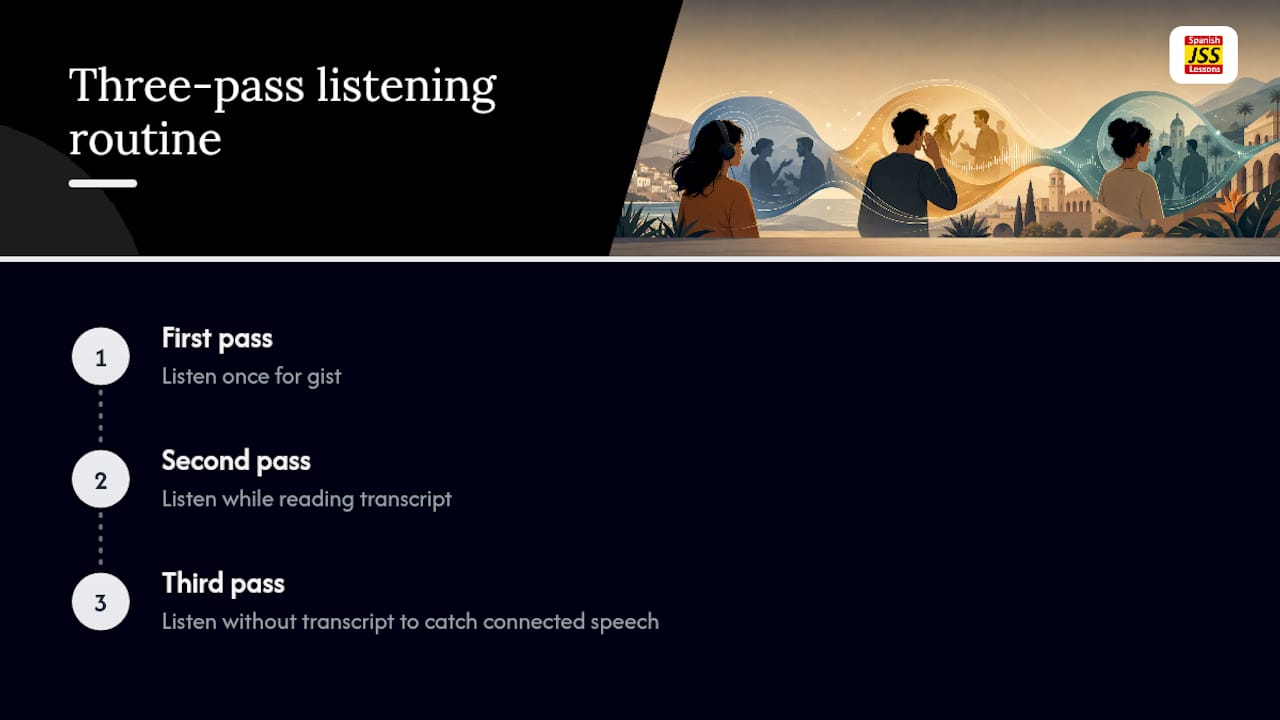
  1. Start with short bursts. Choose a clip of real Spanish audio that is between 30 and 60 seconds long. Listen without stopping and simply note the words or phrases you recognise. Do not attempt to catch everything on the first listen.
  2. Listen a second time and note the rhythm. Focus on where the speech speeds up, where words blend together, and where the speaker pauses. You are training your ear to map the physical shape of fast Spanish, not just decode individual words.
  3. Read the transcript after listening. Identify the words you missed and look at why you missed them. Were they blended with adjacent words? Were they an unfamiliar word? Were they a common filler word like “pues” or “bueno” that you simply did not expect?
  4. Listen again with the transcript open. Follow along and allow your eye to show your ear what it was missing. This is the moment adaptation accelerates most rapidly.
  5. Gradually increase playback speed. Most apps and podcast players allow you to set speed to 1.25x or 1.5x. After working at natural pace, pushing slightly above 190 wpm will make normal speed feel slower and clearer when you return to it.
  6. Alternate active and passive sessions. Active listening with full attention is the core work. Passive listening, playing Spanish radio while cooking or walking, maintains familiarity with the rhythm without draining your concentration reserves.
  7. Join a conversation group or exchange. Real interaction brings unpredictability, which is precisely what you need to develop genuine fluency. You can explore mastering fast listening skills for more structured approaches to this step.

Statistic to keep in mind: Natural spoken Spanish in Spain averages 170–190 wpm, meaning a one-minute conversation typically contains as many words as a full page of standard text. Training with audio Spanish lessons designed for this pace gives your brain the raw material it needs to adapt.

Pro Tip: Use the “10-15 sentence rule” every day. Find a new 10-sentence clip, listen three times with the transcript, and then move on. Consistency across many short sessions beats occasional marathon listening every single time.

Common pitfalls and how to overcome them

Even with good strategies, nearly everyone hits roadblocks. These are the stumbles and how you can get over them.

Audio fog. This is the sensation where everything sounds like one long, undifferentiated stream of noise. It is normal, especially in the early weeks. The brain simply has not built enough templates for fast Spanish yet. The fix is patience and consistent short-burst exposure. Do not skip ahead to harder material; stay at a level where you catch at least 30 to 40 per cent of the content.

Missing transitions and connectors. Words like “sin embargo,” “aunque,” or “a ver” hold conversations together structurally. When you miss them, the logic of what follows collapses. Make a specific study list of the twenty most common Spanish conversational connectors and practise spotting them in audio.

Confidence dips. This is perhaps the most damaging pitfall because it can stop you practising altogether. Research confirms that second-language listening adapts more slowly at high speech rates than first-language listening, so progress feels uneven. Track small wins: the number of words you catch in a 30-second clip, the moment the fog lifts sooner than it did last week.

  • Focus on gist and key words, not every syllable
  • Keep a progress log with specific examples of what you understood
  • Pair listening with context, watch a short Spanish video clip where body language and setting give you visual clues
  • Review practical fluency tips to top up your strategies when motivation dips

Lack of real-world context. Classroom audio is often stripped of background noise, regional accent, and emotional tone. Real conversations in a Spanish bar or market are messier. Introduce some of this messiness deliberately by choosing recordings made in real environments rather than studios.

“Missing individual words is not failure. Understanding the message despite missing words is the actual goal. Train for gist first, precision second.”

Pro Tip: When you miss a word in a real conversation, do not freeze. Nod, keep listening, and use the next sentence to reorient yourself. Stopping to ask for repetition every thirty seconds kills the flow for both speakers and chips away at your confidence.

How to know you’re making progress (and what results feel like)

Finally, after all your effort, here is how to check how far you have come and what you should expect.

Progress with fast Spanish listening does not arrive all at once. It tends to come in quiet, cumulative steps that you notice in hindsight. One afternoon you realise the pharmacist’s instructions made sense without you having to ask for a repeat. A week later, you follow most of a radio weather forecast. These moments matter enormously.

Research confirms that rhythm-based adaptation begins after just 10–15 sentences, but consolidation across different speakers, accents, and contexts takes longer. Setting clear markers for progress helps enormously.

Progress milestone Typical timeframe
Catching gist in short clips 2–4 weeks of daily practice
Recognising numbers and key phrases in real exchanges 4–8 weeks
Following radio with general understanding 2–3 months
Sustaining a natural-pace conversation 3–6 months

A self-test checklist for tracking improvement:

  1. Listen to a 30-second clip. How many complete phrases do you catch on the first listen?
  2. After listening twice, can you summarise the main point in one English sentence?
  3. Can you identify at least two specific words or numbers from the clip?
  4. Does the second listen feel noticeably clearer than the first?
  5. When you open the transcript, are you recognising more than you initially thought you heard?

If you score positively on three or more of these after six weeks of daily practice, you are on track. Reinforcing what you have built through structured conversational fluency work helps lock in these gains and keeps momentum alive.

Why most advice for mastering fast Spanish misses the real point

Most guides on understanding fast Spanish focus on one thing: repetition drills. Listen to the same clip fifty times and you will eventually understand it. There is a kernel of truth there, but it fundamentally misunderstands how listening fluency is built.

Drilling the same clip gives you recognition of that clip. It does not build the transferable rhythm-mapping skill your brain needs to handle a completely new speaker on a different topic at a different pace. Real adaptation requires variety, not volume.

The deeper issue is that most people skip the role of grammar in listening. This is a critical error. When you understand basic sentence structure, your brain stops trying to process every sound in sequence. Instead, it begins to predict. It hears “Necesito que…” and already anticipates a subjunctive verb form and a request. It hears “Hace falta…” and expects a statement of need. This predictive listening is the engine room of fast comprehension, and it only works when rhythm awareness and structural knowledge work together.

Research supports this: rhythm-based adaptation is partly domain-general, meaning it crosses languages, but combining it with grammar knowledge for prediction is what produces genuine, flexible comprehension in real life.

The practical implication is this. Stop spending an hour on one perfect clip. Spend that hour on six different clips at natural speed, using grammar knowledge to anticipate structure and rhythm awareness to smooth the gaps. That combination, as explored more fully in the approach to improving fast Spanish listening, is what actually moves the needle.

Take your Spanish listening skills further

If you have recognised yourself in any of the scenarios above, whether it is the market stall moment or the foggy phone call with a Spanish official, then structured support makes an enormous difference.

https://jamesspanishschool.com

James Spanish School offers specially designed Spanish listening practice tools built specifically for English-speaking adults living in or moving to Spain. The 100-lesson course blends sentence-building with dedicated ear-tuning at natural Spanish speed, so you are practising the exact pace you will encounter in real life. All lessons are available on demand through Spanish online lessons, accessible 24 hours a day on any device, with no time pressure and no expiry date. Read the practical online Spanish guide to see how the course structure supports exactly the kind of progress this article describes.

Frequently asked questions

How many sentences does it take for the brain to adapt to fast Spanish speech?

Research shows the brain begins to adapt noticeably after listening to just 10–15 sentences at a natural fast speed, though sustained improvement builds over weeks of consistent practice.

What is the optimal speed for practising fast Spanish listening?

Effective ear-training occurs at natural radio speeds of 170–190 words per minute, which is precisely the pace used in Spanish broadcasts and everyday conversations in Spain.

Should I worry if I don’t catch every word when listening to fast Spanish?

No. Focus on general meaning and key phrases, because second-language listeners adapt more slowly at high speed than native speakers, and even advanced learners routinely miss individual words at full pace.

Does listening to other fast languages help understand Spanish?

It can. Research shows that exposure to similar rhythms from languages like Catalan helps the brain adapt to fast Spanish, even when the listener does not understand that other language fully.

How important is grammar for understanding rapid Spanish?

Very important. Combining grammar with listening practice allows the brain to predict what is coming next in a sentence, which dramatically improves comprehension of speech at fast, natural speeds.

Categories
Insights

Unlock Spanish slang: speak like a local in Spain


TL;DR:

  • Spanish slang, or jerga, is essential for authentic communication because it reflects informal, regional, and emotional aspects of the language. Mastering Spain-specific slang like vale, guay, and tío/tía helps learners connect genuinely with locals and understand fast-paced conversations. Practice active listening, use slang appropriately in informal contexts, and focus on Spain-based resources to build confidence and fluency effectively.

You arrive in Spain, textbook Spanish at the ready, and someone says “¡Qué guay!” or drops a casual “vale” at the end of every sentence. Nothing in your phrasebook prepared you for this. That moment of confusion is shared by thousands of adult learners every year, and it reveals a gap that most language courses never address. Spanish slang is not a minor addition to the language. It is the living, breathing layer of everyday speech that separates tourists from people who genuinely connect with the locals around them. This guide covers what slang actually is, which terms matter most in Spain, and how to use them confidently.

Table of Contents

Key Takeaways

Point Details
Spanish slang is regional The slang used in Spain is different from Latin American slang, so context is key for learners.
Context shapes appropriateness Use slang in informal conversations, but avoid it in formal or academic Spanish.
Top Spain slang terms Words like vale, guay, and tío/tía are core to casual Spanish in Spain.
Active practice matters To truly master slang, practise with locals, update your knowledge, and focus on Spain-specific resources.

What is Spanish slang and why does it matter?

Slang in Spanish has a name: jerga. Spanish slang (jerga) refers to informal, non-standard words and phrases used in casual conversation, and it typically varies by region, age group, and social context. That last part is critical. Slang is not a fixed list of words you can memorise once and apply everywhere. It shifts depending on where you are, who you are talking to, and what mood the conversation carries.

Why does this matter for you as an English-speaking adult learning Spanish in Spain? Because the Spanish you learned from a textbook, or even from a well-meaning app, was likely built for passing exams. Real conversations with your neighbour, the chap at the hardware shop, or the woman running the local café do not follow textbook rules. They are packed with informal expressions, emotional shortcuts, and playful language that carries warmth and personality.

“Slang is the emotional currency of a language. It tells people you are not just visiting — you actually live here.”

There is also a common misconception worth addressing immediately. Many learners assume that Spanish is Spanish. If a word is used in Mexico, surely it works in Madrid? This is simply not the case. Slang in Spain frequently differs from slang in Latin America, and sometimes the same word carries a completely different meaning on each side of the Atlantic. Mixing them up can lead to confusion or, occasionally, an awkward silence.

Here is why slang matters for real-life Spanish conversation:

  • It signals that you belong. Locals respond very differently to someone who speaks naturally versus someone who sounds like a translated manual.
  • It carries emotional tone. A flat, formal sentence can feel cold, while a phrase peppered with the right slang sounds warm and engaged.
  • It helps you understand what people are actually saying. Listening comprehension falls apart quickly if you cannot recognise informal expressions.
  • It builds confidence. Once you understand slang, fast native speech becomes far less intimidating.

Now that you know why mastering slang matters, let us break down the essential terms you will actually hear in Spain.

Essential Spanish slang words used in Spain

Spain-specific slang includes commonly used terms such as vale, guay, tío/tía, currar, and guiri, each with meanings that can differ significantly from Latin American usage. Learning these words in their Spanish context, not a generalised “Spanish” context, makes all the difference.

Here is a quick-reference table of key terms you will encounter:

Slang word Literal meaning Actual usage Typical context
Vale It is worth OK / Alright / Got it Used constantly in everyday agreement
Guay No literal equivalent Cool / Great / Awesome Complimenting something or someone
Tío / Tía Uncle / Aunt Mate / Dude / Pal Informal address between friends
Currar No literal equivalent To work / To graft Talking about work casually
Guiri Foreign-sounding word Foreigner (usually tourist) Describing or joking about non-Spaniards
Mola No literal equivalent It is cool / I like it Expressing approval of something
Flipar No literal equivalent To be amazed / To freak out Reacting to surprising news
Tío bueno / Tía buena Good uncle / Good aunt Attractive man / Attractive woman Used among friends, context-dependent

It is worth pausing on a few of these. Vale is probably the single most useful word in everyday Spain. You will hear it used the way English speakers use “OK,” “right,” “sure,” and “got it” all rolled into one. Dropping a confident vale at the right moment immediately signals familiarity with how Spaniards actually speak.

Guiri deserves special attention. It is used by Spaniards to refer to foreigners, often tourists, and it carries a light-hearted but pointed meaning. Hearing someone call you a guiri is not necessarily offensive, but it is a gentle reminder that you are not quite blending in yet. The goal, of course, is to stop being the guiri in the room.

Tourist hears Spanish slang word guiri

Here is how a couple of these terms sound in natural conversation:

“¿Quedamos esta tarde?” (“Shall we meet this afternoon?”) “¡Vale, tío, sin problema!” (“Sure, mate, no problem!”)

“¿Qué tal la peli?” (“How was the film?”) “Mola mazo.” (“It was really cool.”)

Pro Tip: Before using a slang term, check whether the explanation you have found specifies that it is used in Spain rather than Latin America. A trustworthy source will note the difference. If you are unsure, ask a Spanish friend from Spain directly. They will almost certainly enjoy explaining it to you.

With these essential phrases in your toolkit, the next step is knowing when, not just what, to use them.

Infographic ranking essential Spanish slang words

When and where to use Spanish slang

Knowing a word is only half the battle. Context and appropriateness matter: slang is generally suitable for informal situations but should be avoided in formal settings like academic writing or professional correspondence. Dropping slang in the wrong place is a bit like wearing flip-flops to a job interview. You might get away with it, but the impression it creates is not the one you want.

Understanding the lay of the land before opening your mouth with slang is a skill in itself. Here are some practical cues to read before you launch into informal territory:

  • Who are you talking to? Friends, neighbours, and shopkeepers in a local market are fair game. A doctor, lawyer, or government official is not.
  • What is the setting? A bar, a family gathering, or a casual walk with someone you know well is perfect. A formal meeting, a job application, or written communication is not.
  • What is the age gap? Slang between peers feels natural. Using young people’s slang with an older Spaniard can feel slightly odd, though not offensive.
  • What is the tone of the conversation? If the person you are speaking with is already relaxed and informal, matching their register works well. If they are being measured and polite, follow their lead.
  • Is it a customer-facing situation? A chat with a friendly shopkeeper is fine for light, casual Spanish. A formal complaint or a legal matter warrants plain, clear language.

Being part of using conversational Spanish confidently is about reading people, not just words. Spaniards are generally warm and will not be offended if you get the register slightly wrong. But they will notice, and getting it right builds genuine rapport.

Pro Tip: Spend time listening before speaking. When you are in a Spanish environment, observe how locals adjust their language between different people. Notice how a shopkeeper talks differently to a regular customer versus someone who has just walked in. That shift in tone is exactly what you are trying to learn.

Understanding when to use slang sets you up for conversations that sound real and local. Now, let us see how to practise and keep learning effectively.

How to practise and master Spanish slang

Learning slang is not a one-off task. It is an ongoing habit. The good news is that with the right approach, it becomes genuinely enjoyable rather than a chore. Here is a practical step-by-step method:

  1. Listen first. Before you try to use any slang, spend time consuming Spanish spoken in Spain. Films, TV series, podcasts, and even YouTube channels from Spanish creators will flood your ears with natural, informal speech.
  2. Copy what you hear. When you catch a phrase that sounds natural and informal, write it down. Note the context: who said it, to whom, and in what situation.
  3. Check it is Spain-specific. Prefer resources that explicitly separate Spain versus Latin America usage and include clear meaning and usage notes. This prevents confusion and wasted effort.
  4. Use it in low-stakes situations. Try a new term with a friend, a local at a café, or someone you chat to regularly. The feedback you get, whether a smile or a puzzled look, teaches you more than any textbook.
  5. Review and update. Slang evolves. What was cool ten years ago might now sound dated. Stay curious and keep collecting new phrases from real interactions.

Here is a comparison of the most common resources for learning Spanish slang, so you can decide what fits your lifestyle:

Resource type Spain-specific? Interactive? Up to date? Practical for adults?
Dedicated online courses Often, if chosen carefully Yes Depends on the course High
Language learning apps Rarely Spain-focused Yes Variable Medium
Spanish TV and films Yes, if set in Spain No Mostly yes High
Slang websites and blogs Variable No Variable Medium
Real-life conversations Entirely yes Fully Always Very high

Real-life conversation sits at the top because nothing replaces the moment when a Spaniard laughs with you, not at you, because you used exactly the right word. There are solid ways to practise Spanish conversation that go well beyond flashcard apps, and pairing those with genuine exposure to spoken Spanish from Spain closes the gap between textbook knowledge and real fluency fast.

When you are ready to build the structural foundation alongside slang, exploring online learning steps designed specifically for adult learners makes the whole process clearer and less overwhelming. Pairing structured learning with dedicated spoken Spanish lessons builds both the vocabulary and the listening ability you need.

Mastering Spanish slang is a journey. So what should you know that most guides skip? Here is where long-term experience offers a unique take.

Why most learners struggle with Spanish slang and what actually works

Here is an uncomfortable truth: most Spanish courses do not teach you Spanish slang from Spain. They teach you a blended version of Spanish slang from everywhere, mixing Argentinian expressions with Mexican street talk and occasionally throwing in something from Madrid. The result is a confused learner who sounds like they have travelled to six countries at once.

The real problem is passive learning. Many people assume that if they watch enough Spanish TV or listen to enough podcasts, slang will simply seep in. It rarely does, at least not efficiently. Your brain filters out what it does not recognise as important. Without active engagement, slang becomes background noise.

What actually works is a combination of focused input and deliberate practice. Focus your listening on content made in Spain, set in Spain, and spoken by Spaniards. Do not settle for generic “Spanish language” resources. Ask yourself: does this source tell me whether this phrase is used in Spain or somewhere else entirely? If it does not, find one that does.

Building a personal collection of phrases you have heard in real situations is far more powerful than memorising a list. When you hear a Spaniard at the market use a word you do not recognise, write it down, look it up, and try it back out. This active collection habit, sometimes called “slang in the wild,” trains your ear and your memory simultaneously.

There are also real-life fluency tips that go beyond vocabulary and address the whole picture of communicating naturally in Spain. Slang is part of a larger skill set that includes listening speed, cultural awareness, and the confidence to speak even when you are not sure you have got it perfectly right. That last part matters enormously. Spaniards are forgiving of mistakes. They are charmed by effort. Getting something slightly wrong while clearly trying is far better than staying silent.

Continue your Spanish slang journey

Slang is just one piece of the puzzle, but it is a vivid, energising piece that transforms your Spanish from functional to genuinely enjoyable. The foundation matters too, and that is where a structured, Spain-focused approach pays off.

https://jamesspanishschool.com

At James Spanish School, every lesson is built around real life in Spain, not exam preparation. The course covers sentence-building and ear-tuning so that fast native speech stops feeling like a wall of sound. You can explore the full range of online Spanish lessons at your own pace, available 24/7 on any device. For slang-specific support, the Spanish slang learning materials in the shop give you focused, Spain-specific resources. And when you are ready to put it all together in conversation, tips for speaking with locals will help you move from practising to actually connecting.

Frequently asked questions

Is Spanish slang the same in all Spanish-speaking countries?

No. Slang varies significantly by region and country, so learners aiming for conversations in Spain should focus specifically on Spain-based slang to avoid confusion.

Are slang words appropriate to use in any situation in Spain?

Spanish slang works well in informal, casual settings but should be avoided in formal or professional contexts such as legal appointments, medical consultations, or written correspondence.

What is the best way for beginners to learn Spanish slang?

Start with slang that is clearly labelled as Spain-specific, and practise it in real conversations as quickly as possible. Resources separating Spain from Latin America in their usage notes are the most reliable starting point.

How do I know if a slang word is Spain-specific?

Look for sources noting Spain-only usage rather than general Spanish, ask a native Spaniard directly, or check whether the explanation distinguishes between Spain and Latin American variants.

Categories
Insights

Discover the benefits of learning Spanish: practical skills for life


Discover benefits learning Spanish

TL;DR:

  • Knowing Spanish enhances daily life and cultural experiences in Spain, especially outside tourist areas.
  • Active engagement, structured practice, and immersion with real conversations accelerate adult language learning.
  • Spaced retrieval practice and meaningful interaction are proven methods for rapid, lasting Spanish proficiency.

Spanish is not just a language spoken far away. It is the daily reality for millions of people living in, moving to, or simply spending extended time in Spain. Over 500 million people speak it as their native tongue, making it one of the most spoken languages on earth. Yet a surprising number of English-speaking adults still arrive in Spain convinced that a smile and a slowly spoken English phrase will carry them through. Sometimes it does. Most of the time, it does not. This guide explains exactly what Spanish unlocks for you in real life, why its importance is only growing in 2026, and which learning methods actually deliver results for adult learners.

Table of Contents

Key Takeaways

Point Details
Spanish is essential Daily life and richer experiences in Spain rely on basic Spanish skills no matter your background.
Global reach Over 630 million people speak Spanish, broadening your horizons at home and abroad.
Evidence-based practice Techniques like Spaced Retrieval deliver far better adult results than old-school rote learning.
Immersion with intent Simply being in Spain is not enough—structured, purposeful interaction accelerates genuine progress.
Start practical Real-life Spanish starts with useful vocabulary and phrases you can use from day one.

How speaking Spanish transforms travel and daily life in Spain

Having seen Spanish’s extraordinary reach, let us look at how using it opens real doors in Spain itself.

The most immediate benefit is practical. Spain is not a country where English is widely spoken outside major tourist zones. Walk into a local pharmacy in a small Andalusian town, visit a GP surgery in rural Catalonia, or try to negotiate a rental contract in Valencia, and the assumption is that you speak Spanish. These are not edge cases. They are the everyday situations that expats and long-term visitors encounter within the first weeks of arrival.

Consider the situations where Spanish makes a measurable difference:

  • Groceries and markets: Local market traders, butchers, and fishmongers rarely speak English. Knowing how to ask for quantities, cuts of meat, or seasonal produce transforms a confusing transaction into a pleasant exchange.
  • Medical appointments: Describing symptoms to a doctor or nurse in Spanish is not just convenient. In an emergency, it can be essential. Many health centres outside major cities have no English-speaking staff on duty.
  • Bureaucracy and paperwork: Registering on the padrón (the local residents’ register), opening a bank account, or dealing with utility companies almost always requires Spanish. Relying on a translator for every interaction is expensive and slow.
  • Finding housing: Landlords who speak only Spanish are common, particularly in residential rather than tourist-facing areas. Being able to ask questions, negotiate terms, and understand a contract puts you in a far stronger position.
  • Making genuine friendships: Spanish neighbours, colleagues, and community members open up entirely differently when you make the effort to speak their language. The shift in warmth and trust is immediate and noticeable.

“Speaking even basic Spanish signals respect. It tells people that you have chosen to meet them on their terms, not yours. That single gesture changes how Spain receives you.”

The cultural dimension matters just as much as the practical one. Local festivals, community meetings, regional television, and the kind of conversation that happens in a bar over a coffee are all in Spanish. Access to these experiences gives life in Spain a richness and texture that is simply not available to those who remain inside an English-speaking bubble.

Spain also sits within a vast Spanish-speaking world. The 630 million Spanish speakers globally mean that your investment in the language pays dividends far beyond the Iberian Peninsula. Every conversation you have in Spain is also practice for Mexico City, Buenos Aires, or anywhere else Spanish is the first language of daily life.

Why Spanish is more important than ever in 2026

Now that we have explored the doors that Spanish opens in Spain, let us consider why its importance is only growing in 2026.

Spanish has quietly overtaken French and German as the most widely chosen second language across much of Europe. The reasons are not hard to find. Remote working has made it possible for professionals in their thirties, forties, and fifties to relocate to Spain without giving up their careers. Retirement abroad, once a niche option, is now a mainstream life choice for a significant number of British adults. Both groups need Spanish not for holidays but for the full, working fabric of their daily lives.

Infographic on daily and social benefits of Spanish

The comparison below shows clearly how Spanish skills affect real-life outcomes in Spain across common scenarios:

Daily scenario Without Spanish With Spanish
Supermarket shopping Guessing at labels, limited to tourist products Full access to local produce, clear pricing conversations
Doctor’s appointment Dependent on a translator or bilingual friend Able to describe symptoms, understand advice, ask questions
Housing search Restricted to English-language listings, often tourist-facing Access to local rental market, direct negotiation with landlords
Making friends Limited to expat community Open relationships with Spanish neighbours and colleagues
Local bureaucracy Delays, errors, frustration Faster resolution, greater trust from officials
Cultural events Excluded from most local activities Full participation in festivals, clubs, and community life

The picture is consistent across every row. Spanish skills do not just make life easier. They make a fundamentally different and richer life possible.

Pro Tip: You do not need to be fluent to start benefiting. Even a handful of well-chosen phrases and a willingness to try changes how Spanish people respond to you. Goodwill is earned by effort, not perfection. Start with the basics and build from there.

What actually works for English-speaking adults: easier methods for real progress

Understanding Spanish’s growing importance leads us to what works best for busy adults aiming for real proficiency.

Many adults carry a quietly painful memory of language learning from school: conjugation tables, grammar drills, textbooks that seemed designed to confuse rather than clarify. These methods frustrated a generation of learners and left many convinced that languages are simply not for them. That belief is wrong. The problem was never the learner. It was the method.

Modern research has changed the picture significantly. Spaced Retrieval Practice is now recognised as one of the most effective methods available for adult language learners. It works by training your brain to retrieve vocabulary and sentence structures at increasing intervals, which makes recall automatic rather than effortful. Research shows it can measurably improve spoken fluency measures including how smoothly you speak and how quickly you can produce sentences. For adults learning Spanish for real conversations rather than academic exams, this is exactly the kind of progress that matters.

Here is how to begin practising Spanish with more impact and less wasted time:

  1. Start with survival sentences. Prioritise the phrases you will actually use in the first weeks: greetings, shopping requests, ordering food, asking for directions, and explaining a basic problem. These build immediate confidence and create real-world opportunities to practise.
  2. Use spaced repetition daily. Even fifteen minutes of retrieval-based practice each day outperforms two hours of passive listening at the weekend. Consistency beats intensity every time.
  3. Tune your ear early. Spanish speakers at native speed can sound like a wall of sound to a beginner. Training your ear to separate words and recognise common phrases is a specific skill, and it needs specific practice. Exploring audio Spanish lessons designed for this purpose can accelerate that process considerably.
  4. Practise speaking out loud from day one. Thinking in Spanish and speaking Spanish are different skills. Many learners can read and translate well but freeze when asked to produce a sentence on the spot. Speaking aloud, even alone, builds the muscle memory you need.
  5. Seek feedback and correct your errors. Errors are not failures. They are the most efficient learning signal available. Understanding common adult learning challenges helps you anticipate where confusion typically strikes and plan around it.

The table below ranks common learning strategies by both their proven effectiveness and how practical they are for a busy adult:

Learning strategy Effectiveness Ease of implementation
Spaced Retrieval Practice Very high Moderate (needs good materials)
Real-world conversation practice High Moderate (requires a partner or context)
Audio and ear-tuning lessons High Easy (fits into any routine)
Structured sentence-building High Moderate (needs clear instruction)
Grammar drills from a textbook Low to moderate Low (time-consuming, demotivating)
Passive listening (music, TV) Low alone Easy (enjoyable but insufficient alone)

Pro Tip: Focus on vocabulary that appears repeatedly in your daily life in Spain. Fifty high-frequency words and ten reliable sentence structures will serve you better in real conversations than five hundred words you cannot recall under pressure.

Does immersion in Spain actually speed up your Spanish?

Once you know which learning method to pick, you might wonder whether simply moving to Spain is the ultimate shortcut.

The honest answer is: sometimes, but only under specific conditions. Immersion has a powerful reputation, and it is not entirely undeserved. Being surrounded by Spanish all day does expose you to patterns, rhythms, and vocabulary that a classroom alone cannot replicate. However, research tells a more nuanced story.

Woman practicing Spanish at home with laptop

Studies of learners abroad show that spending a semester in Spain can improve overall Spanish proficiency, but the gains are uneven. Complexity in speaking tends to improve, meaning learners can attempt longer and more varied sentences. However, fluency and accuracy do not necessarily follow at the same pace. In other words, you might find yourself saying more but still making consistent errors and still struggling to follow a fast reply.

Not all immersion experiences are equal. Here is a realistic look at what different types of immersion actually deliver:

  • Language school in Spain: Structured and effective for grammar foundations, but you often spend breaks and evenings speaking English with other foreign students.
  • Living with a Spanish-speaking family: One of the most effective forms of immersion, providing constant, meaningful interaction in a natural setting.
  • Volunteering in a Spanish community: Excellent for real-world vocabulary and listening, particularly if the role involves regular conversation with locals.
  • Renting alone and working remotely in English: The least effective form of immersion. You are physically in Spain but linguistically still at home.

“Presence in a country is not the same as engagement with its language. Immersion works when it forces you into conversation, not just into proximity.”

The key variable is structured interaction. Passive exposure, hearing Spanish in the background while shopping or watching television, builds familiarity. It does not build fluency. What builds fluency is being placed in situations where you must respond, in real time, to a real person. That is why structured online Spanish lessons taken before and during your time in Spain consistently outperform the ‘sink or swim’ approach for adult learners.

The smartest strategy combines preparation before arrival with active engagement after. Begin building sentence structures and ear-tuning skills before you land. Then use Spain itself as your practice ground, seeking out conversations rather than avoiding them.

The uncomfortable truth about learning Spanish as an adult

After examining how immersion plays out in real-world Spain, it is time for some hard-won truths about what actually works.

Most adults who struggle with Spanish are not struggling because they are too old or because the language is too difficult. They are struggling because they are relying on passive methods and expecting active results. Listening to a Spanish podcast while cooking is pleasant. It is not practice. Scrolling through a vocabulary app for ten minutes feels productive. On its own, it is not enough.

The plateau that so many adult learners hit is almost always the result of the same pattern: a period of initial enthusiasm, followed by a drift into passive absorption, followed by frustration that the language is not sticking. The solution is straightforward even if it is not always comfortable. You have to put yourself in situations where you are required to speak, listen, and respond. Not controlled, predictable exercises but genuine exchanges where you cannot predict what comes next.

This means accepting that you will sometimes not understand. You will sometimes give the wrong word. A Spanish reply will occasionally arrive at the machine-gun speed of a native speaker, and you will feel momentarily lost. These moments are not evidence that you cannot do it. They are the learning itself. Understanding why adults struggle with Spanish is the first step towards removing those obstacles deliberately rather than accidentally.

The adults who make genuine, lasting progress share one characteristic. They give themselves permission to be imperfect early and often. They treat a misunderstood sentence as information, not humiliation. They keep raising the stakes by asking for more complex directions, joining a local club, reading a regional newspaper, or picking up the phone to call a Spanish tradesman rather than sending a message.

Structure matters enormously, particularly at the start. A clear method that builds sentence logic in plain English, without drowning you in grammatical terminology you never needed to learn your first language, changes the experience completely. Progress is measurable. Confidence builds. And Spain, in all its warmth and complexity, becomes genuinely accessible.

Take the next step: practical Spanish for your life in Spain

If you are ready to move beyond the English-only barrier and start building real, usable Spanish, the resources at James Spanish School are designed precisely for that goal.

https://jamesspanishschool.com

James Bretherton has lived in Spain for 40 years and built a 100-lesson course around the skills that actually matter in daily Spanish life. From sentence-building to ear-tuning, every lesson is practical and available on demand, 24/7, on any device. There is no expiry date and no pressure. For practical Spanish tips that go straight to the heart of real-life fluency, or to browse the full range of online Spanish lessons designed for English-speaking adults, the school’s resources are ready when you are. You can also explore essential starter resources to get moving without delay. Real life in Spain is waiting.

Frequently asked questions

Can you live in Spain only speaking English?

It is possible in heavily tourist-facing areas, but everyday life, bureaucracy, and genuine social integration all require at least some Spanish. The 630 million native and second-language speakers worldwide confirm that Spanish is the dominant working language in Spain, not English.

How long does it take for adults to speak practical Spanish?

With consistent daily practice using evidence-backed approaches, most adults can handle basic real-life situations within three to six months. Spaced Retrieval Practice in particular has been shown to measurably improve spoken fluency and recall speed in adult learners.

Is immersion always the fastest way to learn Spanish?

Only when immersion includes structured, meaningful interaction with native speakers. Simply living in Spain without active engagement produces limited gains, as research on study-abroad outcomes confirms.

What method is best for learning Spanish quickly as an adult?

Spaced Retrieval Practice is consistently shown to boost spoken fluency and automatic recall for adult learners, making it significantly more effective than passive listening or rote grammar study alone.

Categories
Insights

Master Spanish conversation: a practical step-by-step workflow


TL;DR:

  • Adults should combine input and output practice for effective Spanish conversation skills.
  • Using AI chatbots reduces embarrassment and boosts confidence early on.
  • Embracing mistakes and improvisation accelerates fluency in real-life conversations.

Many English-speaking adults find themselves stuck in a frustrating gap: they’ve worked through lessons, memorised phrases, and perhaps even passed a course, yet the moment a native speaker replies at full speed, confidence evaporates. Real conversational Spanish in everyday Spain feels a world away from classroom exercises. This guide lays out a structured, culturally aware workflow that bridges exactly that gap. You’ll discover what you need to begin, how to practise effectively, which tools reduce embarrassment, which common mistakes to sidestep, and how to measure whether you’re genuinely moving forward.

Table of Contents

Key Takeaways

Point Details
Blend input and output Listening first, then speaking, creates a robust foundation for real conversation.
Use supportive tools Specialised AI language tools and human tutors together reduce anxiety and improve feedback.
Avoid rigidity Focusing only on memorisation or perfection hinders actual communication.
Track small wins Measuring progress by comprehension and speaking time keeps motivation high.
Adjust your workflow Regularly update your materials and techniques to keep learning fun and effective.

What you need to start your Spanish conversation workflow

Before your very first real conversation, it pays to get organised. Rushing into speaking without the right foundations is a bit like setting off on a long drive without checking the fuel. A little preparation goes a long way.

The essentials before you begin

Here is what you genuinely need in place before starting your workflow:

  • A clear, specific goal. “Get by in Spain” is too vague. “Order food confidently, ask for directions, and chat with my neighbour” is something you can actually plan around.
  • A reliable device: a smartphone, tablet, or laptop with a stable internet connection. Almost all the best modern tools are online.
  • A realistic time commitment. Even 20 to 30 minutes a day produces steady progress. Irregular marathon sessions are far less effective.
  • Basic awareness of how Spanish sentences are put together. You do not need to master grammar terminology, but understanding that Spanish word order sometimes differs from English prevents early confusion. Exploring beginner Spanish basics is a useful first move.
  • An openness to imperfection. Errors are not failures. They are data points that tell you what to work on next.
  • Cultural curiosity. Spain is not Latin America, and Spanish habits, rhythms, and social norms shape conversations in ways that pure vocabulary study never covers. Knowing that a Spanish builder takes a mid-morning break, for example, prepares you for real-life timing and small talk.

Tools worth having from the start

Tool Best for Limitation
AI language bot (e.g. WordAmigo) Low-pressure speaking practice, 24/7 availability Cannot pick up on tone or regional accent nuances
Human tutor Authentic feedback, spontaneous conversation Scheduling and cost constraints
Listening resources (stories, videos) Building “ear” for natural speed and rhythm Passive without output practice
Mobile phrasebook Quick reference in real situations Can encourage script reliance

Research confirms that AI language bots reduce embarrassment in early practice and are best combined with human tutors who can catch the subtler points of nuance and tone. Think of language bots as your rehearsal space and human interaction as the stage.

Pro Tip: Do not wait until you feel “ready” to start speaking. Early output, even clumsy and halting, rewires your brain far more quickly than another week of silent reading. Comfort grows through doing, not through waiting.

The mindset piece matters more than most guides admit. Adults often carry a fear of looking foolish that children simply do not have. Reframing mistakes as useful, expected, and even entertaining is not just positive thinking. It is the most efficient strategy you have.

Step-by-step workflow: from input to speaking confidently

With your resources gathered, it is time to get hands-on and follow a structured yet flexible workflow. This is not a rigid programme. Think of it as a loop you return to and refine, rather than a straight line you walk once.

The five-stage workflow

  1. Listen to relevant stories and videos. Begin each session with Spanish input that is slightly above your current comfort level. Stories, short videos, or audio Spanish lessons work particularly well. The goal is to train your ear to recognise natural rhythm, connected speech, and common phrases before you attempt to reproduce them.
  2. Shadow and echo sentences. After listening, replay short sections and repeat them out loud immediately. This is called shadowing, and it is one of the most powerful techniques in language learning. You are not translating. You are mirroring the sound, speed, and shape of real Spanish speech.
  3. Practise with an AI language bot. Use a conversational AI tool to simulate real exchanges. Ask for directions, practise ordering a coffee, or role-play a conversation with a Spanish landlord. The low-pressure environment means you can make mistakes, try again, and experiment without anxiety.
  4. Shift to human interaction. Once you have rehearsed a scenario several times with an AI language Chatbot, attempt it with a real person. This might be a tutor, a language exchange partner, or eventually someone in Spain itself. Human interaction adds unpredictability and spontaneity that no chatbot can fully replicate.
  5. Reflect and repeat. After each session, spend five minutes noting what felt difficult and what surprised you. Then loop back to step one with those specific gaps in mind. Building spoken Spanish skills requires this kind of deliberate, reflective repetition.

Suggested time and activity guide

Stage Time per session Core activity
Listen 10 minutes Stories, podcasts, or short videos
Shadow 5 to 10 minutes Echo sentences, mimic rhythm
AI practice 10 minutes Simulated conversations
Human interaction 15 to 30 minutes Tutors or language partners
Reflection 5 minutes Note gaps and wins

There is a long-running debate in language learning circles about whether comprehensible input, the process of acquiring a language through stories and listening, is better than structured conversation practice. The honest answer is that both approaches work well, and they work best together. Input fills your bank of sounds and phrases; output forces you to retrieve and use them under real conditions.

Two people practicing Spanish in café

Pro Tip: Alternating between input and output within a single session, rather than doing a week of listening followed by a week of speaking, significantly improves retention. Your brain consolidates new language faster when it has to both absorb and produce it close together.

Common mistakes and how to avoid them in Spanish conversation

As you work through the steps, be aware of pitfalls that can derail your progress. Most of these traps are not about Spanish at all. They are about habits of thinking that get in the way.

The most common pitfalls

  • Overemphasising memorisation. Memorising long lists of vocabulary or scripted dialogues feels productive. In practice, it rarely transfers to real conversation because natural speech is unpredictable and context-dependent. Knowing fifty words for emotions is less useful than knowing how to ask someone to repeat themselves slowly.
  • Translating word for word. English and Spanish have different rhythms and structures. Attempting to translate in your head as you speak produces slow, unnatural output and often leads to errors. The goal is to think in Spanish patterns, not to convert English thoughts.
  • Avoiding mistakes at all costs. Perfectionism is the enemy of fluency. If you wait until a sentence feels correct before speaking, you will rarely speak at all. Mistakes are the mechanism through which you improve.
  • Skipping listening practice. Many learners want to jump straight to speaking, but without sufficient input, your ear cannot process the machine-gun speed of native replies. Listening is not passive. It is the foundation on which speaking is built.
  • Relying entirely on scripts. Phrasebooks and memorised sentences are useful starting points, but real conversation rarely follows a script. If someone gives you an unexpected answer, a script leaves you stranded.

“The most effective learners combine listening-based input with regular speaking practice. Neither method alone produces the fluency that comes from using both in an integrated, ongoing cycle.” This principle, drawn from research into comprehensible input versus structured output, applies regardless of your starting level or age.

Practical solutions

Shift your focus from memorising answers to developing comprehension strategies. Learn phrases like ¿Puede repetir más despacio? (Can you repeat that more slowly?) and No entiendo bien (I don’t quite understand). These tools keep a conversation alive even when you’re lost.

Prioritise communication over correctness. A sentence with a small grammatical error that communicates your meaning is a success. A perfect sentence you never utter is worthless. The Spanish people you encounter in daily life are far more interested in connecting with you than in judging your tenses.

Adopt a flexible, iterative approach. Try something, notice what happened, adjust, and try again. This loop is not just a learning strategy. It is how all natural language acquisition works.

Tracking your progress and fine-tuning your workflow

Avoiding these traps puts you in a strong position. But how do you know you’re truly improving? Progress in conversation can feel invisible, especially when you’re in the middle of it.

What genuine progress looks like

Spanish conversation workflow steps infographic

Real conversational progress is not just about knowing more words. It shows up in several ways: you understand more of what you hear without needing to translate; you feel less anxious before a conversation; you recover more quickly when you don’t understand something; and real-life interactions in Spain begin to feel manageable rather than terrifying.

Simple metrics to track each week

  • Total minutes spent speaking (aim for steady growth over four to six weeks)
  • Number of new phrases used naturally in a conversation
  • Number of successful real-life interactions, however brief
  • Comfort level on a simple 1 to 10 scale before and after speaking sessions
  • Comprehension rate during listening practice (rough estimate: how much did you follow?)

These measures are not scientific. They do not need to be. They give you a directional sense of movement, and that is enough to stay motivated.

Tools for tracking and fine-tuning

Use a simple journal to log your sessions. Note what went well, what caused difficulty, and what you want to revisit. Tutors can offer structured feedback on recurring errors. AI language chatbots are also surprisingly useful here: AI language chatbots provide low-pressure feedback on phrasing and can highlight patterns in your errors without any social awkwardness.

Review your approach to reinforce Spanish skills each month. If listening feels comfortable but speaking still lags, shift more time to output. If you’re speaking freely but not understanding replies, increase your input time. Adjust, do not abandon.

Pro Tip: Revisit listening material or conversation recordings from four to six weeks ago. Noticing how much more you understand now is one of the most motivating things you can do. It makes the progress that felt invisible suddenly very visible.

Understanding what real-life Spanish conversation means in everyday contexts, from the health centre to the hardware shop, helps you calibrate your targets realistically. The goal is not academic perfection. It is functional confidence in the situations that actually matter to you.

Why your Spanish conversation workflow should feel improvisational

Fine-tuning your workflow naturally raises this question: what does a good conversation actually feel like? Most guides focus on structure but miss something vital. Real conversation is improvisational by nature. It never goes quite the way you planned.

This is not a problem. It is the point. Rigid scripts create brittle learners who freeze the moment a conversation veers off-piste. The adults who make the fastest gains are those who treat speaking Spanish as a creative, flexible process, not a performance they must get right.

AI language tools have a genuine role here. They let you rehearse twenty different versions of the same scenario: the plumber who arrives late, the pharmacist who speaks quickly, the neighbour who wants to discuss local politics. You can experiment without stakes. Then, when you move to human interaction, you are not rehearsing a script. You are drawing on a broader repertoire.

Mastering Spanish small talk is a perfect example of where improvisation matters more than preparation. Small talk is spontaneous, culturally loaded, and intensely local. No phrasebook covers it adequately. But a learner who has played with enough conversational scenarios, and who has given themselves permission to stumble, will navigate it far better than someone who memorised a hundred perfectly structured sentences.

Even with limited daily practice time, adults can make rapid, genuine gains. The key is staying adaptive, staying playful, and remembering that every slightly awkward exchange is teaching you something that no lesson plan could.

Take your Spanish conversation workflow even further

For learners seeking to accelerate their progress or connect with a supportive learning environment, James Spanish School offers a practical, accessible next step.

https://jamesspanishschool.com

James Bretherton has spent 40 years living and working in Spain, and his courses are built around the Spanish you actually need: conversations with neighbours, tradesmen, health workers, and local officials. The 100-lesson course blends sentence-building with ear-tuning, helping you both speak and follow fast native speech. Everything is on demand, available on any device, with no countdown clocks or expiry dates. Explore the full range of resources for Spanish conversation workflow, browse flexible online Spanish lessons, or read the online practical Spanish fluency guide to find the right starting point for you.

Frequently asked questions

What is the main difference between comprehensible input and conversation practice in Spanish learning?

Comprehensible input focuses on absorbing Spanish through stories and videos, while conversation practice focuses on producing spoken Spanish; combining both methods consistently delivers the best real-world results.

Are AI language chatbots effective for improving Spanish conversation skills?

Yes, AI language chatbots enable low-pressure practice that reduces embarrassment and builds confidence, particularly when combined with occasional sessions with a human tutor who can address subtler nuances.

How can I measure my improvement in Spanish conversation?

Track your weekly speaking minutes, the number of new phrases you use naturally, your comfort level before conversations, and how well you follow spoken Spanish without needing to translate everything.

What mindset is best for learning Spanish conversation as an adult?

Embrace mistakes as useful data and prioritise communicating your meaning over producing grammatically perfect sentences. This shift alone accelerates progress significantly.

Do I need to memorise scripts to hold real conversations in Spanish?

No. Flexibility and responsiveness serve you far better than fixed scripts, which tend to fail the moment a real conversation takes an unexpected turn.

Categories
Insights

Why Spanish listening is hard and how to beat it


TL;DR:

  • Spanish is spoken faster than English, with nearly 8 syllables per second, overwhelming learners.
  • European Spanish features unique pronunciation and rapid elision, complicating listening comprehension.
  • Authentic, repeated exposure to real speech helps improve understanding more than textbook practice.

Spanish sounds like a freight train when you first hear native speakers talking to each other. You studied vocabulary, you worked through verb tables, yet the moment a real conversation starts, the words blur into one continuous, bewildering stream. You are not alone, and you are not doing anything wrong. The gap between textbook Spanish and the spoken version is enormous, and understanding exactly why that gap exists is the first step to closing it. This article breaks down the science behind Spanish speed, explains the unique challenges of European Spanish, and gives you concrete strategies to genuinely improve your listening comprehension.

Table of Contents

Key Takeaways

Point Details
Spanish is fast spoken Spanish’s high syllable rate challenges English speakers’ real-time comprehension.
Regional Spanish differences European Spanish introduces unique sounds and vocabulary variations that add difficulty.
Active listening is key Consistent practice with real audio and focused listening strategies builds true understanding.
Gist over every word Aiming for overall meaning rather than perfection helps progress and reduces frustration.

Understanding why Spanish sounds so fast

Building on the initial insight, let us unpack why Spanish genuinely sounds much faster than English, because the reasons go deeper than simply “people speak quickly.”

The single most important thing to understand is that Spanish and English are not just different languages. They operate at fundamentally different rhythmic speeds. According to research into speech rates across languages, Spanish is spoken at 7.82 syllables per second, compared to English at just 6.19. That difference of more than one and a half syllables per second might sound small on paper, but in a real conversation it adds up to a relentless torrent of sound.

Infographic showing Spanish listening challenges and solutions

Speech rate comparison: Spanish vs. English

Language Syllables per second Information rate
Spanish 7.82 High syllable rate
English 6.19 Moderate syllable rate
Mandarin 5.18 Lower syllable rate

The table above illustrates something important. Spanish packs more syllables into every second of speech than most other major languages. For an English-speaking brain that is wired to process roughly six syllables per second, being confronted with nearly eight is genuinely disorienting. Your brain is working at capacity just to keep up with the rhythm, let alone decode the meaning.

There is also something called listening fatigue. When you are operating at the very edge of your processing capacity, your concentration burns out far more quickly than it does in your native language. Many adult learners report feeling mentally exhausted after just fifteen minutes of listening to fast spoken Spanish. This is not weakness. It is a perfectly predictable physiological response to cognitive overload.

The speed also creates a masking effect on familiar words. You might know the word también perfectly well when you see it written down. But at machine-gun speed, embedded between other rapidly spoken words, it sounds like a completely unfamiliar noise. The syllables that felt solid and reliable on the page simply vanish into the flow.

Key challenges that speed creates include:

  • Your brain cannot pause to process individual words the way it does when reading
  • Stress patterns in Spanish do not always fall where an English speaker expects them
  • Rapid speech compresses vowel sounds, making them harder to distinguish
  • The brain tries to apply English-rhythm expectations and fails repeatedly

Practising fast Spanish listening from the very beginning of your learning journey, rather than waiting until you feel “ready,” is one of the most valuable adjustments you can make. Readiness, in this context, is not a starting point. It is an outcome of exposure itself.

Unique features of European Spanish that make listening hard

Beyond speed, European Spanish brings an extra layer of difficulty for English speakers, and it is worth understanding exactly what those layers look like in practice.

The Castilian accent that dominates mainland Spain has features that catch learners completely off guard. The most famous is the ceceo sound, where the letter “c” before “e” or “i,” as well as the letter “z,” is pronounced like the English “th” in think. So Barcelona becomes Barthelona, and gracias becomes grathias. If you have spent any time learning Latin American Spanish, this alone can feel like you have stumbled into an entirely different language.

Man recording Castilian Spanish voice message

Beyond that, European Spanish speakers are particularly skilled at running words together in a process linguists call elision. In rapid everyday speech, the phrase ¿Cómo estás? can sound almost like a single word. Vowel sounds at the end of one word and the beginning of the next often merge completely, so individual word boundaries become almost impossible to detect for an untrained ear.

European Spanish vs. Latin American Spanish: listening challenges

Feature European Spanish Latin American Spanish
“C/Z” pronunciation “th” sound (ceceo) “s” sound
Word blending (elision) Very common in fast speech Less pronounced overall
Regional vocabulary Highly varied by region Varies but more standardised
Informal speech register Widely used, quickly paced Often clearer to learners

Regional vocabulary differences add further confusion. Spain has several co-official languages, including Catalan, Galician, and Basque, and even within Castilian Spanish, regional slang shifts significantly between cities and rural areas. A word that means one thing in Madrid may be completely unfamiliar to someone from Seville.

Informal speech is another critical challenge. Textbooks teach you a version of Spanish that is grammatically clean, clearly enunciated, and spoken at a polite, measured pace. Real conversations between friends, colleagues, neighbours, and family members sound nothing like that. Verb endings get swallowed, entire syllables disappear, and sentences collapse into comfortable shorthand that only makes sense if your ear is already well trained.

Pro Tip: Start actively listening to authentic Spanish radio, particularly regional stations from mainland Spain, even if you understand very little at first. The goal in the early stages is not comprehension. It is ear acclimatisation. You are teaching your brain to recognise the rhythm, the ceceo, and the flow of elided words as a normal soundscape rather than a threatening wall of noise.

The European Spanish grammar tips that will serve you most are the ones rooted in real spoken patterns, not written ones. Understanding how sentences are actually assembled in everyday speech is far more useful than memorising formal grammar tables.

Why you miss words, even when you know the vocabulary

Understanding the characteristics of Spanish speech leads to another question: why does known vocabulary suddenly disappear in the flow, even when you have studied those words many times?

The answer lies in what linguists call connected speech, the way native speakers blend individual words into a continuous stream of sound. When someone speaks at full conversational pace, they do not produce neatly separated words. They produce a flowing chain of sounds where one word melts directly into the next.

Consider the phrase ¿Qué es eso? (What is that?). In careful, textbook speech, each word is distinct. In natural conversation, it collapses into something closer to “Késso?” The vowel at the end of qué fuses with the start of es, and the result is unrecognisable to someone who has only ever seen or heard the words in isolation.

“The biggest barrier to Spanish listening comprehension is not vocabulary. It is the failure to train the ear to hear words in connected, naturalistic speech rather than in careful, isolated conditions.”

Several specific processes cause this blurring:

  • Elision: Final vowels absorb into the initial vowels of the following word
  • Assimilation: Consonants at word boundaries change their sound to match the neighbouring sound
  • Reduction: Unstressed syllables become extremely brief and difficult to detect
  • Liaison: Words link together so smoothly that the ear cannot detect where one ends and the next begins

Background noise makes everything significantly worse. A café, a market, a family gathering, a doctor’s waiting room: these are precisely the environments where you most need to communicate in Spain, and they are also the environments where acoustic interference is highest. Your ear is simultaneously trying to filter background sound and process a language stream running at nearly eight syllables per second.

Pro Tip: Practise listening specifically in imperfect conditions. Play audio Spanish lessons while doing light tasks, or listen in slightly noisy environments deliberately. This trains your brain to extract meaning even when conditions are not ideal, which is exactly what real life demands.

Active listening practice, where you focus on what you are hearing rather than passively playing audio in the background, is essential. The ear does not train itself through mere exposure alone. It requires conscious attention, repetition, and gradual challenge.

Proven strategies to improve Spanish listening comprehension

After revealing why listening is such a challenge, it is time to turn the tables and explore concrete, practical ways to master it.

The good news is that listening comprehension is a trainable skill, not a fixed talent. Adults who feel completely lost in fast Spanish conversations can, with the right approach, reach a point where they follow everyday dialogue with genuine confidence. Here is what actually works:

  1. Use authentic audio from the very start. Do not wait until you feel confident with textbook material before exposing yourself to real speech. Authentic audio, conversations between native speakers, radio broadcasts, everyday video content, trains your ear for the actual sounds of the language rather than a classroom approximation of them. The adjustment period is uncomfortable, but it is essential.
  2. Practise segmented and repeated listening. Take a short passage of natural Spanish, ten to thirty seconds, and listen to it repeatedly. On the first listen, note what you catch. On the second, focus on sounds you missed. On the third, try to identify individual word boundaries. This drill builds pattern recognition rapidly, because your brain starts to map the sound stream to known structures.
  3. Focus on gist comprehension, not word-for-word understanding. Native speakers do not process every single word they hear. They use context, rhythm, and key vocabulary to extract meaning. Training yourself to identify the main idea of a sentence or exchange, rather than panicking over missed words, dramatically reduces anxiety and improves overall comprehension.
  4. Pair listening with speaking practice. When you practise Spanish conversation alongside your listening work, you reinforce both skills simultaneously. Speaking forces you to produce the sounds of Spanish yourself, which deepens your ear’s ability to recognise those same sounds when others produce them.
  5. Slow down the audio, then speed back up. Many audio platforms allow playback speed adjustment. Start at 80% speed to identify words, then return to normal speed. This graduated approach lets you build familiarity without permanent reliance on a slower pace.

Additional strategies worth building into your routine:

  • Listen to the same short audio clip every day for a week, noting improvements in what you catch each day
  • Transcribe short passages by hand to force active engagement with each syllable
  • Watch Spanish-language content with Spanish subtitles rather than English ones

The key insight from research into fast listening mastery is that consistent, targeted practice with authentic material outperforms any amount of formal grammar study when the goal is real-world comprehension. The Spanish is spoken at a rate that rewards ear-training above all else.

Why conventional listening practice does not work, and what actually does

Here is a perspective built on decades of working with adult English-speaking learners: the single biggest reason people plateau at intermediate listening is that they spend years practising with audio that sounds nothing like real life.

Textbook recordings are recorded in studios, spoken by trained actors, at a pace carefully calibrated to be manageable. They are useful for one thing only: building initial confidence. The moment they become comfortable, they become useless for further development. Real Spanish, the kind you encounter in a farmacia, at a town hall, or around a neighbour’s kitchen table, sounds nothing like those recordings.

The uncomfortable truth is that improvement requires discomfort. It requires sitting with audio you only partially understand, resisting the urge to reach for a translation, and trusting that repeated exposure will gradually bring clarity. Most learners give up at precisely the moment when the ear is on the verge of a breakthrough.

A practical, imperfect approach beats meticulous over-analysis every time. Mistakes are data. Confusion is progress. The learners who improve fastest are not the ones who prepare most carefully before listening. They are the ones who listen most often to genuinely difficult material and keep going despite the discomfort. Practising Spanish for conversation in real and messy conditions is how the ear finally learns to cope.

Take your Spanish listening further with expert resources

If the strategies in this article have opened your eyes to what is possible, the next step is finding structured, expert-led support that is built specifically around the challenges English speakers face with real spoken Spanish.

https://jamesspanishschool.com

At James Spanish School, every lesson is designed with the fast pace of authentic European Spanish in mind. The 100-lesson course combines sentence-building with dedicated ear-tuning modules, so you develop both sides of the listening equation at once. You can access Spanish online lessons on demand, on any device, at any hour that suits you. The dedicated audio practice portal gives you a library of authentic listening material, and the Spoken Spanish Practice Lessons are specifically crafted to take you from confused to confident, one manageable step at a time.

Frequently asked questions

Why does Spanish sound so much faster than English?

Spanish is spoken at 7.82 syllables per second, compared to English at 6.19, which means your brain is processing significantly more sound per second than it is accustomed to, creating the sensation of overwhelming speed.

Can I improve my Spanish listening without living in Spain?

Yes, with consistent practice using authentic audio and targeted listening exercises, you can make strong progress from anywhere in the world, provided the material reflects real spoken Spanish rather than studio-recorded textbook dialogue.

Is European Spanish harder to understand than Latin American Spanish?

European Spanish has distinctive pronunciation features, particularly the Castilian ceceo and a strong tendency towards elision in fast speech, that can pose additional challenges for learners, especially those who have previously studied Latin American varieties.

Why can I read Spanish well but not understand it when spoken?

Written Spanish presents each word clearly and separately, at whatever pace you choose to read. Spoken Spanish, particularly at the natural rate of 7.82 syllables per second, blends words together, reduces syllables, and adds background noise, making it a genuinely different skill from reading.

Categories
Insights

What is mistake-friendly Spanish practice? Real gains


TL;DR:

  • Mistake-friendly Spanish practice emphasizes communication over perfection, boosting fluency and confidence.
  • Making errors in supportive environments helps long-term retention and real-world speaking skills.
  • Focus on early speaking, low-pressure practice, and strategic correction for effective language learning.

Most Spanish learners share the same quiet dread: saying something wrong and looking foolish in front of a native speaker. That fear holds more people back than any grammar rule ever could. Yet the most fluent conversationalists are rarely the ones who studied hardest in silence. They’re the ones who spoke early, stumbled often, and kept going. Mistake-friendly practice prioritises communication fluency over perfection and encourages learning from errors. This guide explains what mistake-friendly Spanish practice actually looks like, why the research supports it, and how you can apply it to build genuine, everyday fluency in European Spanish.

Table of Contents

Key Takeaways

Point Details
Embrace mistakes Mistake-friendly practice encourages real conversational progress by learning from errors.
Safe learning methods Supportive spaces and error journals make practice less stressful and more effective.
Focus on fluency Prioritising communication over perfection builds confidence and retention.
Balance correction Gentle feedback and real exposure work better than constant grammar drills.

Defining mistake-friendly Spanish practice

Now that we’ve set the stage, let’s define exactly what mistake-friendly Spanish practice means and how it fundamentally shifts your approach to speaking.

At its core, mistake-friendly Spanish practice is a learning philosophy that treats errors as useful data rather than personal failures. It replaces the pressure of getting everything right with the freedom to communicate, however imperfectly. The goal is not to eliminate mistakes but to keep talking, keep connecting, and keep building.

Infographic shows Spanish practice types and outcomes

Traditional drill-focused methods often do the opposite. They reward accuracy and penalise deviation, which trains learners to stay quiet unless they’re certain. For adult learners especially, that silence becomes a habit. And silence never built fluency.

Approach Focus Outcome
Traditional drills Accuracy above all Fear of speaking, slow progress
Mistake-friendly practice Communication first Faster fluency, growing confidence
Error journalling Noticing patterns Long-term retention and self-correction

A supportive environment, combined with error journals and gentle feedback, forms the backbone of this method. These aren’t soft extras. They’re the engine room of the approach.

Here’s what mistake-friendly practice looks like in action:

  • You attempt a sentence even when you’re not sure it’s correct
  • You note errors afterwards rather than freezing mid-conversation
  • You receive feedback that guides rather than shames
  • You repeat attempts with adjustments rather than avoidance
  • You measure progress by how much you communicate, not how little you stumble

“The goal is not a perfect sentence. The goal is a completed conversation.”

Error-making boosts long-term retention and confidence, according to empirical research in language acquisition. When you struggle to retrieve a word or construct a phrase, and then correct it, your brain encodes that knowledge more durably than if you’d rehearsed a flawless script.

This is why building real skills for everyday fluency matters far more than perfecting academic exercises. Real Spanish, spoken by real people in real situations, is messy, fast, and forgiving. Your practice should reflect that reality from the very beginning.

Core strategies for supportive Spanish learning

With its goals and benefits clear, let’s explore the specific methods that make mistake-friendly Spanish learning possible and effective.

Knowing that mistakes are acceptable is one thing. Having a structured way to practise is another. The following strategies give you a practical framework to start speaking Spanish with more confidence and less anxiety.

  1. Create safe practice settings. Self-talk is one of the most underrated tools available. Narrate your morning routine in Spanish, describe what you see on a walk, or rehearse conversations you’re likely to have. Nobody is listening, so nothing is at stake. This low-pressure environment lets you experiment freely.
  2. Try shadowing. Listen to short clips of native Spanish speech and repeat what you hear, matching rhythm and tone. You’re not translating. You’re absorbing. This builds your ear and your mouth simultaneously.
  3. Arrange one-to-one conversation sessions. A patient tutor or language exchange partner creates a contained, supportive space where errors are expected and welcomed. Ways to practise Spanish conversation range from structured lessons to casual video calls with native speakers.
  4. Keep an error journal. After any speaking session, jot down the mistakes you noticed. Note what you said, what you meant to say, and the correct version. Review it weekly. Patterns will emerge and you’ll stop making the same errors without even trying.
  5. Build a daily ten-minute routine. Consistency beats intensity every time. Ten focused minutes of Spanish self-talk or practice lessons each day will outperform a two-hour session once a fortnight.

Safe spaces, error journalling, and daily routines form the foundation of a genuinely effective mistake-friendly methodology. These aren’t complicated techniques requiring expensive resources. They’re habits.

Strategy Effort level Impact on fluency
Self-talk Low High
Error journal Low Very high
Shadowing Medium High
One-to-one sessions Medium Very high
Daily ten-minute routine Low Very high

Pro Tip: Keep a small notebook beside your phone or laptop. The moment a speaking session ends, write down the two or three phrases that felt uncertain. That act of writing is itself a memory reinforcement tool.

Man writing Spanish errors in notebook after session

Having a few rescue phrases ready also helps enormously. Expressions like ¿Cómo se dice…? (How do you say…?) or No lo he entendido bien (I didn’t quite catch that) keep the conversation alive rather than grinding to a halt.

The science behind embracing mistakes in language learning

These core methods owe their success to principles rooted in language teaching research. Here’s what the science reveals.

The idea that mistakes help rather than hinder learning may seem counterintuitive, but the evidence is consistent. Studies confirm that making mistakes enhances long-term language retention, while error-tolerant environments measurably boost both fluency and confidence in adult learners.

One key reason is what researchers call desirable difficulty. When your brain has to struggle to retrieve or produce language, the resulting memory trace is stronger. A fluent phrase you rehearsed to perfection in isolation is far more fragile than one you fumbled in a real conversation and then corrected.

Communicative Language Teaching (CLT) is the academic framework underpinning much of this thinking. CLT places communication at the centre of language learning rather than grammatical accuracy. The core argument is simple: if you can make yourself understood and carry a conversation forward, you are succeeding. Errors are secondary concerns.

Key findings from CLT and related research:

  • Adult learners in low-anxiety settings acquire language faster than those in high-pressure environments
  • Meaningful communication practice produces more durable fluency than repetitive accuracy drills
  • Learners who speak early in the process, even poorly, significantly outpace those who wait until they feel ready
  • Error correction is most effective when it is gentle, delayed, and selective rather than immediate and comprehensive

“Anxiety is not a side effect of language learning. For many adults, it is the single biggest obstacle to progress.”

For adult learners, the emotional dimension is particularly significant. Years of formal education condition many people to associate speaking with being judged. Reframing errors as progress rather than failure is not simply motivational language. It is a psychologically grounded strategy.

Reinforcing Spanish skills through regular, low-anxiety exposure is how genuine competence develops. The science agrees with what experienced language learners have always known: you learn by doing, and doing involves getting things wrong.

Balancing correction and confidence: avoiding common pitfalls

Research shows the value of embracing mistakes, but true progress lies in balancing error correction and personal confidence.

Mistake-friendly practice does not mean abandoning all correction. It means being strategic about when, how, and how much correction you apply. Too little and errors fossilise. Too much and the learner shuts down.

Over-correction demotivates adult learners significantly, and most common errors, including ser/estar confusion and gender agreement, are best resolved through regular exposure rather than drilling.

Here are the most practical guidelines for keeping correction productive:

  • Focus on communication-blocking errors first. If a mistake causes genuine confusion, address it. If the message still lands, let it go for now.
  • Use recasting rather than correction. Simply repeat the phrase correctly in your response without making the error the focus of attention.
  • Treat self-correction as a skill. Train yourself to notice and adjust mid-sentence rather than relying on external correction.
  • Separate speaking time from reviewing time. Don’t pause conversations to analyse grammar. Do that afterwards, in your error journal.

Pro Tip: When practising with a partner, agree beforehand that they’ll note two or three errors to share after the conversation ends, not during. This keeps fluency front of mind while still capturing useful feedback.

The most common error categories for English speakers learning Spanish include:

  • Ser vs. estar (two verbs where English uses one)
  • Noun and adjective gender agreement
  • Pronoun placement before verbs
  • False friends (words that look like English but mean something entirely different)

“Perfection is not the entry requirement for a real conversation. Willingness is.”

For practical Spanish tips that connect grammar realities to everyday situations, focusing on what you can communicate right now is always more valuable than waiting until you feel perfect. That moment rarely arrives on its own.

Why mistake-friendly practice is the secret to real conversational fluency

Stepping back, here’s a perspective most textbooks ignore but experienced speakers know well.

After forty years of living in Spain and watching hundreds of learners struggle through the same patterns, James Bretherton the principal of James Spanish School says one truth stands out clearly. The learners who achieve real conversational fluency are almost never the ones who memorised the most. They are the ones who spoke the soonest and minded the errors the least.

Chasing error-free Spanish is a trap. It feels like diligence but it functions like avoidance. You keep studying, keep preparing, and keep telling yourself you’ll speak properly when you’re ready. But readiness built on perfection never quite arrives.

Real conversations in Spain are not graded. Your neighbour does not mark your verb endings. Your local shopkeeper is delighted you tried at all. Real skills in spoken Spanish are built in the arena of actual exchange, not in the rehearsal room of flawless scripts.

Confidence grows through visible progress. Every stumbled sentence that still gets a warm response is proof that you are already communicating. That proof is more powerful than any textbook grade.

Next steps: tools for mistake-friendly Spanish fluency

If you’re ready to turn these insights into action, these curated resources will help you start practising in a supportive, mistake-friendly way.

At James Spanish School, everything is built around real-life European Spanish, not academic perfection. James Bretherton’s 40 years of living in Spain inform every lesson, from practical sentence-building to the ear-tuning you need to follow native speakers at full speed.

https://jamesspanishschool.com

Whether you’re preparing to live, retire, or spend extended time in Spain, the course meets you where you are and lets you move at your own pace. Start with tips for speaking fluently with locals, browse the resources for Spanish starters, or explore more practical fluency tips. The next conversation you have in Spanish could be more successful than you think.

Frequently asked questions

What are the main benefits of mistake-friendly Spanish practice?

Mistake acceptance boosts fluency and confidence, making it easier to hold real conversations, retain new vocabulary, and recover quickly when you lose your way mid-sentence.

How can I start practising Spanish in a mistake-friendly way?

Begin with low-pressure settings such as self-talk or casual chats, and keep an error journal to track patterns. Safe practice and error journalling are core strategies for sustainable progress.

Is it better to focus on accuracy or communication at first?

Communicative competence should come first, because CLT prioritises fluency over accuracy and waiting for perfection consistently slows practical improvement.

Which common Spanish errors should I worry less about?

Ser/estar and gender errors resolve most naturally through regular exposure to real Spanish rather than through intensive correction drills.

Categories
Insights

Understand and use conversational Spanish with confidence


TL;DR:

  • Conversational Spanish in Spain is fast, colloquial, filled with regional idioms, and involves interruptions.
  • Learning through real-life interactions, not just grammar, builds real confidence and fluency.
  • Daily practice, listening, and engaging in informal settings accelerate speaking and comprehension skills.

Think conversational Spanish is just a handful of polite phrases and basic vocabulary? It is far more alive, fast, and culturally rich than most learners expect. In real Spain, a trip to the market or a chat with a neighbour can involve machine-gun-speed replies, overlapping voices, and expressions that never appeared in any textbook. The good news is that none of this needs to feel overwhelming. With the right approach, one built around real life rather than grammar rules, you can follow conversations, join in, and genuinely connect with people around you.

Table of Contents

Key Takeaways

Point Details
Conversational Spanish explained It’s natural, fast, and involves real-world language not found in textbooks.
Practical strategies matter Daily practice and exposure in real settings outperform memorising grammar rules.
Common mistakes are normal Almost everyone struggles with pace, listening, or slang at first — and that’s part of the process.
Conversation boosts confidence Real conversation practice, not just studying, is the fastest route to Spanish fluency.

What does conversational Spanish really mean?

Most people who start learning Spanish picture a classroom setting: neat sentences, clear pronunciation, and patient teachers waiting while you search for the right word. Real conversational Spanish in Spain is a different animal entirely. It is spontaneous, expressive, and shaped by local habits that no grammar book fully captures.

At its core, conversational Spanish is about engaging, not performing. Native speakers are not marking your accuracy. They want to know if you understood, if you can reply, and whether you can keep the exchange moving. Spanish proficiency research confirms that oral skills develop through interaction, not isolated grammar study, which is why classroom methods often fall short in the real world.

Infographic on conversational Spanish essentials

Understanding real-life Spanish conversation means accepting that speech is fast, filled with fillers, and peppered with regional idioms. Words like pues (well) and o sea (I mean) pop up constantly. Interruptions are not rude; they are a sign of enthusiasm and engagement.

Here is how traditional classroom Spanish compares to the conversational Spanish you will actually encounter:

Feature Classroom Spanish Conversational Spanish
Pace Slow and deliberate Fast and natural
Vocabulary Formal and textbook-driven Colloquial and idiomatic
Grammar focus High Low in practice
Interruptions Rare Common and expected
Fillers used None Pues, o sea, venga, bueno
Setting Structured Markets, cafes, streets

“Real-life speech in Spain features fast pace, fillers, regional idioms, and interruptions. Practice in markets and cafes is essential to build genuine conversational ability.”

What you will notice immediately when you arrive in Spain is that people do not speak in textbook sentences. A shop assistant might say something like “Pues, ¿qué te pongo?” before you have even opened your mouth. Learning Spanish small talk basics gives you a solid foundation for these spontaneous moments.

Key features of conversational Spanish in Spain include:

  • Heavy use of filler words and expressions
  • Regional accents that vary significantly across Spain
  • Frequent use of diminutives and informal verb forms
  • Topic changes mid-sentence
  • Laughter, gestures, and non-verbal cues as part of communication

Once you accept that this is what real Spanish sounds like, the learning path becomes much clearer and far less intimidating.

How conversational Spanish works in real life

With a clearer understanding of what conversational Spanish is, let us explore how it unfolds naturally in everyday Spanish environments.

Spanish in real settings moves at a pace that surprises most learners. Whether you are ordering a coffee, asking for directions, or chatting with a tradesman, the authentic spoken Spanish you encounter will include fillers, regional phrases, and natural interruptions that are simply part of the rhythm.

Man speaking Spanish at street kiosk

Here are the most common conversational fillers you will hear across Spain:

Filler Meaning in context When it is used
Pues Well / So Starting or continuing a thought
O sea I mean / That is to say Clarifying or rephrasing
Venga Come on / Alright / Bye Agreement or farewell
Bueno Right / OK / Well Transitioning between points
Hombre Man / Seriously Expressing surprise or emphasis
Mira Look / Listen Drawing attention

Knowing these words will help you follow conversations even when other vocabulary trips you up. They act as signposts in the dialogue.

Here is a practical sequence for recognising and participating in fast-paced exchanges:

  1. Listen for fillers first. They signal that the speaker is continuing or changing direction, giving you a moment to catch up.
  2. Focus on key nouns and verbs. You do not need every word. The engine room of meaning is usually just two or three core words.
  3. Use short confirmations. Words like sí, claro, entiendo (yes, of course, I understand) keep the conversation moving while you process.
  4. Ask for repetition without panic. ¿Puedes repetir, por favor? is always acceptable and locals appreciate the effort.
  5. Practise listening to fast Spanish regularly so your ear gradually tunes in to the natural speed of native speech.

Pro Tip: When a native speaker interrupts you, do not freeze. Smile and use “perdona, continúa” (sorry, please carry on) to hand the floor back graciously. This shows social awareness and keeps the conversation warm.

Building familiarity with these rhythms takes time, but every interaction is a small lesson. The practical Spanish tips that make the biggest difference are the ones rooted in these everyday moments, not textbook exercises.

Practical steps to build your conversational Spanish skills

Seeing how conversational Spanish is used in the real world, it is time to break down what you can do, day-to-day, to master it practically and confidently.

Research into oral proficiency development shows that learners who maximise contact hours with Spanish, especially through real interaction, make significantly greater gains in complexity and overall proficiency. The method matters, but the consistency matters more.

Here is a practical sequence you can follow regardless of your current level:

  1. Start with sentence patterns, not grammar rules. Learn how to build a sentence by feel, just as you learned English as a child. Practical spoken Spanish is about structure you can use, not rules you need to memorise.
  2. Tune your ear daily. Spend ten minutes listening to spoken Spanish every morning. Radio, TV, or short audio lessons all count. The goal is to make fast speech feel familiar, not foreign.
  3. Practise in low-stakes settings first. A bakery order, a greeting to a neighbour, or asking for the bill. Small exchanges build real confidence faster than long study sessions.
  4. Repeat and recycle phrases. A handful of versatile phrases used well will carry you further than a large vocabulary used awkwardly. Work on reinforcing Spanish skills through regular repetition rather than constant new material.
  5. Record yourself speaking. Playback reveals patterns in your hesitation and pronunciation that you simply cannot hear in the moment.
  6. Use active learning strategies that keep you engaged and producing language, not just receiving it passively.
  7. Review what confused you. After any real conversation, note the words or phrases that tripped you up. Those are your most valuable next lessons.

Pro Tip: Attach Spanish to your existing habits. Make your morning coffee while listening to a short Spanish dialogue. Label items around the house. The goal is to practise Spanish conversation in small, consistent doses every single day rather than in long, occasional sessions.

Mistakes, myths, and what to expect as you learn

Armed with practical routines, you will advance. But it is important to know what hurdles and surprises most learners face along the way.

Every learner struggles with speed, listening, and slang early on. That is completely normal. The mistake is thinking that struggle means failure. Oral proficiency gains do not follow a straight line, and fluency rarely arrives on a predictable schedule.

Here are the most common misconceptions and the realities behind them:

  • Myth: You need perfect grammar before you can hold a conversation. Reality: Locals care about meaning, not accuracy. An imperfect sentence that communicates is worth far more than a perfect one you never say.
  • Myth: Native speakers will lose patience with you. Reality: Most Spanish people are warm and genuinely pleased when foreigners make an effort. A smile and a few words go a long way.
  • Myth: If you do not understand, you have failed. Reality: Not understanding is a sign you are at the right edge of your ability. That discomfort is where learning happens fastest.
  • Myth: Slang and idioms are too advanced to worry about early on. Reality: You will hear them immediately. Knowing a handful of fillers from day one puts you ahead of most learners.
  • Myth: More study automatically means faster progress. Reality: More conversation means faster progress. Study supports it, but cannot replace it.

Expect native speakers to interrupt, switch topics, use gestures, and occasionally speak over each other. None of that is directed at you personally. Understanding fluency tips for locals includes knowing how Spanish social conversation actually flows, which is nothing like a classroom dialogue.

Pro Tip: Keep a simple notebook of every mistake that embarrassed you. Embarrassment is memorable, and memorable moments accelerate learning. The very phrases that made you blush are the ones you will never forget.

Using practice lessons for spoken Spanish alongside real-world interaction creates a powerful feedback loop that speeds up progress considerably.

Why focusing on conversation beats grammar-first learning

Here is the uncomfortable truth that most language courses never tell you: grammar knowledge and conversational ability are not the same thing, and chasing one does not automatically give you the other.

Grammar rules cannot prepare you for an interruption from a market trader or a rapid question from a health worker. What builds real confidence is exposure and practice, combined with the structural logic to understand how sentences fit together in plain terms. Audio lessons for Spanish conversation train your ear and your instincts simultaneously, which is exactly how first-language learning works.

Learners who prioritise conversation from the start retain phrases better because they have emotional and situational context attached to them. They also feel less nervous in daily exchanges because they have already experienced the discomfort and moved through it. Grammar-first learners, by contrast, often freeze the moment a real reply comes back at speed. Conversation-first learning builds adaptability, and adaptability is what everyday life in Spain actually demands.

Take your Spanish conversation further

If the practical steps in this article have given you a clearer picture of what conversational Spanish really involves, the natural next move is to build on that foundation with resources designed for real life, not textbook exams.

https://jamesspanishschool.com

At James Spanish School, every lesson is built around the Spanish you will actually use: with neighbours, shop staff, tradesmen, health workers, and local officials. You can get practical tips that go straight to the heart of everyday interactions, explore the quickstart Spanish resources that learners are already using, or find out how online spoken Spanish lessons fit into your daily routine on demand, at your own pace, with no countdown clock.

Frequently asked questions

What is the difference between conversational Spanish and classroom Spanish?

Conversational Spanish focuses on real-life interaction with natural speech patterns, including fillers, idioms, and interruptions, while classroom Spanish typically emphasises formal grammar and written accuracy.

Can I become fluent in Spanish just by learning conversational phrases?

Conversational phrases are a strong and practical starting point, but significant fluency gains require regular exposure and real interaction over time rather than phrases alone.

What are the most useful settings to practise conversational Spanish in Spain?

Markets, cafes, and spontaneous social exchanges with locals are the best environments, as real-life practice in these settings builds the speed, flexibility, and listening skills that matter most.

How long does it take to gain conversational Spanish skills?

Research shows meaningful proficiency gains are possible within several months of consistent practice and contact, though individual progress varies depending on exposure and starting level.

Categories
Insights

Spanish for beginners checklist: start speaking confidently


TL;DR:

  • Focus on practical conversation goals and micro-goals to build confidence quickly.
  • Learn essential phrases relevant to real-life situations for better retention.
  • Incorporate regular speaking, listening, and reinforcement to transform beginner skills into fluency.

Starting to learn Spanish can feel overwhelming. Type ‘learn Spanish’ into any search engine and you are instantly buried under a landslide of apps, textbooks, YouTube channels, podcasts, and online courses, each promising to be the one method that finally works. The result? Most beginners spend more time choosing a resource than actually speaking. This checklist cuts through that noise. Focused specifically on European Spanish and the practical conversations you will actually need, it gives you a clear, step-by-step roadmap. Follow it in order, and you will move from complete beginner to someone who can hold real everyday conversations with confidence.

Table of Contents

Key Takeaways

Point Details
Start with real goals Set practical, conversation-based goals from day one to guide your learning.
Focus on useful phrases Learn and practise high-frequency phrases for immediate everyday use.
Understand core grammar Grasp the basics of sentence structure, verb forms, and gender to build confidence.
Practise daily Consistent daily use—no matter how small—reinforces your progress and skills.
Checklists keep you on track Using a structured checklist prevents overwhelm and keeps you motivated.

Set your learning foundations

Before you learn a single word of Spanish, the way you approach learning matters enormously. Many beginners make the mistake of treating Spanish like a school subject, drilling grammar rules until they can recite them perfectly but cannot order a coffee without freezing. The far more effective approach is to think like a communicator from the very start.

Starting with real conversation goals makes language learning measurably more effective than abstract study. That means setting micro-goals grounded in daily life. Instead of aiming to ‘learn Spanish,’ aim to introduce yourself by name, ask for the bill in a restaurant, or give your address to a taxi driver. These small, specific wins build momentum in a way that finishing a grammar chapter simply cannot.

Choosing the right resources is equally critical. European Spanish and Latin American Spanish share a great deal, but they differ in vocabulary, certain expressions, and most noticeably in pronunciation. If you are planning to live in, visit, or communicate with people in Spain, make sure your course, audio, and practice materials reflect that. The practical steps for learning Spanish you choose should always match your actual destination.

Here is a quick checklist for building solid foundations:

  • Adopt a conversational mindset: ask ‘Can I use this today?’ about every piece of language you learn
  • Set three micro-goals for your first week, such as greeting someone, saying where you are from, and counting to ten
  • Choose resources specifically designed for European Spanish
  • Start listening to native Spanish speech from day one, even if you understand nothing yet
  • Resist the urge to master numbers or the alphabet before anything else; there are better ways to start than numbers
  • Pay attention to pronunciation early; bad habits formed now are harder to correct later

Here is something that surprises most adult learners: Spanish is actually easier for English speakers than you might expect. Hundreds of words are almost identical across both languages, and the phonetic rules are far more consistent than English ones.

Pro Tip: Write your micro-goals on a sticky note and put it somewhere you will see it every morning. Visible goals become daily reminders, and daily reminders become habits.

Master the essential phrases and expressions

Once your foundations are in place, it is time to stock your toolbox with essential Spanish for real-life situations. High-frequency useful phrases help you communicate quickly and meaningfully, long before you have mastered any grammar at all.

Friends practicing Spanish with flashcards in café

Think about the situations you will genuinely face: walking into a shop, asking for directions, calling a doctor’s surgery, greeting a neighbour. These are the moments that matter. Learning phrases tied to real contexts means you will actually remember them when the pressure is on.

Here are the phrase categories every beginner should cover first:

  • Greetings and farewells: Hola, buenos días, buenas tardes, hasta luego
  • Introductions: Me llamo…, soy de…, encantado/encantada
  • Asking for help: ¿Puede repetir más despacio, por favor? ¿Dónde está…?
  • Shopping and eating out: ¿Cuánto cuesta? Quiero .. , la cuenta, por favor
  • Emergencies: Necesito un médico, llame a la policía, me he perdido

The table below gives you a quick-reference guide to some of the most useful starter phrases for European Spanish:

English European Spanish
Good morning Buenos días
Excuse me / sorry Perdona (informal)
Where is the pharmacy? ¿Dónde está la farmacia?
How much does it cost? ¿Cuánto cuesta?
I don’t understand No entiendo
Can you speak more slowly? ¿Puede hablar más despacio?
I want … Quiero…
Thank you very much Muchas gracias

Repetition is your friend here. It is not enough to read a phrase once. Say it aloud, write it down, use it in a pretend conversation with yourself, and then use it again the next day. The basic Spanish steps that stick fastest are always the ones tied to a real memory or situation.

When learning beginner Spanish structure, focus on phrases that can be adapted by swapping one word. ‘Quiero un café’ becomes ‘Quiero una cerveza’ with a single change. That flexibility is enormously powerful for beginners.

Pro Tip: Link each phrase to a specific place in your mind. Picture yourself standing at a Spanish market stall when you practise ‘quiero’ Emotional and visual memory is far stronger than rote repetition alone.

Core grammar and structures for beginners

Having a bank of core phrases is crucial, but a small amount of grammar goes a surprisingly long way towards making your Spanish understood and making you feel less lost when native speakers reply.

The good news is that sentence structure and core grammar in Spanish follow logical patterns that are genuinely easier to grasp than most beginners expect. You do not need to memorise everything. You need to understand the engine room of how sentences are built.

Spanish broadly follows a Subject-Verb-Object order, much like English. ‘I want a coffee’ becomes ‘Yo quiero un café.’ The subject (Yo) can even be dropped in Spanish because the verb ending tells you who is doing the action. That is actually one less thing to worry about.

Here are the core grammar building blocks every beginner needs:

  • Gender: Every Spanish noun is masculine or feminine. ‘El’ is the masculine definite article (the), ‘la’ is feminine. ‘Un’ and ‘una’ are the indefinite articles (a/an). Most nouns ending in ‘o’ are masculine; most ending in ‘a’ are feminine, though there are exceptions worth noting
  • Key verbs: Ser (to be, permanent), estar (to be, temporary or location), and tener (to have) are the three verbs that unlock the most conversations fastest
  • Verb endings: Spanish verbs change depending on who is doing the action. The endings follow regular patterns, making them learnable without a grammar degree

The comparison table below shows how Spanish sentence logic maps cleanly onto English:

English sentence Spanish equivalent
I am English Soy inglés / inglesa
I am tired Estoy cansado / cansada
I have a reservation Tengo una reserva
The shop is closed La tienda está cerrada
A table for two, please Una mesa para dos, por favor

The key principle from the grammar tips for European Spanish that James teaches is this: focus on function, not terminology. You do not need to know what a subjunctive is to have a real conversation. You need to know how to say what you mean clearly.

Practice and reinforcement strategies

Understanding the basics is one thing. Actually using your Spanish in real moments is what turns knowledge into genuine fluency. Regular use in real situations rapidly accelerates learning and retention in a way that passive study simply cannot match.

The biggest barrier most adult learners face is not ability. It is the fear of making mistakes in front of people. Here is the truth: every native Spanish speaker you meet will be charmed and patient when they see you trying. Mistakes are not embarrassing; they are the fastest learning tool you have.

Here is a practical, numbered sequence to build your daily practice habit:

  1. Spend ten minutes each morning reviewing the phrases and structures from the JSS lesson notes before starting on a new lesson.
  2. Listen to native Spanish audio during activities where your hands are busy, such as cooking, commuting, or walking. WordAmigo is perfect for this. Developed in collaboration with JSS, its essential tool on the path to fluency.
  3. Speak out loud every single day, even if only to yourself; narrate what you are doing in Spanish as you go about your morning routine
  4. Find a language partner or conversation group and commit to at least one short exchange per week; the real-life Spanish tips that accelerate progress fastest always involve speaking to another person
  5. Watch Spanish television with Spanish subtitles rather than English ones; your ear will begin to tune into the rhythm and speed of real speech far more quickly
  6. Use small talk fluency practice to prepare for the everyday chitchat that fills real Spanish life: weather, queues, the morning coffee ritual
  7. Review and celebrate small wins at the end of each week; progress that goes unnoticed loses its motivating power

“The learners who make the fastest progress are never the ones who study the most. They are the ones who use what they know the most. Speak early, speak often, and let the corrections come naturally.”

If you are in Spain or plan to visit, read the tips for fluency with locals to understand how to navigate the pace and style of real Spanish conversation, which can feel very different from anything you practised in a classroom.

Why checklists transform beginner Spanish learning

Most beginners who give up on Spanish do so not because Spanish is too hard, but because they had no clear roadmap. They spent three weeks on an app, felt vaguely uncertain about their progress, got distracted by another method, and quietly drifted away. That pattern is not a personal failure. It is the entirely predictable result of learning without direction.

A practical checklist changes that dynamic completely. It gives you a sequence, a sense of forward movement, and a way to measure what you have actually achieved. You are not chasing fluency in the abstract. You are ticking off ‘ask for directions’ or ‘introduce yourself at the doctor’s surgery.’ Those are real, winnable moments.

The other trap beginners fall into is perfectionism. They wait until they feel ‘ready’ to speak, which means they never speak at all. The checklist approach forces you to act before you feel confident, which is precisely how confidence is built. As James often points out, understanding why Spanish is easier for English speakers than most people assume is itself a powerful mindset shift. You are far closer to a workable level of Spanish than you think.

Take your Spanish further with proven resources

If this checklist has given you a clear picture of where to start, the next step is finding the right structured support to keep that momentum going.

https://jamesspanishschool.com

At James Spanish School, every resource is built specifically for English-speaking adults who want real European Spanish for real life, not academic exams. The online Spanish lessons cover sentence-building and ear-tuning in a sequence that mirrors this checklist perfectly. Whether you are just starting out or looking to consolidate what you already know, the learning resources for beginners available through JSS are designed to move you forward step by step, at your own pace, on any device.

Frequently asked questions

How long does it take to speak basic Spanish with this checklist?

With daily practice, most learners can hold basic conversations within 1-3 months by following this checklist and focusing on practical use rather than grammar theory.

What is the difference between European and Latin American Spanish for beginners?

European Spanish uses slightly different vocabulary, expressions, and pronunciation than Latin American variants, so select resources that match your target region from the very start to avoid building habits you will later need to undo.

Do I need to master all the grammar before speaking?

Absolutely not. Speaking from the start is consistently more effective than studying grammar in isolation; learn rules as they become relevant to what you are trying to say.

What is the most important thing for Spanish beginners to focus on?

Mastering high-frequency phrases and committing to daily spoken practice makes the fastest and most lasting impact on your progress.

Categories
Insights

Master Spanish conversation in shops


TL;DR:

  • Using Spanish in shops fosters genuine connections and enhances local experiences.
  • Learning basic phrases and polite structures boosts confidence and practical communication.
  • Practice through role-plays, real visits, and listening accelerates pragmatic fluency.

Most English-speaking adults heading into a Spanish shop assume a smile and a few pointing gestures will carry them through. They often do, just barely. But that bare minimum approach costs you something real: genuine connection, local knowledge, and the kind of warm exchange that turns a routine errand into a memorable moment. BBC Bitesize confirms that everyday shopping Spanish enables English-speaking adults to handle daily interactions with far greater ease. This guide gives you the practical language, cultural insight, and learning strategies to move beyond survival mode and into genuine conversation in Spanish shops.

Table of Contents

Key Takeaways

Point Details
Connection counts Using Spanish in shops leads to better service, more engaging interactions, and open doors to local culture.
Phrase power A few well-chosen phrases can handle 90% of shop situations, from paying to asking for help.
Practise for fluency Role-plays and immersive shopping scenarios help you master real-world conversational Spanish much faster than memorising lists.
Know the differences Bargaining and shop lingo can change between Spain and Latin America, so adapt accordingly for true fluency.

Why Spanish conversation matters when shopping

With that context set, let’s explore why actually using Spanish matters so much in shops.

Walk into a small Spanish grocery or a neighbourhood bakery and you’ll notice something straight away. The shopkeeper greets every customer by name, lingers over a question about the family, and recommends the cheese that came in this morning. That is not a transaction. It is a relationship. And it happens in Spanish.

Spain’s shopping culture places enormous value on personal connection. Local shops are social spaces as much as commercial ones, and shop Spanish unlocks confidence in ways no amount of silent pointing ever will. When you greet the shopkeeper with a genuine buenos días and ask for help in their language, something shifts. You stop being a tourist and start being a person they want to help.

The numbers back this up. 77.3% of Spaniards actively choose local shops for the personalised service they offer, which means the staff in those shops are primed for conversation, not just cash. Arriving with a few well-placed phrases signals respect and opens the door to recommendations, shortcuts, and occasionally a little extra in the bag.

Using Spanish in real situations also accelerates your learning far faster than rote memorisation from a phrasebook. Conversation demands your brain process language under pressure, which is exactly how long-term retention happens. Spanish tips for real-life fluency consistently point to real-world practice as the most efficient route to genuine competence.

Here is a quick comparison of what changes when you shift from silence to Spanish:

| Situation | English-only approach | Spanish conversation ||
|—|—|—|
| Asking for a product | Pointing, guessing | Clear request, correct item |
| Getting recommendations | Rarely offered | Freely and enthusiastically given |
| Handling a problem | Stressful and unclear | Manageable with key phrases |
| Building rapport | Minimal | Natural and rewarding |

Key benefits of using conversational Spanish in shops:

  • Shopkeepers are more forthcoming with advice and local knowledge
  • You avoid embarrassing misunderstandings over quantities or prices
  • You gain access to BBC shopping Spanish basics that help in everyday situations
  • You build the confidence to take on harder conversations outside the shop

“In Spain, the shop is the village square. Conversation is the currency.” This sentiment captures something any expat who has spent time in a local mercado will recognise immediately.

Essential phrases, vocabulary and polite structures

Understanding why it matters is one thing; actually knowing what to say is another.

The most useful phrases are simple structures you can learn in an afternoon and use for a lifetime. Key phrases enable daily interactions including asking for locations, prices, payments and trying items. Start with these three:

  1. ¿Cuánto cuesta? (How much does it cost?)
  2. ¿Dónde está…? (Where is…?)
  3. ¿Puedo pagar con tarjeta? (Can I pay by card?)

Those three questions alone will handle the vast majority of your shopping needs. Beyond them, a small working vocabulary pays enormous dividends. Knowing that tienda means shop, supermercado is supermarket, panadería is bakery, carrito is a trolley, and cesta is basket means you can follow instructions rather than stand there blankly when a member of staff points you in a direction.

Polite structures matter enormously in Spain. A por favor (please) and gracias (thank you) are non-negotiable. Adding ¿Me puede ayudar? (Can you help me?) in a respectful tone will get you far further than any amount of raised volume in English. The mechanics of store vocabulary also involve verbs and polite structures that, once learned, apply across dozens of situations.

Infographic Spanish polite shop phrases

It is also worth knowing where regional vocabulary differs. Spanish spoken in Spain and in Latin America shares its foundations, but some shop words vary:

Item Spain Latin America
Trolley Carrito Carrito / Carro
Bag Bolsa Bolsa / Funda
Till / checkout Caja Caja / Mostrador
Receipt Ticket / Recibo Recibo / Factura

If you are shopping in Spain specifically, you are unlikely to encounter much confusion. But it is handy to know the differences if your travels take you further afield. For instance, if you ever visit a traditional Spanish charcuterie, the vocabulary around cured meats and cuts is surprisingly specific and well worth learning.

Pro Tip: Practise your key phrases aloud every day for a week before your trip. Saying them out loud, not just reading them, is what builds Spanish small talk for fluency and makes the words available automatically under pressure.

Beyond basics: Handling negotiations, returns and regional differences

Knowing phrases is key, but the real challenge is handling less predictable interactions.

Most of your shop visits will follow a familiar pattern. But some will not. A product is out of stock, the price on the shelf does not match the till, or you need to return something that did not work. These moments are where basic phrasebook knowledge runs out and real conversational ability matters.

Customer requesting return in Spanish hardware store

One key distinction worth understanding early: bargaining is more common in Latin American markets, where ¿Cuál es su mejor precio? (What is your best price?) is perfectly normal. In Spanish supermarkets and most shops, haggling is rare and can feel awkward for both parties. Save the negotiation for flea markets (mercadillos) and antique fairs, where it is expected and even enjoyed.

Returns are a different matter. Knowing how to handle a devolución (return) politely and clearly is genuinely useful. The structure to learn is:

  • Quisiera devolver esto, por favor. (I would like to return this, please.)
  • No funciona. (It doesn’t work.)
  • ¿Puede cambiarme esto? (Can you exchange this for me?)
  • ¿Me devuelve el dinero? (Can I have a refund?)

Using this kind of formulaic but polite language avoids the embarrassment of an awkward standoff at the till. Staff respond well to calm, structured requests.

Regional differences can also catch you out. Even within Spain, vocabulary and speed of speech vary considerably between Andalusia, Catalonia, and the Basque Country. The pace can feel like machine-gun fire to a learner’s ear, especially in busy shops.

“The fastest way to stop being rattled by fast Spanish is to listen for the patterns, not the words.”

Pro Tip: When you visit local shops, listen for phrases that come up again and again. Repetition in real environments builds your ear far faster than any classroom exercise. Visit Spanish shop conversation insights for more practical guidance on handling real-world exchanges.

For those keen on bargaining tips in situations where negotiation is appropriate, knowing when and how to open that conversation makes all the difference.

How to practise Spanish conversation for real shop success

Once you know what to expect, here is how to quickly build real-life shop fluency.

The single biggest mistake learners make is studying Spanish without ever practising the messy, unpredictable reality of a real conversation. Vocabulary lists are useful. Role-plays are transformative. Scenario practice accelerates learning in ways that passive study simply cannot match, particularly when it comes to the pragmatic skills you need in live situations.

Here is a step-by-step approach that works:

  1. Drill your core phrases until they feel automatic, not recalled
  2. Listen to authentic Spanish audio to tune your ear to real pace and rhythm
  3. Role-play specific shop scenarios, including awkward ones like a confused cashier or a missing item
  4. Shop in real Spanish-speaking environments as often as possible
  5. Review what tripped you up and target those gaps directly
  6. Repeat the cycle until the conversation feels easy, not effortful

The research supports combining methods. Combining vocab drills with immersion and role-play produces the strongest results across all learner levels. This is not one-size-fits-all; it is about stacking methods intelligently.

Method Confidence gain Practical fluency Speed of results
Phrase memorisation Low Limited Fast initially, plateaus quickly
Classroom practice Medium Moderate Steady but slow
Immersive role-play High Strong Fast and durable

For role-play shopping practice, structured scenarios that mirror real shop visits are particularly effective. The best ones put you in uncomfortable situations, a hurried assistant, a price dispute, a product you cannot name, because discomfort is where real learning happens.

Pro Tip: Simulate a conversation with a confused or impatient cashier. It sounds stressful, but getting comfortable in that scenario beforehand means nothing in a real shop will rattle you. Combine this with audio Spanish lessons that train your ear to follow practical Spanish skills at full native speed.

A fresh take: Why real shop Spanish is a superpower most learners miss

These strategies are powerful, but the real game-changer lies in shifting your mindset.

Here is something most language courses will never tell you. The shop is one of the best classrooms you will ever find, and almost nobody treats it that way. Most learners push through their shopping list in silence, relieved to escape without embarrassment. They miss something enormous.

Every visit to a Spanish shop is a low-stakes, high-reward language lab. The shopkeeper is not judging your accent. They are delighted you tried. A simple buenos días, ¿tiene pan de centeno? (Good morning, do you have rye bread?) does more for your confidence and your cultural belonging than a month of grammar exercises.

The deeper truth is that most conventional courses skip real shop talk in favour of rigid grammar instruction that nobody uses in natural conversation. They teach you to conjugate verbs correctly but not to ask for 200 grams of manchego without freezing. Pragmatic Spanish, the kind that works in real life, is where fluency actually lives. When you can chat easily in a shop, you belong. That sense of belonging is the engine that keeps learners going long after the initial motivation fades.

Ready to unlock real-world shop Spanish?

You have seen the practical side. Here is how to take the next steps quickly.

James Spanish School is built precisely for moments like these. Real shop conversations, real cultural context, and the kind of everyday Spanish that actually gets used. The 100-lesson course covers sentence-building and ear-tuning, so you can follow native speech at full speed, not just in slow, carefully enunciated classroom audio.

https://jamesspanishschool.com

Whether you are preparing for a move to Spain, planning a long stay, or simply want to feel at home in a local market, the online Spanish lessons at James Spanish School give you structured, on-demand learning that fits your life. As soon as you the basic sentence structure, you into modules focused on Spanish for shop confidence and build from there. Every lesson is available 24/7, with no expiry date, no pressure, and a cast-iron guarantee backing every step.

Frequently asked questions

What are the most useful Spanish phrases for shopping?

The essential phrases are ¿Cuánto cuesta? (How much does it cost?), ¿Dónde está…? (Where is…?), and ¿Puedo pagar con tarjeta? (Can I pay by card?). These three key phrases cover the vast majority of everyday shop interactions.

Is bargaining common in Spain or only in Latin America?

Bargaining is standard in Latin American markets but is rarely practised in Spanish supermarkets and shops. Bargaining is more common in Latin America; in Spain, stick to mercadillos if you want to negotiate.

How can I quickly improve my Spanish for shop conversations?

Practise scenario role-plays, visit real shops whenever possible, and combine vocabulary drills with listening practice for the fastest progress. Scenario practice accelerates learning in pragmatic situations far more effectively than passive study alone.

What if I don’t understand a shopkeeper’s fast speech?

Calmly ask them to slow down: ¿Puede repetirlo más despacio, por favor? (Can you repeat that more slowly, please?). Most shopkeepers are happy to oblige when asked politely.

Categories
Insights

Beginner Spanish guide: speak confidently in Spain


TL;DR:

  • Understanding European Spanish pronunciation and verb uses is essential for authentic communication.
  • Combining structured courses, audio practice, and real-life scenarios accelerates learning.
  • Embracing cultural nuances and authentic expressions builds confidence and fluency in Spain.

You know a handful of Spanish words. You’ve sat through a few lessons, maybe even memorised some verb tables. Then you arrive in Spain, someone speaks at full speed, and your mind goes completely blank. It’s one of the most common experiences for English-speaking adults learning Spanish, and it’s not your fault. Classroom Spanish and real-life Spanish are two very different animals. This guide walks you through the foundations, the right tools, the practical steps, and the cultural confidence you need to hold genuine everyday conversations in Spain.

Table of Contents

Key Takeaways

Point Details
Focus on European Spanish Learning regional pronunciation, slang and culture helps you fit in and communicate confidently.
Master the essentials Prioritise key verbs, handy phrases, and core topics for real-life conversations.
Use the right resources A mix of apps, audio, and live practice is best for developing your skills.
Embrace mistakes Making errors is part of learning—stay relaxed and keep talking, even if you slip up.

Unlocking the basics: what every beginner needs

Now that you know what lies ahead, let’s start with the very foundations for beginner Spanish. The first thing worth understanding is that Spain speaks a particular variety of the language. European Spanish (Castilian) uses distinct pronunciation and regional slang that differs noticeably from Latin American varieties. The most obvious difference is the ‘th’ sound: Spaniards pronounce the letter ‘c’ before ‘e’ or ‘i’, and the letter ‘z’, like the English ‘th’ in think. So gracias sounds more like grath-yas in Spain. This isn’t just a quirk. It’s a marker of local identity, and getting it right helps you sound less like a tourist.

Beyond pronunciation, beginners need a grip on three fundamental verbs: ser, estar, and haber. All three translate loosely as ‘to be’ or ‘to have’, but each carries a specific use. Ser describes permanent states (nationality, personality), estar covers temporary conditions (mood, location), and haber acts as an auxiliary for compound tenses. Understanding Spanish structure basics early on saves enormous frustration later.

Infographic about Spanish beginner key verbs

You’ll also need a working knowledge of adjective agreement. In Spanish, adjectives change their ending depending on whether a noun is masculine or feminine, singular or plural. It sounds fiddly, but with practice it becomes second nature.

Essential polite phrases to learn first:

  • Por favor (please) and gracias (thank you)
  • ¿Puede repetir más despacio? (Can you repeat more slowly?)
  • No entiendo (I don’t understand)
  • ¿Cuánto cuesta? (How much does it cost?)
  • Perdone (Excuse me, to get attention politely)

Spaniards tend to communicate directly and efficiently. This can feel blunt to British ears, but it’s simply the local style. There’s no offence meant. Understanding this cultural tone early on means you won’t misread a perfectly friendly exchange as rudeness.

Comparison: European Spanish vs Latin American Spanish for beginners

Feature European Spanish Latin American Spanish
‘c/z’ pronunciation ‘th’ sound ‘s’ sound
Informal plural vosotros ustedes
Common slang vale, tío órale, chévere
Accent speed Variable by region Variable by country

BBC Bitesize covers essential grammar topics for beginners and is a useful free reference to supplement your early learning. For a focused list of verbs you’ll actually use, you need a core verbs list is built specifically around real-life Spanish interactions.

Pro Tip: When you are learning vocabulary, don’t try to learn every thing at once. Focus on the 25 or so words and phrases you’d need to get through a single day in Spain. Start small, build confidence, and layer in complexity as you go.

Your language starter kit: must-have tools and resources

With the essentials in mind, it’s time to gather the best tools for starting your journey. The good news is that there are more quality resources than ever before, but the sheer volume can be overwhelming. The key is choosing tools that match how you actually learn, rather than piling up apps you’ll never open.

BBC Bitesize Beginner Spanish is a structured resource for Spanish grammar that works well alongside audio-based learning. For those who prefer learning through context, the JSS Spanish language course includes family-themed practice lessons which place vocabulary into realistic, everyday situations rather than abstract drills.

Top resources for beginner Spanish learners:

  1. A structured online course focused on European Spanish. Look for one that explains grammar in plain English without heavy academic jargon. The JSS course fits that need.
  2. A pronunciation tool such as WordAmigo, which is built into the JSS course and helps you hear and reproduce sounds accurately.
  3. A phrasebook or digital guide specifically for Spain. Avoid generic Latin American guides that teach vocabulary or slang you won’t encounter locally.
  4. Podcasts or audio content for passive listening. Even 15 minutes a day while commuting or cooking makes a measurable difference over time.
  5. A sentence practice tool to reinforce structure. The JSS sentence practice tools are designed to build your ability to construct sentences, not just memorise phrases.

Comparison of main beginner learning methods:

Method Best for Limitation
Audio/podcast Passive daily exposure No visual grammar support
Language apps Vocabulary building Often Latin American focused
Online course Structured progression Requires commitment
Live lessons Speaking confidence Expensive and time-dependent
Phrasebooks Quick reference No depth or context

The most effective approach is to combine two or three methods rather than relying on just one. Pair a structured course with regular audio exposure, and add a phrasebook for those moments when you need a quick answer on the spot. Switching between formats also keeps learning fresh and prevents the kind of mental fatigue that makes people quit.

Step-by-step: building your conversational Spanish foundation

Armed with your toolkit, you’re ready to get stuck into real language learning, one step at a time.

  1. Learn core verbs and sentence structure first. Before memorising lists of nouns, understand how a Spanish sentence is put together. Verbs are the engine room of Spanish, and knowing how to use even ten of them correctly unlocks an enormous range of conversation. Visit JSS practical conversation tips for a clear walkthrough of sentence-building logic.
  2. Practise key real-life scenarios. Focus on ordering food, shopping, introducing yourself, asking for directions, and visiting a pharmacy. These are the interactions you’ll have on day one in Spain. Rehearse them until they feel automatic.
  3. Use local expressions and authentic pronunciation. Common phrases like vale (meaning ‘ok’) are used constantly in Spain and signal to locals that you’re making a genuine effort. Regional expressions like these matter more than textbook perfection.
  4. Use spaced repetition and audio training for memory. Spaced repetition means reviewing material just before you’d naturally forget it, which dramatically improves long-term retention. Audio training, the ‘ear-tuning’ approach at the heart of JSS, helps you keep pace when native speakers talk at full speed.

Cultural note: In Spain, silence in conversation is rarely comfortable for locals. If you hesitate too long while searching for a word, your conversation partner may jump in or finish the sentence for you. Don’t be embarrassed. They’re being helpful, not impatient. Embrace the pace and keep going.

For a deeper look at authentic language habits, the JSS guide to tips for real conversations covers the nuances that most beginner courses ignore.

Pro Tip: Learn the words for common daily topics before you travel. Whether it’s essential topics vocabulary around family, food, or home life, having those words ready means you can steer conversations into territory where you feel comfortable.

Man practicing Spanish vocabulary with flashcards

Common pitfalls and how to track your progress

Now you’ve got the steps, it’s vital to avoid pitfalls and know when you’re making real progress.

The most frequent mistakes English speakers make include:

  • Literal translation. English and Spanish sentence structures don’t map onto each other neatly. Translating word-for-word in your head leads to confused or unnatural phrases.
  • Mixing formal and informal registers. Spanish has distinct forms for addressing someone formally (usted) versus informally (). There are now completely different usuages in European and Latino Spanish Using the wrong one in the wrong situation can cause awkwardness.
  • Ignoring local idioms. Learning slang like vale or hablar hasta por los codos (meaning ‘to talk someone’s ear off’) helps you blend in socially and understand the texture of real conversations.
  • Skipping pronunciation practice. Reading Spanish silently and speaking it aloud are completely different skills. Practise speaking from day one.

Practical milestones to aim for:

  • Introduce yourself confidently and ask basic questions about others
  • Complete a purchase at a market or shop without switching to English
  • Order a meal and understand the waiter’s reply
  • Handle a basic phone call or appointment booking
  • Follow a short conversation between two native speakers

Self-testing is simple and effective. Every week, pick one scenario and run through it entirely in Spanish, out loud, without notes. If you get stuck, note exactly where and return to that gap in your next study session. For ongoing tips for everyday Spanish, the JSS resource library covers practical fluency techniques grounded in real Spanish life.

Pro Tip: Find a language partner, either a native Spanish speaker learning English, or a fellow learner at a similar stage. Regular spoken practice with another person accelerates progress faster than any app or course can on its own.

What most beginner guides miss about real-world Spanish

Here’s something worth saying plainly: most beginner guides teach you how to pass a language test, not how to chat over a coffee in Seville or negotiate with a plumber in Alicante. Textbook Spanish is clean, measured, and polite in a very formal way. Real Spanish is faster, slangier, and shaped by centuries of regional culture.

Cultural confidence matters just as much as grammar. Knowing when to use a phrase, how to respond to directness without taking offence, and how to laugh at your own mistakes, these are skills no conjugation table can teach. Spain rewards effort enormously. Make a genuine attempt in Spanish and most people will meet you more than halfway.

The uncomfortable truth is that fear of embarrassment holds more learners back than lack of knowledge. Nobody sounds fluent on their first attempt. Understanding why Spanish is easier for English speakers than most imagine helps dismantle that fear before it takes hold. Embrace the stumbles. They are not failures. They are the fastest route to sounding natural.

Your next step: learn Spanish with expert support

If you’ve read this far, you’re already more prepared than most people who attempt Spanish without a clear plan. The difference between learners who plateau and those who break through is usually structured, real-life focused guidance.

https://jamesspanishschool.com

At James Spanish School, every lesson is built around the Spanish you’ll actually use in Spain. From the starter resources that get you moving quickly, to the full library of Spanish lessons online covering sentence-building and ear-tuning, everything is on demand and designed for adult learners with real lives. There’s no jargon, no countdown clock, and no pressure. Just practical, confident Spanish for the conversations that matter. Carefully structured lessons that get you constructing sentences from lesson one and take the next step at your own pace.

Frequently asked questions

What are the main differences between European and Latin American Spanish for a beginner?

European Spanish uses a ‘th’ sound for c/z and has a distinct informal plural form, vosotros, alongside unique local slang and cultural habits not found in Latin American varieties.

What basic phrases should I learn first for travelling in Spain?

Start with greetings, polite essentials, and key expressions for food, shopping, and directions. Phrases like vale for ‘ok’ are used constantly and immediately signal genuine engagement with the language.

How can I practise Spanish in real-life situations if I’m not in Spain?

Use structured online courses, audio tools, and find conversation partners through language exchange platforms. BBC Bitesize is also recommended for grammar practice alongside spoken exercises.

How do I make my Spanish sound more authentic?

Listen to native speakers regularly, learn regional slang, and mimic the polite but direct conversational style typical in Spain. Picking up expressions like hablar hasta por los codos adds genuine texture to your speech.

Please ask questions
from Lesson pages