

TL;DR:
- Everyday conversation is informal dialogue that uses verbal and non-verbal cues to build social bonds. It involves spontaneous topic shifts, emphasizes communication rhythm, and relies heavily on body language, especially in Spain. Mastering cultural norms and practicing simple exchanges help English speakers feel at home in Spanish social settings.
Everyday conversation is defined as informal, spontaneous verbal and non-verbal communication between people, used primarily to build and maintain social relationships. It differs from formal speech in that it has no fixed agenda, allows free topic shifts, and builds social bonds rather than simply transferring information. For English speakers living in Spain, mastering this type of daily dialogue is the difference between feeling like a tourist and feeling at home. Linguists trace the word “conversation” to the Latin con (with) and versare (turn), which tells you everything: true conversation is a rhythmic exchange of turns, not a monologue.
What is everyday conversation and what makes it different?
Everyday conversation is the informal, natural exchange of ideas, feelings, and observations that forms the backbone of human interaction. It is unstructured by design. Unlike a business meeting or a formal presentation, daily dialogue shifts topics freely, follows the mood of the speakers, and values connection over content.
Approximately 85% of communication in face-to-face exchanges is conveyed through non-verbal cues: tone of voice, facial expressions, gestures, and posture. That figure is striking. It means that even if your Spanish vocabulary is limited, your body language, warmth, and attentiveness carry the conversation further than words alone.

For English speakers in Spain, this is genuinely good news. A smile, an open posture, and a nod of acknowledgement go a long way before a single word is spoken. The verbal content of casual talk matters, but the non-verbal signals around it matter more.
What types of everyday conversations exist and how do they differ?
There are more than 25 recognised types of conversation, each serving a different social purpose and requiring a different register. Understanding the main categories helps you choose the right tone and vocabulary for each situation.
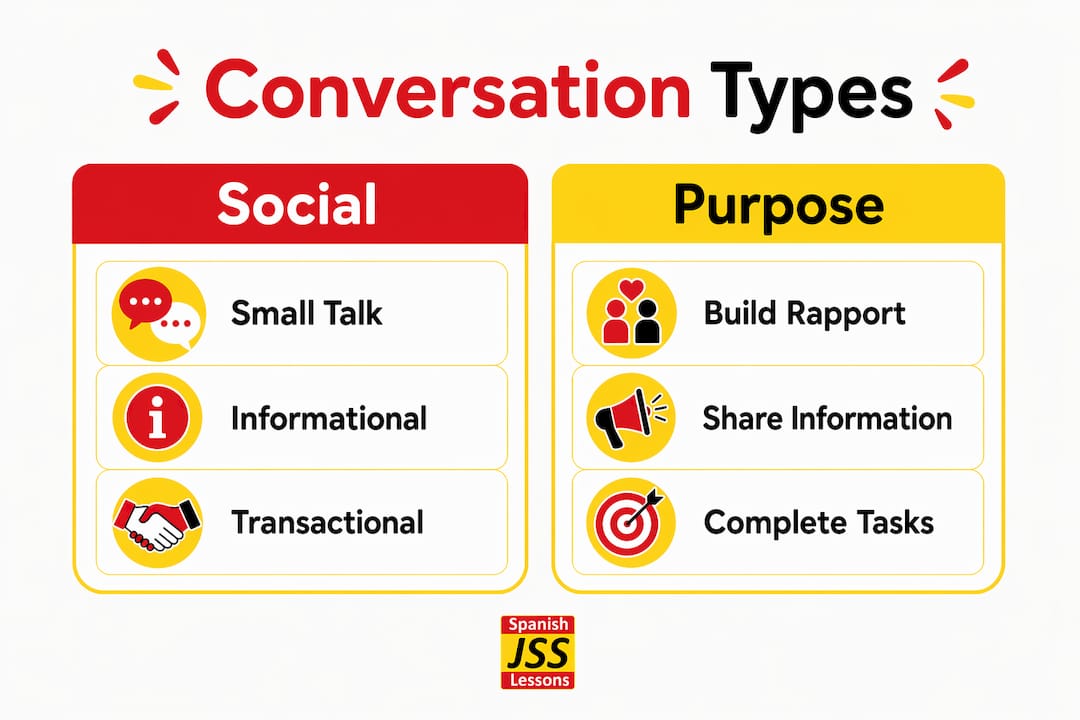
| Conversation type | Purpose | Typical setting | Example in Spain |
|---|---|---|---|
| Small talk | Rapport-building, social warmth | Queue, café, lift | Commenting on the weather or a local festival |
| Casual chat | Relaxed exchange between friends | Bar, neighbour’s doorstep | Discussing weekend plans or local news |
| Informational | Sharing or requesting facts | Shop, pharmacy, town hall | Asking for directions or opening hours |
| Heart-to-heart | Emotional bonding, personal sharing | Home, quiet café | Discussing family, health, or personal concerns |
| Transactional | Task completion, service exchange | Supermarket, bank, post office | Ordering coffee, paying a bill |
Each type demands a different level of intimacy and vocabulary. Small talk is the entry point for most social encounters in Spain. It is light, brief, and non-committal. Casual chat goes one step further: it assumes a degree of familiarity and allows for humour, opinion, and storytelling.
Informational exchanges are functional. You need specific vocabulary and clear pronunciation, but the social pressure is low. Heart-to-heart conversations require emotional vocabulary and patience. They are the deepest form of daily dialogue and take time to reach with Spanish neighbours or colleagues.
Transactional talk is the category most English speakers in Spain encounter first. Ordering a coffee, buying stamps, or asking a pharmacist for advice all fall here. These exchanges follow a predictable script, which makes them easier to practise and master early on.
Pro Tip: When you are unsure which type of conversation you are in, follow the other person’s lead. If they keep responses brief and task-focused, stay transactional. If they linger and ask questions back, shift into casual chat mode.
Why everyday conversation matters for English speakers in Spain
Everyday dialogue is the primary mechanism through which people integrate into a community. It is not a social nicety. It is the tool through which trust, belonging, and local knowledge are built, one exchange at a time.
Spain has a rich culture of public social life. Conversations happen in bars, on doorsteps, in queues at the market, and during the mid-morning coffee break that builders and tradespeople take as a near-sacred ritual. English speakers who can participate in these moments, even briefly, earn a level of respect and warmth that no amount of formal language study can manufacture.
Cultural norms shape how these conversations unfold. A few key points for English speakers in Spain:
- Physical proximity matters. Spaniards tend to stand closer than Northern Europeans during conversation. The standard comfortable distance for conversational engagement is roughly 18 inches (45 centimetres), but in Spain this often feels closer. Stepping back can read as coldness or disinterest.
- Topics are personal, quickly. Questions about family, age, and health arise far sooner in Spanish conversation than in British social exchanges. This is warmth, not intrusion.
- Silence is not awkward. Spanish conversational rhythm includes natural pauses. You do not need to fill every gap.
- Listening is valued. Active listening with nods and brief affirmations signals genuine engagement. It is not passive; it is participatory.
Non-verbal communication is especially significant in Spanish social settings. Mismatched cues, such as a flat tone paired with friendly words, can create confusion or a sense of insincerity. Matching your facial expression and tone to your words is not performance; it is clarity.
Pro Tip: Learn a handful of Spanish affirmations: “claro” (of course), “qué bien” (how nice), and “ya” (right, I see). Dropping these into conversation at the right moment signals fluency far beyond your actual level.
How to confidently engage in small talk and daily dialogue in Spain
Confidence in everyday conversation comes from preparation, not perfection. The goal is not to speak flawlessly. The goal is to keep the exchange moving and leave the other person feeling heard.
Here is a practical sequence for initiating and sustaining daily dialogue in Spain:
- Open with an observation. Comment on something you both share in the moment: the weather, a queue, a local event, or the food. “Hace mucho calor hoy” (it’s very hot today) is a classic opener that works in almost any setting.
- Ask a simple question. Follow your observation with one open question. “¿Es siempre así en agosto?” (Is it always like this in August?) invites a response without demanding a long answer.
- Use back-channelling. Nods and brief affirmations sustain conversation flow without requiring you to speak at length. A well-timed “claro” or “sí, sí” tells the other person you are engaged and following along.
- Match their energy. If the other person is animated, respond with warmth. If they are reserved, keep your tone measured. Mirroring conversational energy builds rapport quickly.
- Know when to close. Spanish conversations often end with a warm but clear signal: “Bueno, hasta luego” (right, see you later) is a natural and friendly close. Do not let a conversation trail off awkwardly.
- Practise real-life Spanish conversation regularly. Even brief daily exchanges with a shopkeeper or neighbour build the muscle memory that formal study alone cannot provide.
Common small talk topics that work well in Spain include local weather, food and restaurants, football (particularly if you know the local team), upcoming fiestas, and family. Avoid politics and regional identity debates until you know someone well. These topics carry strong feelings in many parts of Spain and can derail an otherwise warm exchange.
Body language reinforces every word you say. Stand with an open posture, make natural eye contact, and avoid crossing your arms. These signals communicate openness and respect, which are the foundations of any successful social exchange.
Pro Tip: Mastering Spanish small talk is a skill in itself. Treat each brief exchange as a low-stakes rehearsal. The pharmacist, the market vendor, and the neighbour in the lift are your best teachers.
Common pitfalls English speakers make in everyday conversations in Spain
Successful conversation balances speaking and listening. The most common mistake English speakers make is treating conversation as a performance rather than an exchange. Talking too much, too fast, or without pausing for a response breaks the natural rhythm that makes dialogue enjoyable.
The second major pitfall is confusing transactional talk with social conversation. Transactional exchanges differ fundamentally from genuine social dialogue. Ordering at a bar is a transaction. If you treat it as an opportunity for a lengthy chat during a busy lunch service, you will frustrate the staff and misread the social cue. Read the context first.
Other common errors include:
- Ignoring non-verbal cues. If someone’s body language signals they want to end the conversation, continuing to talk creates discomfort. Watch for closed posture, reduced eye contact, or short responses.
- Dominating the topic. Steering every conversation back to your own experience or problems signals low social awareness. Good conversationalists ask as many questions as they answer.
- Translating British social scripts directly. British conversational habits, such as understatement, irony, and self-deprecation, do not always translate. What reads as charming wit in English can land as confusing or even rude in Spanish.
- Avoiding the language entirely. Defaulting to English at every opportunity prevents the gradual confidence-building that comes from attempting Spanish, even imperfectly.
Recovering from a conversational stumble is straightforward. A simple “perdona, no entendí bien” (sorry, I did not quite understand) resets the exchange without embarrassment. Spanish people generally respond to genuine effort with patience and encouragement.
James Spanish School: building your everyday conversation skills
Everyday conversation fluency in Spanish is a practical skill, and it is one that James Spanish School has built its entire course around.
James Bretherton, a dual-native speaker with 40 years of life in Spain, designed the James Spanish School 100-lesson course specifically for English-speaking adults who need real-life Spanish. Not exam Spanish. Not textbook Spanish. The kind of Spanish you use with your neighbour, your builder, your doctor, and the woman at the town hall. The course includes dedicated ear-tuning lessons to help you follow fast spoken Spanish, because understanding the reply is just as important as knowing what to say. The WordAmigo system then locks vocabulary and pronunciation into long-term memory through a five-step retention loop. Explore the full course and see how quickly everyday conversations start to feel natural.
Key takeaways
Everyday conversation is informal, turn-based dialogue that builds social bonds through verbal and non-verbal exchange, and mastering it requires cultural awareness as much as vocabulary.
| Point | Details |
|---|---|
| Non-verbal cues dominate | Around 85% of face-to-face communication is non-verbal, so tone and body language matter as much as words. |
| Know your conversation type | Distinguishing small talk, casual chat, and transactional exchanges helps you choose the right register and avoid social missteps. |
| Cultural norms shape dialogue in Spain | Closer physical proximity, personal questions, and active listening signals are all normal features of Spanish conversation. |
| Back-channelling builds rapport | Brief affirmations like “claro” and “ya” show engagement and sustain conversation without requiring long responses. |
| Avoid the monologue trap | Good conversation balances speaking and listening; dominating the exchange breaks the natural rhythm that makes dialogue enjoyable. |
FAQ
What is everyday conversation in simple terms?
Everyday conversation is informal, spontaneous dialogue between people that aims to build social connection rather than complete a task. It is unstructured, allows topic shifts, and relies heavily on non-verbal cues such as tone and facial expression.
What are the most common topics in daily chats in Spain?
Common topics include the weather, food, local events and fiestas, family, and football. Personal questions about age, health, and family arise earlier in Spanish conversation than in British social exchanges, and are generally a sign of warmth rather than intrusion.
How do I start a conversation with a Spanish local?
Open with a shared observation about your immediate surroundings, such as the weather or a local event, then follow with a simple question. Conversational confidence builds quickly when you treat each brief exchange as low-stakes practice.
What is the difference between small talk and transactional talk?
Small talk is rapport-building dialogue with no fixed goal, while transactional talk is a task-focused exchange such as ordering food or asking for directions. Treating a transactional encounter as a social conversation can create confusion or frustration, particularly in busy service settings.
Why do non-verbal cues matter so much in everyday conversation?
Approximately 85% of face-to-face communication is conveyed through non-verbal signals. In Spanish social settings, mismatched cues, such as a flat tone paired with friendly words, can undermine the warmth you intend to convey and disrupt the flow of the exchange.