James Spanish School

Categories
Insights

Builder’s mid-morning break in Spain: what expats need to know


What is builder’s mid-morning break in Spain

TL;DR:

  • The builder’s mid-morning break in Spain, known as the almuerzo, is legally mandated and culturally vital. It occurs between 10:30 AM and noon, lasting 15 to 30 minutes, during which workers leave the site to eat and socialize at a nearby café.

The builder’s mid-morning break in Spain is a legally protected and culturally embedded pause in the working day, known in Spanish as the almuerzo. It typically falls between 10:30 AM and noon, lasts 15–30 minutes, and involves coffee, food, and conversation at a local bar or café. For English speakers living or working in Spain, understanding this custom is not optional. It shapes construction schedules, social rhythms, and even your relationship with the tradesmen working on your home.


What is the builder’s mid-morning break in Spain?

The almuerzo is defined as a mid-morning food break taken between 10:30 AM and noon, distinct from both the light early breakfast and the main midday meal. It is not a coffee machine moment grabbed at a desk. Workers leave the site entirely, walk to the nearest bar or café, and sit down to eat and talk. The break typically lasts 15–30 minutes, though the social element often stretches that in practice.
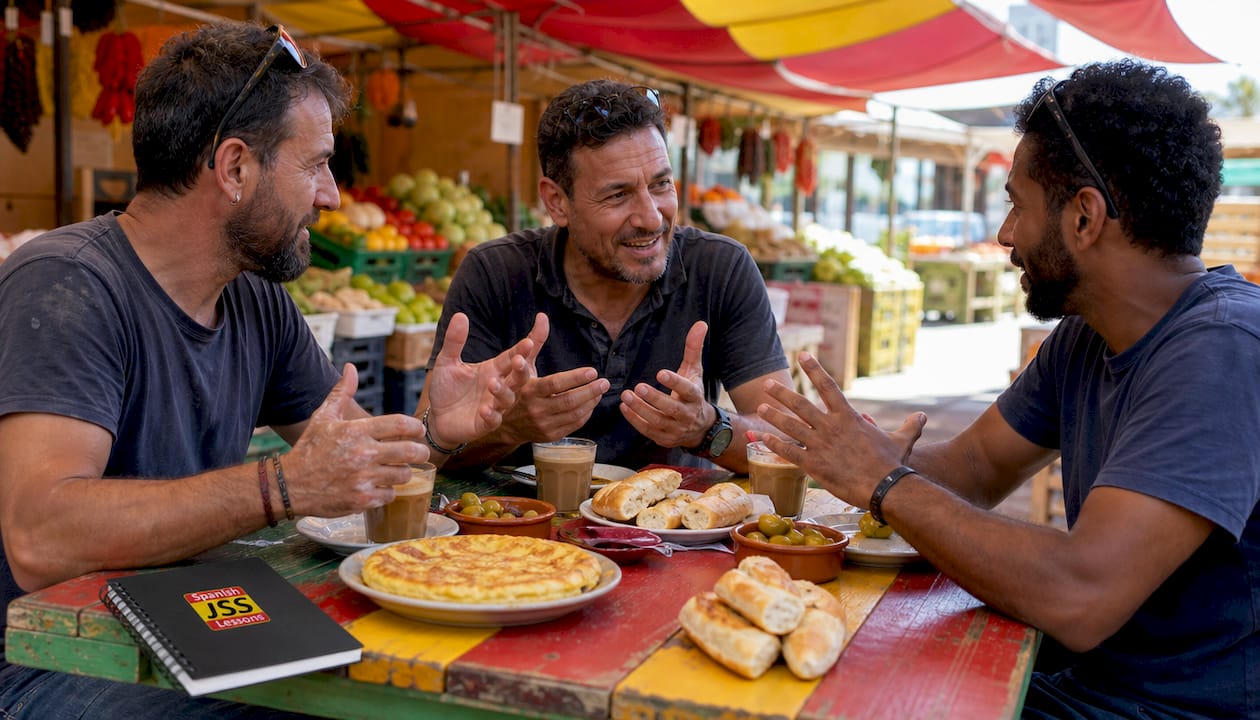
Builders sharing typical almuerzo foods and coffee

The term “builder’s break” is the informal English phrase used by expats and property owners to describe this pause. The correct Spanish term is almuerzo, and using it correctly signals cultural awareness. If you are managing a renovation or building project in Spain, knowing this word will serve you well in conversations with your construction team.

This break sits in the middle of a long working day. Construction crews typically work from 8:00 AM to 6:00 PM, which means the almuerzo falls roughly two to three hours into the shift. Workers often start early on a light stomach, so the mid-morning break functions as a genuine second breakfast. It refuels the body and resets the mind before the heaviest work of the day.


When does the builder’s break happen, and how long does it last?

Timing and duration follow a consistent pattern across Spain, though regional habits create some variation. The key facts are:

  • Start time: The break begins anywhere from 10:30 AM to 11:30 AM, depending on the crew and the employer.
  • Duration: The standard window is 15–30 minutes, though informal extensions are common when workers are at a café.
  • Position in the day: It falls roughly midway between the 8:00 AM start and the longer midday lunch break, which typically runs from 2:00 PM to 3:30 PM.
  • Frequency: One mid-morning break per day is the norm. It is not repeated in the afternoon.
  • Location: Workers leave the site. Expect the site to be empty or unstaffed during this window.

The full builder’s working day in Spain is long by Northern European standards. The 8:00 AM to 6:00 PM schedule includes the almuerzo, a substantial lunch break, and a return to work in the late afternoon. This split-shift structure, known as jornada partida, is deeply rooted in Spanish working culture and explains why the mid-morning pause carries so much weight. Without it, the gap between a 7:30 AM coffee at home and a 2:00 PM lunch would be physically demanding for manual workers.

Pro Tip: If you need to speak with your builder or check on site progress, aim for 9:00 AM to 10:15 AM or after 12:00 PM. Calling or visiting during the break window often means no answer and an empty site.
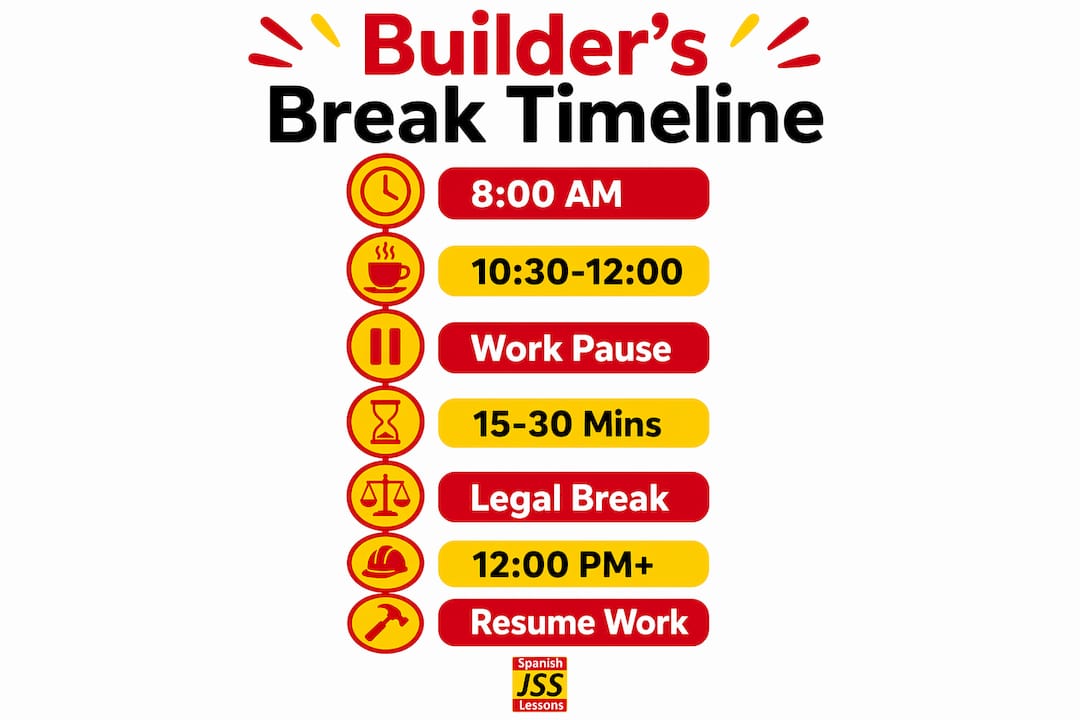
Infographic showing Spanish builder mid-morning break timeline


How does Spanish labour law regulate the mid-morning break?

The builder’s mid-morning break is not a courtesy. It is a legal obligation in Spain’s construction industry. Breaks are contractually mandated through collective agreements and company policies, and the consequences for ignoring them are serious.

A 2026 Spanish Supreme Court ruling confirmed that refusing to take a mandatory break can constitute grounds for lawful dismissal. The case established that the break is not a personal preference a worker can waive. It is an occupational health and safety requirement, particularly in physically demanding sectors like construction. The ruling reinforced what labour lawyers had long argued: mandatory breaks protect workers from fatigue-related accidents on site.

The break is typically unpaid time, but it remains obligatory. Employers cannot instruct workers to skip it in exchange for finishing earlier. Clients who pressure builders to work through the almuerzo risk damaging the working relationship and, in theory, exposing themselves to labour disputes if the employer faces a claim.

Pro Tip: Respecting the builder’s break is not just good manners. It protects you legally and professionally. A builder who feels their rights are respected is far more likely to go the extra mile on your project.


Why is the builder’s mid-morning break culturally significant in Spain?

The almuerzo is one of the clearest windows into how Spain organises its social and professional life. The break fosters social cohesion among workers and should never be read as laziness or inefficiency. It is an energy-sustaining cultural necessity, and treating it as anything less will mark you immediately as someone who does not understand Spain.

“The mid-morning break is where the real conversations happen. Workers share information, solve problems, and build the trust that holds a crew together. The café is as much a part of the worksite as the scaffolding.”

Local bars and cafés play a central role in this ritual. The same group of builders often uses the same café every morning, building a relationship with the owner and a sense of routine that anchors the working day. For expats, this is worth knowing because it means the café near your building site is a genuine social hub, not just a place to grab a coffee. Understanding Spanish cultural habits like this one changes how you read the world around you.

The almuerzo also connects directly to Spain’s broader mealtime culture. Spanish lunch does not happen until 2:00 PM or later, and dinner rarely before 9:00 PM. The mid-morning break bridges the gap between an early, light breakfast and that late lunch. Without it, the Spanish working day would be physiologically unsustainable for manual workers. It is the structural glue that holds the jornada partida together.


How does the builder’s break affect work schedules and project timelines?

For anyone managing a construction or renovation project in Spain, the mid-morning break has direct practical consequences. The table below compares what a typical Northern European client might expect against the reality of a Spanish builder’s day.

Expectation Spanish reality
Continuous work from 8:00 AM to 1:00 PM Work pauses for almuerzo between 10:30 AM and noon
Site always staffed during working hours Site may be empty for 15–30 minutes mid-morning
Noise throughout the morning Noise restrictions (Plan de Ruidos) may limit loud work in certain areas
Project finishes at 5:00 PM Workday extends to 6:00 PM due to break and lunch structure
Quick phone response any time Calls during break window often go unanswered

The Plan de Ruidos regulations add another layer of complexity. In coastal areas and upmarket residential neighbourhoods, noise restrictions limit when builders can use loud machinery. These restrictions sometimes overlap with the mid-morning break window, which means the pause is not always a loss of productive time. Builders often schedule quieter tasks around the break and noisy work earlier in the morning.

The practical advice for expats is straightforward. Plan site visits for early morning or early afternoon. Schedule calls with your project manager outside the 10:30 AM to noon window. Build the break into your timeline expectations from day one. Understanding Spanish construction customs prevents frustration and keeps the working relationship positive.


What do builders eat and drink during the mid-morning break?

The food and drink at the almuerzo follow a clear and consistent pattern across Spain. Common mid-morning foods include:

  • Bocadillo: A small sandwich on crusty bread, typically filled with jamón (cured ham), cheese, or tortilla de patatas (Spanish potato omelette).
  • Tortilla de patatas: A thick slice of potato omelette, served warm or at room temperature. It is filling, cheap, and found in virtually every bar in Spain.
  • Toast with tomato: Bread rubbed with fresh tomato and drizzled with olive oil, sometimes topped with jamón or cheese.
  • Café con leche: A strong espresso with an equal measure of hot milk. This is the standard morning coffee order across Spain and the default drink at the almuerzo.
  • Zumo de naranja: Fresh orange juice, squeezed to order at most Spanish bars, often paired with the coffee.

The almuerzo is deliberately more substantial than the early breakfast, which is often just a coffee at home. It is not, however, a full meal. That distinction belongs to the midday lunch. The mid-morning break fills the energy gap without replacing the main meal, which is why the food choices lean towards filling but not heavy options. Knowing this helps expats understand Spanish meal traditions and participate naturally when invited to join a crew at the local bar.


How James Spanish School helps you understand Spanish culture

Understanding the almuerzo is one piece of a much larger cultural picture. Living well in Spain means reading the rhythms of the day, knowing what to say to your builder at the café, and feeling confident in everyday situations that textbooks never cover.
https://jamesspanishschool.com

James Spanish School was built precisely for this. Founded by James Bretherton, a dual-native speaker with 40 years of life in Spain, the school teaches real Spanish for real situations. The 100-lesson course covers sentence-building and ear-tuning so you can follow fast spoken Spanish, not just read it. The WordAmigo system uses strategic repetition to lock vocabulary and pronunciation into long-term memory. Cultural insights, including workday customs like the builder’s break, are woven throughout. You can explore the full course and start learning at your own pace, on any device, with no expiry date and no pressure.


Key takeaways

The builder’s mid-morning break in Spain is a legally mandated, culturally essential pause that every expat managing a building project or living near a construction site needs to understand and respect.

Point Details
Standard timing The almuerzo falls between 10:30 AM and noon, lasting 15–30 minutes.
Legal status Spanish labour law and 2026 court rulings make the break a mandatory occupational safety requirement.
Cultural role The break builds social cohesion and sustains energy across Spain’s long split-shift working day.
Practical impact Expect an empty site mid-morning; plan calls and visits outside the break window.
Food and drink Bocadillo, tortilla de patatas, and café con leche are the standard choices at local bars and cafés.

FAQ

What is the builder’s mid-morning break in Spain?

The builder’s mid-morning break in Spain is a culturally and legally mandated pause called the almuerzo, taken between 10:30 AM and noon. Workers leave the site to eat and socialise at a local bar or café for 15–30 minutes.

Yes. Spanish labour law and collective agreements make the break a mandatory occupational health and safety requirement. A 2026 Supreme Court ruling confirmed that refusing to take the break can result in lawful dismissal.

What do Spanish builders eat during the mid-morning break?

The typical almuerzo includes a bocadillo (small crusty sandwich), a slice of tortilla de patatas, and a café con leche. Workers buy these at local bars and cafés near the site.

Will the builder’s break delay my construction project?

The break is built into the standard 8:00 AM to 6:00 PM working day and does not extend the overall schedule. Planning site visits and calls outside the 10:30 AM to noon window keeps communication smooth and avoids frustration.

How is the almuerzo different from the Spanish lunch break?

The almuerzo is a light mid-morning pause for snacks and coffee. The main lunch break, which is longer and more substantial, typically runs from 2:00 PM to 3:30 PM and is a separate event in the working day.

Categories
Insights

Role of flexibility in language courses for adult learners


Role of flexibility in language courses

TL;DR:

  • Flexible language courses adapt to individual schedules, boosting learner engagement and language retention. They combine on-demand access, personalized content, and strategic structure to reduce anxiety and improve outcomes. James Spanish School offers a customizable, accessible program designed for busy adults seeking real proficiency.

Flexibility in language courses is defined as the capacity of a course to adapt its schedule, pacing, content, and delivery mode to the individual learner’s life and goals. For adult learners working to build European Spanish proficiency around busy routines, this adaptability is not a convenience. It is the primary driver of whether learning actually sticks. Personalised, flexible tutoring improves test scores by 12% and leads to grade improvement in 80% of learners by targeting individual weaknesses and reducing anxiety. Those numbers tell a clear story: when a course bends to fit your life, you learn more. James Spanish School was built on exactly this principle, offering on-demand access, no expiry dates, and a method designed around how adults genuinely acquire language.


How does flexibility in language courses improve acquisition outcomes?

Flexible learning models produce measurable gains, and the evidence is specific. Blended learning environments report a flexibility satisfaction mean score of 3.73 out of 5, with learners citing better time and place management as the primary benefit. That score reflects something practical: when learners control when and where they study, they show up more consistently.

The HyFlex model, which allows learners to choose between in-person, online synchronous, or online asynchronous participation, produces even stronger results. HyFlex learning increases oral fluency by 18% in secondary EFL students and delivers a statistically significant reduction in speaking anxiety. Reduced anxiety matters enormously for adult learners, who often carry years of self-consciousness about speaking a new language in front of others.

Learner agency is the mechanism behind these gains. Flexible models transform passive recipients into active decision-makers, which significantly increases engagement and long-term investment in the learning process. When you decide how to participate, you take ownership of the outcome.

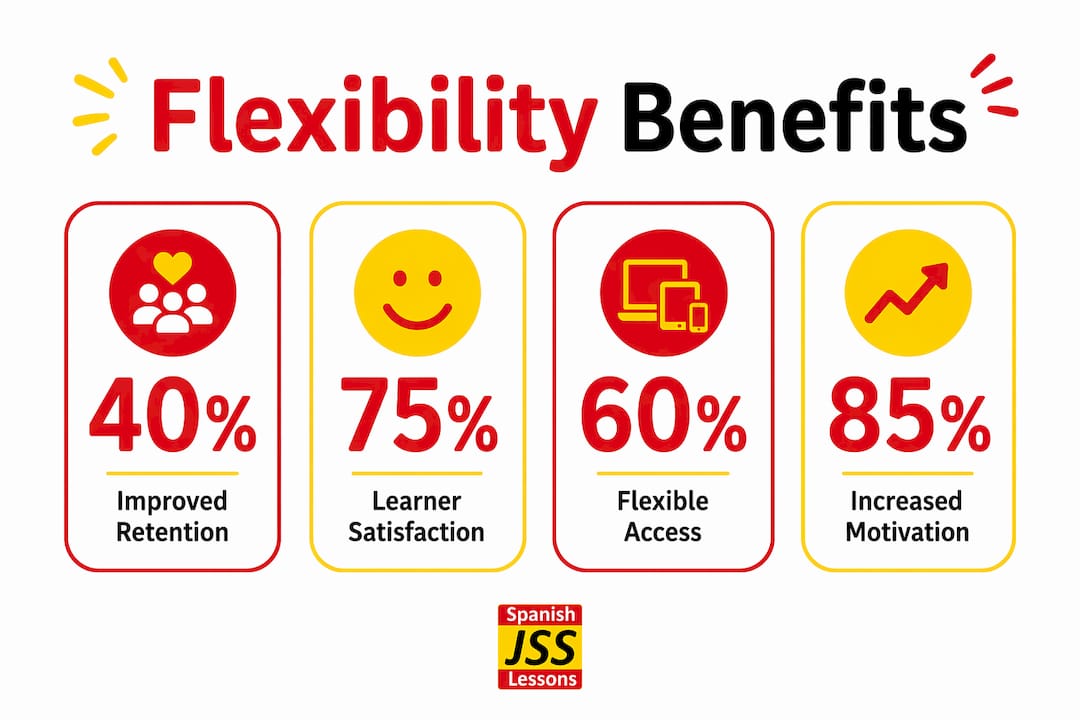
The table below summarises the key evidence on flexibility benefits in language courses.

Infographic showing flexibility benefits statistics

Model Key benefit Evidence
Personalised flexible tutoring 12% test score improvement 80% of learners show grade gains
Blended learning Better time and place management Flexibility satisfaction score 3.73/5
HyFlex model 18% oral fluency improvement Statistically significant anxiety reduction
Learner agency approach Higher engagement and retention Qualitative findings on autonomy

The pattern across all three models is consistent. Flexibility reduces friction, lowers anxiety, and puts the learner in control. Those three factors combine to produce better outcomes than rigid, fixed-schedule instruction.

  • Flexible scheduling removes the “I missed a session, so I’ve fallen behind” problem that derails adult learners.
  • Personalised content targets the specific gaps that matter to each learner, rather than covering ground already mastered.
  • On-demand access means a 20-minute window on a Tuesday evening is as productive as a two-hour Saturday class.
  • Reduced anxiety creates the psychological safety needed to practise speaking, which is where fluency is actually built.

What does flexibility look like in practice?

Adaptive learning in language education takes several concrete forms, and understanding each one helps you choose the right course structure.

  1. Flexible scheduling. The most obvious form of adaptability is timing. A course that runs on demand, 24 hours a day, seven days a week, removes the single biggest barrier for busy adults: the fixed class slot that clashes with work, family, or travel. Flexible tutoring removes friction for busy adults by adapting to their schedules, which directly increases motivation and enjoyment.
  2. Personalised content. Effective adaptive learning targets individual weaknesses rather than delivering the same material to every learner. If your listening comprehension is strong but your sentence construction is weak, a good flexible course redirects resources accordingly. This is the difference between a course that teaches Spanish and a course that teaches you Spanish.
  3. Adaptive pacing. Language acquisition is not a race. Allowing learners to revisit lessons, slow down on difficult structures, and accelerate through familiar territory reflects how memory actually works. James Spanish School’s 100-lesson course has no expiry date and no countdown clock, so learners can repeat any lesson as many times as needed without penalty.
  4. Hybrid human and AI tutoring. The most effective flexible courses combine the consistency of AI-driven repetition with the judgement of an experienced teacher. James Spanish School’s WordAmigo system uses AI-powered strategic repetition to permanently embed vocabulary and pronunciation, while the course content itself is shaped by 40 years of lived experience in Spain.
  5. Metacognitive training. Metacognitive training combined with personalised tutoring enhances the effectiveness of flexible learning by teaching learners how to study effectively. This means understanding your own learning patterns, recognising when you need to revisit a topic, and managing your study time without external pressure.

Pro Tip: Set a fixed minimum study window each day, even if it is only 15 minutes. Consistency beats duration. A flexible course gives you the freedom to choose when; you supply the habit.


Adult learners collaborating in language class

Balancing flexibility with structured progress

Total flexibility without structure is not a learning method. It is a recipe for drifting. The most effective adaptive language courses build structure into their flexibility rather than abandoning it.

Language progress is non-linear by nature. Good language teachers rarely teach in straight lines; effective learning requires spiralling, connection, and revisiting topics to build genuine understanding. A course that moves rigidly from lesson one to lesson one hundred, never looping back, misunderstands how the brain builds language networks.

Flexibility signals a curriculum adapting to how the brain processes language, rather than a weakness in teaching design. The non-linear nature of language acquisition means that revisiting a topic at a higher level of understanding is not repetition for its own sake. It is the mechanism by which knowledge becomes permanent.

The risks of unstructured flexibility are real. Without clear progression pathways, learners lose direction. Without formative checkpoints, they cannot tell whether they are making progress. Flexible learning environments may increase stress without a structured approach, and learner self-regulation and reliable technology access are critical for success. That finding is a useful corrective to the idea that more freedom always means better outcomes.

The solution is a course that offers flexibility within a clear framework. Learners should be able to see where they are, where they are going, and what they have already consolidated. Experienced teachers play a central role here, dynamically adjusting content based on learner performance rather than following a fixed syllabus regardless of progress.

  • Clear module progression gives learners a map, even when they choose their own pace.
  • Formative checkpoints confirm understanding before moving to more complex structures.
  • Spiralling content revisits earlier topics at greater depth, reinforcing rather than repeating.
  • Native language support reduces anxiety and makes new structures accessible without overwhelming the learner.

Allowing native language use in flexible Spanish learning lowers anxiety and burnout, making the target language more accessible. James Spanish School’s method of Radical Simplification applies this directly: James explains Spanish structure through plain English, removing the grammar jargon that creates unnecessary barriers for adult learners.


How can adult learners maximise flexibility benefits in Spanish courses?

Knowing that a course is flexible is one thing. Knowing how to use that flexibility well is another. The benefits of tailored language courses for adult learners are well documented across languages, and the strategies that work are consistent.

Pro Tip: Lower your affective filter by choosing your learning environment deliberately. Studying in a quiet, comfortable space where you feel relaxed produces better retention than forcing yourself through a lesson when you are stressed or distracted.

The following approaches give adult learners the best return from a flexible course structure.

  • Build self-regulation skills first. Tech self-regulation and time management are the foundation of success in any flexible model. Decide in advance when you will study, for how long, and what you will cover. Treat those decisions as commitments rather than intentions.
  • Prioritise real-time feedback. Select courses or tutors that offer targeted feedback on your specific errors. Generic corrections do not build fluency. Feedback that addresses your particular pronunciation or sentence construction errors does. James Spanish School’s feedback-driven approach is built around this principle.
  • Use blended and hybrid formats. Mixing on-demand lessons with live practice sessions, even informal ones with native speakers, accelerates the transition from understanding Spanish to producing it. A flexible way to learn at your own pace works best when it includes varied modes of exposure.
  • Integrate varied materials. Supplement structured lessons with authentic Spanish content: radio, television, conversations with neighbours or tradespeople. James Spanish School’s ear-tuning lessons are specifically designed to help learners follow the machine-gun speed of native Spanish speech, which no textbook alone can replicate.
  • Use native language support strategically. Native language scaffolding lowers affective filters and improves target language accessibility. Do not treat English as the enemy of Spanish learning. Use it as a bridge, then gradually reduce your reliance on it as confidence grows.

The adult learners who succeed in flexible Spanish courses are not necessarily the most talented. They are the most consistent, the most self-aware, and the most willing to use the structure within the flexibility rather than ignoring it.


James Spanish School: flexible Spanish learning for busy adults

James Spanish School offers a course structure built specifically for the realities of adult life. The 100-lesson programme is available on demand, 24/7, with no expiry date and no pressure from a countdown clock.

https://jamesspanishschool.com

The WordAmigo system uses AI-powered strategic repetition to embed vocabulary and pronunciation permanently, addressing the two frustrations that stop most adult learners: words that will not stay in memory and pronunciation that native speakers struggle to follow. Every lesson is accessible on a phone, tablet, or laptop, so learning fits around work, family, and travel rather than competing with them. James Bretherton’s 40 years of living in Spain inform every cultural insight in the course, from Spanish cultural habits for expats to the everyday conversations that matter most. Adult learners ready to build real European Spanish proficiency can view the full course and choose the option that fits their schedule and goals.


Key takeaways

Flexibility in language courses works because it aligns course structure with how adult brains actually acquire language, reducing anxiety, increasing consistency, and enabling personalised progress.

Point Details
Flexibility drives measurable gains Personalised flexible tutoring improves test scores by 12% and benefits 80% of learners.
Structure within flexibility is essential Unstructured freedom increases stress; clear progression pathways keep learners on track.
Learner agency accelerates progress Choosing participation mode transforms passive learners into active, motivated ones.
Native language support reduces barriers Using English strategically lowers anxiety and makes Spanish structures more accessible.
Self-regulation determines success Time management and consistent study habits are the foundation of flexible learning outcomes.

FAQ

What is the role of flexibility in language courses?

Flexibility in language courses means adapting schedule, pacing, and content to the individual learner. Research shows this approach improves test scores by 12% and leads to grade gains in 80% of learners.

Does flexible learning work for adult Spanish learners specifically?

Flexible learning is particularly effective for adults because it removes the scheduling conflicts and anxiety that most commonly disrupt adult language study. On-demand access and personalised content address the two barriers adults face most often.

How does flexibility affect language retention?

Flexible courses that allow learners to revisit topics and spiral back through earlier material reflect how memory consolidates language. Language progress is non-linear, and courses that accommodate this produce stronger long-term retention than linear, fixed-pace programmes.

Can too much flexibility hinder language learning?

Flexibility without structure can increase stress and reduce direction. Learners need clear progression pathways and self-regulation skills to benefit fully from adaptive course formats.

What makes James Spanish School’s approach flexible?

James Spanish School’s 100-lesson course is available on demand with no expiry date, no fixed class times, and the freedom to repeat any lesson as often as needed. The no-deadline approach is designed specifically for adult learners who cannot commit to a fixed weekly schedule.

Categories
Insights

Common Spanish phrases for travel: your essential guide


TL;DR:

  • Learning key Spanish phrases for hotels, dining, transportation, and emergencies helps travelers communicate confidently in Spain. Mastering scripted dialogue patterns and simple sentence formulas reduces anxiety and improves local interactions. Even minimal effort with basic phrases earns appreciation and enhances the travel experience.

Knowing the right common Spanish phrases for travel transforms a trip to Spain from a series of awkward silences into a genuinely rewarding experience. Travel Spanish vocabulary is the practical toolkit that covers everything from checking into your hotel to ordering a plate of jamón in a busy tapas bar. Even limited language efforts earn real appreciation from locals and signal cultural respect. You do not need perfect grammar. You need the right phrases, used with confidence, in the right situations.

1. Which core travel situations require specific Spanish phrases?

Four scenarios account for over 80% of tourist interactions in Spain: hotel check-in, restaurant ordering, asking for directions, and managing taxi rides. That figure matters because it tells you exactly where to focus your preparation time. Spreading your energy across hundreds of random words is far less effective than mastering the phrases that come up again and again.

Guest checking in at hotel reception in Spain

Each of these four situations follows a predictable pattern. A hotel receptionist will ask for your name, your booking reference, and your departure date. A waiter will ask whether you want still or sparkling water. A taxi driver will ask where you are going. When you know the script, you stop panicking and start communicating.

The practical speaking situations you encounter in Spain are far more repetitive than most travellers expect. That repetition is your advantage.

Pro Tip: Prioritise these four core scenarios in your preparation. Nail them first, and you will handle the vast majority of your trip with confidence.

2. What essential Spanish phrases should you know for hotels?

Hotel interactions follow a tight script. Learning that script by heart is more effective than memorising a list of isolated words. The phrases below cover the full arc of a typical hotel stay.

At check-in:

  • Tengo una reserva a nombre de… (I have a booking in the name of…)
  • ¿A qué hora es el desayuno? (What time is breakfast?)
  • ¿Puede darme la llave, por favor? (Can you give me the key, please?)
  • ¿Hay wifi en la habitación? (Is there wifi in the room?)

During your stay:

  • La habitación no tiene toallas. (The room has no towels.)
  • El aire acondicionado no funciona. (The air conditioning is not working.)
  • ¿Puede llamarme un taxi? (Can you call me a taxi?)

At check-out:

  • Quiero hacer el check-out. (I would like to check out.)
  • ¿Puede prepararme la factura? (Can you prepare my bill?)

Notice the vocabulary that recurs: reserva (booking), habitación (room), llave (key), desayuno (breakfast). These are the engine-room words of hotel Spanish. Learn them and the phrases build themselves.

Scripted dialogue patterns train your ear for the follow-up questions a receptionist will ask. That preparation prevents the blank-face moment when a native speaker replies at speed.

Pro Tip: Write your booking name and dates on a card in Spanish before you arrive. Handing it over removes all pressure from the check-in exchange.

3. Which Spanish phrases are most helpful for dining?

Spanish restaurant culture has its own rhythm, and knowing the right expressions puts you in step with it. Spaniards eat late, linger over meals, and expect you to ask for the bill rather than have it brought automatically. Understanding that cultural pattern is as useful as knowing the words.

Ordering and asking for recommendations:

  • ¿Qué recomienda usted? (What do you recommend?)
  • Quiero pedir… (I would like to order…)
  • El menú del día, por favor. (The set menu of the day, please.)
  • ¿Está incluido el pan? (Is bread included?)

Handling dietary needs:

  • Soy vegetariano/a. (I am vegetarian.)
  • Soy alérgico/a a los frutos secos. (I am allergic to nuts.)
  • ¿Contiene gluten? (Does it contain gluten?)

Settling the bill:

  • La cuenta, por favor. (The bill, please.)
  • ¿Está incluido el servicio? (Is service included?)
  • ¿Puedo pagar con tarjeta? (Can I pay by card?)

Knowing how to navigate Spanish menus with confidence takes the guesswork out of ordering. The menú del día is a three-course set lunch offered at a fixed price, typically between €12 and €15, and it is one of the best-value meals in Spain. Asking for it by name immediately marks you out as someone who knows the local way.

Simple formulae like Necesito + noun act as master keys for travel communication. “Necesito una mesa para dos” (I need a table for two) works just as well in a restaurant as “Necesito ayuda” (I need help) works in an emergency.

4. What phrases should you learn for transport and directions?

Getting around Spain requires a small but specific set of essential Spanish travel phrases. Taxis, the metro, buses, and trains each have their own vocabulary, but the core questions overlap considerably.

Taxis and getting around:

  • ¿Cuánto cuesta ir a…? (How much does it cost to go to…?)
  • Lléveme a esta dirección, por favor. (Take me to this address, please.)
  • ¿Puede poner el taxímetro? (Can you put the meter on?)

Public transport:

  • Un billete para…, por favor. (A ticket to…, please.)
  • ¿De qué andén sale el tren? (Which platform does the train leave from?)
  • ¿Dónde está la parada de metro? (Where is the metro stop?)

Asking for directions:

  • ¿Dónde está…? (Where is…?)
  • Todo recto. (Straight ahead.)
  • A la derecha / a la izquierda. (To the right / to the left.)
  • En la esquina. (On the corner.)

Safety phrases that control the pace of a conversation are just as important as the directional vocabulary. “No entiendo” (I do not understand) and “Hable más despacio, por favor” (Please speak more slowly) buy you the time you need to process a reply. “¿Puede escribirlo?” (Can you write it down?) removes the pressure of listening entirely.

Pro Tip: Before any taxi ride, write your destination address in Spanish on your phone. Show it to the driver rather than attempting to pronounce an unfamiliar street name.

5. Which emergency and safety phrases are vital to know?

Emergency phrases form a non-negotiable category of travel Spanish vocabulary. You may never need them, but the cost of not knowing them is too high to ignore.

Core emergency expressions:

  • ¡Ayuda! (Help!)
  • ¡Socorro! (Help! — used in more urgent situations.)
  • Llame a la policía. (Call the police.)
  • Necesito un médico. (I need a doctor.)
  • Llame a una ambulancia. (Call an ambulance.)

Reporting theft or loss:

  • Me han robado. (I have been robbed.)
  • He perdido mi pasaporte. (I have lost my passport.)
  • ¿Dónde está la comisaría? (Where is the police station?)

Health and allergy phrases:

  • Tengo una alergia a… (I am allergic to…)
  • Me duele aquí. (It hurts here.)
  • Necesito ir al hospital. (I need to go to hospital.)
Situation Key phrase Meaning
Urgent help needed ¡Ayuda! / ¡Socorro! Help!
Medical emergency Necesito un médico I need a doctor
Police required Llame a la policía Call the police
Lost documents He perdido mi pasaporte I have lost my passport
Hospital Necesito ir al hospital I need to go to hospital

Save these phrases in a notes app on your phone before you travel. A screenshot works even without mobile data.

6. How to build confidence with Spanish phrase patterns

Language experts recommend treating travel Spanish as a set of scripted exchanges rather than word-for-word translations from English. This shift in thinking is the single most useful adjustment you can make before your trip.

The reason scripted patterns work so well is that they reduce anxiety caused by rapid native speech. When you know the script, you can anticipate the reply. A hotel receptionist who asks “¿Para cuántas noches?” (For how many nights?) is following a predictable sequence. Recognising that sequence is what speaking Spanish fluently with locals actually looks like in practice.

Constructing sentences with simple formulas frees you from complex grammar entirely. “Quiero + [noun or infinitive]” (I want + something) and “¿Dónde está + [place]?” (Where is + place?) are two patterns that generate dozens of useful sentences. You do not need to understand Spanish grammar to use them correctly.

Perfect grammar is unnecessary for travellers. Respectful communication and genuine effort earn better responses from locals than technically correct but robotic speech. Spaniards respond warmly to anyone who tries. The effort itself is the message.

For everyday Spanish situations beyond the tourist trail, the same pattern-based approach applies. Whether you are talking to a pharmacist, a market stallholder, or a neighbour, the structure of the exchange is almost always predictable.

Key takeaways

Mastering common Spanish phrases for travel means learning scripted patterns for the four core scenarios that cover the vast majority of tourist interactions in Spain.

Point Details
Focus on four scenarios Hotels, restaurants, transport, and directions cover over 80% of tourist communication needs.
Learn scripts, not word lists Scripted dialogue patterns train your ear and make replies predictable.
Use simple sentence formulas Patterns like Necesito + noun generate dozens of useful phrases without grammar knowledge.
Know your emergency phrases Phrases like ¡Ayuda! and Necesito un médico are non-negotiable before any trip.
Effort earns respect Even basic Spanish attempts earn genuine appreciation and warmer service from locals.

Build your travel Spanish before you board

Knowing a handful of phrases is a good start. Knowing how to build sentences, follow a conversation, and understand a fast reply is what actually gets you through a trip to Spain with confidence.

https://jamesspanishschool.com

James Spanish School was built for exactly this kind of practical, real-life Spanish. Founded by James Bretherton, a dual-native speaker with 40 years of living in Spain, the school uses a method called Radical Simplification. It removes the grammar jargon and replaces it with plain English explanations that actually make sense. The WordAmigo system uses strategic repetition to lock vocabulary and pronunciation into long-term memory. The 100-lesson course covers both sentence-building and ear-tuning so you can follow what locals actually say. Browse the full range of courses and resources at James Spanish School and travel to Spain ready to speak.

FAQ

What are the most important Spanish phrases for tourists?

The most useful phrases cover hotel check-in, restaurant ordering, asking for directions, and taxi rides. These four scenarios account for over 80% of the interactions a tourist will have in Spain.

Do I need to speak perfect Spanish to get by in Spain?

Perfect grammar is not required. Respectful communication and genuine effort earn better responses from locals than technically correct but stilted speech.

What should I say if I do not understand a Spanish speaker?

Say “No entiendo” (I do not understand) or “Hable más despacio, por favor” (Please speak more slowly). You can also ask “¿Puede escribirlo?” (Can you write it down?) to remove the pressure of listening entirely.

How do I ask for help in an emergency in Spain?

Shout “¡Ayuda!” or “¡Socorro!” to attract attention. Follow with “Necesito un médico” (I need a doctor) or “Llame a la policía” (Call the police) depending on the situation.

Is it worth learning Spanish phrases before a short trip to Spain?

Yes. Even a small set of well-chosen phrases signals cultural respect and consistently leads to warmer, more helpful responses from locals. The preparation pays back many times over during the trip itself.

Categories
Insights

How to make appointments in Spanish: a practical guide


TL;DR:

  • Making appointments in Spanish requires polite phrases, correct date structures, and structured dialogues for effective communication.
  • Using conditional tense forms like “quisiera” and “querría” shows respect and improves cooperation in formal settings.

Making appointments in Spanish requires polite expressions, correct date structures, and a clear dialogue flow to communicate effectively. For English speakers living in Spain, knowing how to make appointments in Spanish is the difference between a smooth visit to the doctor, the town hall, or the bank, and a frustrating exchange that leaves both parties confused. This guide covers the core phrases, date and time formats, cancellation language, and a full sample conversation so you can walk into any appointment with confidence.


What are the key polite phrases for making appointments in Spanish?

The most important phrase to learn is “Quisiera hacer una cita,” which means “I would like to make an appointment.” This uses the conditional tense, which is the polite form in Spanish. The alternative, “¿Puedo hacer una cita, por favor?” works well too, though it is slightly less formal.

The reason the conditional tense matters so much is cultural. Avoiding the imperative mood is not just good manners in Spain. It directly affects how cooperative the person on the other end of the phone or desk will be. Many English speakers instinctively use direct forms, which can come across as blunt or even rude in formal Spanish settings.

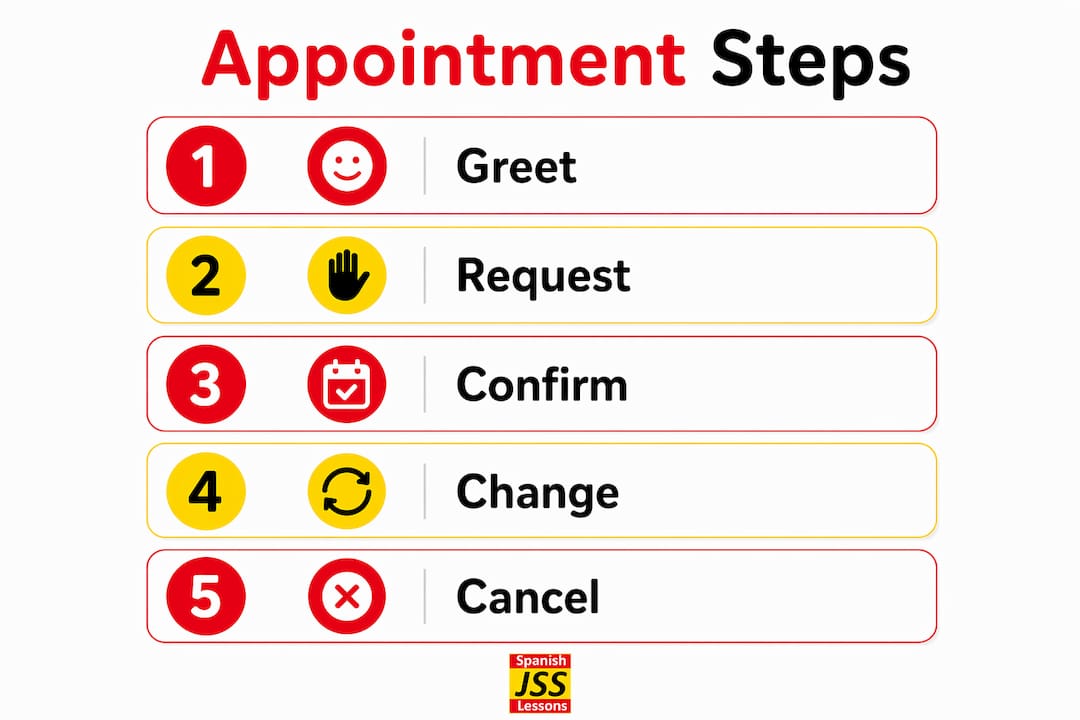
The four-step structure that appointment conversations follow is: greeting, stating your request, discussing availability, and confirming the details. Thinking of it as a structured dialogue, rather than a single sentence to memorise, makes the whole interaction far easier to manage.

Here are the core phrases to have ready:

  • “Buenos días / Buenas tardes” — Good morning / Good afternoon (always open with a greeting)
  • “Quisiera hacer una cita” — I would like to make an appointment
  • “¿Puedo hacer una cita, por favor?” — Can I make an appointment, please?
  • “Querría hablar con el médico” — I would like to speak with the doctor
  • “Necesitaría una cita para esta semana” — I would need an appointment this week
  • “¿Cuándo tienen disponible?” — When do you have availability?
  • “Perfecto, muchas gracias” — Perfect, thank you very much

Pro Tip: Use “querría” and “necesitaría” instead of “quiero” and “necesito.” The conditional forms sound softer and more respectful, and native speakers notice the difference immediately.

The verbs “querría” and “necesitaría” are conditional forms of “querer” and “necesitar.” Using conditional tense verbs like these immediately signals politeness and cultural awareness. That single grammatical choice can change the entire tone of an interaction.


How do you express dates and times correctly for appointments in Spanish?

Spanish dates follow the order of day, then month, then year. The structure uses the preposition “de” between each element. So the 15th of march 2026 becomes “el 15 de marzo de 2026.” Spanish date structures place the day first, which is the opposite of the American format and slightly different from how British English speakers sometimes write dates informally.

Hands writing Spanish appointment date on calendar

One detail that trips up many learners: months and days of the week are not capitalised in Spanish. The Real Academia Española, which is the official authority on the Spanish language, confirms that “lunes,” “martes,” “enero,” and “febrero” are all written in lowercase. This applies in both handwriting and typed communication.

English Spanish Notes
Monday lunes Lowercase in Spanish
Tuesday martes Lowercase in Spanish
15 March 2026 el 15 de marzo de 2026 “de” links each element
At 10:30 AM a las 10:30 Use “a las” for times
At 1:00 PM a la una Singular “la” for 1 o’clock
Half past three a las tres y media Literally “three and a half”
Quarter past four a las cuatro y cuarto Literally “four and a quarter”

Infographic outlining Spanish appointment steps

Time expressions in Spanish use “a las” for most hours and “a la” only for one o’clock. This is a small but consistent rule that avoids confusion when confirming appointment times.

Pro Tip: When giving a date over the phone, say each element slowly and clearly: “el quince de marzo.” Receptionists often write while you speak, so pace yourself rather than rushing through the numbers.

The phrase “¿A qué hora?” means “At what time?” and is the standard question for checking when an appointment falls. “¿Qué día?” asks “Which day?” Combining these two questions covers the most common back-and-forth in any scheduling conversation. For more on Spanish for health care settings specifically, the vocabulary around times and dates follows the same patterns covered here.


How do you change or cancel an appointment politely in Spanish?

Changing or cancelling an appointment requires the same conditional politeness as booking one. The go-to phrase is “¿Podría cambiar la cita?” which means “Could I change the appointment?” The formula “¿Podría…?” combined with “por favor” is a classic softening strategy in formal Spanish communication. It is noticeably gentler than “¿Puede…?” and that difference matters in public offices.

Public administration offices in Spain expect a formal register. Using conditional forms significantly increases cooperation compared to direct imperative forms. This is especially true at the extranjería (immigration office), the Seguridad Social, and local council offices, where staff handle high volumes of requests and respond better to courteous language. If you need to reduce errors at the extranjería, getting the register right from the first sentence makes a real difference.

Useful phrases for cancellations and rescheduling:

  • “Quisiera cancelar mi cita” — I would like to cancel my appointment
  • “¿Podría cambiar la cita para otro día?” — Could I change the appointment to another day?
  • “¿Sería posible aplazarla?” — Would it be possible to postpone it?
  • “Necesitaría cambiarla, si es posible” — I would need to change it, if possible
  • “Es que tengo un imprevisto” — The thing is, something unexpected has come up

That last phrase, “Es que…,” is worth memorising on its own. “Es que…” acts as a conversational softener when explaining reasons for rescheduling. It translates loosely as “The thing is…” or “It’s just that…” and signals to the listener that you are about to give a reasonable explanation rather than a demand. Native speakers use it constantly, and it makes your Spanish sound natural rather than textbook.


What does a typical appointment conversation look like in Spanish?

Viewing appointment making as a structured dialogue rather than a single phrase improves your ability to navigate the full conversation. The four stages are consistent across most settings, from a GP surgery to a hairdresser.

Here is how a typical exchange unfolds:

  1. Greeting. You say “Buenos días” and the receptionist responds in kind. Always open with a greeting before stating your purpose.
  2. Stating your request. “Quisiera hacer una cita con el médico, por favor.” You have used the conditional, named who you need, and added “por favor.” That covers the essentials.
  3. Discussing availability. The receptionist asks “¿Cuándo le viene bien?” (When suits you?) or “¿Tiene preferencia de día?” (Do you have a day preference?). You respond with “El martes o el miércoles, si es posible” (Tuesday or Wednesday, if possible).
  4. Confirming the details. The receptionist offers a slot: “Le puedo dar el martes a las 11:00.” You confirm: “Perfecto, el martes a las 11:00. Muchas gracias.”
Stage Your phrase What it achieves
Greeting “Buenos días” Opens the interaction politely
Request “Quisiera hacer una cita” States purpose with conditional politeness
Availability “El martes o el miércoles” Gives options without being demanding
Confirmation “Perfecto, muchas gracias” Closes the exchange clearly

Clear confirmations like “Entonces, la cita es el jueves a las 2:30, ¿correcto?” prevent misunderstandings. Repeating the day and time back to the receptionist is standard practice and shows you are organised. It also gives the other person a chance to correct any error before you hang up or leave.

One practical tip: speak at a measured pace. Native Spanish speakers often reply at speed, and the instinct is to match that pace. Resist it. Speaking clearly and at a moderate speed signals confidence, not uncertainty, and gives you time to process what is being said to you. For spoken Spanish practice in realistic dialogue settings, rehearsing these four stages repeatedly is the most effective preparation.


Key takeaways

Mastering appointment conversations in Spanish requires polite conditional phrases, correct date structures, and a clear four-stage dialogue framework.

Point Details
Use the conditional tense “Quisiera” and “querría” signal politeness and get better results than direct forms.
Follow the four-stage structure Greeting, request, availability, and confirmation cover every appointment scenario.
Dates go day, month, year Write “el 15 de marzo de 2026” and keep months and weekdays in lowercase.
Soften cancellations with “Es que…” This phrase explains your reason naturally and avoids sounding demanding.
Confirm details out loud Repeating the day and time back prevents errors and shows you are organised.

How James Spanish School can help you practise these conversations

Knowing the phrases is one thing. Feeling confident enough to use them in real time is another. James Spanish School was built specifically for English-speaking adults living in Spain who need practical Spanish for everyday life, not academic exams.

https://jamesspanishschool.com

The 100-lesson course from James Spanish School covers sentence-building and ear-tuning, which is exactly what you need when a receptionist replies at speed and you have to process and respond quickly. The WordAmigo system embeds vocabulary and pronunciation through strategic repetition, so phrases like “Quisiera hacer una cita” become automatic rather than effortful. Everything is available on demand, 24/7, with no expiry date and no pressure. If you want to build real confidence for appointments, council offices, and daily life in Spain, the JSS course range is the place to start.


FAQ

What is the most polite way to ask for an appointment in Spanish?

The most polite form is “Quisiera hacer una cita, por favor,” using the conditional tense. Conditional verbs like “quisiera” and “querría” are standard in formal Spanish settings and produce better results than direct imperative forms.

How do you write dates correctly in Spanish?

Spanish dates follow the order of day, month, and year, linked by “de”: for example, “el 15 de marzo de 2026.” Months and days of the week are written in lowercase, as confirmed by the Real Academia Española.

How do you confirm an appointment in Spanish?

Repeat the day and time back to the receptionist using a phrase like “Entonces, la cita es el martes a las 11:00, ¿correcto?” This avoids misunderstandings and is standard practice in Spanish-speaking settings.

What should you say to cancel an appointment in Spanish?

Use “Quisiera cancelar mi cita, por favor” for a straightforward cancellation. To reschedule, say “¿Podría cambiar la cita para otro día?” and add “Es que…” followed by your reason to soften the request naturally.

Why does the conditional tense matter so much for appointments in Spanish?

Public administration offices and medical receptions in Spain expect a formal register. Using conditional forms like “¿Podría…?” and “Necesitaría…” signals respect and cultural awareness, and it directly increases how cooperative staff are in response.

Categories
Insights

Spanish queuing culture explained for English speakers


TL;DR:

  • Spanish queuing relies on verbal communication where people ask who is last to establish their place. This social trust-based system functions in informal settings but is replaced by ticket machines in formal environments like banks. To adapt, foreigners should ask “Who is last?” upon arrival and acknowledge their position loudly to maintain the flow.

Spanish queuing culture is an informal, socially negotiated system where people verbally establish their place in a queue rather than standing in a rigid physical line. Instead of forming an orderly row, Spaniards ask a simple question on arrival, track their position through conversation, and trust the group to manage the order collectively. For English speakers moving to Spain or visiting regularly, understanding this system is not optional. It is the difference between fitting in and being permanently overlooked at the bakery counter.

Young man verbally joining a Spanish queue


What is Spanish queuing culture and how does it work?

The standard term for this practice is the “invisible queue,” and it operates on a principle of verbal social negotiation rather than physical positioning. When you walk into a Spanish bakery, pharmacy, or deli, you will rarely see a neat line of people. What you will see looks, to British eyes, like a crowd of people chatting, browsing, or simply standing around. That crowd is, in fact, a perfectly functioning queue.

The system works because every person who arrives asks one question: “¿Quién es el último?” This translates as “Who is last?” The person who answers confirms they are currently last, and you mentally note that you are after them. You can then step away or browse freely, because your position is held not by your physical location but by the group’s collective awareness of who arrived when.

The key phrases you need are:

  • ¿Quién es el último? (“Who is last?”) — use this every time you enter an informal queue
  • ¿Quién da la vez? (“Who gives the turn?”) — a regional variant with the same function
  • Yo soy el último / la última (“I am last”) — what you say when the next person arrives after you

Pro Tip: When someone new walks in after you, it is your responsibility to tell them you are last. This reciprocal system only functions when everyone participates. Staying silent is not neutral; it breaks the chain.

The invisible queue also allows genuine freedom of movement. People may wander, sit, or step outside briefly, and others will alert them when their turn is near, provided they identified themselves properly on arrival. This is not chaos. It is a distributed, self-managing system that has worked reliably for generations. You can read more about the origins of this behaviour in this detailed look at why Spaniards don’t queue in the conventional sense.

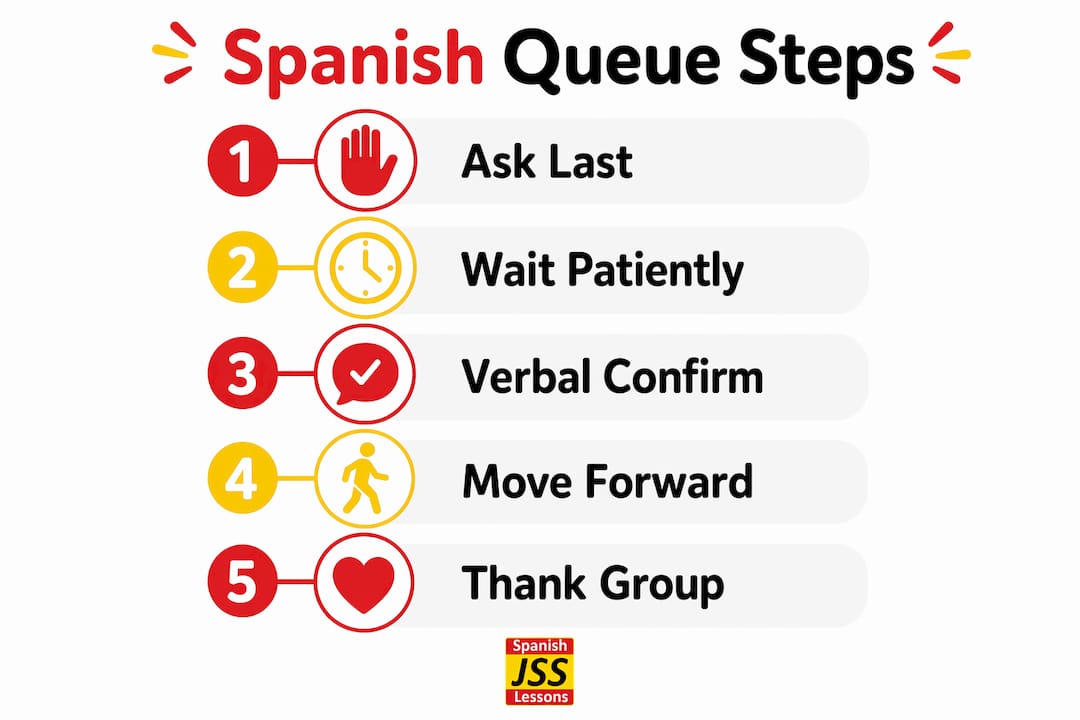
Infographic outlining steps of Spanish queuing etiquette


What social values shape Spanish queuing habits?

Spanish queuing behaviour reflects something deeper than a preference for informality. The invisible queue is rooted in social trust and a cultural preference for interpersonal interaction over impersonal, rigid structures. Waiting is treated as a communal experience, not a solitary inconvenience to be endured in silence.

In British culture, the queue is a moral institution. Standing in line signals patience, fairness, and respect for rules. Jumping a queue is a near-criminal act. In Spain, the equivalent moral signal is verbal participation. Engaging with the group, announcing your arrival, and acknowledging others demonstrates that you are a trustworthy member of the social moment. Silence, by contrast, reads as either ignorance or rudeness.

“What can appear disorganised to a foreign eye is actually a functional system where waiting is communal and polite participation requires verbal acknowledgement. The queue is not a line. It is a conversation.”

This distinction matters enormously for expats. Failing to ask who is last is interpreted as being unaware of, or indifferent to, the social group. The consequence is practical: you will simply be overlooked when your turn comes, because nobody knows where you fit in the order. The system is not designed to exclude you. It just requires you to opt in verbally.

Common misconceptions among foreigners include assuming that the person nearest the counter is next, or that arriving first guarantees priority without verbal confirmation. Neither is true. Position in a Spanish queue is a social fact, not a physical one. Understanding this shifts the entire experience from frustrating to fascinating.


When do formal queuing systems apply in Spain?

Not every setting in Spain uses the invisible queue. Formal establishments such as post offices and banks commonly use ticket machines with automated numbering systems. You take a numbered ticket on arrival, wait until your number appears on a screen, and approach the counter. This removes all ambiguity and requires no verbal interaction whatsoever.

The table below shows where each system typically applies:

Setting Queuing type What to do
Bakery, deli, market stall Informal / invisible Ask ¿Quién es el último? on arrival
Pharmacy Often informal Ask on arrival; some use tickets
Post office Formal ticket system Take a numbered ticket from the machine
Bank Formal ticket system Take a numbered ticket from the machine
Medical centre Mixed / appointment-based Announce arrival at reception; observe group
Supermarket checkout Physical line Stand in the visible queue as normal

Medical waiting rooms deserve special mention. Appointment punctuality in Spanish healthcare is fluid, and service order is often socially negotiated amongst patients in the waiting area rather than strictly governed by appointment times. Patients observe group cues and arrival order rather than relying on appointment slips alone. Announcing your arrival to reception and paying attention to who was there before you remains the safest approach.

The mixed environments are where English speakers most often come unstuck. A large supermarket deli counter may use tickets on busy Saturday mornings but revert to the invisible queue on a quiet Tuesday afternoon. When in doubt, look for a ticket machine first. If there is none, ask ¿Quién es el último?


Practical tips for adapting to Spanish queue etiquette

Adapting to Spanish waiting customs is straightforward once you accept that the system is verbal, not physical. The following steps will serve you well in the vast majority of everyday situations.

  1. Ask immediately on arrival. The moment you enter any shop or waiting area without an obvious physical line, say ¿Quién es el último? Do not wait, observe, or hover. Asking promptly is the polite act.
  2. Confirm your position out loud. When someone answers your question, make brief eye contact and acknowledge them. A simple “Vale, gracias” (“OK, thanks”) confirms the exchange and locks in your place.
  3. Announce yourself to the next arrival. When someone new enters after you, tell them you are last. Say “Yo soy el último” (or “la última” if you are a woman). This is your social obligation in the system.
  4. Stay loosely aware of the group. You do not need to stand rigidly in one spot, but keep an eye on the counter. The group will alert you when your turn approaches if you have identified yourself, but wandering too far risks missing your moment.
  5. Do not interpret conversation as queue-jumping. Spaniards often chat with shop staff or other customers while waiting. This is normal social behaviour, not an attempt to gain advantage. Relax and treat the wait as a social moment rather than a competitive exercise.

Pro Tip: Pronunciation matters here. If your Spanish is hesitant, the phrase ¿Quién es el último? can feel daunting at speed. Practising it aloud before you walk into a shop takes ten seconds and removes the anxiety entirely. James Spanish School’s spoken Spanish practice lessons include exactly this kind of real-life phrase work.

Successful adaptation requires a genuine mindset shift: from treating a queue as a rigid structure to treating it as a group activity. Once that shift happens, the system feels natural rather than chaotic. For a broader view of the cultural habits that shape daily life in Spain, the guide to must-know Spanish cultural habits for expats covers many of the same social dynamics in other contexts. Getting your pronunciation right also helps enormously; structured pronunciation training versus app-based learning is worth understanding before you commit to a method.


Key takeaways

Spanish queuing culture is a self-managed, verbal system where social participation replaces physical lines, and silent waiting is the single most common mistake English speakers make.

Point Details
The invisible queue is the norm Most informal settings use verbal position-tracking, not physical lines.
One phrase unlocks the system Asking ¿Quién es el último? on arrival is the essential act of joining any informal queue.
Silence is a social error Failing to announce your arrival or update the next person causes you to lose your place.
Formal settings use ticket machines Post offices, banks, and some pharmacies use numbered tickets; look for the machine first.
Medical queues are socially negotiated Healthcare waiting rooms follow arrival order and group awareness, not strict appointment times.

How James Spanish School helps you fit into real Spanish life

Understanding queuing norms in Spain is one piece of a much larger picture. Daily life as an English speaker in Spain involves dozens of small social codes: how to greet a neighbour, how to speak to a tradesman, how to navigate a government office. Getting these right requires real language, not textbook Spanish.

https://jamesspanishschool.com

James Spanish School was built specifically for English-speaking adults who want to function confidently in everyday Spanish life. The 100-lesson course covers practical, real-world situations, and James Bretherton, a dual-native speaker with 40 years of life in Spain, shares the cultural insider knowledge that no grammar book includes. The WordAmigo system then locks vocabulary and pronunciation into long-term memory through strategic repetition, so the phrases you practise actually stay with you. Explore the full course range at James Spanish School and see how quickly real-life Spanish becomes manageable.


FAQ

What does ¿Quién es el último? mean and when do I use it?

It means “Who is last?” and you use it every time you enter an informal queue in Spain, such as at a bakery, pharmacy, or market deli counter. It is the standard phrase for joining an invisible queue and signals to the group that you are participating in the system.

Why do Spanish queues look so disorganised to British eyes?

Spanish queuing relies on verbal acknowledgement and social trust rather than physical lines, so there is no visible row of people. What appears disorganised is a functioning self-managed system where position is tracked collectively by the group.

What happens if I stay silent in a Spanish queue?

Remaining silent means nobody knows where you fit in the order. Expats who do not ask who is last are routinely overlooked when their turn comes, because the system depends entirely on verbal participation.

Do all places in Spain use the informal queue system?

No. Post offices, banks, and many pharmacies use automated ticket machines with numbered displays. Supermarket checkouts use standard physical lines. The informal verbal system applies mainly to smaller shops, market stalls, and some waiting rooms.

How does queuing work in Spanish medical centres?

Medical waiting rooms in Spain often follow arrival order and group awareness rather than strict appointment times. Appointment punctuality is fluid, so announcing your arrival at reception and observing who was present before you is the reliable approach.

Categories
Insights

Spanish vocabulary for shopping: the expat’s practical guide


TL;DR:

  • Learning polite phrases and market-specific vocabulary helps travelers communicate confidently in Spanish shops. Training your ear to understand fast, natural speech is essential for real-world conversations.

Spanish vocabulary for shopping is the set of words and phrases English-speaking travellers and expats need to communicate confidently in Spanish markets and shops. Without it, even a simple trip to the market becomes a guessing game. With the right phrases, you get better service, avoid misunderstandings, and start to feel genuinely at home in Spain. This guide covers everything from polite openers to market bargaining, checkout questions, and handling returns, so you can walk into any Spanish shop and hold your own.


1. Core polite phrases for asking for help in Spanish shops

Politeness is the single most effective tool in any Spanish shop. Polite “usted” forms such as “¿Me puede ayudar?” are recommended by language guides for travellers and expats to improve customer service interactions. Using “usted” instead of “tú” signals respect, and Spanish shop staff respond warmly to it.

The phrases below form your foundation. Learn these before anything else:

  • ¿Me puede ayudar? (“Can you help me?”) — your go-to opener in any shop
  • Por favor (“Please”) — attach it to almost any request
  • Muchas gracias (“Thank you very much”) — always close an exchange with this
  • Disculpe (“Excuse me”) — use it to get a shop assistant’s attention politely
  • ¿Tiene…? (“Do you have…?”) — the simplest way to ask for a product
  • No entiendo (“I don’t understand”) — honest and always appreciated
  • ¿Puede repetir más despacio? (“Can you repeat more slowly?”) — vital when the reply comes at machine-gun speed

Courtesy phrases such as “por favor,” “gracias,” and “disculpe” make shopping exchanges smoother and more pleasant. That is not just politeness for its own sake. It genuinely changes how staff treat you, and in smaller local shops, it builds the kind of rapport that gets you the best produce or the last item in stock.

Pro Tip: Mastering polite defaults like “por favor” and the “usted” form is more effective than memorising long word lists. Two or three well-delivered phrases beat twenty hesitant ones every time.


2. Sizes, colours, and trying on clothes

Clothing shops require a specific set of phrases. Knowing how to ask about sizes and colours, and how to request the fitting room, saves you from a lot of awkward miming.

Key phrases for clothing:

  • ¿Tiene otra talla? (“Do you have another size?”)
  • ¿Lo tienen en otro color? (“Do you have it in another colour?”)
  • ¿Dónde está el probador? (“Where is the fitting room?”)
  • ¿Puedo probármelo? (“Can I try it on?”)
  • Me queda bien (“It fits me well”)
  • Me queda pequeño / grande (“It’s too small / too big for me”)
  • ¿Tiene una talla más grande / más pequeña? (“Do you have a size bigger / smaller?”)

The key size words to remember are: talla (size), pequeño (small), mediano (medium), and grande (large). Spanish clothing sizes follow European sizing, so a UK size 12 is typically a Spanish size 40 in women’s clothing. Knowing this before you go in saves confusion at the till.

Colour vocabulary is straightforward but worth drilling. Rojo (red), azul (blue), verde (green), negro (black), blanco (white), and gris (grey) cover most situations. If you want a specific shade, point and say “¿Lo tiene en este color?” (“Do you have it in this colour?”) while gesturing at a reference item.

Man checking shirt size and color in Spanish boutique

Pro Tip: In smaller boutiques, staff often bring items directly to you once you ask. A simple “¿Tiene algo similar en azul?” (“Do you have something similar in blue?”) can open up options that are not on display.


3. How to ask for prices and manage payment in Spanish

Price and payment questions are the most frequently used shopping phrases in Spanish. Key checkout phrases such as “¿Cuánto cuesta?,” “¿Aceptan tarjeta?,” and “¿Tiene descuento?” appear in every practical guide to shopping interactions. Getting these right means the transaction flows without awkwardness.

  1. ¿Cuánto cuesta? (“How much does it cost?”) — standard in any fixed-price shop
  2. ¿Cuánto es en total? (“How much is it in total?”) — use at the checkout
  3. ¿Aceptan tarjeta? (“Do you accept card?”) — always worth asking in smaller shops
  4. ¿Puedo pagar con tarjeta? (“Can I pay by card?”) — a slightly more polite variant
  5. ¿Tiene cambio? (“Do you have change?”) — useful when paying with a large note
  6. ¿Tiene descuento? (“Do you have a discount?”) — direct and perfectly acceptable
  7. ¿Hay alguna oferta? (“Is there any offer on?”) — good for spotting sales
  8. La cuenta, por favor (“The bill, please”) — used in shops as well as restaurants

Sale vocabulary is worth knowing separately. Descuento means discount, oferta means a special offer, and rebaja refers specifically to sale-season reductions. Spanish shops run formal sales periods, called las rebajas, typically in january and july. Spotting a “Rebajas” sign in a window tells you prices have dropped significantly.

Context-dependent vocabulary matters here. “¿Cuánto cuesta?” works perfectly in a fixed-price shop, but sounds slightly odd at a market stall where prices fluctuate. The market equivalent comes in the next section.

Pro Tip: Many smaller Spanish shops still prefer cash. Always carry some euros, and keep small notes handy. Asking “¿Aceptan tarjeta?” before you reach the till avoids an embarrassing scramble.


4. Market phrases for fresh produce and weighted items

Local Spanish markets operate on different rules from high-street shops. Shopping vocabulary is highly context-dependent, and using the right phrases for markets versus fixed-price stores makes a real difference to how interactions go.

The key phrase for price at a market is “¿A cuánto está el kilo de…?” (“How much is a kilo of…?”). This is the standard phrase for produce pricing by weight, and it signals to the stallholder that you know how markets work. Compare it with “¿Cuánto cuesta?” which implies a fixed, labelled price.

For ordering quantities, the verb “Póngame” is the most natural and polite way to request items by weight. It is preferred over “Deme” because it sounds less abrupt. Use it like this:

  • Póngame un kilo de manzanas (“Give me a kilo of apples”)
  • Póngame medio kilo de queso (“Give me half a kilo of cheese”)
  • Póngame doscientos gramos de jamón (“Give me 200 grams of ham”)

Key market nouns to know:

  • Manzana (apple), naranja (orange), tomate (tomato)
  • Queso (cheese), jamón (ham), pollo (chicken)
  • Panadería (bakery), carnicería (butcher’s), frutería (fruit stall)
  • Mercado (market), puesto (stall)

The expression “hacer la compra” is the standard Spanish phrase for doing the weekly grocery shop. Using it naturally in conversation signals cultural fluency and builds local rapport. Saying “Vengo a hacer la compra” (“I’ve come to do the shopping”) to a regular stallholder marks you as someone who belongs, not just a passing tourist.

Market phrase Meaning When to use
¿A cuánto está el kilo? How much per kilo? Fresh produce with variable prices
Póngame un kilo de… Give me a kilo of… Ordering by weight
¿Está fresco? Is it fresh? Checking quality of fish or meat
¿Qué me recomienda? What do you recommend? Asking for the stallholder’s best pick

5. Handling returns, exchanges, and problems politely

Returns and exchanges require calm, clear language. Spanish shop staff are generally helpful, but the process goes more smoothly when you use the right phrases from the start.

Core phrases for returns and exchanges:

  • Quisiera devolver esto (“I would like to return this”) — polite and direct
  • Quiero cambiar esto (“I want to exchange this”) — use when swapping for a different size or colour
  • ¿Cuál es la política de devoluciones? (“What is the returns policy?”) — ask this before you hand anything over
  • Tengo el recibo (“I have the receipt”) — always lead with this; it speeds everything up
  • Está defectuoso (“It is faulty”) — use when describing a product problem
  • No funciona (“It doesn’t work”) — straightforward for electrical or mechanical items
  • Me gustaría un reembolso (“I would like a refund”) — clear and polite

The tone matters as much as the words. Spanish customer service culture values calm, respectful dialogue. Raising your voice or showing frustration rarely helps and often slows things down. A quiet “Disculpe, tengo un problema con esto” (“Excuse me, I have a problem with this”) opens the conversation far better than a blunt complaint.

Keep your receipt. Spanish shops are not legally required to accept returns without one, and many smaller shops will simply decline. The phrase “¿Puedo cambiar esto si no me queda bien?” (“Can I exchange this if it doesn’t fit?”) is worth asking at the point of purchase, before you leave the shop.


6. Tuning your ear to fast spoken Spanish in shops

The hardest part of shopping in Spanish is not speaking. It is understanding the reply. Effective vocabulary learning focuses on listening to rapid, combined native phrases rather than textbook isolated words. Shop assistants in Spain speak quickly, run words together, and use regional expressions that no phrasebook covers.

The phrase “¿Algo más?” (“Anything else?”) is one of the most common things you will hear at a market or bakery counter. It comes fast and sounds like one word. Knowing it in advance means you can answer “No, gracias, es todo” (“No, thank you, that’s everything”) without freezing. Similarly, “¿Tiene la tarjeta de fidelidad?” (“Do you have a loyalty card?”) is a standard checkout question in supermarkets. You will hear it every single time.

Tuning your ear to quick, combined spoken phrases used by native shop assistants is a skill that develops separately from vocabulary. You can know every word on this page and still struggle when a cashier fires three sentences at you in four seconds. The solution is deliberate listening practice, not more word lists. James Spanish School’s 100-lesson course dedicates a full strand to ear-tuning, training you to follow fast, natural Spanish as it actually sounds in shops, markets, and everyday life. The fast Spanish comprehension strategies in that course are built specifically for this problem.


Key takeaways

Mastering Spanish shopping vocabulary means learning polite phrases first, context-specific terms second, and training your ear to follow fast native speech third.

Point Details
Politeness opens doors Use “usted” forms and “por favor” in every interaction to get better service.
Context changes the phrase “¿Cuánto cuesta?” suits fixed-price shops; “¿A cuánto está el kilo?” suits markets.
“Póngame” sounds local Use “Póngame un kilo de…” at market stalls to sound natural and polite.
Keep your receipt Returns without a receipt are not guaranteed in Spanish shops; always ask the policy first.
Ear-tuning is non-negotiable Fast spoken replies are the real challenge; deliberate listening practice solves it.

Build your shopping Spanish with James Spanish School

Knowing the phrases is one thing. Feeling confident enough to use them in a busy market or at a supermarket checkout is another. James Spanish School is built for exactly this situation.

https://jamesspanishschool.com

The JSS vocabulary and conversation courses are designed for English-speaking adults living in or travelling to Spain. James Bretherton, a dual-native speaker with 40 years in Spain, teaches you the phrases that actually come up in shops, markets, and daily life, not the ones that fill textbooks. The WordAmigo system uses strategic repetition to lock vocabulary into long-term memory, and the ear-tuning lessons train you to follow fast, natural Spanish replies. Everything is on demand, available 24/7 on your phone, tablet, or laptop. There is no expiry date and no pressure. You learn at your pace, repeat what you need, and build real confidence one conversation at a time.


FAQ

What are the most useful Spanish phrases for shopping?

“¿Me puede ayudar?,” “¿Cuánto cuesta?,” “¿Aceptan tarjeta?,” and “Por favor” cover the majority of everyday shopping interactions. Polite “usted” forms consistently produce better service responses.

How do I ask for prices at a Spanish market?

Use “¿A cuánto está el kilo de…?” for fresh produce sold by weight. This phrase signals you understand market pricing, unlike “¿Cuánto cuesta?,” which implies a fixed label price.

What does “hacer la compra” mean?

“Hacer la compra” is the standard Spanish expression for doing the weekly grocery shop. Using it naturally marks you as culturally aware and builds rapport with local stallholders.

How do I return something in a Spanish shop?

Say “Quisiera devolver esto” and present your receipt. Always ask “¿Cuál es la política de devoluciones?” before purchasing, as smaller shops are not required to accept returns without proof of purchase.

Why do I struggle to understand shop assistants even when I know the words?

Native Spanish speakers combine words and speak quickly in natural conversation. Listening to rapid spoken phrases rather than isolated textbook words is the recommended approach for building real comprehension in shops and markets.

Categories
Insights

How to greet in Spanish: a practical guide for English speakers


TL;DR:

  • Mastering Spanish greetings involves understanding social context, time of day, and formality levels.
  • Using “Hola” as a universal greeting works anytime, with formal and informal situations alike.
  • Properly pairing greetings with polite questions and introductions builds confidence in real conversations.

Knowing how to greet in Spanish is the single most important conversational skill you can build before setting foot in a Spanish-speaking country. A greeting is not just a formality. It signals respect, sets the tone for everything that follows, and tells the person you are speaking to that you understand their culture. Spanish has a clear system of greetings tied to time of day, social context, and the relationship between speakers. Master that system, and every conversation starts on solid ground.

What are the common Spanish greetings and their meanings?

The most versatile Spanish greeting is Hola, meaning “hello.” Hola works universally for friends, family, strangers, and colleagues alike, regardless of the time of day or the level of formality. That makes it the safest starting point for any learner.

Beyond Hola, Spanish greeting phrases are organised by time of day:

  • Buenos días — “Good morning.” Used from sunrise until noon.
  • Buenas tardes — “Good afternoon.” Used from noon until early evening.
  • Buenas noches — “Good evening” or “Good night.” Used from evening onwards, and also as a farewell at night.
  • Buenas — An informal shortening of any of the above, used casually throughout the day.

Casual greetings go further than simple hellos. Informal phrases like ¿Qué tal? (“How’s it going?”), ¿Qué pasa? (“What’s happening?”), and the regional ¿Cómo andas? (“How are you getting on?”) add warmth and familiarity among peers. These expressions are common among friends and younger speakers, but they are not appropriate in formal or professional settings.

Knowing the right response matters just as much as the greeting itself. When someone says ¿Qué tal?, a natural reply is Bien, gracias (“Fine, thanks”) or Muy bien (“Very well”). Pairing a greeting with a polite inquiry, such as Buenos días, ¿cómo está usted?, creates a positive first impression and shows genuine social awareness.

People practicing informal Spanish greetings by café table

How do formal and informal Spanish greetings differ?

The formal and informal divide in Spanish is not just about vocabulary. It reflects a social code that Spanish speakers take seriously. Using greetings correctly signals respect and shapes how people perceive you from the very first exchange.

Infographic comparing formal and informal Spanish greetings

The key difference lies in the pronoun used to address someone. Tú is informal, used with friends, family, children, and peers. Usted is formal, used with strangers, elders, authority figures, and in professional settings. That pronoun choice changes the greeting phrase that follows.

Formal greetings and phrases:

  • ¿Cómo está usted? — “How are you?” (formal, to a stranger or elder)
  • ¿Cómo está? — “How are you?” (formal, slightly less explicit but still polite)
  • Mucho gusto — “Pleased to meet you” (formal introduction)
  • Buenos días, señor / señora — “Good morning, sir / madam”

Informal greetings and phrases:

  • ¿Cómo estás? — “How are you?” (informal, to a friend or peer)
  • ¿Qué tal? — “How’s it going?” (casual, among friends)
  • ¡Hola! ¿Qué pasa? — “Hey! What’s up?” (very casual, among close friends)

The formal usted form is standard in professional settings and when addressing elders. Switching to tú too early can come across as presumptuous or disrespectful. Spanish speakers will usually signal when it is appropriate to drop the formality.

Pro Tip: When you are unsure which level of formality to use, err on the formal side. Using usted with someone who expected tú is easily forgiven. The reverse is far more likely to cause offence, particularly with authority figures or older people.

How do you greet someone at different times of day in Spanish?

Time-based greetings are a cornerstone of Spanish politeness. Choosing the right one shows that you are paying attention, not just reciting a phrase from a phrasebook.

Time of day Spanish greeting English meaning Notes
Morning to noon Buenos días Good morning Formal and informal use
Noon to evening Buenas tardes Good afternoon Switches at midday
Evening and night Buenas noches Good evening / Good night Also used as a farewell
Any time (casual) Buenas Hi / Hello Informal shortening

Buenos días covers the morning until noon, at which point Buenas tardes takes over and runs through to early evening. Buenas noches begins at dusk and doubles as a farewell when leaving at night. That dual function surprises many English speakers, who are used to “good night” meaning only a goodbye.

A well-constructed greeting pairs the time-of-day phrase with a polite inquiry. The typical sequence runs: greeting, then time-of-day phrase, then inquiry. For example: Hola, buenas tardes, ¿cómo está usted? This three-part structure is natural in Spanish and sounds far more fluent than a bare Hola alone.

Regional habits also affect timing. In Spain, lunch runs late and the working day extends into the evening, so Buenas tardes is often heard well into what English speakers would consider late afternoon. Adapting to local rhythms is part of Spanish cultural habits that make a real difference to how you are received.

How do you introduce yourself and respond to greetings in Spanish?

A greeting opens the door. An introduction keeps the conversation going. These two skills work together, and learning them as a pair is far more effective than practising them separately.

  1. State your name. Use Me llamo… (“My name is…”) or the simpler Soy… (“I am…”). For example: Me llamo Sarah or Soy David. Both are correct; Me llamo is slightly more formal.
  2. Ask for the other person’s name. Use ¿Cómo te llamas? in informal settings (“What’s your name?”) or ¿Cómo se llama usted? in formal ones. The formal and informal name questions follow the same tú versus usted rule as greetings.
  3. Express pleasure at meeting them. Mucho gusto means “Pleased to meet you” and works in any context. Encantado (said by a man) or Encantada (said by a woman) means “Delighted to meet you” and carries a slightly warmer tone.
  4. Respond to their greeting. If someone asks ¿Cómo estás?, reply with Bien, gracias, ¿y tú? (“Fine, thanks, and you?”). In a formal exchange, use Bien, gracias, ¿y usted? The reciprocal question is expected and its absence can feel abrupt.
  5. Close the introduction politely. Phrases like Un placer (“A pleasure”) or Igualmente (“Likewise”) wrap up an introduction naturally. They signal that the exchange has been positive and leave a good impression.

Practising these five steps as a sequence builds conversational confidence faster than memorising isolated phrases. The structure is consistent, so once you know it, you can apply it in any social or professional setting.

Tips for practising Spanish greetings and avoiding common mistakes

Greetings are simple in theory and surprisingly easy to get wrong in practice. A few consistent habits make the difference between sounding natural and sounding like a tourist reading from a card.

  • Always greet before asking anything. Neglecting a greeting in a shop, office, or social setting reads as rude in Spanish culture. Walk in, say Buenos días, and then make your request.
  • Match your greeting to the setting. Use ¿Qué tal? with a friend at a café. Use Buenos días, ¿cómo está usted? with a doctor or official. The mismatch is immediately noticeable.
  • Learn the physical customs alongside the words. In Spain, two kisses on the cheek (one on each side) are standard between women and between men and women in social settings. Men typically shake hands. Knowing this prevents awkward hesitation when the moment arrives.
  • Practise with audio, not just text. Spanish pronunciation shifts significantly by region. Audio resources that expose you to real spoken greetings help your ear adjust to the rhythm and speed of native speech.
  • Spanish greetings vary by region, so what sounds natural in Madrid may differ from what you hear in Seville or Valencia. Exposure to regional variation builds flexibility.

Pro Tip: Record yourself saying a greeting sequence, then compare it to a native speaker. The gap between what you think you sound like and what you actually sound like is where most pronunciation errors hide. Improving your pronunciation early prevents bad habits from becoming permanent.

James Spanish School: structured learning for real conversations

https://jamesspanishschool.com

Memorising a list of phrases gets you started. Building the confidence to use them naturally in real situations takes structured practice. James Spanish School was founded by James Bretherton, a dual-native speaker who has lived in Spain for 40 years. The 100-lesson course uses Radical Simplification, stripping out grammar jargon and teaching Spanish structure through plain English. Lessons cover sentence-building and ear-tuning, so you can follow fast native speech, not just recite rehearsed lines. The WordAmigo system uses strategic repetition to lock vocabulary and pronunciation into long-term memory. You can access everything on demand, 24/7, on any device. Explore the full course and start building real conversational skills from the ground up.

FAQ

What is the most common way to say hello in Spanish?

Hola is the most widely used Spanish greeting and works in every situation, formal or informal. It can be combined with a time-of-day phrase such as Buenos días for a more complete and polished greeting.

When should I use formal versus informal Spanish greetings?

Use formal greetings with strangers, elders, officials, and in professional settings. Use informal greetings with friends, family, and peers. When in doubt, default to the formal usted form to avoid causing offence.

What does “Buenas noches” mean and when do I use it?

Buenas noches means “Good evening” or “Good night.” It is used as a greeting from dusk onwards and also serves as a farewell when leaving at night.

How do I introduce myself in Spanish?

Say Me llamo followed by your name, or use Soy for a simpler version. Follow with Mucho gusto or Encantado/Encantada to express that you are pleased to meet the other person.

Is it rude to skip a greeting in Spanish?

Yes. Entering a shop, office, or social gathering without greeting first is considered impolite in Spanish-speaking cultures. A brief Buenos días or Hola before making any request is the expected norm.


Key takeaways

Greeting correctly in Spanish requires matching your phrase to the time of day, the level of formality, and the social context of the interaction.

Point Details
Start with Hola or a time phrase Hola, Buenos días, Buenas tardes, and Buenas noches cover every situation.
Match formality to context Use usted with strangers and elders; use tú with friends and peers.
Pair greetings with polite inquiries A greeting followed by ¿Cómo está? sounds natural and respectful to native speakers.
Learn introductions alongside greetings Me llamo, Mucho gusto, and Encantado/a complete the opening exchange.
Practise with audio and real speech Hearing greetings spoken at native speed builds the ear-tuning needed for real conversations.
Categories
Insights

Natural sentence order in Spanish: a clear guide for learners


What is natural sentence order in Spanish


TL;DR:

  • Spanish sentence order primarily follows the subject-verb-object pattern similar to English, but it allows flexible rearrangement for emphasis or focus. Native speakers commonly omit subject pronouns and position elements at the sentence’s end for emphasis, with rules driven by grammatical agreement. Learning to use these patterns naturally enhances fluency and makes speech sound more authentic.

Natural sentence order in Spanish is defined by the Subject-Verb-Object (SVO) pattern, the same basic structure English speakers already use. What makes Spanish genuinely different is that this order is flexible. Spanish grammar rules allow speakers to shift words around for emphasis, contrast, or focus without losing meaning. That flexibility is not random. It follows clear principles that, once understood, make your Spanish sound far more natural and confident.

What is the typical sentence structure in European Spanish?

The default word order in Spanish follows the SVO pattern, placing the subject first, then the verb, then the object. The basic SVO structure is illustrated clearly by “María come manzanas” (María eats apples), which maps directly onto English. This close match gives English speakers a strong starting point.

Spanish sentence formation does carry one important difference from English: the null subject feature. Subject pronouns are regularly omitted because the verb conjugation itself signals who is performing the action. “Como manzanas” means “I eat apples” without needing the word “yo” (I). Including the pronoun is not wrong, but omitting it sounds more natural to a native ear.

Adjective placement also differs from English. In Spanish, adjectives typically follow the noun they describe rather than precede it. “Un coche rojo” (a red car) is the natural order. Placing the adjective before the noun is possible but carries a stylistic or poetic weight that everyday speech rarely uses.

The key building blocks of a standard Spanish declarative sentence are:

  • Subject: the person or thing performing the action (often omitted)
  • Verb: conjugated to match the subject in person and number
  • Object: the person or thing receiving the action
  • Adjective: placed after the noun it modifies in most cases

Understanding these foundations is the first step. The beginner sentence patterns used in European Spanish all build from this core.

How flexible is Spanish word order compared to English?

Infographic illustrating Spanish sentence order key steps

Spanish word order is significantly more flexible than English, and the reason is grammatical agreement. Spanish flexibility stems from verb conjugations and gendered articles that clarify the role of each word regardless of its position. Because the verb tells you who is acting and the article signals gender and number, moving a word does not create confusion the way it would in English.

Hands manipulating Spanish word order tiles

English relies almost entirely on word order to signal meaning. “The dog bit the man” and “The man bit the dog” are opposites, yet the words are identical. Spanish can rearrange those elements because the grammar carries the meaning, not the position alone.

The concept that governs this flexibility is the topic-focus principle. Known information (the topic) is placed at the front of the sentence, while new or emphasised information (the focus) moves toward the end. This mirrors how conversation naturally works: you establish what you are talking about, then deliver the new detail.

Consider these two versions of the same idea:

  • “Juan compró el coche” (Juan bought the car) — neutral statement, SVO order
  • “El coche lo compró Juan” (The car, Juan bought it) — the car is the topic; Juan is the new or surprising information

Both sentences are grammatically correct. The second version signals that the car was already part of the conversation, and the new detail is who bought it.

Pro Tip: When you want to stress a particular word in Spanish, move it toward the end of the sentence. The end position carries natural emphasis, which is why native speakers use it instinctively.

Flexibility does have limits. Object pronouns, for example, follow strict placement rules that cannot be rearranged freely. Those rules are covered in the next section.

What are the rules for changing standard word order in Spanish?

Spanish allows several structured variations from the default SVO pattern, each serving a specific communicative purpose. Understanding these patterns is what separates learners who sound textbook-correct from those who sound genuinely natural.

Subject placement after the verb

The subject can follow the verb in Spanish, particularly with presentational verbs or when introducing new information. “Llega el tren” (The train arrives) places the subject after the verb to present it as new information. Spanish can move the subject almost anywhere in the sentence, especially in these presentational contexts.

Object pronoun placement

Object pronouns precede the conjugated verb but attach to the end of infinitives and gerunds. “María las come” (María eats them) shows the pronoun before the verb. “Quiero verlo” (I want to see it) shows the pronoun attached to the infinitive. This is one of the most common stumbling points for English learners, because English always places object pronouns after the verb.

Negation rules

Negation in Spanish requires “no” directly before the conjugated verb, following the pattern: Subject + “no” + Verb + Object. This position is fixed and cannot be moved. Double negatives are grammatically correct in Spanish, formed by keeping “no” before the verb and adding a negative word after it. “No veo nada” (I see nothing) is standard, correct Spanish. This contrasts sharply with English, where double negatives are considered errors.

The table below summarises the key word order patterns and their uses:

Pattern Structure Example Purpose
Standard SVO Subject + Verb + Object María come manzanas Neutral statement
Post-verb subject Verb + Subject Llega el tren Presenting new information
Topicalisation Object + Verb + Subject El coche lo compró Juan Highlighting a known topic
Object pronoun (conjugated verb) Pronoun + Verb María las come Standard pronoun placement
Object pronoun (infinitive) Infinitive + Pronoun Quiero verlo Attached pronoun after infinitive
Negation No + Verb No veo nada Standard negation with double negative

Each pattern has a clear rule behind it. Learning these rules as patterns rather than exceptions makes them far easier to retain and apply in real conversation.

How to apply natural word order in real Spanish conversations

Applying natural Spanish syntax in real speech requires a staged approach. Trying to master all the flexibility at once leads to hesitation and errors. A structured progression works far better.

  1. Start with SVO and build confidence. Use the default Subject-Verb-Object order for every sentence until it feels automatic. Starting learners are advised to use default SVO while gaining comfort before experimenting with reordering. Confidence in the base pattern is the foundation for everything else.
  2. Identify old versus new information. Before speaking or writing, ask yourself: what does my listener already know, and what am I adding? Place the known information first and the new detail at the end. This single habit produces noticeably more natural sentences without requiring complex grammar knowledge.
  3. Practise pronoun placement deliberately. Take ten sentences with object pronouns and rewrite them, placing the pronoun correctly before the conjugated verb or attached to the infinitive. Pronoun placement before verbs and attached to infinitives marks a significant departure from English, so deliberate practice is the fastest way to make it feel natural.
  4. Use negation actively. Construct sentences using “no” before the verb and add double negatives such as “nada,” “nadie,” or “nunca” after the verb. Hearing and producing these patterns repeatedly removes the instinct to avoid them.
  5. Experiment with emphasis. Once the base pattern is solid, try moving elements to the end of the sentence for stress. Compare “Juan compró el coche” with “El coche lo compró Juan” and notice how the emphasis shifts. This kind of word order experimentation improves native-like fluency over time.

Common pitfalls to avoid include placing object pronouns after conjugated verbs (an English habit that produces incorrect Spanish), using English-style negation without “no” before the verb, and placing adjectives before nouns in everyday speech where it sounds unnatural.

Pro Tip: Read short Spanish news articles or subtitles and underline every sentence where the subject comes after the verb or where an object appears at the front. Noticing these patterns in real text trains your eye and ear far faster than grammar drills alone.

The practical guide to building sentences at James Spanish School walks through these stages with European Spanish examples drawn from real conversations, not academic exercises.

How James Spanish School teaches natural Spanish sentence structure

James Spanish School takes a different approach to sentence structure than most courses. Rather than loading learners with grammatical terminology, the method uses plain English explanations to show how Spanish sentences are built and why they work the way they do.

https://jamesspanishschool.com

The 100-lesson course at James Spanish School covers sentence construction and ear-tuning in equal measure. Sentence-building lessons address SVO structure, pronoun placement, negation, and emphasis patterns in a logical sequence. Ear-tuning lessons train learners to follow the fast, natural rhythm of spoken European Spanish, where word order shifts happen at speed. The WordAmigo system reinforces vocabulary and pronunciation through strategic repetition, so the words needed to build natural sentences stay in memory. All lessons are available on demand, with no expiry date and no pressure. You can explore the full course range at James Spanish School’s course shop.

Key takeaways

Natural sentence order in Spanish follows the SVO pattern by default, but grammatical agreement and the topic-focus principle allow flexible word order that English does not permit.

Point Details
Default order is SVO Spanish declarative sentences follow Subject-Verb-Object, matching English structure.
Subject pronouns are often dropped Verb conjugation signals the subject, so omitting pronouns sounds more natural.
Flexibility serves emphasis Moving elements to the end of a sentence highlights them as new or important information.
Pronoun placement is fixed Object pronouns go before conjugated verbs but attach to infinitives and gerunds.
Double negatives are correct Spanish requires “no” before the verb plus a negative word after, unlike English rules.

FAQ

What is the basic word order in Spanish?

The basic word order in Spanish is Subject-Verb-Object (SVO), the same pattern used in English. For example, “María come manzanas” (María eats apples) follows this structure directly.

Why can Spanish change its word order?

Spanish can change its word order because verb conjugations and grammatical agreements clarify meaning regardless of position. This allows speakers to move elements for emphasis or to signal new versus known information.

Do Spanish speakers always include the subject pronoun?

Spanish speakers regularly omit subject pronouns because the verb conjugation already indicates who is acting. Including the pronoun is correct but often sounds unnatural or adds unnecessary emphasis.

Where do object pronouns go in a Spanish sentence?

Object pronouns go directly before a conjugated verb, as in “María las come” (María eats them). When attached to an infinitive or gerund, they follow the verb form, as in “Quiero verlo” (I want to see it).

Are double negatives correct in Spanish?

Double negatives are grammatically correct in Spanish. The standard construction places “no” before the verb and adds a negative word such as “nada” (nothing) after it, for example “No veo nada” (I see nothing).

Categories
Insights

How to talk to Spanish neighbours: a practical guide


TL;DR:

  • Talking to Spanish neighbors requires respectful greetings and understanding social norms. Building rapport through small talk and face-to-face conversations is essential for effective communication. Proper formality and polite language help foster trust and goodwill in Spanish communities.

Knowing how to talk to Spanish neighbours is the single most useful social skill you can build as an English speaker living in Spain. The foundation is not perfect grammar. It is respectful greetings, the right level of formality, and an understanding of the unwritten social rules that Spanish communities run on. Greeting neighbours with “buenos días” or “hola” is a fundamental social expectation in Spain. Skipping that greeting in a shared hallway or lift is read as cold or dismissive, not neutral. James Spanish School was built precisely for this reality: real conversations with real neighbours, not academic exercises.

What key Spanish phrases should you learn for neighbourly conversations?

Infographic comparing formal and informal Spanish phrases

The most effective starting point for communicating with Spanish neighbours is a small set of reliable phrases. You do not need hundreds of words. You need the right ones, delivered with confidence and the correct level of politeness.

Man practicing Spanish greetings in kitchen mirror

Greetings and introductions

Start with these every time:

  • “Hola, buenos días / buenas tardes” — Hello, good morning / good afternoon
  • “Me llamo…” — My name is…
  • “Acabo de mudarme aquí” — I have just moved in here
  • “Encantado/a de conocerte” — Pleased to meet you
  • “Soy inglés/inglesa” — I am English

These phrases cover your first week of interactions. They signal friendliness and effort, which counts for a great deal.

Asking for help politely

Polite requests require a softening phrase before the actual ask. Spanish speakers value indirect, courteous language. The conditional form signals respect even when your Spanish is basic.

  1. “¿Podría ayudarme, por favor?” — Could you help me, please?
  2. “¿Sabe usted dónde está…?” — Do you know where… is? (formal)
  3. “¿Tienes un momento?” — Do you have a moment? (informal)
  4. “Lo siento, no hablo mucho español” — I am sorry, I do not speak much Spanish
  5. “¿Puede hablar más despacio, por favor?” — Can you speak more slowly, please?

Formal versus informal: “usted” and “tú”

Pronoun use in Spanish directly signals respect or familiarity. Use “usted” with older neighbours, people you have just met, or anyone in a position of authority. Use “tú” with neighbours your own age or younger, once a friendly rapport is established. Getting this wrong rarely causes offence, but getting it right earns genuine respect.

Pro Tip: When in doubt, start with “usted.” Your neighbour will almost certainly invite you to use “tú” if they prefer it, and that invitation itself builds warmth.

Short dialogues build confidence faster than vocabulary lists. Practise saying “Hola, ¿cómo está usted?” (formal) or “Hola, ¿cómo estás?” (informal) until it feels automatic. That single exchange opens every door.

How do Spanish cultural norms shape neighbour communication?

Language is only half the picture. Spanish neighbourhood culture has its own unwritten rules, and understanding them changes everything about how your conversations land.

Small talk is a prerequisite before any practical request in Spain. Asking a neighbour to turn down their music without first asking how they are feels abrupt and rude. A brief exchange about the weather, the local market, or a recent fiesta is not wasted time. It is the social currency that makes the actual request acceptable.

“Building rapport through small talk is a prerequisite for successful requests and neighbourly trust in Spain. Active participation in local traditions often does more for social integration than language perfection alone.”

Face-to-face conversation is the expected format for resolving any issue. Notes left under doors are perceived as cold or even passive-aggressive in Spanish culture. If something needs addressing, knock on the door. That single act of showing up in person signals that you respect the relationship enough to have a real conversation.

Key cultural habits worth knowing:

  • Participate in local fiestas and community events. Active social involvement overcomes language barriers faster than any phrase book.
  • Recognise the role of the “presidente de la comunidad.” This is the elected building representative who manages shared spaces and resolves disputes. Knowing who this person is, and greeting them regularly, puts you in good standing.
  • Match your tone to the moment. Formal language in a tense situation signals respect. Casual language too early can feel presumptuous.
  • Never rush a conversation. Spanish social exchanges have a natural pace. Cutting them short reads as disinterest.

Spanish cultural habits for expats go deeper than language. The social architecture of a Spanish community rewards patience, presence, and genuine warmth.

What is the best way to approach sensitive topics like noise?

Noise is the most common source of friction between neighbours in Spain. The good news is that indirect, apologetic language prevents most disputes from escalating, provided you handle the conversation face to face.

Follow this sequence when addressing a noise issue:

  1. Choose the right moment. Knock during the day, not late at night. Catching someone at a bad time makes the conversation harder before it starts.
  2. Open with a polite phrase. “Perdón, ¿tienes un momento?” (Sorry, do you have a moment?) signals that you are not there to confront, but to talk.
  3. Acknowledge the inconvenience of raising it. “Siento molestar” (I am sorry to bother you) softens the opening and shows empathy.
  4. State the issue indirectly. “Es que el sonido llega bastante a mi piso” (It is just that the sound carries quite a lot to my flat) is far less confrontational than “You are too loud.”
  5. Make a collaborative request. “¿Crees que sería posible…?” (Do you think it might be possible to…?) invites cooperation rather than demanding compliance.
  6. Thank them warmly. “Muchas gracias, te lo agradezco mucho” (Thank you very much, I really appreciate it) closes the exchange on a positive note.

Tone matters more than grammar in these moments. A respectful, apologetic delivery with basic Spanish will resolve most issues. A blunt demand in perfect Spanish will not.

Pro Tip: If the issue continues after one conversation, speak to the “presidente de la comunidad” rather than returning to the neighbour directly. This keeps the relationship intact and puts the resolution in the right hands.

Avoid written notes entirely unless the neighbour has already communicated with you in writing. The Spanish preference for face-to-face contact is not just cultural preference. It is the method most likely to produce a good outcome.

What practical steps help English speakers build conversation skills?

Preparation makes every neighbourly exchange easier. The gap between knowing a phrase and using it confidently under pressure is closed by practice, not by reading alone.

Preparation step Why it works
Learn foundational phrases from a structured course Gives you reliable language you can use without hesitation
Use audio lessons for pronunciation Trains your ear to follow fast spoken Spanish, not just textbook speech
Practise role-play dialogues Builds the muscle memory needed for real-time conversation
Study local customs and regional expressions Prevents cultural misunderstandings that language alone cannot fix
Carry valid photo ID at all times Expats in Spain are legally required to carry ID, and it smooths administrative and social situations

The biggest mistake English speakers make is preparing vocabulary without preparing their ear. Native Spanish speakers talk fast. Very fast. James Spanish School addresses this directly through “ear-tuning” lessons that train you to follow the machine-gun speed of natural conversation, not just the slow, clear speech of a classroom recording.

Mastering Spanish small talk is the single most practical skill you can build for daily life in Spain. It covers the weather, the local area, family, and weekend plans. These topics come up every single day in a Spanish community. Knowing how to navigate them confidently changes your entire experience of living there.

The WordAmigo system from James Spanish School uses strategic repetition to permanently embed vocabulary and pronunciation. It was built specifically by IT experts and long-time English expats who understood the exact frustrations of adult learners: words that will not stay in memory, and pronunciation that native speakers struggle to follow. That combination of structured learning and cultural insight is what separates useful preparation from generic study.

James Spanish School: Spanish for real life in Spain

Real neighbourly Spanish is not taught in most language courses. James Spanish School was built for exactly this situation: everyday conversations with neighbours, tradesmen, shop staff, and local officials.

https://jamesspanishschool.com

The 100-lesson course covers sentence-building and ear-tuning, so you can both speak and follow replies. The WordAmigo system locks vocabulary and pronunciation into long-term memory through a five-step retention loop. You can access everything on demand, on any device, with no expiry date and no pressure. If you are ready to speak to your neighbours with confidence, the James Spanish School course gives you the phrases, the pronunciation, and the cultural knowledge to do it well.

FAQ

What is the most important phrase for greeting Spanish neighbours?

“Buenos días” (good morning) or “hola” (hello) are the essential greetings. Failing to acknowledge neighbours in shared spaces is perceived as impolite in Spain.

Should I use “usted” or “tú” with my neighbours?

Use “usted” with older neighbours or those you have just met, and switch to “tú” only once they invite it. Starting formal is always the safer and more respectful choice.

How do I raise a noise complaint with a Spanish neighbour?

Knock on their door during the day, open with “Perdón, ¿tienes un momento?”, and express the issue indirectly. Face-to-face conversation is far more effective than leaving a note.

Do I need to speak perfect Spanish to get on with my neighbours?

No. Respectful tone and formal language matter more than flawless grammar. Basic phrases delivered politely build more goodwill than perfect sentences delivered bluntly.

What role does the “presidente de la comunidad” play?

The “presidente de la comunidad” is the elected representative who manages shared building matters. Building a good relationship with this person is one of the most practical steps any expat can take.

Key takeaways

Communicating with Spanish neighbours requires respectful greetings, the correct level of formality, and a cultural understanding that values face-to-face conversation and small talk above all else.

Point Details
Greet every time Saying “hola” or “buenos días” in shared spaces is a social expectation, not optional.
Match your formality Use “usted” with older or unfamiliar neighbours; switch to “tú” only when invited.
Small talk comes first Build rapport before making any request; skipping it reads as rude in Spanish culture.
Go face to face Address sensitive issues in person; notes are seen as cold or passive-aggressive.
Tone beats grammar Respectful, indirect language resolves conflicts more effectively than perfect Spanish.
Categories
Insights

What is 24/7 language learning and why it works


What is 24/7 language learning


TL;DR:

  • 24/7 language learning allows adults to study a new language anytime using on-demand tools and spaced repetition. It reduces social anxiety and boosts confidence by providing a judgment-free, flexible environment tailored to daily routines. Combining consistent practice with human interaction accelerates fluency and improves spontaneous language use.

24/7 language learning is a method of language acquisition that lets you study a new language at any hour, on any day, fitting practice around your life rather than the other way round. The formal term in applied linguistics is continuous self-directed learning, though most learners simply call it flexible or on-demand study. What makes it powerful is not the technology alone. It is the combination of consistent daily exposure, spaced repetition systems, and a low-pressure environment that removes the social anxiety blocking so many adult learners. James Spanish School is built on exactly this model: every lesson is available on demand, 24/7, with no expiry date and no countdown clock pressuring you to perform.


How does 24/7 language learning use technology to enable continuous study?

The engine room of around the clock language study is the spaced repetition system, or SRS. An SRS schedules vocabulary reviews at the precise moment your memory is about to forget a word, reinforcing it just in time. Modern algorithms such as FSRS are empirically more effective than older methods like SM-2, and research shows that maintaining hundreds of words requires as little as 15 minutes of daily review when the scheduling is done correctly. That figure matters because it means fluency is not reserved for people with hours to spare each day.

Hands using language app spaced repetition at café

AI-powered tools extend this further by adapting to your level in real time. Adaptive AI tutors can adjust exercise difficulty, send proactive reminders, and personalise your study plan based on what you got wrong yesterday. This is a significant shift from fixed textbook curricula, which treat every learner as identical. The result is a study session that feels relevant rather than generic.

Mobile access is the third pillar. When your lessons live on your phone, you can practise Spanish vocabulary during a commute, revisit a sentence-building exercise before bed, or replay an audio drill while cooking. James Spanish School’s mobile Spanish learning approach is built around exactly this kind of flexible, anywhere access. The course works equally well on a phone, tablet, or laptop, with no software to install.

Key technology features that make 24/7 study work:

  • Spaced repetition scheduling using algorithms like FSRS to time reviews optimally
  • AI-generated adaptive exercises that match your current level and flag weak areas
  • Instant feedback on answers, so errors are corrected before they become habits
  • Push notifications and reminders that keep daily practice consistent without nagging
  • On-demand audio and video that replicate the listening experience of real conversation

Pro Tip: Set a fixed 15-minute slot each morning for vocabulary review. Pairing a spaced repetition session with an existing habit, such as your first coffee, builds the daily routine that produces real retention.


What psychological benefits make 24/7 language learning effective?

Fear of making mistakes is the single biggest barrier to language mastery for adult learners. In a classroom or conversation group, every error feels public. That social pressure causes learners to stay silent, avoid complex sentences, and ultimately plateau well below their potential. AI practice environments remove that pressure entirely. You can mispronounce a word, construct a broken sentence, or forget a verb ending without anyone raising an eyebrow.

“Fear of mistakes is a major barrier to language mastery. 24/7 AI tools reduce this fear by providing a non-judgemental environment for learners, encouraging practice and mistakes as part of learning.”

This matters more for adult learners than for children. Children acquire language through relentless trial and error, completely unbothered by being wrong. Adults carry years of self-consciousness into the classroom. A private, on-demand study environment gives adults back the same freedom children have naturally, which is why mistake-friendly practice produces faster real-world gains than formal correction-heavy instruction.

Confidence builds through small, repeated wins. Completing a short lesson at 10 PM, recalling a word you reviewed yesterday, or understanding a sentence you would have missed a week ago, each of these moments reinforces the belief that progress is real. That belief sustains motivation far better than a weekly class where progress is harder to see.

Psychological benefits that continuous, flexible study supports:

  • Reduced anxiety through private, judgement-free practice sessions
  • Stronger motivation from visible daily progress rather than infrequent milestones
  • Greater willingness to experiment with new vocabulary and sentence structures
  • Habit formation that makes practice feel automatic rather than effortful
  • Confidence transfer from private AI practice to real conversations with native speakers

Which study routines optimise 24/7 language learning results?

Consistency beats intensity. Daily practice of 30–60 minutes produces better language acquisition than a three-hour session once a week, because the brain builds neuro-cognitive habits through repetition over time, not through volume in a single sitting. This is not a motivational claim. It is confirmed by second language acquisition research and by the experience of polyglots who treat language learning as a daily discipline rather than an occasional effort.

The most effective daily routine combines three distinct activities, each serving a different cognitive function.

  1. Vocabulary review with spaced repetition (10–15 minutes). Use an SRS tool to work through your scheduled cards. Active recall, where you retrieve the word before seeing the answer, outperforms passive review such as re-reading a word list. The FSRS algorithm ensures you only review words that need reinforcement, so no time is wasted on vocabulary you already know solidly.
  2. Sentence-building practice (15–20 minutes). Work through structured sentence exercises that teach you how the language is assembled, not just what individual words mean. James Spanish School’s 100-lesson course dedicates half its content to this, using plain English explanations rather than grammar terminology. Understanding the structure of a sentence is what lets you generate new sentences spontaneously, rather than reciting memorised phrases.
  3. Ear-tuning listening (10–15 minutes). Replay audio at native speed. The goal is not to understand every word immediately. The goal is to train your ear to parse the rhythm, speed, and sound patterns of real speech. Native speakers do not slow down for learners, and the earlier you expose yourself to natural pace, the faster your comprehension develops.
Study block Duration Primary benefit
Spaced repetition review 10–15 minutes Long-term vocabulary retention
Sentence-building exercises 15–20 minutes Spontaneous sentence generation
Ear-tuning audio 10–15 minutes Listening comprehension at native speed
Total daily commitment 35–50 minutes Consistent habit formation

Chunking study time into these three shorter blocks also prevents cognitive fatigue. A single 45-minute session of mixed activity keeps focus sharper than 45 minutes of one task. For memorising Spanish vocabulary specifically, the combination of active recall and spaced scheduling is the most reliable method available.

Infographic showing optimized study routines for language learning


How do you combine 24/7 learning with human interaction for real fluency?

AI tools are practice partners, not complete teachers. Best learning outcomes occur when AI drills are combined with real conversations, reading materials, and community involvement. This is the critical distinction between building a vocabulary and actually becoming fluent. Fluency requires the ability to respond spontaneously, read social cues, and handle the unpredictable direction of a real conversation. No AI replicates that fully.

Combining AI with human conversation accelerates communicative confidence and helps learners use language spontaneously rather than retrieving rehearsed phrases. The practical approach is to use your 24/7 tools to build the raw material, then deploy that material in real interactions. Think of it as rehearsing privately before performing publicly.

Ways to integrate human interaction with continuous digital study:

  • Language exchange partners for weekly conversation practice in both directions
  • Structured online lessons with a qualified tutor for targeted correction and feedback
  • Reading authentic materials such as Spanish news sites, menus, or local notices
  • Listening to native-speed podcasts or Spanish radio to extend ear-tuning beyond lesson time
  • Joining expat or learner communities where Spanish is used in low-stakes social contexts

A Spanish conversation practice routine that pairs digital study with real speaking opportunities is the fastest route to genuine fluency. The 24/7 tools handle the volume and consistency. Human interaction handles the spontaneity and cultural nuance that no algorithm fully captures.

Pro Tip: After each AI study session, write two or three sentences in Spanish using the vocabulary you just reviewed. Send them to a language partner for quick feedback. This bridges private practice and real communication in under five minutes.

A well-structured Spanish practice workflow maps out exactly how to sequence AI tools, listening practice, and human conversation for maximum efficiency. The sequence matters as much as the individual components.


James Spanish School: structured learning for 24/7 learners

James Spanish School is built for English-speaking adults who want to learn Spanish at their own pace, without grammar jargon or classroom pressure.

https://jamesspanishschool.com

The 100-lesson course is available on demand, every hour of every day, on any device. Half the lessons focus on sentence-building using plain English logic. The other half develop your ear for fast, natural Spanish speech. The WordAmigo system adds an AI-powered vocabulary and pronunciation layer, using strategic repetition to embed words permanently rather than temporarily. There is no expiry date, no countdown clock, and a cast-iron guarantee: if a core lesson teaches you nothing new, James credits you with extra practice modules at no cost. For adult learners who want structured, flexible, and genuinely useful Spanish, this is where to begin.


FAQ

What is 24/7 language learning?

24/7 language learning, formally known as continuous self-directed learning, is a method that lets you study a new language at any time using on-demand digital tools, spaced repetition systems, and AI-powered practice. It prioritises daily consistency over fixed class schedules.

How much time do I need each day for 24/7 language study?

Daily practice of 30–60 minutes is more effective than longer but infrequent sessions. Research in second language acquisition confirms that regularity builds the neuro-cognitive habits that produce lasting fluency.

Does AI replace a human tutor in 24/7 language learning?

AI tools act as practice partners, not complete teachers. Real fluency develops when AI drills are combined with human conversation, reading, and community involvement, as confirmed by language learning research.

Can spaced repetition really improve vocabulary retention?

Spaced repetition algorithms like FSRS schedule reviews at the optimal moment before forgetting occurs, enabling learners to maintain hundreds of words with as little as 15 minutes of daily review.

Is 24/7 language learning suitable for adult beginners?

Adult beginners benefit particularly from 24/7 on-demand study because it removes the social pressure of classroom errors, allows unlimited repetition of difficult material, and fits around work and family commitments.


Key takeaways

24/7 language learning works because daily consistency, spaced repetition, and a judgement-free practice environment combine to build fluency faster than any fixed-schedule classroom method.

Point Details
Consistency over intensity Daily sessions of 30–60 minutes outperform longer, infrequent study for language acquisition.
Spaced repetition is essential Algorithms like FSRS schedule reviews optimally, enabling retention of hundreds of words with minimal daily time.
Fear reduction accelerates progress Private AI practice removes social pressure, encouraging the trial and error that fluency requires.
Human interaction completes fluency AI tools build vocabulary and confidence, but real conversation is needed for spontaneous, natural speech.
Structure matters within flexibility Chunking study into vocabulary review, sentence-building, and ear-tuning produces better results than unplanned practice.
Please ask questions
from Lesson pages