James Spanish School

Categories
Insights

Role of tradesmen in Spain: a guide for homeowners


Role of tradesmen Spanish

In Spain, the word “tradesman” translates most naturally as obrero cualificado (skilled worker) or artesano (craftsman), depending on context. Cambridge Dictionary confirms the term covers skilled, hands-on building trades, while WordReference notes that comerciante means shopkeeper, not tradesman, so the distinction matters when you are trying to hire the right person. Understanding the role of tradesmen in Spanish life, and knowing how to speak with them confidently, is one of the most practical skills any English-speaking homeowner or renter in Spain can develop.

Before you agree any work, do three things straight away:

  • Ask for the trade name in Spanish and a one-line description of what they do.
  • Request a factura (official invoice) or proof of qualifications before work begins.
  • Check references, ideally from a neighbour or local contact who has used them recently.

Table of Contents

What are the common trades in Spain and what does each one do?

Matching the English term to the correct Spanish one saves real confusion when you are standing in front of a problem and need to call the right person. SpanishDict notes that Spanish trade nouns are gendered, so you will see el fontanero or la fontanera depending on who you are speaking about.

English trade Spanish term Scope of work
Plumber El fontanero Water supply, drainage, leaks, boilers
Electrician El electricista Wiring, fuse boards, sockets, lighting
Carpenter El carpintero Doors, windows, fitted furniture, woodwork
Tiler El alicatador Wall and floor tiles, grouting, waterproofing
Plasterer El yesero Plastering, rendering, patching walls
Roofer El tejador Roof repairs, waterproofing, guttering
Locksmith El cerrajero Locks, security doors, emergency entry
Painter/decorator El pintor Interior and exterior painting, preparation
Builder/general El albañil Brickwork, extensions, structural repairs

A practical rule: water leak goes to el fontanero first; no power goes to el electricista; a door that will not close properly is a job for el carpintero or el cerrajero, depending on whether the problem is the frame or the lock.

Infographic listing common trades in Spanish home repairs

How are trades organised in Spain and how do you check qualifications?

Trades in Spain follow an apprenticeship-to-master structure that has deep historical roots. Skilled trades require specialised training and offer clear progression, and in Spain that progression typically runs from apprentice (aprendiz) through journeyman (oficial) to master (maestro). Confirming where someone sits on that ladder for the specific task you need is standard practice, not rudeness.

For electrical and gas work, a formal licence is required by law. For most other trades, experience and references carry the most weight. Before you hire anyone, ask for:

  • Their trade certificate or proof of training (certificado de formación profesional).
  • Two or three recent references (referencias) you can actually contact.
  • Examples of similar recent work, ideally with photos.
  • Their tax identification number (NIF or CIF) if they are operating as a business.
  • Confirmation that they will issue a factura for all work.

Pro Tip: Frame the verification conversation respectfully. Something like “¿Tiene referencias de trabajos similares?” (Do you have references from similar jobs?) lands far better than a blunt demand. Most experienced tradesmen expect the question and will answer confidently.

Skilled labour on site often determines the durability and finish of a job more than the design or materials, so this check is worth the two minutes it takes.

Homeowner discussing tradesman qualifications outside house

Ready-to-use Spanish phrases for phone, WhatsApp, and on-site

You do not need perfect grammar to communicate clearly. Short, direct sentences work well, and a polite tone goes a long way. Save these templates to your phone.

Phone script (calling to describe a problem and request a quote):

WhatsApp message to set an appointment:

Send a photo of the problem with the message. It saves a wasted visit and shows you are organised.

On-site phrases:

  • “El problema está aquí.” (The problem is here.)
  • “¿Qué recomienda usted?” (What do you recommend?)
  • “¿Cuánto tiempo tardará?” (How long will it take?)
  • “¿Cuánto costará en total?” (How much will it cost in total?)
  • “¿Me puede dar la factura, por favor?” (Can you give me the invoice, please?)

Pro Tip: Pronunciation matters more than vocabulary when a native speaker is listening fast. Focus on clear vowels: Spanish vowels are short and consistent, unlike English. For a deeper guide to getting your pronunciation right, the Spanish pronunciation guide at James Spanish School is a practical starting point.

How to build a good working relationship with Spanish tradesmen

The word artesano carries genuine pride in Spain. Treating a tradesman as a maestro of their craft, rather than a generic pair of hands, tends to produce a more engaged and accountable approach to the job. Ask for their recommendation rather than dictating the solution, and you will often get better work as a result.

Moreover, Spanish trades adapt plans to site conditions rather than following blueprints rigidly. Expect on-the-spot judgement calls, and ask for a brief explanation if anything changes: “¿Por qué ha cambiado el plan?” (Why has the plan changed?) is a perfectly reasonable question, asked politely.

A few practical courtesies that make a real difference:

  • Clear the work area before they arrive. A tidy site signals respect for their time.
  • Offer a coffee at the start of the day. It is a small gesture that sets a cooperative tone.
  • Respect the mid-morning break (el almuerzo), typically around 10:00–10:30 AM. Trades stop for 20–30 minutes; plan your questions around it, not through it.
  • Keep your brief clear and simple. Changing your mind mid-job costs everyone time and goodwill.

Pro Tip: A neighbour’s introduction is worth more than any online review in Spain. Local trades rely heavily on word-of-mouth, and arriving with a personal recommendation from someone they already know builds trust before you have said a word. Ask around before you call.

For a broader look at Spanish customs for expats, the cultural context behind these habits makes them much easier to navigate.

Payments, facturas, permits, and safety checks before work starts

Always agree the total price, payment schedule, and invoice terms in writing before any work begins. A verbal agreement is hard to enforce if something goes wrong.

Typical payment practice in Spain involves a deposit (señal) paid upfront to secure the booking, with the balance paid on completion. Avoid paying more than a third upfront for any job. Staged payments for longer projects are normal and reasonable.

A factura is not optional. It is your proof of payment, your warranty record, and your protection if a dispute arises. Any legitimate tradesman operating legally will issue one without hesitation. If they resist, treat that as a serious warning sign.

For electrical work, gas installations, and any structural changes, a permit (licencia de obras) or certified sign-off may be required. Check with your local ayuntamiento (town hall) before work starts. Gas engineers must hold a specific licence (instalador autorizado de gas); the same applies to certain electrical work. Ask to see the certificate before they touch anything.

Basic safety checks before work starts: confirm the tradesman knows where the mains water, electricity, and gas shut-offs are. If work affects any utility, agree who is responsible for isolating it safely.

How to find reliable tradesmen and red flags to watch for

The most reliable route to a good tradesman in Spain is a personal recommendation from a neighbour, a local hardware shop (ferretería), or a trusted community contact. Expat WhatsApp groups and local Facebook communities are useful secondary sources, though always verify independently.

“Un buen fontanero se encuentra por el boca a boca.” (A good plumber is found by word of mouth.) This is not just a saying in Spain; it reflects how the local trades economy actually works.

Red flags that should make you pause:

  • No references and evasive answers when you ask for them.
  • Refusal to issue a factura or vague answers about permits.
  • A quote significantly below every other estimate you have received.
  • Pressure to pay the full amount upfront before work starts.
  • No tax number or business registration when asked.

A quick vetting checklist for the first call or message: ask for their full name, trade, a recent reference, and confirmation they will issue a factura. Four questions, two minutes, and you will filter out most unreliable operators immediately.

If work turns out to be unsafe or a payment dispute arises, your first step is the local Oficina Municipal de Información al Consumidor (OMIC), which handles consumer complaints. For serious safety issues involving gas or electricity, contact the relevant regional authority directly.

For a practical guide to chatting with Spanish tradesmen, including more phrase examples and real-life scenarios, James Spanish School has a dedicated resource worth bookmarking.

Key takeaways

Knowing the right Spanish terms and cultural habits puts you in control before the tradesman even arrives.

Point Details
Core Spanish terms Use obrero cualificado or artesano; match the specific trade name (fontanero, electricista, etc.) to the job.
Always request a factura A factura is your legal proof of payment and warranty; no legitimate tradesman will refuse to issue one.
Verify before you hire Ask for a trade certificate, two references, and a tax number before agreeing any work.
Respect cultural rhythms Acknowledge the mid-morning break, treat the tradesman as a maestro, and keep your brief clear.
James Spanish School Offers a 100-lesson course with the WordAmigo pronunciation system, built for expats who need real-life Spanish fast.

James Spanish School: faster phrase recall for real conversations

Knowing the phrases is one thing. Saying them confidently, at the speed a native speaker expects, is where most expats struggle.

James Spanish School

James Spanish School was built specifically for English-speaking adults living in Spain. James Bretherton, a dual-native speaker with 40 years of life in Spain, designed the 100-lesson course around the conversations you actually need: tradesmen, neighbours, shop staff, health workers. The WordAmigo system uses strategic repetition to lock vocabulary and pronunciation into memory, so the right word comes out at the right moment rather than disappearing under pressure. There are no grammar tables to memorise, no countdown clocks, and no expiry dates. You learn on your phone, repeat any lesson as often as you like, and build real spoken confidence at your own pace. If you are ready to move from phrase-hunting to genuine communication, start with the course today.

Useful resources and next steps

Practical steps you can take right now:

  • Save the phrase templates from this article to your phone’s notes app before your next call.
  • Take a clear photo of the problem before contacting any tradesman.
  • Ask for a simple written quote (presupuesto escrito) covering materials and labour separately.
  • Check your local ayuntamiento website for permit requirements before structural or utility work begins.
  • Bookmark the James Spanish School resources page for on-demand phrase practice and pronunciation drills.
  • For translation checks, WordReference and Cambridge Dictionary are the most reliable free references for trade vocabulary.
  • If you want a structured course option in Europe, Bogaers Taleninstituut offers Spanish language training as an alternative format for learners based on the continent.

This article provides general information for English-speaking homeowners and renters in Spain. For permit requirements, legal obligations, and safety regulations specific to your property and region, always confirm the current rules with your local ayuntamiento or a qualified professional.

Categories
Insights

Why cultural tips boost your practical Spanish skills


TL;DR:

  • Cultural tips are essential for making language skills truly effective and socially appropriate. They connect vocabulary and grammar to real-life situations, improving confidence and communication accuracy. James Spanish School integrates decades of cultural knowledge with AI-driven retention tools to help learners speak Spanish naturally and confidently in Spain.

Cultural tips are not a bonus layer you add once you have mastered the grammar. They are the reason the grammar starts to make sense in real life. When you understand why a Spaniard greets a stranger with two kisses, why the word “mañana” carries a different weight than its dictionary translation, or why interrupting someone mid-sentence is often a sign of enthusiasm rather than rudeness, your Spanish shifts from technically correct to genuinely communicative. That is the core of why cultural tips boost language skills: they connect the words you learn to the social world those words actually live in.

James Spanish School, founded by James Bretherton, a dual-native speaker with 40 years of living in Spain, has built its entire teaching philosophy around this principle. Dr Nika White, author of Inclusion Uncomplicated, puts it plainly: “Just like any other relationship, you must understand their culture to truly understand someone’s lived experiences and how they show up to the world.” For adult learners focused on real-life communication in Spain, that insight is not abstract. It is the difference between being understood and being tolerated.

Purely grammatical learning versus culturally enriched learning:

  • Grammar-only: you construct correct sentences that still confuse or alienate native speakers.
  • Culturally enriched: you read the room, match the register, and communicate with appropriate warmth or directness.
  • Grammar-only: vocabulary is memorised in isolation and forgotten quickly.
  • Culturally enriched: words are embedded in social contexts, making them far easier to recall.
  • Grammar-only: you pass a test but freeze in a real conversation.
  • Culturally enriched: you recover from mistakes gracefully and keep the exchange moving.

Cultural understanding is not optional. It is foundational to language acquisition.

Table of Contents

How cultural awareness sharpens Spanish communication

Spanish in Spain is not a neutral, context-free code. The same phrase can signal warmth, sarcasm, or impatience depending on tone, setting, and relationship. Culture shapes tone, politeness, and social expectations in ways that no grammar textbook captures.

Infographic displaying five key steps for improving Spanish skills using culture

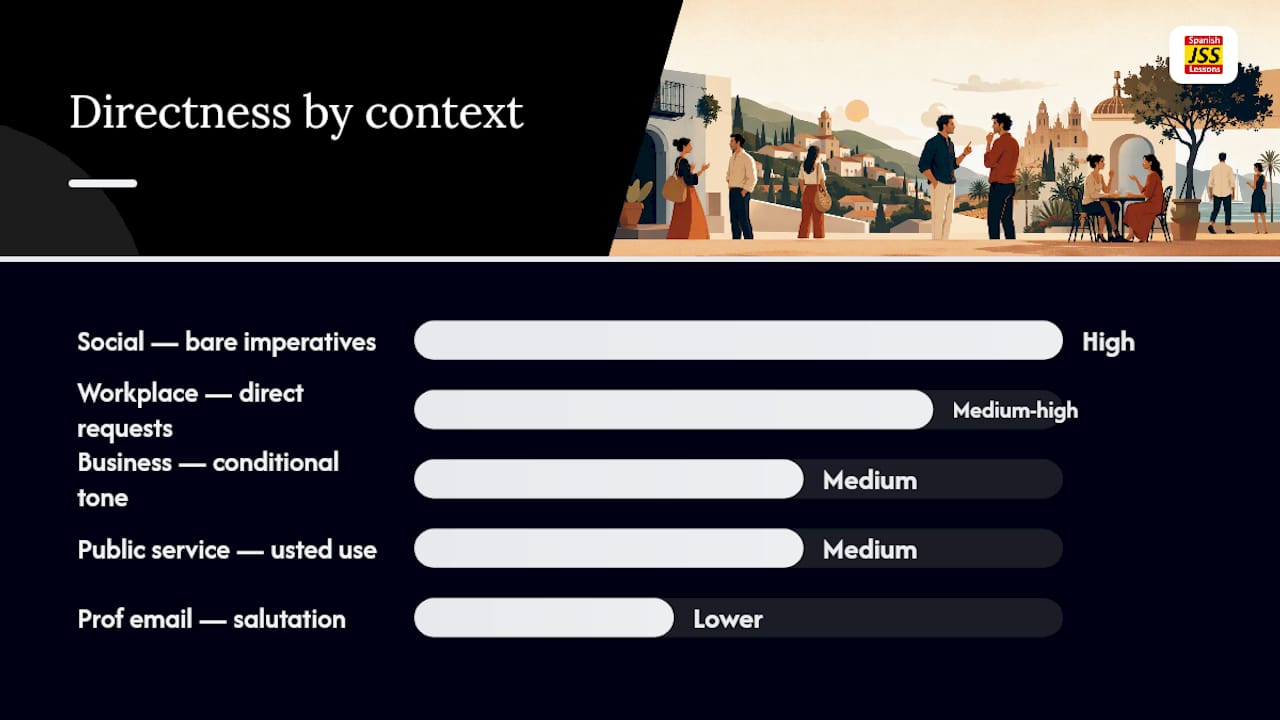
Consider the formal and informal “you”: knowing when to use usted versus tú requires cultural judgement, not just vocabulary. Misjudging it in a conversation with a doctor or a government official can make you seem either disrespectful or oddly stiff. Similarly, Spanish communication in Spain tends toward directness that can read as bluntness to British ears, yet the same directness is paired with genuine warmth and physical closeness that softens it entirely.

Man learning Spanish cultural communication outdoors

Cultural awareness also affects how you listen. When you understand that Spaniards often speak simultaneously in animated conversation, you stop interpreting overlapping voices as conflict and start hearing them as engagement. That shift alone reduces anxiety and helps you follow fast spoken exchanges far more effectively.

Cultural impacts across communication domains:

  • Speaking: matching register, directness, and warmth to the social context.
  • Listening: interpreting overlapping speech, regional accents, and implied meaning.
  • Reading: grasping idioms, proverbs, and culturally loaded references.
  • Writing: adjusting formality in messages to neighbours, tradesmen, or officials.

Practical cultural tips for English speakers in Spain

The most useful cultural knowledge is not a rulebook. It is a set of observations that help you read situations and respond with respect. As cultural etiquette experts note, when locals sense genuine effort and curiosity, they become far more open and willing to help.

Here are the habits worth building:

  • Greetings matter enormously. Two kisses on the cheek (left first) is standard between women and between men and women in social settings. A firm handshake works in formal or professional contexts. Getting this right immediately signals that you are paying attention.
  • Meal times are non-negotiable. Lunch is the main meal, typically between 2 PM and 4 PM. Dinner rarely starts before 9 PM. Turning up at a restaurant at 6 PM and expecting a full service is a reliable way to mark yourself as a tourist.
  • Queuing is fluid. In busy bars and markets, the unwritten rule is that everyone knows who arrived before whom. Jumping in aggressively causes friction; waiting patiently while making eye contact with the server works.
  • Silence is not awkward. Unlike British conversational norms, a pause in Spanish conversation does not always need filling. Letting a moment breathe shows confidence.
  • Humour is cultural, not translatable. Understanding jokes and wordplay in Spanish requires cultural immersion and social knowledge, not just vocabulary. Shared laughter is one of the fastest routes to genuine connection with native speakers.
  • Use authentic media. Spanish television, radio, and local newspapers expose you to real registers, regional expressions, and current references that no coursebook replicates. Even 20 minutes of a Spanish chat show teaches more about conversational rhythm than an hour of drills.

Pro Tip: When you are unsure about a custom, ask directly and with genuine curiosity. Most Spaniards find the question flattering rather than intrusive, and the answer will stick in your memory far longer than anything you read in a guide.

Learning through cultural context also applies to music, which carries regional identity, slang, and emotional register in a form that is easy to revisit and enjoy.

How James Spanish School and the WordAmigo System embed culture in learning

James Bretherton’s 40 years of living and working in Spain give James Spanish School a depth of cultural knowledge that most language courses simply cannot replicate. The school’s method, Radical Simplification, strips away the grammar jargon that clutters traditional teaching and explains Spanish structure through plain English, making space for cultural context to take centre stage rather than being squeezed into a footnote.

The 100-lesson course weaves genuine insider knowledge throughout: the builder’s mid-morning break, queuing habits, how to speak to a pharmacist versus a neighbour, the rhythm of a Spanish working day. These are not anecdotes. They are the social scaffolding that makes vocabulary and sentence patterns stick.

The WordAmigo System takes retention further. Built by James Bretherton alongside IT experts and long-term English expats fully immersed in Spanish society, it uses AI-driven strategic repetition to permanently embed vocabulary and pronunciation. The five-step retention loop covers reading, listening, speaking, and writing, ensuring that words are not just recognised but recalled under the pressure of a real conversation.

What the course delivers:

  • Cultural insights woven into every lesson, not treated as an add-on.
  • Authentic contexts drawn from everyday life in Spain: neighbours, shop staff, tradesmen, health workers, and government officials.
  • WordAmigo’s AI repetition system targeting the two biggest adult learner frustrations: words that will not stay in memory and pronunciation that native speakers struggle to follow.
  • Ear-tuning lessons specifically designed to help you follow the machine-gun speed of native replies.
  • A cast-iron guarantee: if a core lesson teaches you nothing new, James credits you with extra practice modules at no cost.

Cultural learning is most effective when integrated from the start, building social awareness alongside vocabulary and grammar. That is precisely how James Spanish School structures its course.

How cultural awareness builds your confidence in Spain

The practical effect of cultural competence is confidence, and confidence changes everything about how you communicate. Learners with cultural understanding recover more gracefully from mistakes and engage more fully in conversations, rather than retreating into silence after a stumble.

Understanding a culture’s history and traditions reveals the “why” behind expressions and social norms, which makes those norms feel logical rather than arbitrary. Once you understand why Spaniards eat late, why the siesta exists, or why a local might seem brusque at first but warm up quickly, you stop second-guessing yourself in social situations.

Confidence-building effects of cultural awareness:

  • Fewer misunderstandings with neighbours, tradesmen, and officials.
  • Ability to read a room and adjust your tone without overthinking it.
  • Reduced anxiety when conversations move fast or go off-script.
  • Stronger relationships built on genuine mutual respect rather than polite distance.
  • Richer day-to-day experiences: markets, fiestas, local bars, and community events become accessible rather than intimidating.

For practical Spanish fluency in Spain, cultural confidence and linguistic confidence grow together. You cannot fully have one without the other.

James Spanish School: real Spanish for real life in Spain

Forty years of living in Spain, a cast-iron teaching method, and an AI-powered vocabulary system built specifically for English-speaking expats. That is what James Spanish School brings to adult learners who want Spanish that actually works when the plumber arrives, when the town hall sends a letter, or when the neighbours invite you for a drink.

James Spanish School

The course is available on demand, 24/7, on any device, with no expiry date and no countdown pressure. Cultural insights are built into every lesson, not bolted on at the end. The WordAmigo System handles vocabulary and pronunciation retention so that words stay with you when you need them most. Whether you are preparing to move to Spain, already living there, or simply determined to communicate properly rather than just get by, the course is designed for exactly your situation.

Take a look at the full course options and see which fits your stage of learning.

Key takeaways

Cultural awareness is the single most effective way to convert grammar knowledge into real, confident communication in Spain.

Point Details
Culture shapes communication Tone, register, and social expectations in Spain go far beyond what grammar rules can teach.
Context embeds vocabulary Learning words within cultural situations leads to stronger, faster recall than isolated drills.
Confidence follows cultural knowledge Learners who understand Spanish customs recover from mistakes more easily and engage more fully.
Humour and personality require culture Jokes, idioms, and warmth in Spanish cannot be learned from a textbook; they need social context.
James Spanish School Integrates 40 years of cultural expertise and the AI-powered WordAmigo System into every lesson.
Categories
Insights

Best Duolingo.com alternatives for European Spanish learners


Duolingo.com alternatives


TL;DR:

  • Structured courses like James Spanish School with AI memory systems deliver practical European Spanish tailored for UK adults. These methods focus on native speech, cultural context, and real-world language use, outperforming gamified apps. Prioritizing grammar clarity, native feedback, and regional accuracy ensures lasting fluency and confidence in Spain.

What are the best Duolingo alternatives for UK adults learning European Spanish?

For UK adults who want practical, memory-focused European Spanish rather than a streak counter, the strongest alternatives are Babbel, Busuu, Rosetta Stone, and James Spanish School. Each takes a meaningfully different approach, and the right choice depends on whether you need grammar clarity, native speaker feedback, audio immersion, or a purpose-built system for adult retention.

Duolingo’s gamified habit approach works well for casual beginners, but it tends to plateau learners who want real-world fluency. The “hearts” system caps practice time artificially, and many of its sentences lack the practical context you need for conversations with Spanish neighbours, tradesmen, or health workers.

Platform Best for Teaching style Feedback and support Pricing model Devices
Babbel Grammar clarity and travel phrases Structured dialogue with explicit grammar Speech recognition, no live tutor Subscription Mobile and desktop
Busuu Speaking confidence with human feedback Guided lessons plus peer correction Native speaker corrections, live tutors Free tier; premium subscription Mobile and desktop
Rosetta Stone Audio immersion, no translation Immersive visual and audio method Speech recognition Subscription or lifetime licence Mobile and desktop
James Spanish School Practical European Spanish for UK adults Radical Simplification, ear-tuning, AI retention Cast-iron guarantee, extra practice modules One-off course purchase Phone, tablet, laptop

James Spanish School stands apart because it is built specifically for English-speaking adults learning European Spanish as spoken in Spain, not a generic multi-dialect course.

Infographic comparing Spanish learning platform features


Table of Contents

How do these Spanish learning platforms actually differ?

Babbel: structured lessons with grammar built in

Babbel’s courses are built around real-world conversations, with grammar explanations woven directly into each lesson rather than bolted on as an afterthought. That makes it a solid choice for learners who want a classroom-style feel without attending a class. The trade-off is pacing: Babbel moves methodically, which suits goal-focused adults but can feel slow for those who already have some Spanish.

Hands writing Spanish grammar notes in café

Busuu: native feedback changes the game

Busuu adds something most apps skip entirely: corrections from actual native speakers. Its community model means you submit written or spoken exercises and receive real feedback, not just a green tick from an algorithm. Live tutor sessions are available on the premium tier. For building speaking confidence, that human loop matters, though the quality of community feedback depends on how active the platform is at any given time.

Rosetta Stone: immersion without translation

Rosetta Stone takes a deliberately translation-free approach, teaching through images and audio rather than English explanations. That works well for absorbing pronunciation and building an instinctive feel for the language. Adult learners sometimes find the lack of grammar explanation frustrating, particularly when they want to understand why a sentence is constructed a certain way.

James Spanish School: built for the way adults actually learn

James Spanish School uses a method called Radical Simplification, which removes the grammar terminology that native speakers never use when learning their own language. Instead, founder James Bretherton explains Spanish structure through plain English, making the logic of the language immediately accessible. The 100-lesson course splits between sentence-building and “ear-tuning,” the latter training you to follow Spanish at the machine-gun speed of native conversation.


How do you choose the right Spanish learning platform for your goals?

Learner goals should drive platform choice rather than any generic “best app” label, as Wirecutter’s testing of multiple language apps confirmed. A few practical pointers:

  • Grammar clarity first: If you struggle to understand why Spanish sentences work the way they do, a structured course with explicit explanations (Babbel or James Spanish School) will serve you better than an immersive app.
  • Speaking confidence: If your priority is holding a real conversation, you need feedback from a human or a system that drills spoken output. Busuu’s peer corrections and James Spanish School’s ear-tuning lessons both address this directly.
  • Vocabulary that sticks: Spaced repetition systems show consistent advantages over passive review for long-term recall. Any platform you choose should incorporate scheduled review, not just new content.
  • Budget and flexibility: Subscriptions suit learners who want to dip in and out; a one-off course purchase suits those who prefer to own their material outright with no monthly pressure.
  • European Spanish specifically: Generic platforms often blend Castilian and Latin American Spanish without flagging the differences. If you are moving to Spain, retiring there, or dealing with Spanish bureaucracy, regional accuracy matters.

Pro Tip: Avoid mixing too many platforms at once. Pick one primary course for structure and one supplementary tool for vocabulary review. More than two active learning tools at the same time tends to fragment progress rather than accelerate it.

For UK adults with a practical goal, such as living in Spain, managing a property there, or simply communicating confidently with Spanish-speaking family, a course that addresses how to learn Spanish online with a clear method beats a collection of apps every time.


Why Radical Simplification and AI memory systems change European Spanish learning

Most adult learners hit a wall not because they lack ability, but because the teaching method works against how adult memory actually functions. Gamified apps build a fluency ceiling by drilling invented sentences that never appear in real conversation, leaving learners unable to follow a native speaker at natural speed.

Radical Simplification, the method at the heart of James Spanish School, removes this barrier by stripping out grammar labels that serve no practical purpose. You learn how Spanish sentences are built through plain English reasoning, not through memorising terms like “subjunctive imperfect.” The result is that the structural logic of Spanish becomes genuinely clear, often for the first time.

The WordAmigo system takes vocabulary retention a step further. Built by IT experts and long-term English expats working alongside James Bretherton, it uses AI-driven spaced repetition to predict when a word is about to fade from memory and schedules a review at precisely that moment. The system covers reading, listening, speaking, and writing in a five-step loop, so vocabulary is reinforced across every channel rather than just one.

For adult learners, this combination of clear structural teaching and AI-timed review addresses the two most common frustrations: words that refuse to stay in memory, and pronunciation that native speakers struggle to follow.


What do European Spanish learners say about their results?

Adult learners who move beyond gamified apps consistently report the same pattern: early progress feels fast, then stalls. The transition to a course that prioritises native speech listening and practical vocabulary tends to unlock the progress that apps alone could not deliver. James Spanish School’s feedback-driven approach is designed specifically to break that plateau.

The cast-iron guarantee reinforces this confidence: if a core lesson does not teach you anything new, James credits you with extra practice modules at no cost. That kind of commitment is rare among language learning platforms and reflects genuine confidence in the course’s quality.


Does the platform you choose reflect real life in Spain?

Most language learning websites are built for a global audience, which means the Spanish they teach blends regional dialects, uses vocabulary more common in Latin America, and skips the cultural context that makes communication feel natural. For UK adults planning to live, retire, or spend extended time in Spain, that gap is noticeable the moment a real conversation starts.

James Spanish School addresses this directly. The course covers European Spanish as it is actually spoken in Spain, including the cultural nuances that textbooks ignore: queuing habits, the mid-morning builder’s break, how to talk to a pharmacist or a local official. That cultural grounding is not a bonus feature. It is the difference between sounding like a tourist and sounding like someone who belongs.

For learners interested in connecting with expat communities alongside their studies, platforms like expat community networks can complement language practice with real social context in Spain.


James Spanish School: a different kind of Spanish course for UK adults

If you have worked through the alternatives and want a course built specifically for English-speaking adults learning practical European Spanish, James Spanish School offers something the mainstream apps do not.

Jamesspanishschool

The course consists of numerous lessons available on demand, 24/7, on any device, with no expiry date or countdown clock. You learn at your own pace, repeat any lesson as many times as you need, and carry the WordAmigo AI retention system with you for vocabulary and pronunciation. James Bretherton’s 40 years of living in Spain and dual-native fluency are woven into every lesson, from sentence structure to the cultural details that make real conversations work.

The course is not about passing an exam. It is about speaking confidently with the people around you in Spain. Explore the full course and current offers at the James Spanish School shop and see which option fits your goals.


Key takeaways

For UK adults learning European Spanish, a structured course with AI-powered memory retention and Radical Simplification outperforms gamified apps for practical, lasting fluency.

Point Details
Duolingo’s limits are real Gamification suits habit formation but creates a fluency ceiling for adults wanting practical conversation.
Method drives results Structured grammar clarity (Babbel) and native feedback (Busuu) outperform passive repetition for adult learners.
Memory systems matter AI-driven spaced repetition, as used in WordAmigo, embeds vocabulary across reading, listening, speaking, and writing.
European Spanish needs specificity Generic platforms blend dialects; courses built for Spain cover the vocabulary and culture UK adults actually need.
James Spanish School A 100-lesson, on-demand course using Radical Simplification and WordAmigo, with a cast-iron guarantee on lesson value.
Categories
Insights

Spanish cultural faux pas list: what to avoid in Spain

Getting Spain wrong is easier than you think. The social rules are unwritten, the meal times will catch you off guard, and what feels polite in Britain can land badly here. This spanish cultural faux pas list covers the missteps that matter most, so you can focus on connecting with people rather than recovering from awkward moments, including practical cultural faux pas useful for travellers and language learners seeking seamless integration by using an eSIM in Spain.

The most common errors English-speaking learners make include:

  • Greeting incorrectly: skipping the “dos besos” or going in for a hug on a first meeting
  • Eating at the wrong time: suggesting dinner at 7pm, or expecting a restaurant kitchen to be open at 6:30pm
  • Over-tipping: leaving an American-style gratuity when a few coins or rounding up is the norm
  • Rushing the sobremesa: leaving the table immediately after eating, rather than staying for conversation
  • Taboo topics: raising money, religion, the Spanish Civil War, or Catalan independence with people you have just met
  • Politeness overload: peppering every sentence with “por favor” and “gracias” in a way that sounds insincere
  • Arriving early: turning up before the host is ready, which is considered intrusive
  • Ignoring queuing etiquette: standing silently rather than asking “¿Quién es el último?”
  • Dressing too casually: wearing beachwear or athletic clothes away from the beach or gym

Each of these carries a real social cost. Understanding why they matter is what turns a list into genuine cultural fluency.


Table of Contents

How Spanish social etiquette works: greetings, meals, and public life

Greetings

Two people exchanging dos besos greeting outdoors

The “dos besos” is the standard social greeting between women, and between men and women. You lean in starting with the right cheek, and it applies even on a first meeting in casual settings. In professional or formal situations, a firm handshake is the expected norm. The mistake most learners make is hesitating or going straight for a hug, which reads as either cold or presumptuous depending on the context. When you walk into a small shop, café, or family gathering, greet the whole room, not just the person you came to see.

Meal times

Lunch in Spain is the main meal of the day, eaten between 14:00 and 16:00. Dinner rarely begins before 21:00. Arriving at a restaurant at 18:30 expecting a full kitchen is one of the most reliable ways to mark yourself as a tourist. The afternoon gap is not poor planning; it is a cultural rhythm built around climate, family, and lifestyle.

Pro Tip: When dining with Spaniards, keep both hands visible on the table, wait for the host or eldest person to say “¡Buen provecho!” before eating, and never guard a shared plate of tapas for yourself.

Tipping

Tipping is optional in Spain because wait staff receive a standard living wage. For a coffee, leaving small change is perfectly appropriate. At a fine-dining restaurant, a modest tip is considered generous. Leaving 20% as you might in the United States creates confusion rather than gratitude.

The sobremesa

After a meal, Spaniards stay at the table for conversation, coffee, and sometimes a digestif. This tradition, the sobremesa, is where real social bonding happens. Rushing away signals that you found the company dull. Factor it into your plans.

Public behaviour

Spaniards are comfortable with close physical proximity and will stand nearer than British social norms suggest. Overlapping conversations are normal and not considered rude. Loud English spoken in public transport, however, draws negative attention quickly. Dress neatly even for casual errands; athletic wear and flip-flops away from the beach are a reliable way to stand out for the wrong reasons.


Taboo topics and conversation norms to avoid

Spain is one of the most socially open countries in Europe. People discuss health problems over lunch, share family drama freely, and argue about football with genuine passion. Two subjects, however, are consistently off-limits in casual conversation: money and religion.

Personal finances are private in Spain. Nobody asks what you earn, what you paid for your flat, or how much your holiday cost. Bragging about wealth reads as tone-deaf, and direct questions about someone’s salary cross a clear social line. The silence around money is not embarrassment; it reflects a preference for social equality over status signalling.

Religion carries similar weight. Spain has a strong Catholic heritage, but faith is treated as intensely personal and rarely discussed openly, even among friends. Asking someone whether they attend church or believe in God can feel invasive, regardless of your intention.

Beyond money and religion, these topics require care:

  • The Spanish Civil War: still emotionally raw for many families; listen first, never lead
  • Catalan independence: you cannot know your companion’s position, so avoid taking sides
  • Gibraltar and regional politics: capable of turning a pleasant evening tense very quickly
  • Personal family matters: shared only when a relationship is established, not on first acquaintance

Safe ground for small talk includes food, travel, local culture, and sport. If a sensitive subject arises naturally, the phrase “¿Te importa si hablamos de esto?” (“Do you mind if we talk about this?”) shows respect before you proceed. Steering away from divisive subjects is not avoidance; it is how Spaniards prioritise social harmony over winning an argument.


How to show cultural adaptation and recover from mistakes

Spaniards are generally forgiving when they see genuine effort. Cultural integration is less about perfect etiquette and more about a visible, sincere willingness to adapt. Nobody expects a newcomer to get everything right immediately. What earns respect is observation, humility, and a readiness to mirror local behaviour.

James Bretherton, founder of James Spanish School and a dual-native speaker with 40 years living in Spain, makes this point consistently in his teaching: the learners who settle most comfortably are those who watch before they act. Notice how people greet each other in a specific setting before you commit to a style. Follow the host’s lead at the dinner table. Ask “¿Quién es el último?” when you join a queue rather than standing silently and hoping the system works itself out.

Pro Tip: When you make a mistake, a simple, warm acknowledgement in Spanish goes further than a lengthy apology in English. “Perdona, no lo sabía” (“Sorry, I didn’t know”) delivered with a smile signals exactly the right attitude.

Practical scenarios where adaptation shows most clearly include shopping (greeting the staff when you enter), dining (waiting for the sobremesa rather than asking for the bill immediately), and social gatherings (arriving slightly after the stated time rather than on the dot). Each small adjustment builds credibility over time. You can find deeper guidance on adapting to Spanish customs through James Spanish School’s dedicated resources.


Practical tips for English-speaking learners to avoid cultural errors

Language and culture are inseparable. Getting the words right without understanding the social context behind them produces exactly the kind of well-meaning awkwardness this article is designed to prevent. Here is what actually helps:

  • Learn culturally loaded phrases first: “¡Buen provecho!”, “¿Quién es el último?”, “La cuenta, por favor”, and “Vale” will serve you in daily life far more than textbook grammar drills
  • Calibrate your politeness: use “por favor” and “gracias” naturally, but do not attach them to every sentence; Spanish communication relies more on tone and warmth than on formal markers
  • Embrace overlapping conversation: speaking over someone in Spain is not interrupting, it is engaging; silence can read as disinterest
  • Be direct: Spanish communication is more straightforward than British norms; over-softening a point or relying on heavy sarcasm creates confusion rather than tact
  • Respect regional identity: Catalonia, the Basque Country, and Galicia have their own languages and cultural pride; referring to everything as simply “Spanish” can feel dismissive in those regions
  • Dress for the setting: smart-casual is the baseline for most social situations; religious sites require covered shoulders and knees
  • Default to “tú”: modern Spain is informal, and “usted” in the wrong context creates unnecessary distance; mirror what the other person uses

The WordAmigo system, developed by James Spanish School with input from long-term English expats fully immersed in Spanish society, addresses the two frustrations that undermine cultural confidence most: vocabulary that will not stick and pronunciation that native speakers struggle to follow. Its five-step retention loop covers reading, listening, speaking, and writing, so the phrases you need in real social situations actually stay with you. For a broader look at avoiding common Spanish mistakes, James Spanish School’s practical guide is worth bookmarking alongside this one.


Handling punctuality: the Spanish approach to time

Punctuality in Spain is entirely context-dependent, and treating it as a single national trait is one of the most common missteps visitors make. For business meetings, medical appointments, and any formal or official setting, being on time is expected and lateness damages credibility. Arriving early to a private home, however, is considered intrusive because it catches the host mid-preparation.

For social gatherings, a relaxed approach to arrival time is the accepted norm. Turning up at the exact stated time to a dinner party at someone’s home is actually a minor social faux pas in Spain. The host needs that buffer to finish cooking or tidying. Arriving early is universally seen as rude, while a slightly later arrival is simply good manners.

The practical rule: be punctual for anything professional or official, and give yourself a little extra time before arriving at anything social and private. If you are used to British precision, this requires a conscious mental shift rather than a vague intention to “be more relaxed.”


Gift-giving customs and how to handle a refusal gracefully

Arriving at a Spanish home empty-handed is a clear social misstep. The custom is to bring a small, quality gift: a good bottle of local wine, artisanal chocolates, or a freshly baked pastry from a neighbourhood bakery all work well. The gesture matters more than the price. One firm rule: avoid chrysanthemums entirely, as they are associated with funerals and All Saints’ Day and carry an unmistakably sombre meaning.

When you receive a gift, the Spanish approach is often to set it aside rather than open it immediately in front of the giver. Do not read this as indifference; it is simply the local convention. Opening a gift on the spot and performing visible delight can actually feel performative in this context.

If you need to decline a gift or an offer, do so warmly and briefly. A simple “Es muy amable de tu parte, pero no hace falta” (“That’s very kind of you, but there’s no need”) handles the moment without awkwardness. Refusing too forcefully or repeatedly, on the other hand, can make the giver feel their gesture was unwelcome. One polite decline, delivered with genuine warmth, is always enough.


Key takeaways

Avoiding Spanish cultural faux pas comes down to three things: learning the unwritten timing rules, respecting conversational boundaries around money and religion, and showing visible willingness to adapt rather than expecting perfection from yourself.

Point Details
Meal times are non-negotiable Lunch runs 14:00–16:00; plan around this, not against it. Dinner rarely starts before 21:00.
Tipping is optional Staff receive a living wage; small change for coffee and around 5–10% for fine dining is generous, not obligatory.
Money and religion are private Avoid both topics in casual conversation; they are considered too personal and divisive for social settings.
Punctuality depends on context Be on time for professional settings; a relaxed arrival is expected and appropriate for social gatherings.
Adaptation earns forgiveness Spaniards respond warmly to visible effort; a sincere attempt to follow local customs matters more than flawless behaviour.

Start learning Spanish the way it actually works in Spain

Jamesspanishschool

James Spanish School was built specifically for English-speaking adults who want real-life Spanish, not exam preparation. James Bretherton’s 40 years of living in Spain inform every lesson, from the cultural habits covered in this article to the sentence structures you need for conversations with neighbours, tradespeople, and local officials. The WordAmigo system locks in vocabulary and pronunciation through a proven retention loop, so what you learn stays with you when it counts. Explore the full course at James Spanish School and start building the cultural and language confidence to feel genuinely at home in Spain.

Categories
Insights

Using Spanish music to learn: a practical guide for adults

Using Spanish music to learn is most effective when you treat it as active study, not background noise. The method works like this: listen to a song without lyrics first, then follow the lyrics with a translation, sing aloud, and extract vocabulary to practise separately. Rhythm and melody encode words into memory in ways that silent reading simply cannot match. Here is the core process at a glance:

  • Listen to the song two or three times without looking at the lyrics
  • Read the lyrics line by line while listening, noting how words link together
  • Translate the lyrics, focusing on meaning rather than word-for-word accuracy
  • Select 8–10 new words or phrases and write them down with their meanings
  • Create short sentences using those words to build context
  • Sing along, repeating the chorus until the sounds feel natural in your mouth
  • Review your chosen vocabulary using spaced repetition over the following days

Why learning Spanish through music actually works

The science here is clear and encouraging. Research by Ludke, Ferreira & Overy (2014) found that adults who sang unfamiliar vocabulary recalled it significantly better than those who simply spoke the same words aloud. Singing engages the motor cortex alongside the language centres of the brain, creating what researchers call “enriched encoding.” That is not a minor advantage.

Man studying neuroscience of music and language learning

Spanish presents a particular challenge for English speakers: native speakers link words together at speed, making it hard to hear where one word ends and the next begins. Songs slow that process down and impose a rhythmic structure that helps your brain find those boundaries. If you have ever wondered why Spanish listening feels so hard, this word-linking tendency is usually the culprit, and music addresses it directly.

Music also delivers authentic cultural context that textbooks rarely capture. A bachata lyric teaches you how Spanish speakers actually express emotion. A pop chorus gives you the contractions and informal speech patterns that formal lessons skip. The benefits, in short:

  • Improved pronunciation through repeated exposure to natural rhythm and stress patterns
  • Better word segmentation in fast speech
  • Stronger vocabulary recall through melody-linked memory
  • Genuine cultural exposure through authentic language
  • Higher motivation, which sustains consistent practice over time

One caveat worth stating plainly: music is a supplement, not a full curriculum. Passive listening alone does not build conversational fluency. You pick up sound patterns and catchy hooks, but you will not develop the ability to produce or understand Spanish in conversation without active practice alongside it.

Techniques that turn songs into real Spanish learning

The difference between a learner who improves and one who just enjoys the music comes down to method. Active engagement is everything.

Teacher demonstrating Spanish learning through music in class

Pro Tip: Sing the vocabulary aloud rather than just reading it. Singing unfamiliar words improves recall more than speaking them, because producing the sounds yourself deepens the memory trace. You do not need to sound good. You just need to open your mouth.

Follow this sequence for each song you study:

  • First listen, no lyrics. Notice the rhythm, catch any words you already know, and let your ear adjust to the pace and accent.
  • Second listen with lyrics. Read along and observe how words run together. Pay attention to the translation but do not obsess over every single word.
  • Vocabulary extraction. Pick 8–10 words or phrases that are new and useful. Write them down, note their meanings, and build a short example sentence for each.
  • Sing along. Repeat the chorus and any verse you find difficult. Your mouth learns the movements just as your brain learns the meaning.
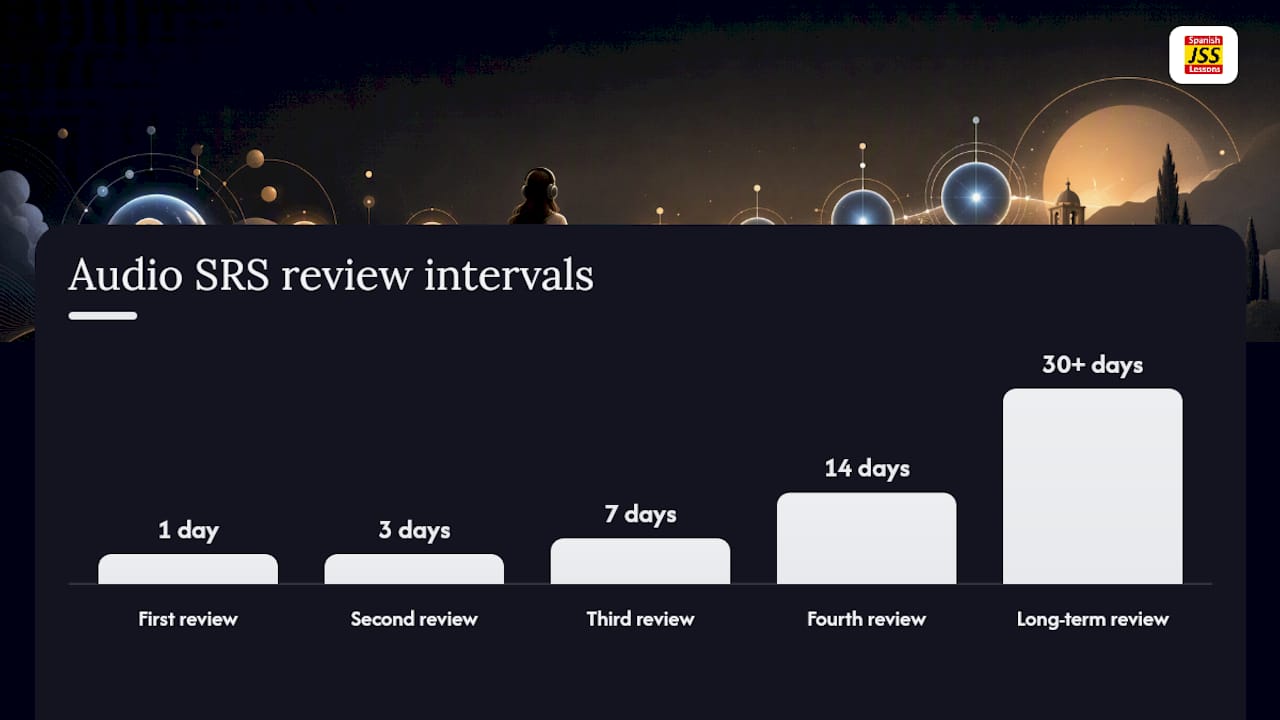
  • Spaced repetition review. Return to your vocabulary list the next day, then three days later, then a week later. This spacing locks words into long-term memory far more reliably than a single session.

Combine music practice with audio-based Spanish lessons to reinforce what you hear in songs with structured sentence-building. Music gives you the sound; structured study gives you the grammar engine to use it.

How to choose the right Spanish songs for learners in the UK

Song choice matters more than most learners realise. The wrong song at the wrong level produces frustration, not progress.

  • Start slow, literally. Ballads and slower pop tracks give you time to hear individual words. Fast reggaeton at beginner level is mostly noise your brain cannot map to meaning.
  • Look for clear pronunciation. Artists like Shakira and Enrique Iglesias enunciate clearly. Their tracks are excellent starting points because the words are audible even at natural speed.
  • Match the theme to your goals. If you are moving to Spain, songs about everyday life, relationships, and places give you vocabulary you will actually use.
  • Progress through genres as you improve. Once you can follow a slow ballad comfortably, move into bachata, cumbia, and eventually reggaeton. Each genre exposes you to different accents, regional slang, and speech rhythms.
  • Use reliable lyric sources. Genius.com and AZLyrics carry accurate Spanish lyrics for most popular tracks. For translations, DeepL gives you a solid working version that you can then refine yourself.
  • Choose music you genuinely enjoy. Motivation is not a soft concern. Learners who enjoy their practice material study more consistently, and consistency is what produces results.

Pro Tip: Search for “canciones para aprender español” on YouTube. Several channels publish songs written specifically for learners, with controlled vocabulary and clear diction. These are ideal for the first few months before you move to mainstream artists.

How James Spanish School and the WordAmigo System enhance learning through music

James Bretherton, founder of James Spanish School, has lived in Spain for 40 years and speaks Spanish as a dual native. His teaching method, called Radical Simplification, strips out the grammar terminology that native speakers never use when they learn their own language. Instead, he explains Spanish structure in plain English, making the logic of the language accessible to adult learners without the intimidation of academic jargon.

The WordAmigo System is an AI-powered vocabulary and pronunciation tool built specifically for adult learners of European Spanish. It uses a Five-Step Retention Loop to embed words permanently, cycling through reading, listening, speaking, and writing in a sequence that mirrors how memory consolidates new information. This is precisely the kind of active, multi-modal engagement that the research on music-based learning points to as most effective.

The 100-lesson James Spanish School course divides its focus between sentence-building and “ear-tuning,” the latter designed specifically to help learners follow fast spoken Spanish. That ear-tuning component works in direct partnership with music practice: songs train your ear to the rhythm and sound of Spanish, while the course trains you to decode and produce it. The two reinforce each other.

Key features of the James Spanish School approach:

  • Radical Simplification: no grammar jargon, plain English explanations throughout
  • WordAmigo’s Five-Step Retention Loop for vocabulary and pronunciation
  • 100 on-demand lessons available 24/7 on any device
  • Ear-tuning lessons focused on fast, natural spoken Spanish
  • A cast-iron guarantee: if a core lesson teaches you nothing new, James credits you with extra practice modules at no cost
  • Real-life focus on everyday conversations, not academic exams

For UK learners who want to learn Spanish online at their own pace, this combination of structured course work and music-based practice covers every angle: grammar, vocabulary, pronunciation, and listening comprehension.

https://jamesspanishschool.com

Infographic illustrating five steps for learning Spanish through music

Ready to put the method into practice? Explore the James Spanish School course and the WordAmigo System at jamesspanishschool.com/shop-blg and start building the Spanish you actually need for real life in Spain.

Key takeaways

Using Spanish music to learn works best when active engagement, structured vocabulary practice, and a solid course sit alongside each other.

Point Details
Active engagement is essential Passive listening builds familiarity but not fluency; translate, sing, and review vocabulary every session.
Singing beats speaking for recall Research shows singing unfamiliar vocabulary produces stronger memory retention than speaking it aloud.
Song choice shapes progress Start with slow, clearly pronounced tracks and move to reggaeton and bachata as your ear improves.
Music supplements, not replaces, structure Pair songs with a structured course to develop the grammar and sentence-building skills music alone cannot teach.
WordAmigo deepens retention James Spanish School’s Five-Step Retention Loop automates the multi-modal practice that makes vocabulary stick permanently.
Categories
Insights

Why learn real phrases: the key to natural fluency


Why learn real phrases.

Learning real phrases is the single most direct route to sounding natural in a new language. A “real phrase” is a multi-word lexical chunk — a fixed or semi-fixed expression that native speakers use automatically, without assembling it word by word. Think “I’m so sorry,” “How are you getting on?” or the Spanish “¿Qué tal?” These are not grammar exercises. They are the actual building blocks of fluent speech.

Research from Cambridge ELT confirms three core reasons to prioritise phrase learning:

  • Fluency: memorised chunks allow faster processing in both speaking and listening, because retrieving a ready-made expression from memory is quicker than constructing one from scratch.
  • Idiomaticity: phrases help you choose the expressions native speakers actually use, rather than grammatically correct but unnatural alternatives.
  • Grammar development: phrases learned as wholes later get broken down into frames with slots, giving you the raw material for building new sentences by analogy.

Why learning phrases beats isolated words

The difference between knowing words and knowing phrases is the difference between owning bricks and knowing how to build a wall. You can memorise a thousand individual words and still sound stilted the moment you open your mouth.

Lexical chunks are stored and retrieved as complete units in long-term memory. That means when you need to express agreement, a phrase like “I see eye to eye with you on that” comes out whole, without the mental gymnastics of selecting each word and checking the grammar. Learners who rely on isolated vocabulary, by contrast, are forced to translate word by word, which slows speech and produces unnatural output.

The benefits of phrase learning over word-by-word study are well documented:

  • Natural speech: phrases reflect how native speakers actually talk, so your output sounds right even when your grammar knowledge is incomplete.
  • Faster recall: ready-made chunks reduce cognitive load during conversation, freeing mental space to listen, plan, and respond.
  • Contextual grammar: seeing a phrase in use shows you how grammar works in practice, without needing to memorise abstract rules.
  • Practical vocabulary: phrases are aligned with real communication needs, not just dictionary definitions.
  • Comprehension gains: phraseological knowledge improves reading and listening comprehension alongside production skills.

The English Vocabulary Profile, built on corpus evidence from over a billion words of real language use, lists phrases as a substantial component of vocabulary knowledge at every CEFR level. Even learners who know the top 2,000 most frequent words will struggle if they do not know how those words combine into phrases.


Infographic highlighting top reasons to learn phrases

Practical tips for learning and using real phrases effectively

The gap between knowing a phrase and using it automatically is closed by one thing: deliberate, repeated practice in context. Here is how to do it well.

  • Choose phrases with high fixedness and idiomaticity. Teachable, prototypical chunks are easier to memorise and more reusable than obscure idioms. Start with phrases that appear frequently in real conversation.
  • Encounter phrases in authentic contexts. Films, podcasts, and real conversations show you not just the phrase but when and how to use it. Context is what makes a phrase stick.
  • Use spaced repetition. Reviewing phrases at increasing intervals moves them from passive recognition to automatic production. James Spanish School’s WordAmigo system automates this process across reading, listening, speaking, and writing.
  • Recycle phrases actively. Textbooks often introduce phrases once and never revisit them, which is why learners recognise expressions but cannot produce them under pressure. Build in regular review.
  • Balance phrase learning with vocabulary and grammar. Phrases are the engine room, but you also need individual words and structural knowledge to generate new sentences. Neither alone is sufficient.

Pro Tip: When selecting which phrases to learn first, prioritise those that contain slots for variable fillers, such as “Can I have a…?” or “I’d like to…”. These generalisable frames give you far more communicative range than a fixed phrase you can only use in one situation.


How James Spanish School approaches real phrases and fluency

James Bretherton has lived in Spain for 40 years as a dual-native speaker, and the method he built at James Spanish School reflects that depth of real-world experience. The course does not teach Spanish through abstract grammar rules. It teaches through the structural logic of how Spanish actually works, using plain English explanations and, critically, the phrases that come up in everyday life in Spain: conversations with neighbours, shop staff, tradesmen, health workers, and local officials.

The WordAmigo system is the vocabulary and pronunciation architecture that sits at the heart of the course. Built by IT experts and long-term English expats working alongside James, it uses AI-driven spaced repetition to permanently embed phrases and vocabulary through a five-step retention loop covering reading, listening, speaking, and writing. Pronunciation is built in from the start, so learners do not just recognise phrases on paper but can produce them in a way native speakers understand.

Key takeaways from the James Spanish School approach:

  • Phrase learning is embedded in real-life Spanish contexts, not academic exercises.
  • The WordAmigo system automates the full retention cycle, removing the guesswork from review schedules.
  • Ear-tuning lessons train learners to follow fast native speech, where phrases are delivered at machine-gun speed.
  • The cast-iron guarantee means that if a core lesson teaches you nothing new, James credits you with extra practice modules at no cost.

You can explore practical Spanish fluency tips that align directly with this phrase-first approach.


Examples of real phrases across everyday contexts

Phrases are not abstract. They belong to specific situations, and knowing which phrase fits which moment is what separates a confident speaker from a hesitant one. Here are common phrase categories with examples across different contexts.

Hands writing phrases in language journal

Greetings and social contact
“¿Qué tal?” (How are things?), “Mucho gusto” (Pleased to meet you), “¿Cómo le va?” (How are you getting on?). These are the phrases you need within the first thirty seconds of any conversation.

Requests and transactions
“¿Me pone un café, por favor?” (Can I have a coffee, please?), “¿Cuánto es?” (How much is it?), “¿Tiene cambio?” (Do you have change?). Mastering these transforms a trip to a Spanish bar or market from a stressful guessing game into a natural exchange.

Expressing difficulty or misunderstanding
“No entiendo” (I don’t understand), “¿Puede repetir más despacio?” (Can you repeat that more slowly?), “¿Cómo se dice…?” (How do you say…?). These phrases are lifelines, and knowing them reduces anxiety enormously.

Formal and official situations
“Quisiera hacer una consulta” (I’d like to make an enquiry), “¿Podría hablar con el responsable?” (Could I speak to the person in charge?). These matter when dealing with health workers or local government offices.

Learning new language benefits go well beyond the phrases themselves: confidence, cultural connection, and cognitive engagement all follow from being able to communicate naturally.


Common challenges when learning real phrases and how to overcome them

The most common frustration adult learners report is this: they recognise a phrase when they hear it but cannot produce it when they need it. That gap between passive and active knowledge is real, and it has a clear cause.

EFL textbooks at B1 and B2 level typically introduce phraseological units in a limited range of exercises and then never revisit them. Without recycling, phrases stay at the surface of memory rather than becoming automatic. The fix is deliberate repetition across multiple modes, not just reading a phrase once and moving on.

A second challenge is choosing the wrong phrases to learn. Obscure idioms with no obvious logic are far harder to retain than phrases with transparent meaning or a memorable image behind them. Phrases like “jump the gun” become memorable once you understand the sporting reference; without that hook, they are just noise.

A third obstacle is pronunciation. You might know a phrase perfectly on paper but deliver it in a way that leaves native speakers puzzled. This is where audio-based practice, with real native recordings, makes a concrete difference to whether your phrases actually land in conversation.


How to bring real phrases into your daily speaking and writing

The most effective method is also the simplest: use a phrase the same day you learn it. Passive study builds recognition; active use builds production. These habits move phrases from your notes into your mouth.

Woman speaking Spanish on video call

In speaking: choose two or three phrases each day and find a way to use them, whether in a language exchange, a conversation with a native speaker, or even narrating your own activities aloud. Repeating Spanish lessons reinforces phrase retention far more effectively than moving on to new material before the old material is secure.

In writing: keep a short daily journal in your target language. Aim to use at least one new phrase per entry. Writing forces you to recall a phrase actively rather than just recognise it, which accelerates the move to automatic production.

In listening: pay attention to how native speakers use the phrases you are learning. Podcasts, films, and real conversations all provide this input. When you hear a phrase you have studied, your brain registers it differently than it would an unknown expression, and that recognition reinforces the memory.

For learners working on Spanish small talk, the same principle applies: practise the phrases you need for the situations you actually face, not a generic list from a textbook.


Ready to put real phrases to work?

https://jamesspanishschool.com

James Spanish School’s 100-lesson course is built around exactly this principle: real phrases, real contexts, and a system that makes them stick. The WordAmigo AI retention system handles the repetition cycle for you, so you spend your time using Spanish rather than struggling to remember it. There is no expiry date and no countdown clock.

Start learning real Spanish today and hear the difference that phrase-first learning makes from your very first lesson.


Key takeaways

Learning real phrases, rather than isolated words, is the most direct path to fluent, natural-sounding language use.

Point Details
Phrases enable faster speech Retrieving a memorised chunk is quicker than assembling a sentence word by word, reducing cognitive load in real conversation.
Idiomaticity comes from phrases Knowing individual words does not guarantee natural expression; phrases carry the patterns native speakers actually use.
Recycling is non-negotiable Phrases introduced once and never revisited stay passive; consistent repetition across reading, listening, speaking, and writing builds automatic production.
Choose teachable chunks first Prioritise phrases with high fixedness and generalisable slots, as these are easier to memorise and more versatile in use.
Balance with vocabulary and grammar Phrase learning is the engine room of fluency, but individual word knowledge and structural understanding are needed alongside it for full communicative competence.
Categories
Insights

The role of listening in language mastery: your guide

Role of listening in language mastery


Listening is the single most important skill you can develop as a language learner. Before you can speak, read, or write with any confidence, you need to understand what you hear. Research confirms that listening is prerequisite to all other language skills, and that promoting listening comprehension leads directly to stronger acquisition across the board. Put simply: you cannot produce language well unless you first comprehend it deeply.

Here is what that means in practice for adult learners:

  • Listening provides the comprehensible input your brain needs to map out grammar and vocabulary naturally, without rote drilling.
  • It trains your ear to decode phonemes, connected speech, and word boundaries before you ever attempt to produce them yourself.
  • It builds vocabulary, sharpens pronunciation, and accelerates spoken fluency, all at once.
  • It is the most accessible skill to practise: no classroom, no partner, no pressure.
  • Active listening is a demanding cognitive process, not passive background noise. The distinction matters enormously for how you approach your study time.

The term “ear-tuning” captures this well. It describes the deliberate, repeated exposure to authentic spoken language that moves you from merely hearing sounds to genuinely understanding meaning. That shift is where real language mastery begins.


1. Why listening should come first among all language skills

The human brain acquires language in a fixed sequence, and listening always leads. Children spend months absorbing spoken language before producing a single word. Adult learners who try to skip that stage and speak immediately tend to plateau quickly, because they are attempting output without sufficient input to draw from.

The research is clear on this point. Emphasising aural comprehension training in the early stages, while relaxing the pressure to speak immediately, produces better results than intensive oral practice from day one. Comprehension must precede reproduction. That is not a pedagogical preference; it reflects how the brain actually builds language competence.

There are several concrete reasons why listening deserves priority:

  • It lays the blueprint for speaking. You cannot replicate pronunciation patterns, intonation, or natural rhythm unless you have heard them repeatedly first.
  • It reduces anxiety. Listening asks nothing of you in terms of production. You absorb without performing, which keeps motivation high in the early weeks.
  • It transfers to other skills. Studies show that promoting listening skills results in positive transfer to speaking, reading, and writing. The gains are not confined to comprehension alone.
  • It aligns with Krashen’s Input Hypothesis. Stephen Krashen’s foundational theory holds that comprehensible input drives acquisition. Listening is the primary vehicle for that input.
  • It builds confidence before social interaction. Adult learners who invest time in listening report feeling better prepared for real conversations, because they recognise speech patterns before they need to respond to them.

For adult learners in the UK who are learning Spanish for life in Spain, this is especially relevant. The machine-gun speed of native conversation is one of the biggest barriers. Tackling listening first, rather than last, is the practical solution.


Infographic illustrating listening benefits for language learning

2. How listening improves speaking, pronunciation, and vocabulary

Listening and speaking are not separate skills that develop in parallel. They are deeply intertwined, with listening doing most of the foundational work.

Man practicing Spanish pronunciation at home

When you listen repeatedly to authentic spoken language, you internalise the rhythm, stress, and intonation of the target language without consciously studying any of it. Speaking well depends on listening well; pronunciation develops when learners absorb native rhythm and intonation through sustained auditory exposure. You begin to mimic patterns naturally, the same way a child picks up an accent from their environment rather than from a textbook.

The vocabulary gains are equally well documented. Research has identified a statistically meaningful positive correlation between listening proficiency and vocabulary size. Hearing words in context, with natural stress and collocations intact, embeds them far more durably than flashcard drilling.

“Listening is vital in the language classroom because it provides input for the learner. Without understanding input at the right level, any learning simply cannot begin. Listening is thus fundamental to speaking.”
— Rost (1994), cited in JALT Publications

The table below summarises how listening input contributes to each productive skill:

Language skill How listening supports it
Speaking Internalises rhythm, intonation, and natural phrasing for spontaneous use
Pronunciation Provides phonetic models that learners unconsciously replicate
Vocabulary Embeds words in context, with collocations and stress patterns intact
Reading Builds phonological awareness that supports word recognition on the page
Writing Exposes learners to grammatical structures and natural sentence patterns

Combining listening with reading amplifies these gains further. Reading while listening produces the greatest vocabulary gains of any single study mode, particularly for learners at lower proficiency levels who struggle to segment words from the speech stream on audio alone.

Pro Tip: When you encounter a new word in a listening session, do not pause to look it up immediately. Let context do the work first. Return to the word after the session and check it then. This trains your brain to tolerate ambiguity, a skill native speakers use constantly.


3. Practical reasons listening is the easiest skill to start with

Listening has a practical advantage that no other language skill can match: you can do it anywhere, at any time, with nothing more than a phone and a pair of earphones. There is no partner required, no performance anxiety, and no grammar exercise to complete. You simply listen.

For adult learners juggling work, family, and the demands of daily life, that accessibility is not a minor convenience. It is the difference between consistent practice and no practice at all. A twenty-minute commute, a walk, a lunch break: all of these become study sessions without any additional effort.

Here is why listening is the most learner-friendly skill to prioritise early:

  • Low production pressure. You are receiving language, not producing it. That removes the fear of making mistakes in front of others, which is one of the most common barriers for adult learners.
  • Flexible scheduling. Unlike speaking practice, which requires another person, or writing, which demands focused desk time, listening fits around your life.
  • Exposure to varied accents and registers. Authentic audio materials, from recorded conversations to podcasts to news segments, introduce you to the full range of how a language is actually spoken. Approximately 90% of participants in one structured study reported that authentic materials were the most engaging and beneficial part of their listening activities.
  • Gradual difficulty scaling. You can start with slow, clear speech and move progressively to faster, more colloquial material. The challenge grows with your ability.
  • Repetition without embarrassment. You can replay the same audio ten times without anyone noticing. That repetition is exactly what the brain needs to consolidate new patterns.

Effective listening practice is not simply pressing play and hoping for the best, though. Research supports a three-phase approach: pre-listening activation, focused attention during the listening itself, and post-listening reflection. Preparing your brain for what it is about to hear, by thinking about the topic or predicting vocabulary, measurably improves comprehension. Reflecting afterwards on what you understood and what you missed reinforces retention.

Good teaching practices for listening consistently emphasise this structured approach over passive exposure. The difference between a learner who improves quickly and one who stagnates often comes down to whether they are listening with intent or simply filling time.


4. What recent research says about listening and adult language learning

The scientific case for prioritising listening has grown considerably stronger over the past decade. Studies now quantify benefits that language teachers have long observed anecdotally, and the numbers are persuasive.

A six-week structured listening programme produced a 25% improvement in listening comprehension scores among participants, alongside measurable gains in pronunciation and speaking confidence. That is a substantial return for a relatively short investment of focused effort. The same study found that a substantial proportion of participants reported feeling more effective and confident after dedicating specific time to listening practice.

“Listening is the Cinderella skill in second language learning. All too often, it has been overlooked by its elder sister: speaking.”
— David Nunan, Listening in Language Learning

The “Cinderella skill” framing captures something real. Listening is frequently the last thing language programmes address systematically, yet it is the first thing learners need. The cognitive demands involved are considerable: active mental decoding of phonemes, recognition of connected speech, segmentation of word boundaries, and simultaneous meaning construction. All of this happens in real time, under time pressure, with no opportunity to rewind the speaker.

The table below summarises key research outcomes relevant to adult learners:

Study focus Key finding Source
Listening and vocabulary Positive correlation between listening proficiency and vocabulary size Ciencia y Reflexión
Structured listening programme 25% improvement in comprehension over six weeks AGHEL Journal
Learner confidence 75% of learners reported greater confidence after dedicated listening practice AGHEL Journal
Reading while listening Greatest vocabulary gains compared to either mode alone TESL Canada Journal
Bottom-up and top-down processing Effective listening requires both phoneme decoding and contextual interpretation JALT Publications

Learners must develop both bottom-up and top-down listening skills to reach mastery. Bottom-up processing means decoding sounds accurately, recognising individual phonemes and word boundaries. Top-down processing means using context, topic knowledge, and situational clues to fill gaps and construct meaning. Neither alone is sufficient. A learner who only decodes sounds will struggle with fast, colloquial speech. One who only guesses from context will miss precision.

This is precisely why ear-tuning, as James Spanish School describes it, is not optional for adult learners of Spanish. Many learners can read Spanish reasonably well but freeze when a native speaker replies at full conversational speed. The gap between reading comprehension and listening comprehension is real, and it closes only through deliberate, repeated auditory exposure. James Spanish School’s 100-lesson course dedicates a substantial portion of its structure to this exact challenge, with ear-tuning lessons designed specifically to train adult ears for the pace and patterns of real spoken Spanish.


5. Strategies that genuinely develop your listening ability

Knowing that listening matters is one thing. Knowing how to practise it well is another. The strategies below are grounded in research and adapted for adult learners who want results without wasted effort.

Focus on comprehensible input, not difficulty. Material that is slightly above your current level, where you understand most but not all, produces the greatest acquisition gains. Listening to content that is entirely beyond you builds frustration, not fluency. Start with graded audio and move up gradually.

Use authentic materials as soon as you can tolerate them. Scripted audio teaches you idealised language. Authentic recordings, conversations between native speakers, radio programmes, podcasts, teach you how the language actually sounds. The gap between the two is where most learners get stuck. Exposure to authentic spoken Spanish from early in your learning closes that gap far faster than staying with scripted content indefinitely.

Practise selective listening. Do not try to understand every word. Native speakers do not process every word either; they extract meaning from key phrases, stress patterns, and context. Practising this selective approach reduces cognitive overload and builds the kind of flexible comprehension you need for real conversations.

Repeat the same audio multiple times with different goals. First listen for general meaning. Second listen for specific details. Third listen while reading a transcript if one is available. Each pass activates a different level of processing and deepens retention.

Address the fast-speech problem directly. Spanish in particular is spoken at a pace that catches most learners off guard. Understanding why Spanish listening is hard and training specifically for fast connected speech is a separate skill from understanding slow, clear audio. Both matter, but the fast-speech skill is what determines whether you can hold a real conversation.

Build a daily listening habit, however short. Consistency outperforms intensity. Twenty minutes every day produces better results than two hours once a week, because the brain consolidates language patterns during sleep and rest. Short, regular sessions keep the language active in your working memory.

Pro Tip: Pair your listening sessions with a brief written note afterwards: three words you heard clearly, one phrase you want to look up, and one thing you understood from context alone. This post-listening reflection, even done in thirty seconds, measurably improves retention over time.


Key takeaways

Listening is the foundational skill that drives vocabulary growth, pronunciation accuracy, and spoken fluency, and it remains the most accessible skill for adult learners to practise consistently.

Point Details
Listening comes first Comprehension must precede production; promoting listening leads to gains in speaking, reading, and writing.
Vocabulary and listening are linked Research records a positive correlation between listening proficiency and vocabulary size.
Structured practice delivers results A six-week listening programme produced a 25% improvement in comprehension scores, and 75% of participants reported greater confidence after dedicating time to listening practice.
Authentic materials accelerate progress Exposure to real spoken language trains learners for natural, unscripted conversation.
Ear-tuning is a learnable skill Deliberate, repeated auditory exposure moves learners from hearing sounds to understanding meaning.
Categories
Insights

Spanish politeness rules: the essential guide for expats


TL;DR:

  • Spanish politeness rules are culturally embedded and include greetings, address forms, and meal customs that signal respect. Mastering these conventions, like the two-kiss greeting and appropriate use of usted or tú, helps expats avoid awkwardness and show genuine respect in Spain. Understanding customs like sobremesa and relaxed timing for social events enhances cultural connection and social harmony.

Spanish politeness rules are culturally embedded social norms and linguistic practices that govern how respect, warmth, and familiarity are expressed in everyday interactions across Spain. This list of Spanish politeness rules covers the customs that matter most to English speakers living in Spain: from the dos besos greeting and the formal address form usted, to the sobremesa tradition and the unwritten rules around meal times. Getting these right signals genuine respect. Getting them wrong can create awkward silences or unintended offence, even when your intentions are good. James Spanish School has built its entire teaching method around exactly this kind of real-life, practical knowledge.

1. The list of Spanish politeness rules every expat must know first

Spanish social etiquette is not a single rule but a layered system of greetings, language choices, timing, and dining customs. Each layer carries social weight. Miss one, and locals may read you as cold, overly formal, or simply foreign in a way that closes doors. Master them, and you signal that you belong. The sections below break each rule down clearly, with the context you need to apply it confidently.

Woman studying Spanish social etiquette at home desk

2. Dos besos: the two-kiss greeting

The dos besos greeting is the standard informal hello across Spain. Women greet both men and women with two kisses, starting on the right cheek. Men typically shake hands with other men unless they are close friends or family, in which case an abrazo (a hug) is appropriate.

The technique matters as much as the gesture itself. Proper dos besos involves cheek-to-cheek contact with a kissing sound made in the air. No actual lip contact touches the skin. Leading with the left cheek is the most common mistake English speakers make, and it causes an immediate, awkward collision.

Key points to remember:

  • Always start on the right cheek, leaning your right cheek towards the other person’s right cheek.
  • The sound is the gesture. No lip contact is expected or appropriate.
  • Follow the other person’s lead in unfamiliar situations.
  • Handshakes are correct for formal business settings and first meetings between men.
  • Abrazos are reserved for close friends and family.

Pro Tip: If you are unsure whether to go for dos besos or a handshake, watch what the Spanish person initiates. They will signal the appropriate greeting before you need to decide.

3. Formal vs informal address: usted and tú

Usted conveys respect and social distance; tú denotes familiarity. This distinction is non-negotiable in Spanish social communication, and misuse affects the tone of an entire conversation. Use usted with elderly people, strangers, doctors, officials, and anyone in a professional context where you have not been invited to use tú.

Tú is correct with friends, colleagues of similar age, and children. The shift from usted to tú usually happens when the other person invites it, either explicitly (“Tutéame,” meaning “call me tú”) or by using tú themselves. Do not rush this transition.

Politeness in Spanish also depends heavily on grammatical structures like conditional verbs and indirect questions rather than direct commands. Asking “¿Podría usted ayudarme?” (Could you help me?) is far more polite than a blunt imperative. This is the engine room of Spanish politeness: grammar does the work that English speakers often try to do with extra words.

Practical guidance for address forms:

  • Default to usted with anyone over 60 or in a professional role.
  • Switch to tú only when the other person signals it.
  • Use conditional verb forms (podría, querría) to soften requests in formal contexts.
  • Avoid using first names with older Spanish people until invited to do so.
  • In shops and bars, tú is generally acceptable with staff of similar age.

4. Spanish meal etiquette and dining customs

Spanish meal times are a social institution, not just a schedule. Lunch falls between 2PM and 4PM and is the main meal of the day. Dinner is typically after 9PM and is lighter. Arriving at a restaurant at 6PM expecting a full meal will often mean a closed kitchen and a confused waiter.

Dining customs follow a clear order of politeness:

  1. Wait for the host to indicate where to sit before taking a place at the table.
  2. Do not begin eating until the host starts or invites everyone to begin.
  3. Share tapas freely. Keeping a shared dish to yourself reads as antisocial.
  4. Do not rush. Meals are social events, not fuel stops.
  5. Tipping is not mandatory. 5-10% for exceptional service is a gracious gesture. Small coins are sufficient for a coffee or minor purchase.

The custom that surprises most English speakers is sobremesa. Rushing away immediately after eating is considered impolite. Sobremesa is the time spent lingering at the table after the meal, talking, laughing, and enjoying each other’s company. It can last an hour or more.

“Sobremesa is not wasted time. It is the point of the meal. The food brings people to the table; the conversation is why they stay.”

Understanding sobremesa reframes the entire Spanish approach to dining. It is not inefficiency. It is a deliberate cultural choice that places human connection above productivity. For expats who understand this, Spanish dining customs become one of the most enjoyable parts of life in Spain.

5. Everyday polite expressions and communication styles

Polite expressions in Spanish work differently from their English equivalents. Overusing “por favor” and “gracias” in routine transactions can mark you as a tourist. Tone and context carry more weight than the frequency of polite words. A warm, direct tone with a shopkeeper is more natural than a string of formal phrases.

Core expressions and how to use them:

  • Por favor (please): use it when making requests of strangers or in formal settings, but not after every single word in a casual exchange.
  • Gracias (thank you): always appropriate, but a simple nod or smile also works in very brief transactions.
  • De nada (you’re welcome): the standard reply to gracias.
  • Perdón: use this to excuse yourself physically, such as when passing someone or bumping into them.
  • Lo siento: use this for genuine apologies involving hurt or inconvenience.
  • Vale: the all-purpose “OK” that signals agreement and understanding.
  • Venga: a versatile expression meaning “come on,” “let’s go,” or “see you later” depending on context.

Greeting shopkeepers when you enter and saying goodbye when you leave is standard Spanish speaking etiquette. Walking into a small shop without a “buenos días” is noticeably abrupt. The same applies to lifts, waiting rooms, and small offices.

Pro Tip: Learn to use “venga” and “vale” naturally. They are cultural markers that signal you are comfortable in Spanish social settings, not just reciting phrases from a textbook. James Spanish School’s everyday polite expressions resource covers exactly these kinds of practical phrases.

6. Timing, punctuality, and personal space

Punctuality in Spain is context-dependent. Arriving 15–20 minutes late for social gatherings is polite and expected. Arriving exactly on time can cause discomfort to a host who is not yet ready. This is the opposite of British social norms, and it catches many expats off guard.

Formal appointments are different. Doctors, government offices, and business meetings require punctuality. The relaxed arrival window applies only to social events: dinner parties, birthday gatherings, and informal get-togethers.

Physical proximity in conversation also differs from Anglophone norms:

  • Spanish speakers stand closer during conversation than most British people expect.
  • Touching an arm or standing close is a positive social signal, not an intrusion.
  • Stepping back to create distance can read as coldness or discomfort.
  • Expressive gestures are a normal part of communication, not exaggeration.
  • Queue behaviour differs from the UK. The polite convention is to ask “¿Quién es el último?” (Who is last?) when joining a queue, then simply remember your place without a formal line.

Understanding these norms prevents the common expat mistake of misreading warmth as pushiness. Spanish social customs for expats are built on physical expressiveness and a relaxed relationship with time, both of which reflect genuine warmth rather than a lack of organisation.

Key takeaways

Mastering Spanish politeness rules requires understanding that respect is communicated through grammar, timing, physical warmth, and cultural customs rather than through formal vocabulary alone.

Point Details
Dos besos technique Start on the right cheek; use air kisses, not lip contact, to avoid awkwardness.
Usted vs tú Default to usted with strangers and elders; switch to tú only when invited.
Sobremesa is expected Lingering at the table after a meal is polite; leaving immediately is considered rude.
Timing at social events Arrive 15–20 minutes late for social gatherings; punctuality is for formal appointments only.
Tone over vocabulary Overusing “por favor” marks you as a tourist; a warm, direct tone signals genuine integration.

Putting Spanish politeness into practice with James Spanish School

Learning the rules is one thing. Feeling confident enough to use them in real conversations is another. James Spanish School was built specifically for English-speaking adults living in Spain, with a focus on the everyday language and cultural knowledge that actually matters.

https://jamesspanishschool.com

The 100-lesson course covers sentence-building and ear-tuning so you can follow fast spoken Spanish as well as produce it. The WordAmigo System uses strategic repetition to permanently embed vocabulary and pronunciation, including the polite expressions and address forms covered in this article. James Bretherton, a dual-native speaker with 40 years of life in Spain, brings genuine insider knowledge to every lesson. Explore the full course range at James Spanish School and start communicating with the confidence that comes from understanding the culture, not just the words.

FAQ

What is the dos besos greeting in Spain?

Dos besos is the standard informal greeting in Spain, involving two cheek-to-cheek air kisses starting on the right cheek. No actual lip contact is made; the kissing sound is the gesture.

When should I use usted instead of tú?

Use usted with elderly people, strangers, doctors, and anyone in a formal or professional context. Switch to tú only when the other person invites it, either explicitly or by using tú themselves.

Is tipping expected in Spanish restaurants?

Tipping is not mandatory in Spain. A gesture of 5–10% is appropriate for exceptional service, and small coins suffice for coffee or minor purchases, as workers do not rely on tips.

What is sobremesa and why does it matter?

Sobremesa is the Spanish custom of lingering at the table after a meal to talk and enjoy company. Leaving immediately after eating is considered impolite; the conversation after the meal is a valued part of the social experience.

How late is acceptable for a social event in Spain?

Arriving 15–20 minutes after the stated time is normal and expected for social gatherings in Spain. Arriving exactly on time can catch the host unprepared and cause mild discomfort.

Categories
Insights

What is everyday conversation: a guide for English speakers in Spain


TL;DR:

  • Everyday conversation is informal dialogue that uses verbal and non-verbal cues to build social bonds. It involves spontaneous topic shifts, emphasizes communication rhythm, and relies heavily on body language, especially in Spain. Mastering cultural norms and practicing simple exchanges help English speakers feel at home in Spanish social settings.

Everyday conversation is defined as informal, spontaneous verbal and non-verbal communication between people, used primarily to build and maintain social relationships. It differs from formal speech in that it has no fixed agenda, allows free topic shifts, and builds social bonds rather than simply transferring information. For English speakers living in Spain, mastering this type of daily dialogue is the difference between feeling like a tourist and feeling at home. Linguists trace the word “conversation” to the Latin con (with) and versare (turn), which tells you everything: true conversation is a rhythmic exchange of turns, not a monologue.


What is everyday conversation and what makes it different?

Everyday conversation is the informal, natural exchange of ideas, feelings, and observations that forms the backbone of human interaction. It is unstructured by design. Unlike a business meeting or a formal presentation, daily dialogue shifts topics freely, follows the mood of the speakers, and values connection over content.

Approximately 85% of communication in face-to-face exchanges is conveyed through non-verbal cues: tone of voice, facial expressions, gestures, and posture. That figure is striking. It means that even if your Spanish vocabulary is limited, your body language, warmth, and attentiveness carry the conversation further than words alone.

Spanish man smiling and gesturing during conversation

For English speakers in Spain, this is genuinely good news. A smile, an open posture, and a nod of acknowledgement go a long way before a single word is spoken. The verbal content of casual talk matters, but the non-verbal signals around it matter more.


What types of everyday conversations exist and how do they differ?

There are more than 25 recognised types of conversation, each serving a different social purpose and requiring a different register. Understanding the main categories helps you choose the right tone and vocabulary for each situation.

Infographic showing types and purposes of everyday conversations in Spain

Conversation type Purpose Typical setting Example in Spain
Small talk Rapport-building, social warmth Queue, café, lift Commenting on the weather or a local festival
Casual chat Relaxed exchange between friends Bar, neighbour’s doorstep Discussing weekend plans or local news
Informational Sharing or requesting facts Shop, pharmacy, town hall Asking for directions or opening hours
Heart-to-heart Emotional bonding, personal sharing Home, quiet café Discussing family, health, or personal concerns
Transactional Task completion, service exchange Supermarket, bank, post office Ordering coffee, paying a bill

Each type demands a different level of intimacy and vocabulary. Small talk is the entry point for most social encounters in Spain. It is light, brief, and non-committal. Casual chat goes one step further: it assumes a degree of familiarity and allows for humour, opinion, and storytelling.

Informational exchanges are functional. You need specific vocabulary and clear pronunciation, but the social pressure is low. Heart-to-heart conversations require emotional vocabulary and patience. They are the deepest form of daily dialogue and take time to reach with Spanish neighbours or colleagues.

Transactional talk is the category most English speakers in Spain encounter first. Ordering a coffee, buying stamps, or asking a pharmacist for advice all fall here. These exchanges follow a predictable script, which makes them easier to practise and master early on.

Pro Tip: When you are unsure which type of conversation you are in, follow the other person’s lead. If they keep responses brief and task-focused, stay transactional. If they linger and ask questions back, shift into casual chat mode.


Why everyday conversation matters for English speakers in Spain

Everyday dialogue is the primary mechanism through which people integrate into a community. It is not a social nicety. It is the tool through which trust, belonging, and local knowledge are built, one exchange at a time.

Spain has a rich culture of public social life. Conversations happen in bars, on doorsteps, in queues at the market, and during the mid-morning coffee break that builders and tradespeople take as a near-sacred ritual. English speakers who can participate in these moments, even briefly, earn a level of respect and warmth that no amount of formal language study can manufacture.

Cultural norms shape how these conversations unfold. A few key points for English speakers in Spain:

  • Physical proximity matters. Spaniards tend to stand closer than Northern Europeans during conversation. The standard comfortable distance for conversational engagement is roughly 18 inches (45 centimetres), but in Spain this often feels closer. Stepping back can read as coldness or disinterest.
  • Topics are personal, quickly. Questions about family, age, and health arise far sooner in Spanish conversation than in British social exchanges. This is warmth, not intrusion.
  • Silence is not awkward. Spanish conversational rhythm includes natural pauses. You do not need to fill every gap.
  • Listening is valued. Active listening with nods and brief affirmations signals genuine engagement. It is not passive; it is participatory.

Non-verbal communication is especially significant in Spanish social settings. Mismatched cues, such as a flat tone paired with friendly words, can create confusion or a sense of insincerity. Matching your facial expression and tone to your words is not performance; it is clarity.

Pro Tip: Learn a handful of Spanish affirmations: “claro” (of course), “qué bien” (how nice), and “ya” (right, I see). Dropping these into conversation at the right moment signals fluency far beyond your actual level.


How to confidently engage in small talk and daily dialogue in Spain

Confidence in everyday conversation comes from preparation, not perfection. The goal is not to speak flawlessly. The goal is to keep the exchange moving and leave the other person feeling heard.

Here is a practical sequence for initiating and sustaining daily dialogue in Spain:

  1. Open with an observation. Comment on something you both share in the moment: the weather, a queue, a local event, or the food. “Hace mucho calor hoy” (it’s very hot today) is a classic opener that works in almost any setting.
  2. Ask a simple question. Follow your observation with one open question. “¿Es siempre así en agosto?” (Is it always like this in August?) invites a response without demanding a long answer.
  3. Use back-channelling. Nods and brief affirmations sustain conversation flow without requiring you to speak at length. A well-timed “claro” or “sí, sí” tells the other person you are engaged and following along.
  4. Match their energy. If the other person is animated, respond with warmth. If they are reserved, keep your tone measured. Mirroring conversational energy builds rapport quickly.
  5. Know when to close. Spanish conversations often end with a warm but clear signal: “Bueno, hasta luego” (right, see you later) is a natural and friendly close. Do not let a conversation trail off awkwardly.
  6. Practise real-life Spanish conversation regularly. Even brief daily exchanges with a shopkeeper or neighbour build the muscle memory that formal study alone cannot provide.

Common small talk topics that work well in Spain include local weather, food and restaurants, football (particularly if you know the local team), upcoming fiestas, and family. Avoid politics and regional identity debates until you know someone well. These topics carry strong feelings in many parts of Spain and can derail an otherwise warm exchange.

Body language reinforces every word you say. Stand with an open posture, make natural eye contact, and avoid crossing your arms. These signals communicate openness and respect, which are the foundations of any successful social exchange.

Pro Tip: Mastering Spanish small talk is a skill in itself. Treat each brief exchange as a low-stakes rehearsal. The pharmacist, the market vendor, and the neighbour in the lift are your best teachers.


Common pitfalls English speakers make in everyday conversations in Spain

Successful conversation balances speaking and listening. The most common mistake English speakers make is treating conversation as a performance rather than an exchange. Talking too much, too fast, or without pausing for a response breaks the natural rhythm that makes dialogue enjoyable.

The second major pitfall is confusing transactional talk with social conversation. Transactional exchanges differ fundamentally from genuine social dialogue. Ordering at a bar is a transaction. If you treat it as an opportunity for a lengthy chat during a busy lunch service, you will frustrate the staff and misread the social cue. Read the context first.

Other common errors include:

  • Ignoring non-verbal cues. If someone’s body language signals they want to end the conversation, continuing to talk creates discomfort. Watch for closed posture, reduced eye contact, or short responses.
  • Dominating the topic. Steering every conversation back to your own experience or problems signals low social awareness. Good conversationalists ask as many questions as they answer.
  • Translating British social scripts directly. British conversational habits, such as understatement, irony, and self-deprecation, do not always translate. What reads as charming wit in English can land as confusing or even rude in Spanish.
  • Avoiding the language entirely. Defaulting to English at every opportunity prevents the gradual confidence-building that comes from attempting Spanish, even imperfectly.

Recovering from a conversational stumble is straightforward. A simple “perdona, no entendí bien” (sorry, I did not quite understand) resets the exchange without embarrassment. Spanish people generally respond to genuine effort with patience and encouragement.


James Spanish School: building your everyday conversation skills

Everyday conversation fluency in Spanish is a practical skill, and it is one that James Spanish School has built its entire course around.

https://jamesspanishschool.com

James Bretherton, a dual-native speaker with 40 years of life in Spain, designed the James Spanish School 100-lesson course specifically for English-speaking adults who need real-life Spanish. Not exam Spanish. Not textbook Spanish. The kind of Spanish you use with your neighbour, your builder, your doctor, and the woman at the town hall. The course includes dedicated ear-tuning lessons to help you follow fast spoken Spanish, because understanding the reply is just as important as knowing what to say. The WordAmigo system then locks vocabulary and pronunciation into long-term memory through a five-step retention loop. Explore the full course and see how quickly everyday conversations start to feel natural.


Key takeaways

Everyday conversation is informal, turn-based dialogue that builds social bonds through verbal and non-verbal exchange, and mastering it requires cultural awareness as much as vocabulary.

Point Details
Non-verbal cues dominate Around 85% of face-to-face communication is non-verbal, so tone and body language matter as much as words.
Know your conversation type Distinguishing small talk, casual chat, and transactional exchanges helps you choose the right register and avoid social missteps.
Cultural norms shape dialogue in Spain Closer physical proximity, personal questions, and active listening signals are all normal features of Spanish conversation.
Back-channelling builds rapport Brief affirmations like “claro” and “ya” show engagement and sustain conversation without requiring long responses.
Avoid the monologue trap Good conversation balances speaking and listening; dominating the exchange breaks the natural rhythm that makes dialogue enjoyable.

FAQ

What is everyday conversation in simple terms?

Everyday conversation is informal, spontaneous dialogue between people that aims to build social connection rather than complete a task. It is unstructured, allows topic shifts, and relies heavily on non-verbal cues such as tone and facial expression.

What are the most common topics in daily chats in Spain?

Common topics include the weather, food, local events and fiestas, family, and football. Personal questions about age, health, and family arise earlier in Spanish conversation than in British social exchanges, and are generally a sign of warmth rather than intrusion.

How do I start a conversation with a Spanish local?

Open with a shared observation about your immediate surroundings, such as the weather or a local event, then follow with a simple question. Conversational confidence builds quickly when you treat each brief exchange as low-stakes practice.

What is the difference between small talk and transactional talk?

Small talk is rapport-building dialogue with no fixed goal, while transactional talk is a task-focused exchange such as ordering food or asking for directions. Treating a transactional encounter as a social conversation can create confusion or frustration, particularly in busy service settings.

Why do non-verbal cues matter so much in everyday conversation?

Approximately 85% of face-to-face communication is conveyed through non-verbal signals. In Spanish social settings, mismatched cues, such as a flat tone paired with friendly words, can undermine the warmth you intend to convey and disrupt the flow of the exchange.

Categories
Insights

Builder’s mid-morning break in Spain: what expats need to know


What is builder’s mid-morning break in Spain

TL;DR:

  • The builder’s mid-morning break in Spain, known as the almuerzo, is legally mandated and culturally vital. It occurs between 10:30 AM and noon, lasting 15 to 30 minutes, during which workers leave the site to eat and socialize at a nearby café.

The builder’s mid-morning break in Spain is a legally protected and culturally embedded pause in the working day, known in Spanish as the almuerzo. It typically falls between 10:30 AM and noon, lasts 15–30 minutes, and involves coffee, food, and conversation at a local bar or café. For English speakers living or working in Spain, understanding this custom is not optional. It shapes construction schedules, social rhythms, and even your relationship with the tradesmen working on your home.


What is the builder’s mid-morning break in Spain?

The almuerzo is defined as a mid-morning food break taken between 10:30 AM and noon, distinct from both the light early breakfast and the main midday meal. It is not a coffee machine moment grabbed at a desk. Workers leave the site entirely, walk to the nearest bar or café, and sit down to eat and talk. The break typically lasts 15–30 minutes, though the social element often stretches that in practice.

Builders sharing typical almuerzo foods and coffee

The term “builder’s break” is the informal English phrase used by expats and property owners to describe this pause. The correct Spanish term is almuerzo, and using it correctly signals cultural awareness. If you are managing a renovation or building project in Spain, knowing this word will serve you well in conversations with your construction team.

This break sits in the middle of a long working day. Construction crews typically work from 8:00 AM to 6:00 PM, which means the almuerzo falls roughly two to three hours into the shift. Workers often start early on a light stomach, so the mid-morning break functions as a genuine second breakfast. It refuels the body and resets the mind before the heaviest work of the day.


When does the builder’s break happen, and how long does it last?

Timing and duration follow a consistent pattern across Spain, though regional habits create some variation. The key facts are:

  • Start time: The break begins anywhere from 10:30 AM to 11:30 AM, depending on the crew and the employer.
  • Duration: The standard window is 15–30 minutes, though informal extensions are common when workers are at a café.
  • Position in the day: It falls roughly midway between the 8:00 AM start and the longer midday lunch break, which typically runs from 2:00 PM to 3:30 PM.
  • Frequency: One mid-morning break per day is the norm. It is not repeated in the afternoon.
  • Location: Workers leave the site. Expect the site to be empty or unstaffed during this window.

The full builder’s working day in Spain is long by Northern European standards. The 8:00 AM to 6:00 PM schedule includes the almuerzo, a substantial lunch break, and a return to work in the late afternoon. This split-shift structure, known as jornada partida, is deeply rooted in Spanish working culture and explains why the mid-morning pause carries so much weight. Without it, the gap between a 7:30 AM coffee at home and a 2:00 PM lunch would be physically demanding for manual workers.

Pro Tip: If you need to speak with your builder or check on site progress, aim for 9:00 AM to 10:15 AM or after 12:00 PM. Calling or visiting during the break window often means no answer and an empty site.

Infographic showing Spanish builder mid-morning break timeline


How does Spanish labour law regulate the mid-morning break?

The builder’s mid-morning break is not a courtesy. It is a legal obligation in Spain’s construction industry. Breaks are contractually mandated through collective agreements and company policies, and the consequences for ignoring them are serious.

A 2026 Spanish Supreme Court ruling confirmed that refusing to take a mandatory break can constitute grounds for lawful dismissal. The case established that the break is not a personal preference a worker can waive. It is an occupational health and safety requirement, particularly in physically demanding sectors like construction. The ruling reinforced what labour lawyers had long argued: mandatory breaks protect workers from fatigue-related accidents on site.

The break is typically unpaid time, but it remains obligatory. Employers cannot instruct workers to skip it in exchange for finishing earlier. Clients who pressure builders to work through the almuerzo risk damaging the working relationship and, in theory, exposing themselves to labour disputes if the employer faces a claim.

Pro Tip: Respecting the builder’s break is not just good manners. It protects you legally and professionally. A builder who feels their rights are respected is far more likely to go the extra mile on your project.


Why is the builder’s mid-morning break culturally significant in Spain?

The almuerzo is one of the clearest windows into how Spain organises its social and professional life. The break fosters social cohesion among workers and should never be read as laziness or inefficiency. It is an energy-sustaining cultural necessity, and treating it as anything less will mark you immediately as someone who does not understand Spain.

“The mid-morning break is where the real conversations happen. Workers share information, solve problems, and build the trust that holds a crew together. The café is as much a part of the worksite as the scaffolding.”

Local bars and cafés play a central role in this ritual. The same group of builders often uses the same café every morning, building a relationship with the owner and a sense of routine that anchors the working day. For expats, this is worth knowing because it means the café near your building site is a genuine social hub, not just a place to grab a coffee. Understanding Spanish cultural habits like this one changes how you read the world around you.

The almuerzo also connects directly to Spain’s broader mealtime culture. Spanish lunch does not happen until 2:00 PM or later, and dinner rarely before 9:00 PM. The mid-morning break bridges the gap between an early, light breakfast and that late lunch. Without it, the Spanish working day would be physiologically unsustainable for manual workers. It is the structural glue that holds the jornada partida together.


How does the builder’s break affect work schedules and project timelines?

For anyone managing a construction or renovation project in Spain, the mid-morning break has direct practical consequences. The table below compares what a typical Northern European client might expect against the reality of a Spanish builder’s day.

Expectation Spanish reality
Continuous work from 8:00 AM to 1:00 PM Work pauses for almuerzo between 10:30 AM and noon
Site always staffed during working hours Site may be empty for 15–30 minutes mid-morning
Noise throughout the morning Noise restrictions (Plan de Ruidos) may limit loud work in certain areas
Project finishes at 5:00 PM Workday extends to 6:00 PM due to break and lunch structure
Quick phone response any time Calls during break window often go unanswered

The Plan de Ruidos regulations add another layer of complexity. In coastal areas and upmarket residential neighbourhoods, noise restrictions limit when builders can use loud machinery. These restrictions sometimes overlap with the mid-morning break window, which means the pause is not always a loss of productive time. Builders often schedule quieter tasks around the break and noisy work earlier in the morning.

The practical advice for expats is straightforward. Plan site visits for early morning or early afternoon. Schedule calls with your project manager outside the 10:30 AM to noon window. Build the break into your timeline expectations from day one. Understanding Spanish construction customs prevents frustration and keeps the working relationship positive.


What do builders eat and drink during the mid-morning break?

The food and drink at the almuerzo follow a clear and consistent pattern across Spain. Common mid-morning foods include:

  • Bocadillo: A small sandwich on crusty bread, typically filled with jamón (cured ham), cheese, or tortilla de patatas (Spanish potato omelette).
  • Tortilla de patatas: A thick slice of potato omelette, served warm or at room temperature. It is filling, cheap, and found in virtually every bar in Spain.
  • Toast with tomato: Bread rubbed with fresh tomato and drizzled with olive oil, sometimes topped with jamón or cheese.
  • Café con leche: A strong espresso with an equal measure of hot milk. This is the standard morning coffee order across Spain and the default drink at the almuerzo.
  • Zumo de naranja: Fresh orange juice, squeezed to order at most Spanish bars, often paired with the coffee.

The almuerzo is deliberately more substantial than the early breakfast, which is often just a coffee at home. It is not, however, a full meal. That distinction belongs to the midday lunch. The mid-morning break fills the energy gap without replacing the main meal, which is why the food choices lean towards filling but not heavy options. Knowing this helps expats understand Spanish meal traditions and participate naturally when invited to join a crew at the local bar.


How James Spanish School helps you understand Spanish culture

Understanding the almuerzo is one piece of a much larger cultural picture. Living well in Spain means reading the rhythms of the day, knowing what to say to your builder at the café, and feeling confident in everyday situations that textbooks never cover.

https://jamesspanishschool.com

James Spanish School was built precisely for this. Founded by James Bretherton, a dual-native speaker with 40 years of life in Spain, the school teaches real Spanish for real situations. The 100-lesson course covers sentence-building and ear-tuning so you can follow fast spoken Spanish, not just read it. The WordAmigo system uses strategic repetition to lock vocabulary and pronunciation into long-term memory. Cultural insights, including workday customs like the builder’s break, are woven throughout. You can explore the full course and start learning at your own pace, on any device, with no expiry date and no pressure.


Key takeaways

The builder’s mid-morning break in Spain is a legally mandated, culturally essential pause that every expat managing a building project or living near a construction site needs to understand and respect.

Point Details
Standard timing The almuerzo falls between 10:30 AM and noon, lasting 15–30 minutes.
Legal status Spanish labour law and 2026 court rulings make the break a mandatory occupational safety requirement.
Cultural role The break builds social cohesion and sustains energy across Spain’s long split-shift working day.
Practical impact Expect an empty site mid-morning; plan calls and visits outside the break window.
Food and drink Bocadillo, tortilla de patatas, and café con leche are the standard choices at local bars and cafés.

FAQ

What is the builder’s mid-morning break in Spain?

The builder’s mid-morning break in Spain is a culturally and legally mandated pause called the almuerzo, taken between 10:30 AM and noon. Workers leave the site to eat and socialise at a local bar or café for 15–30 minutes.

Yes. Spanish labour law and collective agreements make the break a mandatory occupational health and safety requirement. A 2026 Supreme Court ruling confirmed that refusing to take the break can result in lawful dismissal.

What do Spanish builders eat during the mid-morning break?

The typical almuerzo includes a bocadillo (small crusty sandwich), a slice of tortilla de patatas, and a café con leche. Workers buy these at local bars and cafés near the site.

Will the builder’s break delay my construction project?

The break is built into the standard 8:00 AM to 6:00 PM working day and does not extend the overall schedule. Planning site visits and calls outside the 10:30 AM to noon window keeps communication smooth and avoids frustration.

How is the almuerzo different from the Spanish lunch break?

The almuerzo is a light mid-morning pause for snacks and coffee. The main lunch break, which is longer and more substantial, typically runs from 2:00 PM to 3:30 PM and is a separate event in the working day.

Please ask questions
from Lesson pages