Español para angloparlantes
Spanish is genuinely learnable for English speakers, but the difficulty is not evenly spread. Most struggles cluster into four predictable zones: the rhythm and melody of spoken Spanish, a handful of grammar habits that fight against English instincts, false friends that translate wrongly in your head, and study methods that either build real fluency or waste your time.
TL;DR:
- Focusing on pronunciation must prioritize melody and intonation, as prosody significantly impacts naturalness and intelligibility more than segmental sounds.
- Learning to distinguish and correctly produce the Spanish /r/, guttural j/g, pure vowels, and intervocalic d requires deliberate practice and short, shadowed phrases.
- Starting with ear-tuning exercises and prosody before vocabulary and grammar accelerates conversational fluency, emphasizing listening and sentence construction in early weeks.
- Avoid common interference patterns by consistently modeling correct adjective order, subject pronoun dropping, and native sentence structures through repeated listening and practice.
- Choosing courses with natural speech listening drills, sentence templating, spaced repetition, and native speaker interaction ensures meaningful progress and real-life conversational skills.
Table of Contents
- Español para angloparlantes: why pronunciation trips people up first
- Grammar and orthography pitfalls English speakers hit
- False friends: stop translating word for word
- Your 12-week Spanish study plan
- What the research says about prosody and classroom design
- Fixing course choice: what actually matters
- Untangling English word order habits
- Accredited Spanish study routes if you’re based in Spain
- Formality, regional variety, and everyday idiom
- Getting real practice with native speakers
- Cognate traps beyond the obvious false friends
- Choosing apps and technology that actually build fluency
- James Spanish School: built around exactly these challenges
- Sources
Español para angloparlantes: why pronunciation trips people up first
The biggest gap between “textbook Spanish” and sounding like a real speaker is not vowels or consonants. It is prosody: the rise and fall, the rhythm, the stress pattern that native listeners use to judge whether you sound natural. An acoustic study of Spanish spoken by English speakers found that learners often transfer English intonation patterns onto Spanish sentences, distorting rhythm and pitch contour in ways that hurt intelligibility even when grammar and vocabulary are correct. Interestingly, the same analysis found the deviations are not uniform: women in the study tended to drift off-target at the end of sentences, while men showed bigger distortions across the middle of the sentence contour.
That matters because most courses drill sounds, not tune. Segmental issues still matter, and four come up constantly:
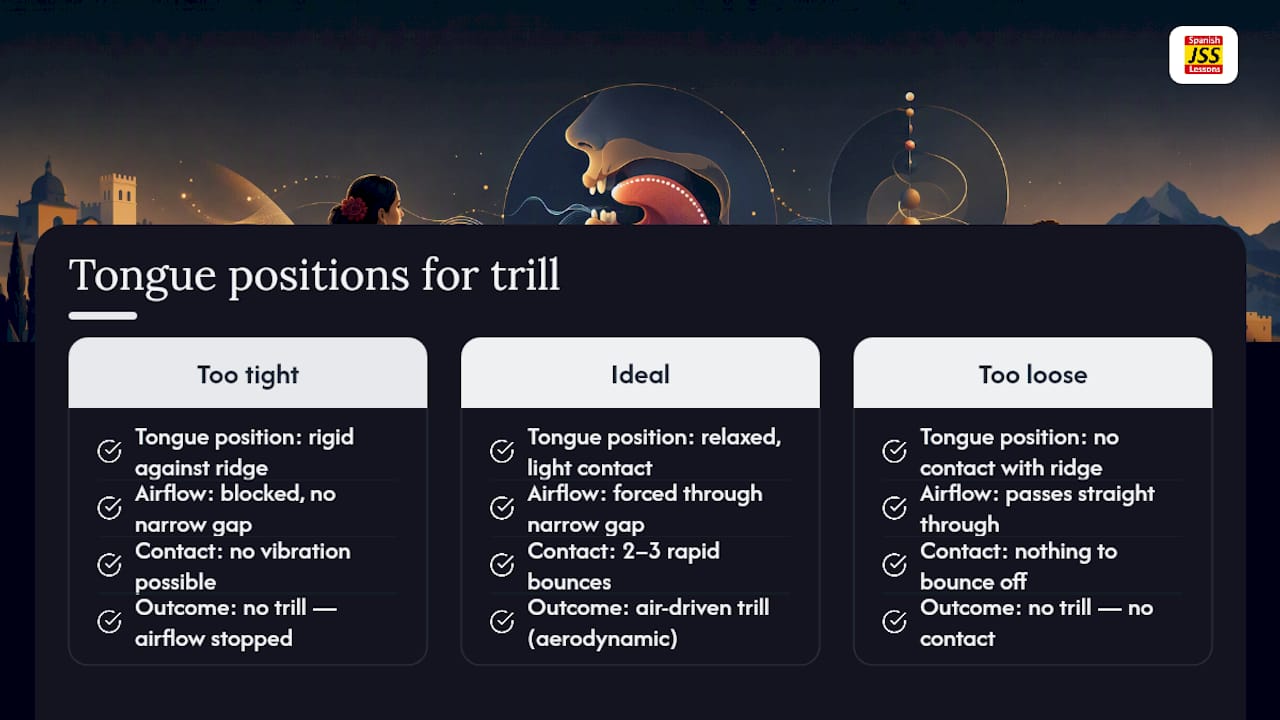
- The Spanish /r/: a single tap (as in “pero”) versus the trilled “rr” (as in “perro”) — two different sounds, not variations of one.
- The guttural j/g: the “jota” sound in “jamón” has no true English equivalent and needs deliberate practice, not approximation.
- Pure vowels: English vowels glide; Spanish vowels stay flat and short, which is why “no” sounds like two syllables when English speakers say it.
- Intervocalic d: the soft, almost-swallowed “d” in words like “nada” gets over-pronounced by English speakers used to a harder consonant.
Fix the melody before the individual sounds. Practise in short chunks: take a five-word phrase, shadow a native recording line by line, then slow it right down before speeding back up to natural pace. Recordings of short dialogues work better than single words because entonation is best learned inside functional speech, not in isolation. Our own pronunciation guide walks through this shadowing method step by step.
Pro Tip: Mark the melodic contour on paper before you speak. Draw an arrow rising or falling over each syllable of a short phrase, then say it following your own drawing. It forces your ear to notice the tune, not just the words.

Grammar and orthography pitfalls English speakers hit
Four grammar habits cause most of the repeated mistakes among English speakers, and none of them need a full grammar rulebook to fix.
Ser vs estar trips almost everyone early on. A rough working rule: use ser for identity and lasting traits (“soy inglés”), and estar for states, conditions and location (“estoy cansado”). Practise with two templates you fill in daily: “Soy ___ / Estoy ___” for yourself, and “Está ___” describing objects around you.
The subjunctive does not need to be conquered wholesale. Learn it through fixed triggers first: “espero que”, “quiero que”, “es importante que”. Once ten of these phrases feel automatic, the pattern generalises on its own.
Noun gender rarely needs memorising in isolation. Instead, tune your ear to adjective endings: “la mesa roja” versus “el coche rojo” teaches gender agreement by sound repetition rather than rote lists.
Accent marks are not decoration. “Como” (as/like) and “cómo” (how) are different words; “papa” (potato) and “papá” (dad) likewise. Build a two-step proofreading habit:
- Read the sentence aloud and listen for stress that doesn’t match the written accent.
- Check every question word (qué, cómo, dónde) carries its accent, since these are the most common slip.
Pro Tip: Keep a running list of your own repeated mistakes rather than a generic grammar list. Five personal errors, reviewed weekly, correct faster than fifty rules you have never actually made.
False friends: stop translating word for word
English speakers instinctively guess Spanish meaning from spelling, and that instinct fails constantly with false friends. Common lexical traps include “embarazada” (pregnant, not embarrassed), “actual” (current, not actual), “asistir” (to attend, not to assist), and “realizar” (to carry out, not to realise) — mistakes that repeatedly cause awkward or confusing moments in conversation.
The cause is straightforward: your brain defaults to the nearest-looking English word because that pathway is faster than retrieving the correct Spanish meaning. The fix is to learn words in families and collocations rather than as single items. “Asistir a una reunión” (attend a meeting) sticks better as a phrase than “asistir” alone ever will.
Practical drills that work:
- Write the false friend inside a full sentence, never as an isolated flashcard word.
- On flashcards, prompt yourself to produce the correct meaning, not just recognise it passively.
- Group words by family (asistir, asistencia, asistente) so context reinforces the real meaning each time.
Your 12-week Spanish study plan
Sequence matters more than sheer hours. Adults who front-load listening and prosody work, then build sentences before chasing vocabulary lists, tend to reach usable fluency faster than those who start with grammar drills.
- Weeks 1 to 3: Ear-tuning first. Spend most of your time listening to short native dialogues, shadowing phrases, and marking melodic contour. Grammar study stays light here. This is deliberate: your ear needs to recognise natural rhythm before your mouth can reproduce it.
- Weeks 4 to 6: Sentence-building. Move from single words to slot-and-template practice: “Quiero ___”, “Voy a ___”, “¿Puedes ___?” Fill the slots with new vocabulary daily rather than memorising standalone word lists.
- Weeks 7 to 9: Multi-modal vocabulary retention. Push words through reading, listening, speaking and writing in the same week. Multi-modal exposure paired with spaced repetition builds stronger recall than single-mode rote study, because each mode reinforces the word through a different memory pathway.
- Weeks 10 to 12: Low-stakes speaking practice. Book short, repeatable conversations, whether with a tutor, exchange partner, or shopkeeper if you live locally. Build a correction loop: note what went wrong, drill it once, then move on rather than dwelling on it.
A realistic weekly rhythm across all twelve weeks looks like this: twenty minutes of listening most days, three short sentence-building sessions, one vocabulary review session using spaced repetition, and at least one real conversation, however brief. Consistency across small sessions beats occasional long ones, because language retention depends on frequency of exposure more than duration of any single session.
Pro Tip: Treat week six and week twelve as checkpoints, not exams. Record yourself answering five simple questions about your day, then compare the two recordings. You will hear progress in rhythm before you hear it in vocabulary.
For structured sentence practice, our guide to real-life spoken fluency breaks this sequencing down further, and the vocabulary memorisation guide covers the retention side in more depth.
What the research says about prosody and classroom design
Suprasegmental differences in rhythm and intonation persist even at advanced levels of Spanish among English speakers, making melody, not vocabulary, the main barrier to sounding natural.
That finding comes from acoustic-digital analysis comparing native and non-native Spanish speech patterns, and it has a direct implication for how lessons should be structured. The Plan Curricular del Instituto Cervantes recommends weaving prosody into every lesson rather than treating it as a bolt-on module taught once and forgotten.
For self-study, the takeaway is practical: don’t wait until you “know enough grammar” to start training your ear. Rhythm work belongs in week one, not month six, because the deviations researchers measure in advanced learners often trace back to habits formed early and never corrected.
Fixing course choice: what actually matters
Look past marketing claims and check for three concrete features before you commit to any course.
- Ear-tuning content, not just grammar explanation: does the course include listening drills built around natural speed speech?
- Sentence-building practice, where you construct language from templates rather than memorising isolated vocabulary lists.
- A spaced repetition system that brings vocabulary back at increasing intervals, rather than a single pass through a word list.
- Access to a sample lesson before you pay, so you can judge teaching style rather than trust a sales page.
Self-paced formats suit adults with unpredictable schedules, retirees, and anyone who wants to repeat difficult lessons without embarrassment. Live classes suit learners who want scheduled accountability. Full immersion works fastest but only for those who can relocate or dedicate weeks entirely to Spanish. Whichever you choose, ask directly whether the teacher is genuinely bilingual and whether the course addresses suprasegmental training explicitly, since many do not.
Untangling English word order habits
English sentence structure leaks into Spanish in predictable, fixable ways. English speakers default to subject-verb-object rigidly, then carry that rigidity into Spanish, where word order is far more flexible and often signals emphasis rather than grammar.
Three interference patterns show up constantly. First, English speakers often place adjectives before nouns out of habit (“roja mesa” instead of “mesa roja”), because English adjective order feels instinctive even after the rule is known intellectually. Second, English speakers overuse subject pronouns (“yo quiero”, “yo voy”) because English cannot drop its subject, whereas Spanish verb endings already signal who is speaking, making the pronoun optional and often unnatural when overused. Third, question formation gets stuck in English patterns, with learners trying to insert an equivalent of “do” that Spanish simply does not use.
The fix is repetition through correct models, not memorised rules. Read or listen to Spanish sentences aloud daily, focusing specifically on adjective placement and pronoun dropping, until the correct pattern feels automatic rather than calculated. Sentence-building practice, where you physically construct sentences from slots and templates rather than translating English sentences word by word, retrains this instinct faster than grammar study alone. Translating in your head will always default to English structure; building sentences from Spanish patterns bypasses that default entirely.
Accredited Spanish study routes if you’re based in Spain
If formal accreditation matters to you, whether for residency, work, or personal benchmarking, several established routes exist. Centres accredited by Instituto Cervantes and other Spanish education bodies offer everything from short conversation-focused classes to structured exam preparation, both in person and online.
The two recognised proficiency exams worth knowing are the DELE (Diploma de Español como Lengua Extranjera), issued by Instituto Cervantes and widely required for certain residency or employment applications, and SIELE (Servicio Internacional de Evaluación de la Lengua Española), a faster, computer-based alternative recognised by a growing number of institutions. Neither exam tests rhythm or intonation directly, which matters: passing a written or reading-based exam does not guarantee conversational fluency, since the two skill sets develop somewhat separately.
For most adult learners the practical question is not which exam to sit, but whether a formal qualification is actually required for their situation. Retirees and expats settling into daily life often need conversational competence far more urgently than a certificate. Those pursuing employment or citizenship applications should check the specific level required, since requirements vary by purpose and institution rather than following one fixed national standard.
Formality, regional variety, and everyday idiom
Spanish carries a formality distinction English mostly lost: tú versus usted. Getting this wrong doesn’t usually cause offence, but it does mark you instantly as a learner still finding their footing. As a rough guide, use usted with anyone older, in an official role, or in a first professional interaction, and shift to tú once the other person signals it, often by using tú themselves first.
Regional variation matters too, more than most textbooks admit. Peninsular Spanish (spoken in Spain) differs from Latin American Spanish in vocabulary, some pronunciation, and plenty of idiom. Someone learning European Spanish should expect words like “coger” (to take/catch) to carry entirely different, sometimes awkward, connotations in parts of Latin America. This is not a flaw in either variety, simply a reason to know which audience you are learning for.
Idiomatic expressions resist literal translation entirely. “Estar como una cabra” (literally “to be like a goat”) means to be a bit mad or eccentric. “Ponerse las piles” (literally “put in the batteries”) means to get your act together. These phrases only stick when learned in context, through real conversation or dialogue, never through a vocabulary list translated word by word.
Getting real practice with native speakers
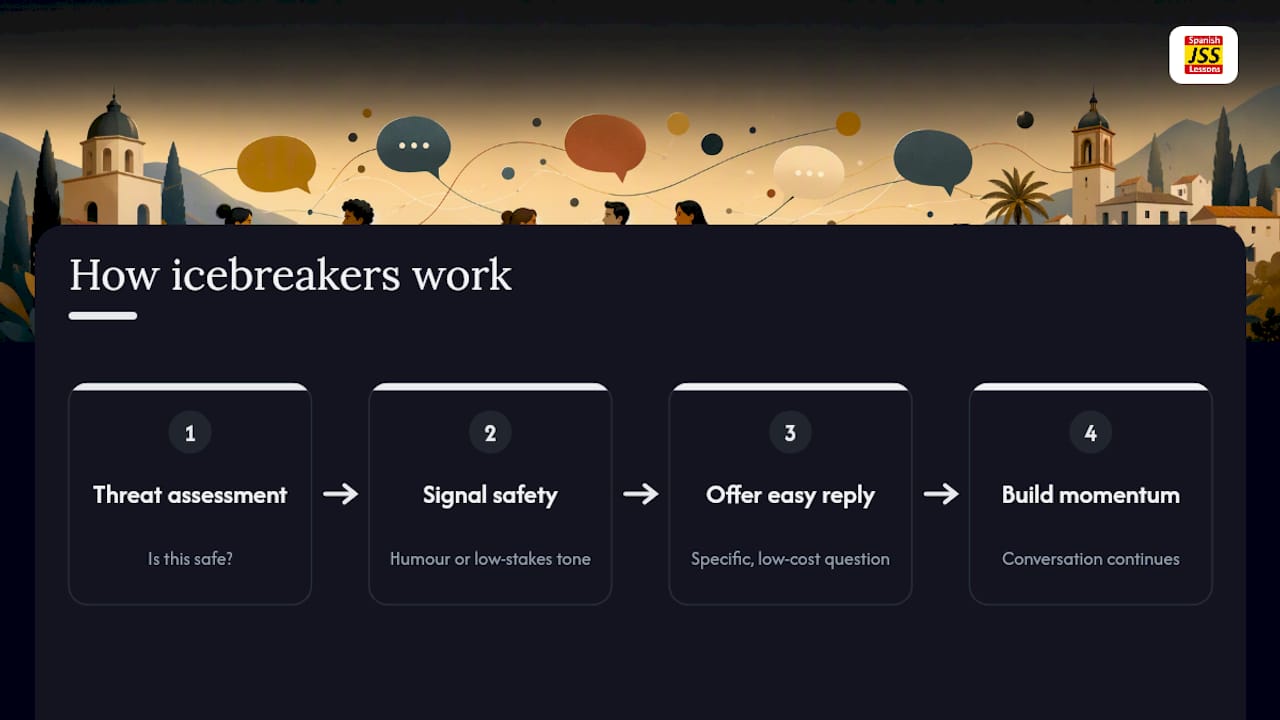
Textbook Spanish and spoken Spanish diverge fast, and the only real fix is exposure to people who actually speak it at natural speed. Start with low-stakes, repeatable interactions rather than long, high-pressure conversations. A two-minute exchange with a shopkeeper or a five-minute video call with a language exchange partner does more for confidence than an hour-long lesson you dread.
Many English speakers can perform well in a controlled classroom setting but freeze in a genuine social exchange, a pattern often called the confidence crash. Building small, repeatable routines, the same greeting, the same follow-up questions, used across multiple real interactions, reduces this because familiarity replaces panic with pattern recognition.
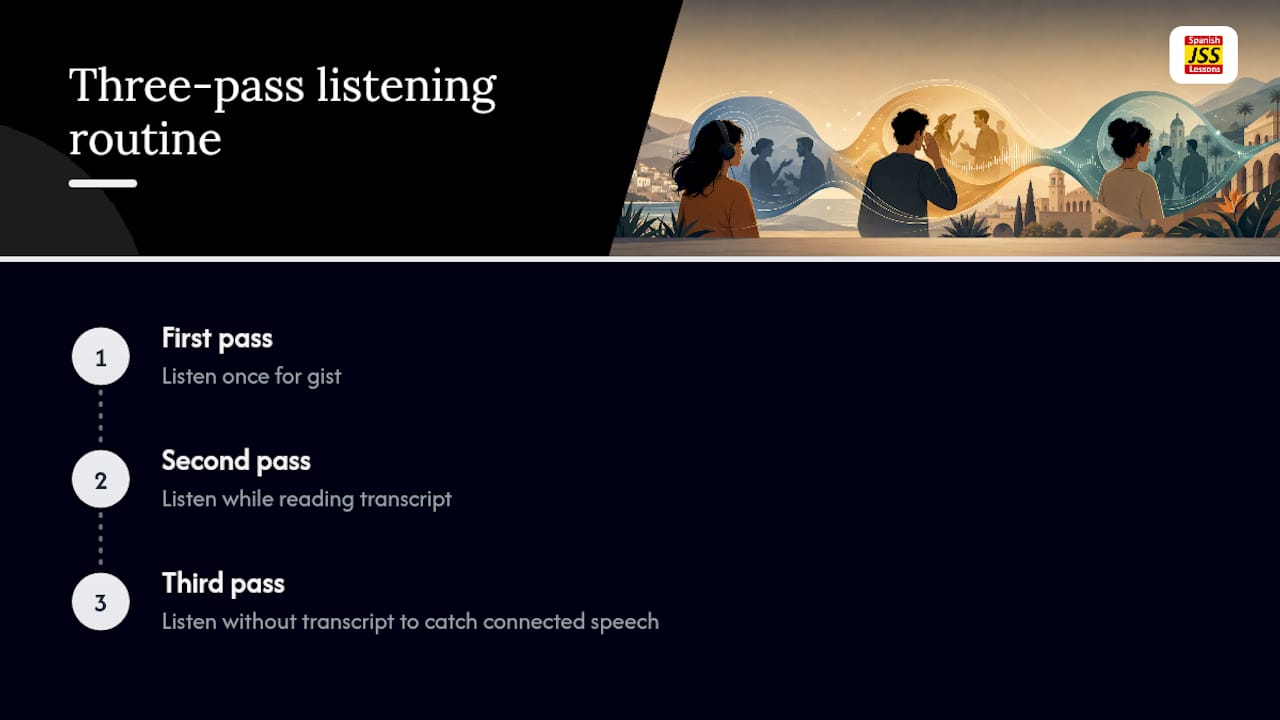
Comprehension improves faster through targeted listening than through general exposure. Choose short native audio, listen once for gist, then again while reading a transcript, then a third time without it. This trains your ear to catch connected speech, where words blur together at natural speed, which is usually the actual barrier rather than vocabulary size. Our guide on speaking with confidence covers specific routines for these early real-world conversations.
Cognate traps beyond the obvious false friends
Beyond the well-known false friends, a second layer of cognate traps catches learners who feel confident enough to stop double-checking. Words that look nearly identical but carry meaningfully different weight or register cause quiet, repeated errors that rarely get corrected because native speakers usually understand the intended meaning anyway.
“Molestar” looks like “molest” but simply means to bother or annoy, a mismatch that alarms new learners the first time they see it in a mild context. “Constipado” means having a cold, not constipation. “Introducir” means to insert or introduce a concept, not to introduce a person, where “presenter” is correct instead. These are not obscure edge cases; they appear in ordinary daily conversation.
The underlying pattern worth learning, rather than memorising each case individually, is that Spanish and English share a huge amount of Latin-derived vocabulary, but centuries of separate evolution have shifted plenty of these words in different directions. Treat any suspiciously familiar-looking word as a hypothesis to verify, not a fact to assume, especially the first few times you encounter it in a new context.
Choosing apps and technology that actually build fluency
Most language apps optimise for streaks and gamified points rather than genuine retention or conversational readiness, which is worth knowing before you invest months in one. The features that matter for English speakers specifically are spaced repetition scheduling, audio at natural (not slowed) speed, and exercises that require producing language rather than just recognising it in a multiple-choice format.
Multi-modal exposure, meaning vocabulary and structures reinforced across reading, listening, speaking and writing rather than one single mode, builds stronger retention than any single-skill app used alone. This is the logic behind pairing a listening-focused tool with a separate speaking-practice routine rather than relying on one app to cover everything.
Look specifically for tools that combine vocabulary retention with pronunciation feedback, since most apps handle one but not both well. A system that tracks which words you consistently forget and resurfaces them at increasing intervals will outperform a fixed daily lesson plan, because your actual weak points rarely match the app’s pre-set curriculum. Technology works best as a support structure around a coherent method, not as the method itself.
James Spanish School: built around exactly these challenges
Everything covered so far, prosody first, sentence-building before vocabulary lists, retention through repetition rather than rote memorisation, is the design logic behind the James Spanish School course itself.
James Spanish School uses a method called Radical Simplification: grammar terminology that native speakers never use in their own heads gets stripped out, replaced with plain English explanations of how Spanish structure actually works. The 100-lesson course splits between sentence-building, the “engine room” of constructing your own sentences from templates, and ear-tuning, training your ear to follow natural, fast spoken Spanish rather than the slow, careful diction most courses default to.
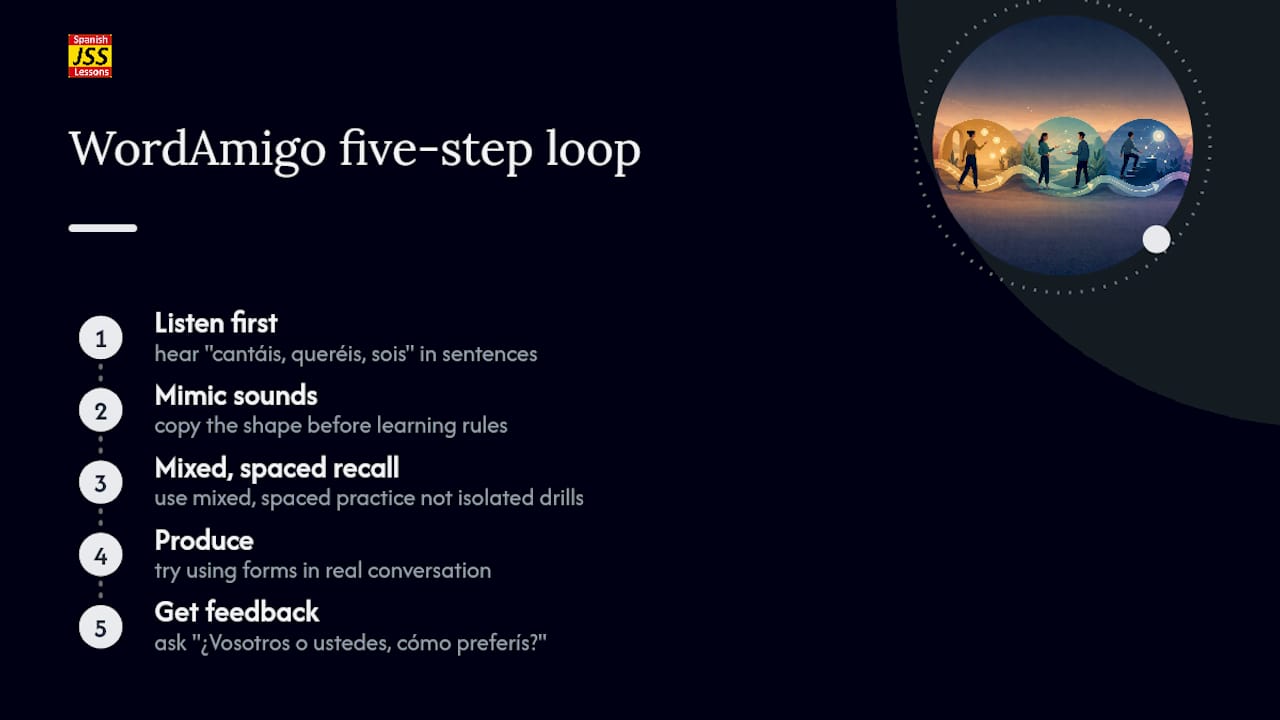
Vocabulary and pronunciation retention run through WordAmigo, an AI-powered system built with IT specialists and long-term English expats living in Spanish society, alongside dual-native founder James Bretherton. WordAmigo drives a five-step retention loop across reading, listening, speaking and writing, the same multi-modal exposure that outperforms single-mode study, so words and sounds embed permanently rather than fading after a week.
Every lesson is available on demand, twenty-four hours a day, on phone, tablet, or laptop, with lifetime access and no expiry date pressuring you through the material. If a core lesson genuinely teaches you nothing new, James Spanish School credits you with extra practice modules at no cost, a straightforward guarantee rather than a marketing gesture. The course suits retirees, expats, and any adult who wants real conversational competence for everyday life in Spain, queuing, tradesmen, health workers, government officials, rather than passing an academic exam.
Browse the full course and sample lessons on the James Spanish School shop, or explore the Vocab Builder resources to see the retention system in action before you commit.
Sources
- Análisis acústico-digital de la entonación del español hablado por anglófonos (Revista de Humanidades Digitales, 2024)
- La enseñanza pautada de la entonación en ELE en el PCIC 2006 (Spanish education resource)
- Studying Spanish in Spain – RedELE / Instituto Cervantes listings (Spanish ministry guidance)