James Spanish School

Categories
Insights

Essential European Spanish grammar tips for real conversations


TL;DR:

  • Gender agreement of nouns, articles, and adjectives is essential for natural-sounding Spanish.
  • Spanish word order is flexible and used for emphasis, storytelling, and natural conversation flow.
  • Focusing on mastering key verb conjugations and practicing regularly accelerates fluency more than perfection.

You’ve probably had that moment: you’ve studied Spanish, you know the rules, and then a local in Spain fires back at the speed of light and you freeze. Textbook Spanish and real Spanish are not the same thing. The gap between them comes down to a handful of practical grammar patterns that most courses simply gloss over. This article cuts through the noise and gives you the everyday grammar essentials that actually matter for speaking European Spanish with confidence. Whether you’re an expat, a retiree, or simply someone who wants to chat with the neighbours, these tips will help you sound natural and feel at home.

Table of Contents

Key Takeaways

Point Details
Gender and agreement Always match your articles and adjectives to the noun’s gender and number for clear, correct sentences.
Flexible word order Use Spanish’s flexible sentence structure to add emphasis, but remember adjectives usually follow the noun.
Conjugation focus Focus on mastering key verb patterns, especially ‘ser’ and ‘estar’, to confidently express identity and state.
Embrace practice Daily conversation and media exposure accelerate progress faster than just studying grammar rules.

Get gender and agreement right

If there’s one thing that catches English speakers off guard, it’s the fact that every single noun in Spanish has a gender. Not just people. Tables, cars, problems, ideas. All of them are either masculine or feminine, and everything around them must match. This is the engine room of Spanish sentence construction, and getting it right makes your speech sound polished rather than patchy.

Nouns in Spanish have gender (masculine or feminine) and number (singular or plural), and both articles and adjectives must agree with them. So it’s el libro rojo (the red book, masculine) but la mesa roja (the red table, feminine). Change the noun, and everything around it changes too.

Here’s what you need to know to get started:

  • Most masculine nouns end in -o (el chico, the boy) and most feminine nouns end in -a (la chica, the girl), but there are important exceptions such as el día (masculine, despite ending in -a) and la mano (feminine, despite ending in -o).
  • Articles must match: el/los for masculine, la/las for feminine.
  • Adjectives follow the noun and must agree in both gender and number: los libros rojos, las mesas rojas.
  • When a group contains both genders, even if it’s ninety-nine women and one man, the masculine plural is used. This is a cultural and grammatical reality of Spanish worth knowing early.
  • Agreement errors are among the most frequent beginner mistakes, but learning set phrases as whole units (rather than word by word) speeds up accuracy considerably.

The good news is that once you absorb the logic, it becomes second nature. Understanding Spanish structure for beginners helps you see how gender and agreement fit into the bigger picture of how sentences work. And when you’re practising basic Spanish conversations, you’ll find these patterns reinforcing themselves naturally.

Pro Tip: When you learn a new noun, always learn it with its article attached. Don’t just learn libro. Learn el libro. This locks in the gender automatically and saves you guessing later.

With agreement as your base, the next layer is how to build flexible yet natural-sounding Spanish sentences.

Master word order and emphasis for fluid speech

Here’s something that surprises many learners: Spanish word order is far more flexible than English. In English, shifting words around changes meaning or sounds wrong. In Spanish, it often adds colour, drama, or emphasis. That flexibility is part of what makes Spanish conversation so expressive.

Friends speaking Spanish at café table

Sentence structure is typically Subject-Verb-Object, much like English, but word order can shift for emphasis without breaking the rules. So Juan come manzanas (Juan eats apples) is perfectly standard, but Manzanas come Juan is also understood, with the emphasis now falling on what he eats.

Some key points to keep in mind:

  • Adjectives in Spanish usually follow the noun, not precede it: una casa grande (a big house), not una grande casa (though some adjectives do go before the noun and change meaning when they do).
  • Fronting a phrase or adverb to the start of a sentence adds dramatic effect, as in En el cielo azul, el sol brilla (In the blue sky, the sun shines). This is common in storytelling and casual speech alike.
  • Dropping the subject pronoun is normal and expected, because the verb ending already tells you who’s acting: Como means I eat without needing yo (I) in front of it.
  • Questions are formed by inversion or simply by intonation: ¿Hablas español? or ¿Tú hablas español? Both work in conversation.

“Word order in Spanish is not just grammar. It’s a storytelling tool. Native speakers use it instinctively to control where the listener’s attention falls.” This cultural use of structure is something textbooks rarely teach but real conversation demands.

Practising these patterns with real conversation steps helps you move from mechanical sentence-building to something that actually sounds human. For a broader view of how this connects to learning Spanish fluency, understanding word order is one of the most underrated tools you have.

Word order brings your sentences to life. Next, learn how verbs shift meaning using subject, tense, and mood.

Conjugate verbs like a native: the essentials

Verbs are where many adult learners hit a wall. Spanish verbs change form depending on who’s doing the action, when it happened, and even the speaker’s attitude. That’s a lot to take in. But here’s the practical truth: you don’t need to master every tense to hold a real conversation. You need a solid grip on a few key ones.

Verbs conjugate by subject, tense, and mood, and the most important distinction for English speakers is ser versus estar. Both mean “to be”, but they are not interchangeable.

Verb Use Example Meaning
Ser Permanent identity, origin, profession Soy inglés I am English
Ser Describing inherent qualities Es alto He is tall
Estar Temporary states or feelings Estoy cansado I am tired
Estar Location Está en casa He is at home

For daily conversation, focus on these tenses in this order:

  1. Present tense (hablo, como, vivo): Used constantly, covers current actions and habits.
  2. Preterite past (hablé, comí, viví): For completed actions with a clear endpoint.
  3. Present perfect (he hablado, he comido): Especially important in European Spanish for recent events.
  4. Simple future (hablaré) or the informal going-to future (voy a hablar): Both are used in everyday speech.

You can explore verb practice resources to build these patterns through repetition rather than rote memorisation. Pairing that with spoken Spanish lessons helps the conjugations stick in context rather than as abstract charts.

Pro Tip: Start with the ten verbs you use most in your own daily life. Conjugate only those in the present and past tense. That alone will carry you through a huge proportion of everyday conversation.

With verbs mastered, you’ll need to handle negation and pronouns, which are core to clear, natural communication.

Essential negation, pronouns, and Spanish specifics

Negation in Spanish is refreshingly simple to start with. Place no directly before the verb and you’re done: No tengo gato means I don’t have a cat. No auxiliary verb needed, no rearranging the sentence.

But there’s a twist. Double negatives are correct and common in Spanish, unlike in formal English. No tengo nada literally translates as “I don’t have nothing”, but it’s the standard way to say “I don’t have anything.” You’ll also hear No veo a nadie (I don’t see anyone) and No voy nunca (I never go). These are not errors. They’re the rule.

Here are the pronouns and specifics that matter most for European Spanish:

  • Vosotros is the informal plural “you” used in Spain but not in Latin America. You’ll hear it constantly: ¿Coméis aquí? (Are you all eating here?)
  • Le/lo distinction: Le is the indirect object pronoun (to him, to her, to you formal), while lo is the direct object (him, it). In European Spanish, leísmo (using le for a male direct object) is also common and accepted.
  • Present perfect for recent past: Where Latin American Spanish might use the preterite, European Spanish strongly prefers he comido hoy (I have eaten today) over comí hoy. You will hear the preterite far less in Spain that Latin America.
  • Adverbs are often formed by adding -mente to the feminine adjective (rápidamente, quickly), though irregular adverbs like bien (well) and mal (badly) don’t follow this pattern.
Feature European Spanish Latin American Spanish
Informal plural you Vosotros coméis Ustedes comen
Recent past Present perfect preferred Preterite common
Leísmo Widely accepted Less common

For more on blending in naturally, Spanish fluency tips Spain covers the cultural and grammatical nuances that matter on the ground. And if you want to understand how much grammar for new learners actually matters, the answer might surprise you.

Now that you have the grammar essentials, it’s time for tips on how to practise and use these patterns confidently.

Keep it practical: how to use grammar tips for rapid improvement

Knowing grammar rules is one thing. Using them under pressure, in a real conversation, with a fast-talking Spaniard, is another entirely. The bridge between the two is consistent, low-pressure practice built into your daily routine.

Adults learn best through a combination of grammar foundations and early speaking practice. Consistent daily engagement, even in short bursts, outperforms long weekly study sessions.

Here’s a practical routine to build grammar confidence quickly:

  1. Spend ten minutes each morning reviewing one grammar point, such as a verb tense or a pronoun rule, using a real example from your life.
  2. Listen to Spanish daily, whether a podcast, a TV show, or a radio station. Your ear needs exposure to natural rhythm and speed.
  3. Speak out loud, even to yourself. Narrate what you’re doing in Spanish. It feels odd at first, but it builds fluency fast.
  4. Join a conversation group or language exchange to practise with real people in low-stakes settings.
  5. Keep a small notebook of the grammar mistakes you make most often. Reviewing these regularly turns weaknesses into strengths.

Mistakes are not setbacks. They are data. Every error tells you exactly what to focus on next. The learners who progress fastest are not the ones who avoid mistakes. They’re the ones who make them quickly, notice them, and adjust.

For structured support, practical online learning gives you a clear path from grammar basics to genuine fluency. Pairing that with beginner conversation routines means you’re practising grammar in the context where it actually matters.

Pro Tip: Track the three grammar mistakes you make most often. Work on just those three until they feel automatic. Then move to the next three. Focused improvement beats scattered study every time.

Expert take: why perfect grammar isn’t the goal for real conversation

After years of teaching English-speaking adults to speak Spanish in Spain, one pattern stands out above all others: the learners who hold back waiting to be perfect are the ones who make the slowest progress. They study more, speak less, and wonder why fluency feels so far away.

Prioritise practice from day one: speak early, immerse yourself via media and podcasts, and let grammar sharpen through use rather than study alone.

Authentic communication matters far more than perfect endings or rare pronouns. A Spanish neighbour, shopkeeper, or tradesman will understand you and appreciate the effort even if your agreement wobbles or you mix up ser and estar. What they won’t engage with is silence.

The fastest route to fluency is through fluency-first approaches that treat grammar as a tool for communication, not an end in itself. Use the language. Embrace the culture. Then finesse the finer grammar points as you go.

“You can always fix grammar, but you can’t fix silence.”

Real progress comes from using Spanish, not just studying it.

Take your Spanish further with James Spanish School

Practical grammar skills and cultural understanding grow fastest when you have structured lessons designed for real life, not academic exams. At James Spanish School, every lesson is built around the conversations you’ll actually have: with neighbours, shop staff, tradesmen, and local officials.

https://jamesspanishschool.com

James Bretherton’s method of Radical Simplification strips away unnecessary jargon and explains Spanish through plain English, so you spend less time confused and more time speaking. Explore the full range of Spanish learning resources, work through the core Spanish lessons at your own pace, and put everything into practice with real-life fluency tips drawn from 40 years of living in Spain. No countdown clocks. No pressure. Just Spanish that works.

Frequently asked questions

What is the most important Spanish grammar rule for beginners?

Make sure your articles and adjectives agree in gender and number with the nouns. For example, use el amigo simpático for a male friend and la amiga simpática for a female friend.

How do I know when to use ‘ser’ or ‘estar’?

Ser is for identity or origin, while estar describes temporary states or locations. A simple rule: ser for permanent, estar for temporary, so Soy inglesa (I am English) versus Estoy cansada (I am tired).

What is a common mistake English speakers make in Spanish conversation?

Many learners forget to change adjectives to match the noun in gender and number, or rely on word-for-word translations that create awkward sentences. Gender agreement errors are among the most frequent issues for beginners.

Is it true that Spanish uses double negatives?

Yes, double negatives are correct and entirely normal in Spanish. No tengo nada literally means “I don’t have nothing” but is the standard way to say “I don’t have anything.”

What’s different about European Spanish grammar?

European Spanish uses vosotros for the informal plural “you” and prefers the present perfect for recent past events, both of which help you sound local when speaking in Spain rather than Latin America.

Categories
Insights

Spanish learning with no deadline: flexibility and fluency


TL;DR:

  • Adult learners thrive with flexible, self-paced Spanish study that fits their busy lives.
  • Removing deadlines increases motivation, reduces stress, and enhances long-term language retention.
  • Combining self-study with real-life practice and milestones builds genuine conversational fluency.

Most adults assume that learning a language without a fixed deadline means drifting aimlessly, making little real progress. That assumption is worth questioning. Research consistently shows that adult learners thrive when they can study on their own terms, free from the anxiety of countdown clocks and rigid timetables. European Spanish, in particular, rewards a relaxed, conversational approach because the goal is real life: chatting with neighbours, ordering at a bar, or navigating a Spanish health centre. This article explores what deadline-free Spanish learning actually looks like, how it works in practice, and why it may be the most effective path to genuine fluency for busy adults.

Table of Contents

Key Takeaways

Point Details
Flexibility matters Self-paced learning allows you to adapt Spanish study to real life and reduce unnecessary stress.
Real conversation counts Combining solo study with practical speaking boosts confidence and lasting fluency.
Assess your style Pick resources and habits that motivate you, then adjust as life changes.
Celebrate milestones Marking progress—even small wins—keeps momentum strong in deadline-free learning.

What does Spanish learning with no deadline mean?

With the value of flexibility in mind, let’s clarify exactly how deadline-free Spanish learning stands apart from traditional methods.

Spanish learning with no deadline simply means you set the pace. There is no exam date looming, no course expiry, and no tutor tapping a watch. You move through material when it suits your life, whether that is fifteen minutes on a Tuesday morning or a longer session on a rainy Sunday afternoon. The focus shifts from finishing to absorbing, which is a meaningful difference for adult learners juggling work, family, and everything else.

A common misconception is that removing deadlines removes motivation. In practice, the opposite is often true. When there is no fear of falling behind, learners tend to return to their studies more willingly and more often. Pressure can create avoidance; freedom tends to create curiosity.

Another myth is that self-paced learning is unstructured. Good online Spanish lessons are carefully sequenced, building vocabulary and sentence structure in a logical order. The difference is that you control the speed, not an institution.

Who benefits most from this approach?

  • Working adults with unpredictable schedules
  • Retirees and expats settling into life in Spain
  • Parents who can only study in short windows
  • Learners who experience anxiety in formal classroom settings
  • Anyone who has previously abandoned a course due to falling behind
Feature Flexible, deadline-free learning Fixed-schedule traditional course
Pace Set by the learner Set by the institution
Stress level Low Often high
Lesson access On demand, 24/7 Fixed times and dates
Repetition Unlimited Usually restricted
Focus Conversational fluency Often exam preparation
Accountability Self-directed External pressure

Infographic comparing flexible and traditional Spanish courses

The core Spanish course at James Spanish School is built around exactly this philosophy. Lessons are available whenever you need them, with no expiry date attached. Check out what students say about this course.

Pro Tip: Combining self-paced study with occasional live interaction is more effective than apps alone. Even a short weekly conversation with a Spanish speaker anchors what you have been learning in a way that solo study cannot fully replicate.

How does flexible Spanish learning actually work?

Once you understand what makes self-paced learning unique, it is important to see how it plays out day to day.

Man practicing Spanish on smartphone at kitchen table

Self-paced language learning boosts motivation and allows for sustained engagement over months and years, rather than the short bursts typical of deadline-driven courses. But that sustained engagement needs a practical framework to keep it moving.

Here are the main steps to get started effectively:

  1. Choose your core material carefully. Pick a structured course that builds sentence logic progressively. Random YouTube videos and isolated vocabulary lists rarely produce conversational ability on their own.
  2. Set realistic, personal goals. Rather than “be fluent by March,” aim for “hold a short conversation about directions” or “understand my Spanish neighbour’s greeting.” Small, specific targets feel achievable.
  3. Track progress casually. A simple notebook or phone note recording new phrases you have used in real life is often more motivating than a formal progress chart.
  4. Mix your resources. Audio lessons suit commutes; flashcard apps work well in waiting rooms; podcasts in Spanish build your ear for natural speech patterns.
  5. Schedule real-life practice moments. Order your coffee in Spanish. Ask a question at the local market. These small acts consolidate learning faster than hours of passive study.

For a fuller breakdown, the practical Spanish learning steps guide walks through this process in detail, and the on-demand Spanish learning guide explains how to make the most of flexible resources.

Pro Tip: Avoid getting trapped by purely gamified apps. They are entertaining and useful for vocabulary, but they rarely teach you to construct a sentence under pressure. Prioritise real speech practice, even if it is just talking to yourself in Spanish while cooking.

Comparing flexible Spanish learning to traditional courses

But is deadline-free Spanish learning always better? A direct comparison with traditional courses reveals where each shines.

Gamified apps alone are often insufficient for reaching real-world conversational ability. They can build a useful vocabulary base, but they rarely prepare you for the machine-gun speed of native replies or the cultural nuances woven into everyday Spanish conversation.

Dimension Flexible, self-paced Traditional fixed course
Learner satisfaction Generally higher long-term Can drop sharply if pace is wrong
Stress and anxiety Significantly lower Often elevated near deadlines
Depth of understanding Higher, due to repetition Variable, dependent on pace
Real-world output Strong with good resources Strong with good teaching
Suited to Adults with busy lives Younger learners, structured environments

“The richest language learning happens when output, meaning actual speaking and writing, is prioritised alongside structured input. Self-paced environments make it far easier to return to a lesson, repeat it, and truly internalise it before moving on.”

The trade-off is real, though. Fixed-schedule courses offer external accountability, which some learners genuinely need. If you know you will not open a lesson without a deadline, a structured course may suit you better, at least initially. The Spanish Core Lessons 1-50 and the spoken Spanish practice lessons at James Spanish School are designed to bridge this gap, offering structure without rigidity.

The honest answer is that personality matters. Autonomous, curious learners almost always flourish in self-paced environments. Learners who need social pressure to perform may benefit from blending both approaches.

How to personalise your deadline-free Spanish journey

Now that the main approaches are clear, it is time to create your ideal flexible learning pathway.

A mix of structured lessons and real-life conversation is most effective for adults. The key is designing a routine that fits your actual life, not an idealised version of it.

Steps for building your personal pathway:

  • Start with a structured course that covers sentence-building logic, not just vocabulary lists
  • Add one or two audio or podcast resources for passive listening during daily routines
  • Find a language exchange partner or informal conversation group, even online
  • Use real-life scenarios as practice: shopping lists in Spanish, labelling items at home, or narrating simple tasks aloud
  • Revisit earlier lessons freely. There is no shame in repetition; it is how fluency actually forms

The Spanish Lessons 1-50 module and the Spoken Spanish Practice Lessons1-50  course offer excellent material for this kind of layered, self-directed learning.

Pro Tip: Celebrate milestones, even tiny ones. The first time you understand a full sentence spoken by a native, write it down. The first time you successfully ask for directions and understand the reply, tell someone. These moments build genuine confidence, and confidence is the engine room of conversational fluency.

Avoid the trap of waiting until you feel “ready” to speak. Fluency is not a destination you arrive at before you start talking. It is built through the talking itself, imperfect and hesitant as it may be at first.

Why most adults thrive with deadline-free Spanish learning

Looking back over the evidence and practical experience, one truth stands out: most adults do not fail at language learning because they lack ability. They fail because the system they chose was designed for a different kind of learner.

School-style deadlines made sense when you were seventeen, had few other responsibilities, and were surrounded by peers at the same stage. As an adult, that context is gone. Life interrupts. A deadline missed becomes a reason to quit rather than a reason to catch up.

Deadline-free learning removes that exit ramp. When there is no “behind” to fall, there is no failure to trigger avoidance. Learners who have found fluency through gentle, self-directed momentum often describe the same experience: they stopped dreading their study sessions and started looking forward to them. That shift is everything.

For adults learning Spanish, the most important variable is not speed. It is consistency. And consistency is far easier to maintain when learning fits around your life rather than demanding your life fit around it.

Start your flexible Spanish journey today

If you are ready to make real progress at your own pace, James Spanish School has everything you need to get started without stress or obligation.

https://jamesspanishschool.com

The Spanish course resources at James Spanish School are built for exactly the kind of learner described throughout this article: an English-speaking adult who wants practical, conversational European Spanish without the pressure of deadlines or the confusion of grammar jargon. Browse the full range of online lessons at your own pace, revisit any lesson as often as you like, and apply what you learn to real conversations. For practical guidance on speaking confidently with locals, the tips for speaking Spanish fluently resource is a natural next step.

Frequently asked questions

Is learning Spanish without deadlines really effective for adults?

Yes, flexible learning helps adults stay motivated and reduces the stress that often comes with rigid deadlines. Self-paced learning consistently boosts motivation and long-term engagement compared to fixed-schedule alternatives.

How can I ensure progress without a formal schedule?

Mix consistent short sessions with occasional real-life practice and celebrate small milestones to keep moving forward. Combining self-study with live conversation is particularly effective for maintaining momentum.

What resources are best for learning Spanish flexibly?

Audio lessons, podcasts, flashcard apps, and informal conversation exchanges all suit flexible learners well, especially when used together rather than in isolation.

Will I be able to speak Spanish in real life if I learn at my own pace?

Yes, especially if you prioritise speaking opportunities alongside self-study. Real conversation practice is essential for developing the output skills needed for everyday life in Spain.

Categories
Insights

Learn everyday Spanish: why context beats vocabulary lists


TL;DR:

Learn everyday Spanish

  • Context-based learning enhances memory, fluency, and real-world conversational abilities in Spanish.
  • Real-life situations, cultural understanding, and varied scenarios improve vocabulary and grammar retention.
  • Immersive, practical practice helps adult learners break plateaus and speak confidently with locals.

Most adult learners spend months memorising vocabulary lists and grammar tables, only to freeze the moment a native speaker replies at full speed. The frustration is real and remarkably common. What separates learners who break through from those who stall is not effort or intelligence. It is context. Context provides purpose and real-world relevance to language tasks, shifting the focus from rote exercises to genuine communicative proficiency. This guide explains what context-based learning actually means, why it works so powerfully for European Spanish, and how you can use it to hold real conversations with neighbours, shopkeepers, and tradespeople in Spain.

Table of Contents

Key Takeaways

Point Details
Context boosts retention Learning Spanish in real-life scenarios helps you remember and use vocabulary naturally.
Cultural cues accelerate fluency Understanding when and how to use forms like ‘tu’ and ‘vosotros’ makes conversations smoother.
Practical practice outperforms rote study Contextual, immersive exercises deliver faster gains than memorising lists or grammar rules.
Easy strategies for immersion Simple activities like journaling or themed audio can add essential context to daily Spanish practice.

Why context matters for Spanish learning

Context in language learning refers to the situational, cultural, and conversational framework surrounding a word or phrase. Instead of learning hablar as an entry on a list, you encounter it inside a sentence, inside a scene: ordering at a bar, asking a builder when the work will be finished, chatting on the bus. That surrounding information is not decoration. It is the mechanism that makes meaning stick.

When you strip language of its setting, you are left with symbols. When you place it back inside a situation, those symbols become tools. This is the shift that transforms rote learning into meaningful communication, and it is the shift that real-life Spanish conversation demands from the very first lesson.

Context-based learning in practice looks like this:

  • Dialogue practice based on real scenarios such as visiting a pharmacy or negotiating with a landlord
  • Problem-solving tasks where you must communicate to achieve an outcome, not just recite a phrase
  • Role-plays that simulate the unpredictability of genuine exchanges
  • Listening exercises set in authentic environments, from market stalls to medical waiting rooms

Learning a language by using it in real-life situations works much better than just doing repetitive drills.

The evidence behind this is substantial. A synthesis of research across 145 experiments found that contextual diversity improves word recognition and processing and vocabulary encoding, meaning words encountered across varied real-world situations are processed faster and remembered longer. For adult learners of European Spanish, this is not an abstract finding. It is the difference between knowing a word exists and being able to reach for it mid-conversation without hesitating. To achieve this requires a purpose built tool because its a real challenge. 

Starting with beginner conversation basics in context, rather than isolated grammar rules, sets a far stronger foundation for everything that follows.

How context accelerates vocabulary and grammar mastery

Vocabulary learned in isolation fades quickly. Most people who have studied a language at school will recognise this. You could recall words perfectly for a test on Friday and struggle to find them in a real conversation by Monday. The reason is that isolated memorisation does not build the retrieval pathways that spontaneous speech requires.

Context solves this by creating multiple memory anchors. When you learn la cola while reading about queuing at a Spanish government office, you attach the word to a situation, an emotion, perhaps even a mild sense of impatience. Those anchors make retrieval faster and more reliable under pressure.

Friends using Spanish while cooking together

Research confirms that contextual diversity facilitates vocabulary encoding, with words encountered across varied settings showing stronger long-term retention than those drilled in uniform exercises.

Infographic comparing vocabulary lists and context learning

Learning method Retention after 1 week Spontaneous use in conversation
Isolated vocabulary list Low Rare
Single-context repetition Moderate Occasional
Multi-context exposure High Consistent

The same principle applies to grammar. Grammar-translation methods give you rules, but rules are fragile under the pressure of a fast-moving conversation. Context makes grammar feel natural because you absorb patterns through repeated exposure, the same way you learned English as a child.

Here is a practical sequence for embedding new vocabulary effectively:

  1. Encounter the word inside a real-life dialogue or scenario
  2. Use it immediately in a sentence related to your own life
  3. Review it in a different context the following day
  4. Revisit it again within a week, in yet another setting
  5. Apply it in a spoken or written exchange with another person

Pro Tip: Short Spanish podcasts or audio dialogues set in everyday situations are one of the most efficient tools available. Using audio lessons built around real-world scenarios gives your brain both the linguistic input and the situational context it needs to encode vocabulary deeply. Using a tool that improve vocabulary retention and improved pronunciation is essential

Grammar absorbed through context does not need to be consciously retrieved. It simply surfaces when you need it, because you have heard and used it enough times in situations that felt real.

The impact of cultural context on real-life fluency

Language and culture are inseparable. You can know every word in a sentence and still communicate the wrong thing entirely if you misread the cultural register. In European Spanish, this matters enormously. Knowing when to use versus usted, or understanding that vosotros is used in Spain but not in Latin America, is not a grammar footnote. It is the difference between sounding natural and sounding odd.

Cultural context enhances retention, motivation, and pragmatic use, including knowing when to use or vosotros in European Spanish, which directly affects how locals respond to you.

Textbook Spanish Practical immersion Spanish
Asking directions using formal script Asking directions the way locals actually phrase it
Ordering food with textbook vocabulary Understanding the waiter’s rapid reply and regional terms
Memorising polite phrases Knowing when informality is expected and welcomed
Learning grammar rules in isolation Picking up patterns through real conversations

The cultural settings where this plays out most vividly include:

  • The market where vendors speak quickly, use local slang, and expect directness
  • The bar where informal register and regional expressions dominate
  • The family dinner where warmth, humour, and overlapping speech are the norm
  • Public transport where brief, practical exchanges happen at pace

These settings tie memory to emotion and practical necessity, which is precisely why they work. Exploring Spanish travel experiences in real locations accelerates this process considerably.

The motivational effect is equally important. When you successfully navigate a real cultural situation in Spanish, even a small one, you feel capable. That feeling drives further learning far more effectively than a good test score. Practical real-life fluency tips rooted in Spanish culture give you that edge.

Applying context-based strategies in your Spanish learning

Context provides purpose and real-world relevance to language tasks, and the good news is that you do not need to move to Spain to benefit from this approach. You can build context into your practice wherever you are.

Here is how to set up an immersive routine:

  1. Find a language partner or conversation meetup group focused on everyday topics, not textbook exercises
  2. Use shadowing to mimic native speakers in short audio clips, matching their rhythm and intonation
  3. Watch Spanish content with Spanish subtitles, pausing to absorb phrases in their natural setting
  4. Simulate real scenarios at home before you encounter them in Spain
  5. Reflect on actual exchanges you have had, noting what worked and what you struggled to express

Everyday scenarios worth practising regularly include:

  • Ordering at a café and responding to the server’s follow-up questions
  • Asking for and understanding directions in an unfamiliar neighbourhood
  • Making a phone call to book an appointment or report a problem
  • Greeting neighbours and sustaining a brief, natural conversation
  • Shopping at a market and negotiating or clarifying prices

Pro Tip: Keep a language diary. Each day, write two or three sentences in Spanish about something that actually happened to you. This contextualises new words and phrases in your own experience, making them far easier to recall later. Mastering Spanish small talk begins with exactly this kind of low-pressure, personal practice.

Context-based strategies are also the most reliable way to break through a learning plateau. If you feel stuck, the answer is rarely more grammar study. It is more varied, realistic exposure. Try a new scenario, a new setting, or a new conversation partner. Each fresh context creates new retrieval pathways and reignites progress. Explore tips for speaking Spanish fluently with locals to find the scenarios that will stretch you most usefully.

The uncomfortable truth: context, not cramming, wins real-world Spanish

Here is something worth saying plainly. Many motivated, intelligent adults spend hundreds of hours studying Spanish and still cannot hold a basic conversation. This is not a failure of effort. It is a failure of method.

The learners who progress fastest are not the ones who memorise the most. They are the ones who put themselves into situations where Spanish is the only option, even imperfectly, even awkwardly. They make mistakes in front of people. They ask a shopkeeper to repeat something. They fumble through a phone call. And each time, they retain far more than any drilling session would have given them.

Conventional classroom techniques are genuinely useful for understanding structure, but they are built around predictability. Real Spanish is not predictable. Grammar-translation alone is fragile under the pressure of everyday communication, whereas context-trained recall surfaces naturally when you need it.

The learners who succeed are not the ones who studied hardest in isolation. They are the ones who let conversation in practice become their classroom.

If you have been studying for a while and still feel uncertain, the answer is not more vocabulary lists. It is more context, more real situations, and more willingness to use what you know before you feel fully ready.

Take your Spanish further with context-driven resources

Everything covered in this guide points in one direction: real progress in Spanish comes from learning inside context, not around it. James Spanish School was built on exactly this principle.

https://jamesspanishschool.com

James Bretherton’s online Spanish lessons are structured around the situations you will actually face in Spain, from conversations with tradespeople to navigating local bureaucracy. The course uses Radical Simplification to make grammar feel intuitive rather than academic, and the ear-tuning lessons prepare you for the machine gun speed of native replies. For Spanish tips for everyday fluency grounded in 40 years of living in Spain, James Spanish School is where context-based learning comes to life.  Click here to discover James Bretherton’s top tips for learning Spanish

Frequently asked questions

What does ‘context’ mean in Spanish learning?

Context means situational relevance. Words and grammar are learned within real-life scenarios, not in isolation, so they carry meaning and are easier to recall when you need them.

Does context-based learning really improve Spanish fluency?

Yes. Research shows that context-rich practice leads to better engagement and authentic conversational skills than traditional rote methods, particularly for adult learners.

How does cultural context help me use Spanish like a local?

Cultural context helps you choose the right forms, phrases, and register for each situation. Cultural context enhances pragmatic use, including knowing when or vosotros is appropriate, making your Spanish sound natural rather than textbook-formal.

What are some simple ways to add more context to my Spanish studies?

Try journalling about daily events in Spanish, role-playing common situations, or using audio lessons based on real-life scenarios. Contextual diversity facilitates vocabulary encoding, so varying your practice settings consistently delivers stronger results.

Categories
Insights

Practical spoken Spanish: real skills for everyday fluency


TL;DR:

  • Practical spoken Spanish focuses on real-life conversation, slang, and unscripted speech.
  • Sounding natural in Spain requires understanding regional features like the “th” pronunciation and “vosotros”.
  • Repeated active practice and embracing mistakes are essential for building confidence and fluency.

Most people who decide to learn Spanish spend months wrestling with verb conjugation tables and gender rules, only to freeze completely when a local speaks at full speed. The gap between classroom Spanish and real spoken Spanish in Spain is wider than most guides admit. What actually gets you through a conversation at the market, the health centre, or the neighbour’s doorstep is not a perfect grasp of grammar. It is the ability to understand unscripted, natural speech and respond with confidence. This guide cuts through the confusion and focuses on what practical spoken Spanish really means, how Spain shapes it, and what you can do to build genuine confidence without the academic stress.

Table of Contents

Key Takeaways

Point Details
Everyday Spanish matters Focusing on real conversations builds confidence and fluency faster than focusing on grammar alone.
Spain has unique quirks Knowing Castilian pronunciation, ‘vosotros’ forms and local slang is vital for practical interactions in Spain.
Culture shapes communication Gestures, greetings and idioms are essential for connecting with locals and navigating daily scenarios.
Practice is key Audio lessons, roleplay and daily conversation drills accelerate real-world fluency.

What is practical spoken Spanish?

There is a common assumption that fluency means knowing the rules. In reality, native speakers break rules constantly. They shorten words, swallow syllables, and string sentences together in ways no textbook ever models. Practical spoken Spanish refers to the natural, conversational form of the language used in everyday interactions, focusing on high-frequency vocabulary, colloquial expressions, slang, regional idioms, and unscripted speech patterns rather than formal grammar or academic structures.

This distinction matters enormously. Classroom Spanish is designed for assessment. It is slow, clear, and structured around rules. Real spoken Spanish is designed for connection. It is fast, flexible, and shaped by context. When a shopkeeper in Seville says “¿Qué va a ser?” instead of the textbook “¿Qué desea usted?”, a grammar-focused learner may not even recognise it as a question.

Practical spoken Spanish is built around several core features that set it apart:

  • High-frequency vocabulary: The 1,000 most common words cover roughly 85% of everyday conversation. Knowing these beats knowing rare vocabulary.
  • Colloquial expressions: Phrases like “venga” (used as “OK”, “come on”, or even “goodbye” depending on tone) appear constantly in Spain.
  • Real conversational rhythm: Sentences overlap, trail off, and get interrupted. This is normal, not rude.
  • Slang and filler words: Words like “tío” (mate) and “mola” (it’s cool) are everywhere in informal speech.
  • Unscripted responses: Real conversations do not follow scripts. Flexibility matters more than perfection.

“The goal is not to sound like a textbook. The goal is to be understood and to understand. Those are very different targets.”

If you want to build Spanish small talk skills or take your first beginner conversation steps, the starting point is always the same: prioritise the language people actually use, not the language that scores well on tests. Audio lesson formats are particularly effective here because they train your ear for real rhythm from the very beginning.

Key differences in spoken Spanish for Spain

Not all Spanish is the same. The version spoken in Spain, known as Castilian, has specific features that learners living in or visiting Spain need to know. Picking up these features early saves a great deal of confusion and helps you sound far more natural to local ears.

One of the most immediately noticeable features is the distinción, the pronunciation of “c” (before e or i) and “z” as a “th” sound. So “gracias” sounds like “grathias” and “Barcelona” sounds like “Barthelona”. This is not a lisp, as is commonly and incorrectly assumed. It is a distinct regional feature that marks Castilian Spanish clearly from Latin American varieties. As research on Castilian confirms, Spain also uses vosotros for informal plural address, vocabulary like coche (car), ordenador (computer), móvil (mobile phone) and zumo (juice), a faster overall rhythm, and leísmo in central Spain.

Here is a quick comparison to show how Spain’s spoken Spanish differs from neutral or Latin American Spanish:

Feature Spain (Castilian) Neutral/Latin American
“c/z” pronunciation “th” sound (distinción) “s” sound
Informal plural Vosotros Ustedes
Word for “car” Coche Carro or auto
Word for “computer” Ordenador Computadora
Word for “juice” Zumo Jugo
Speech pace Fast, clipped Generally slower

Other features worth knowing include:

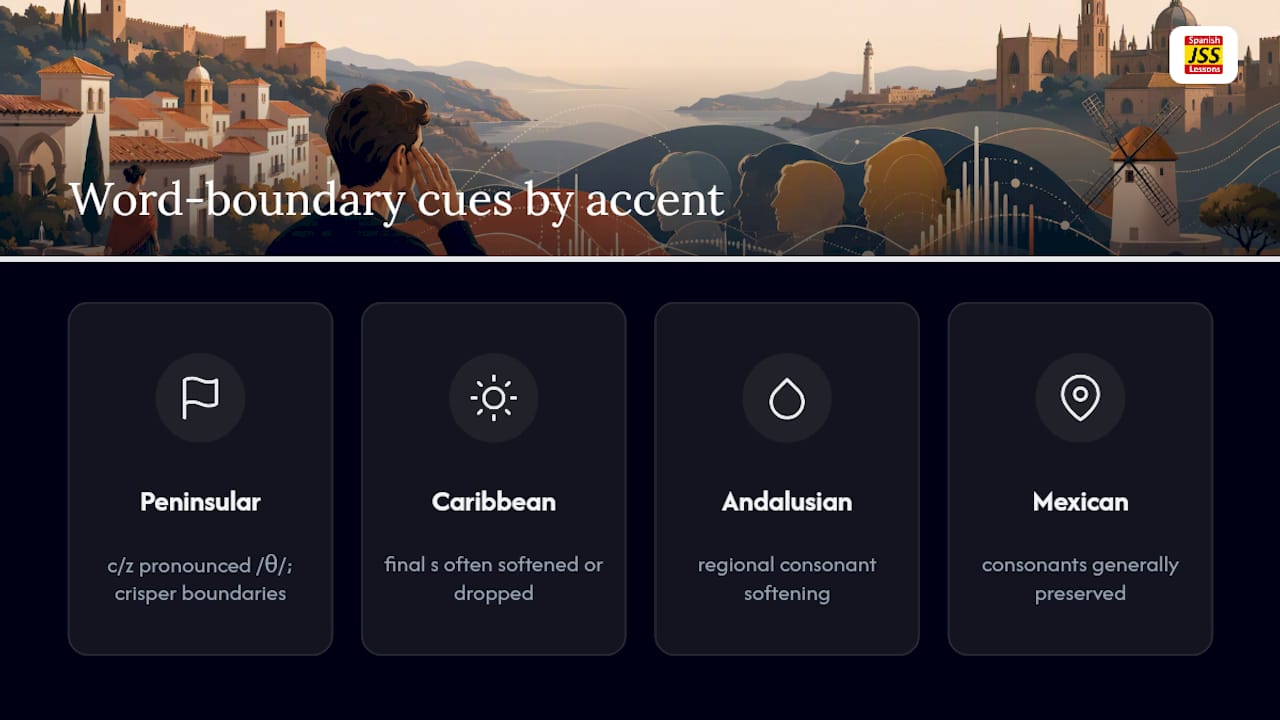
  • Regional accents: Andalusian Spanish drops final consonants and softens sounds heavily. Madrid Spanish is crisp and fast. Both are very different from what most courses teach.
  • Everyday vocabulary: Spain uses words that simply do not appear in Latin American Spanish courses, so learners often feel blindsided by basic items.
  • Pace and rhythm: Spanish in Spain tends to run faster than in Latin America, which is why ear-tuning for English speakers is so important from the start.

Understanding these features early means you are not caught off guard when you arrive. Adults who address these Spanish hurdles early in their learning journey make significantly faster progress than those who discover them by accident.

Cultural nuance and mutual understanding

Language does not exist in a vacuum. In Spain, how you say something matters just as much as what you say. Cultural context shapes every conversation, and picking up on these cues makes a real difference to how warmly locals receive you.

Greetings are a good example. In Spain, social customs include two kisses on the cheek (right cheek first) between women and between men and women, while men typically shake hands. Getting this wrong is not offensive, but getting it right signals genuine effort and respect. Body language also carries weight. Spaniards tend to stand closer during conversation than British people are used to, and maintaining eye contact is a sign of engagement, not aggression.

Idioms and slang are another layer entirely. Some common Spanish expressions used in Spain include:

  • “No hay mal que por bien no venga” (Every cloud has a silver lining)
  • “Estar en las nubes” (To have your head in the clouds)
  • “Me importa un pepino” (I couldn’t care less, literally “it matters to me like a cucumber”)
  • “Venga, va” (Go on then / alright / see you later, depending on context)
  • “Tío / tía” (Mate / pal, used constantly in informal speech)

Accent variation across Spain is significant. Andalusian Spanish, spoken in the south, drops final consonants and blurs sounds together in ways that even advanced learners find challenging. Madrid Spanish is faster and crisper. Catalan-influenced Spanish in Barcelona has its own rhythm. All varieties are mutually intelligible, but the differences are real and worth being aware of.

Street conversation in Andalusia with accent context

Pro Tip: When you arrive somewhere new in Spain, spend the first few days simply listening. Notice which filler words locals use most, how they greet each other, and how fast they speak. This passive listening is not wasted time. It is your ear calibrating to the local frequency. For more on connecting naturally with locals, explore these fluency tips for Spain.

Building practical confidence: approaches and real-life strategies

Knowing what practical spoken Spanish looks like is one thing. Building the confidence to use it is another. The good news is that the most effective methods are also the most accessible, and none of them require a classroom.

On the question of time, it helps to have realistic expectations. FSI research estimates 600 to 750 hours for English speakers to reach conversational fluency in Spanish, with gains modulated by initial proficiency and contact hours. That sounds like a lot, but spread across consistent daily practice, it is very achievable.

Method Estimated hours to impact Confidence boost
Audio lessons (daily) 30 to 50 hours High
Scenario roleplay 20 to 40 hours Very high
Grammar study alone 100+ hours Low
Immersive listening 50 to 80 hours High

Here are the steps that make the biggest practical difference:

  1. Start with high-frequency vocabulary. Focus on the words that appear in almost every conversation before anything else.
  2. Use scenario-based practice. Rehearse real situations: ordering coffee, asking for directions, speaking to a pharmacist.
  3. Train your ear deliberately. Listen to audio Spanish lessons at natural speed, not slowed-down classroom recordings.
  4. Practise roleplay regularly. AI roleplay tools boost self-efficacy for spoken Spanish, giving you a safe space to make mistakes without embarrassment.
  5. Review and repeat. Confidence comes from repetition, not from getting it right the first time.

For practical fluency in Spain, the most important shift is moving away from passive study and towards active, spoken practice as early as possible.

Infographic showing practical spoken Spanish strategies

Pro Tip: Record yourself speaking Spanish for 60 seconds each day on any topic. Play it back. You will notice your own patterns, hesitations, and improvements far more clearly than any teacher could point out.

The uncomfortable truth most Spanish guides miss

Here is something most guides will not say plainly: the pursuit of grammatical perfection is one of the biggest obstacles to real spoken fluency. Adults who have spent years in formal education are conditioned to avoid mistakes. In language learning, that instinct works against you.

Every fluent Spanish speaker you admire made thousands of errors on the way there. The locals in Spain are not grading you. They are trying to understand you, and they will meet you more than halfway if you show genuine effort. Study abroad research consistently shows that real-world practice in markets, cafés, and everyday settings yields far greater gains than structured academic study alone.

What actually builds confidence is exposure, repetition, and the willingness to look slightly foolish in the short term. For Spain specifically, focusing on Castilian features like the theta sound and vosotros from the start means you are learning the right version of the language for your actual context. For a fresh fluency perspective that cuts through the noise, the message is simple: speak sooner, correct later, and never let the fear of mistakes stop you from opening your mouth.

Discover resources to make Spanish learning stress-free

If this article has shifted how you think about learning Spanish, the next step is finding resources that match this practical, real-world approach.

https://jamesspanishschool.com

At James Spanish School, everything is built around the kind of Spanish you actually need in Spain. From real-life Spanish fluency guides to scenario-based audio lessons, the focus is always on confidence in everyday situations rather than academic performance. Whether you want to chat with your neighbours, handle a visit to the doctor, or simply order lunch without anxiety, you will find practical, adult-friendly support at every step. Explore tips for speaking Spanish with locals and discover how stress-free learning can genuinely be.

Discover much more about the JSS course here.

Frequently asked questions

How is practical spoken Spanish different from textbook Spanish?

Practical spoken Spanish uses real-life expressions, slang, and unscripted speech, unlike the formal grammar and set dialogues found in textbooks. It prioritises being understood over being grammatically perfect.

What are common pronunciation challenges for English speakers in Spain?

English speakers often struggle with Spain’s “th” sound (c/z as distinción), the fast conversational rhythm, and the vosotros verb forms that do not appear in most beginner courses.

How long does it take to reach conversational fluency?

FSI estimates suggest 600 to 750 hours are needed for English speakers to reach conversational fluency in Spanish, though consistent daily practice can make this very achievable over time.

Are regional varieties of Spanish hard to understand?

All Spanish varieties are mutually intelligible, but regional accents such as Andalusian or Catalan-influenced Spanish may take some adjustment, particularly for learners used to neutral or textbook Spanish.

What practice methods boost confidence fastest?

Scenario roleplay and audio lessons are consistently the fastest routes to spoken confidence, as they replicate real conversational conditions rather than passive study.

Categories
Insights

Practical Spanish tips for real-life fluency in Spain


TL;DR:

  • The goal is functional communication, not perfection, to build confidence and practical skills.
  • Daily habits like listening, speaking, and immersion accelerate real-life Spanish proficiency.
  • Practice real scenarios, embrace mistakes, and prioritize conversation over passive study.

Practical Spanish tips.

School Spanish and real-life Spanish are two very different things. You can conjugate a verb perfectly in a classroom and still freeze when the woman at the bread counter rattles off a question at machine-gun speed. For English-speaking adults living in or moving to Spain, the gap between textbook knowledge and genuine conversational ease is the single biggest frustration. This article addresses that gap directly. You will find evidence-backed, practical strategies for the situations that actually matter: shops, cafés, neighbours, tradespeople, and local officials. No grammar lectures. No academic theory. Just what works.

Table of Contents

Key Takeaways

Point Details
Focus on conversation Fluency grows when you practise speaking and listening daily, not just by studying grammar.
Set achievable goals Small, everyday language wins—like ordering in shops—build confidence and skill quickly.
Use immersive strategies Surround yourself with authentic Spanish, even at home, for faster progress.
Embrace imperfect practice Mistakes are a sign of real progress—speak early and often for practical fluency.

Set the right goals for conversational Spanish

The first thing to accept is that perfection is not the goal. It never was. The goal is functional communication: making yourself understood, understanding the reply, and keeping the exchange moving. That shift in thinking alone removes an enormous amount of pressure.

Many adult learners waste months drilling grammar rules they will never consciously use in conversation. Native speakers do not think about rules. They think about meaning. Spanish for English speakers is actually more accessible than most people realise, because the two languages share thousands of words and a broadly similar sentence rhythm. Starting from that position of strength matters.

Setting SMART goals makes progress visible and motivating. Instead of “I want to speak Spanish,” try goals like these:

  • Ask for directions and understand the answer
  • Order food and drink confidently at a café
  • Greet your neighbours and exchange small talk
  • Explain a basic health symptom to a pharmacist
  • Understand a tradesperson’s estimate or question

These are real, achievable targets. Each one builds confidence and gives you a measurable win. Research shows that immersion boosts fluency and confidence most, though gains depend on your starting level and how many hours you spend actually using Spanish. That last part is key: using it, not just studying it.

High-frequency phrases are your best investment. Learning the 200 or 300 words and expressions that appear most often in daily Spanish conversation will carry you through the vast majority of real encounters. Reviewing basic Spanish steps gives you a solid foundation to build from.

Pro Tip: Embrace mistakes. Every stumble is a signal that you are pushing into new territory. Locals in Spain are almost universally patient and appreciative when a foreigner makes the effort. A wrong verb ending will not offend anyone. Silence will.

Core habits for rapid real-life Spanish improvement

Once your goals are clear, developing effective daily habits gives you the framework for progress. Consistency beats intensity every time. Ten to fifteen minutes of focused Spanish practice every day produces better results than a two-hour session once a week.

Here is a practical daily routine that works:

  1. Listen first thing. Play a short Spanish audio clip, from an on phone audio list such as ones from WordAmigo while you have breakfast. Your brain absorbs patterns even when you are not actively concentrating.
  2. Shadow a native speaker. Pick a short clip and repeat what you hear, mimicking the rhythm and intonation exactly. This trains your mouth and your ear simultaneously.
  3. Recycle your phrases. Take five expressions you already know and use them in new combinations. Repetition cements retention, and repeating Spanish lessons is one of the most underrated tools for long-term memory.
  4. Speak out loud every day. Even talking to yourself counts. Narrate what you are doing around the house in Spanish. It feels odd at first. It works.
  5. Review before bed. A quick five-minute recap of the day’s new words or phrases dramatically improves overnight retention.

Prioritise listening and speaking over reading and writing if your goal is conversational fluency. Reading has its place, but it will not train your ear to follow fast native speech. Audio Spanish lessons are particularly effective for this, because they replicate the rhythm and pace of real conversation.

“Students who spent a semester in Spain saw measurable gains in linguistic complexity, though fluency and accuracy varied considerably between individuals.”

The takeaway is clear: contact with real Spanish, at real speed, is what drives genuine progress.

Woman practicing Spanish in home kitchen

Using immersive techniques (even from home)

With daily routines in place, replicating an immersive environment accelerates your conversational ease considerably. The good news is that you do not need to live in Spain to create meaningful immersion. You need regular, active contact with the language.

Immersion-related gains are strongest in linguistic complexity, but even remote contact hours matter when you interact regularly and purposefully. The table below compares the two main approaches:

Method Effectiveness Cost Social element
Living in Spain Very high High (relocation) Daily, unavoidable
Language exchange apps Moderate to high Free to low Structured, on demand
Spanish TV and radio Moderate Free Passive
Virtual tutors High Medium One to one, focused
Conversation groups High Low to free Group, varied levels
Spanish podcasts Moderate Free Passive

Building a mix of these options gives you comprehensive exposure without the cost or disruption of relocation. Practical at-home immersion tools include:

  • Language exchange apps such as Tandem or HelloTalk for real conversation practice
  • Spanish Netflix series with Spanish subtitles (not English)
  • Spanish radio stations streamed online for background listening
  • Weekly video calls with a virtual tutor focused on your specific scenarios

For those already in Spain or planning a move, speaking Spanish with locals every day, even briefly, multiplies your progress faster than any app. And if you want to accelerate online Spanish fluency, structured online learning combined with live practice is the most reliable path.

Pro Tip: Switch your phone, tablet, and social media accounts to Spanish. You will encounter hundreds of familiar words in a new language context every single day. Passive exposure adds up faster than you expect.

Quick-win strategies for common Spanish scenarios

Armed with immersive habits, you can now apply quick-win strategies to make your daily encounters smoother. The secret is preparation. Most real-life interactions follow predictable patterns, which means you can script and rehearse them in advance.

Here is how to build your own scenario scripts:

  1. Identify your top five daily situations. Think about where you use language most: the market, the pharmacy, the town hall, the café, the hardware shop.
  2. Write out the exchange. Draft what you will say and the most likely responses. Keep it short and functional.
  3. Practise out loud. Repeat the script until it feels automatic, not translated.
  4. Add one or two polite phrases. A simple “perdone” (excuse me) or “muchas gracias” (thank you very much) changes the tone of any interaction.
  5. Adapt for your region. Andalucía, Catalonia, and Valencia each have local flavours. Ask a local contact or tutor to check your script for regional fit.

The table below shows the most useful phrases for three common scenarios:

Scenario Key phrase What it covers
Café or bar “Pónme un café con leche, por favor” Ordering coffee politely
Market or shop “¿Cuánto cuesta esto?” Asking the price
Pharmacy “Me duele aquí” Indicating where it hurts
Asking directions “¿Dónde está la calle…?” Finding a street
Meeting a neighbour “Buenos días, ¿cómo estas?” Formal greeting

Research confirms that high-frequency language gets used and mastered fastest, so investing time in these core phrases pays off quickly. For a structured approach to building these skills, revisiting basic conversation steps will sharpen your foundation.

What most Spanish learning advice misses

Here is the uncomfortable truth that most courses and apps will not tell you: passive study does not produce conversational fluency. Reading workbooks, watching grammar videos, and completing exercises are all comfortable activities. They feel productive. But they do not prepare you for the moment a Spanish speaker replies at full speed and expects an answer.

Evidence shows that complexity and fluency come more from real contact than from study alone. The adults who make the fastest progress are not the ones who studied hardest in private. They are the ones who started speaking early, made mistakes publicly, and kept going. Understanding why adults struggle with Spanish often comes down to this single pattern: too much preparation, not enough conversation. The shift from perfectionism to communicative experimentation is where real fluency begins.

Next steps: unlock fluency with resources that fit you

If the strategies in this article have resonated, the next step is finding resources built specifically for your situation as an English-speaking adult learner.

https://jamesspanishschool.com

James Spanish School offers core Spanish resources including audio lessons, phrase collections, and scenario-based tools designed for real life in Spain, not academic exams. The 100-lesson course uses Radical Simplification to remove confusing grammar jargon, replacing it with plain English explanations that actually make sense. You will also find practical tips for fluent conversation with locals and a clear guide to the Spanish learning advantages that English speakers already have. Everything is available on demand, with no expiry date and no pressure.

Frequently asked questions

What’s the fastest way to speak Spanish for daily life?

Start speaking Spanish every day, even imperfectly, and focus on the phrases you will use most in your routine. Regular contact with real Spanish boosts fluency faster than any amount of private study.

How much Spanish do I need to live in Spain?

Basic conversational ability covering shopping, health, and directions will handle the vast majority of daily situations and builds confidence quickly. Initial proficiency shapes how quickly you progress, so starting sooner is always better.

Can I really get fluent from home without moving to Spain?

Yes. Remote immersion using apps, virtual tutors, and Spanish media can produce strong conversational skills when practised consistently. Regular L2 contact drives complexity gains even without living abroad.

What’s the most common mistake adult learners make?

Focusing too much on grammar rules rather than practising out loud and engaging in real conversations. Speaking early and often is consistently linked with meaningful functional fluency gains.

Categories
Insights

Mastering Spanish small talk: real-world fluency


TL;DR:

  • Spanish small talk emphasizes rapport, warmth, and personal connection over transactional exchanges.
  • Key phrases, body language, and time-sensitive greetings are essential for natural conversations.
  • Real fluency develops through daily human interactions, not just language apps or textbooks.

You say Hola to your neighbour, she replies in a warm rush of Spanish, and suddenly you’re nodding politely while understanding almost nothing. Sound familiar? Millions of English speakers arrive in Spain with a handful of phrases from an app, only to find that real conversations move faster, feel warmer, and follow unwritten rules that no algorithm has ever taught them. This guide bridges that gap. You’ll discover what makes Spanish small talk tick culturally, pick up the essential phrases that open doors, and follow a practical daily routine that builds genuine confidence. No grammar jargon. No countdown clocks. Just real tools for real life in Spain.

Table of Contents

Key Takeaways

Point Details
Cultural connection first Spanish small talk focuses on building personal rapport before diving into any business.
Essential phrases matter Mastering a few context-based greetings and filler words is the fastest way into local conversations.
Practise daily in real life True fluency comes from short, frequent exchanges with all kinds of people in Spain.
Adapt to directness Expect overlapping speech and direct questions as positive signs of engagement, not rudeness.
Trouble? Politely clarify If lost, asking for slower speech or repeating back shows respect and keeps the chat on track.

What makes Spanish small talk different?

Spanish small talk is not simply English small talk translated word for word. It operates on a different emotional frequency. Where English conversations often stay transactional, “Did you find everything okay?” style exchanges, Spanish small talk is built on rapport. Locals want to feel a human connection before they get to the point, and that shift in expectation catches many English speakers off guard.

Greetings in Spain are time-sensitive and context-aware. Buenos días (good morning) gives way to buenas tardes (good afternoon) around 2pm, and buenas noches (good evening) takes over after dark. Walking into a shop, a waiting room, or even a lift and greeting everyone present is standard practice. Spanish social norms place enormous value on acknowledging the people around you, and skipping that greeting can read as cold or rude, even if it is perfectly normal back home.

Infographic showing Spanish small talk essentials

Physical customs matter too. The dos besos (two kisses on the cheek) between women and between men and women is common in social settings, though a firm handshake works fine in more formal ones. While once upon a time the advice was  n Spain, use formal usted initially, that these days is more reserved for your Bank Manager, the Mayor or King Felipe or with Business clients, use Tu (informal) otherwise, greet upon entering shared spaces, and prioritise personal rapport before moving to any practical matter.

Topic-wise, Spanish small talk gravitates towards weather, weekend plans, food, and family. These are not throwaway subjects. They are genuine invitations to connect. Core mechanics of Spanish small talk include structured greetings, weather discussions, work and hobby inquiries, and smooth exits using time-specific phrases. Compare that to the typical English approach:

Aspect Spanish small talk English small talk
Opening Time-specific greeting, physical acknowledgement Generic “Hi” or “Hello”
Tone Warm, personal, expressive Polite but often reserved
Common topics Food, family, weekend, weather Weather, work, sport
Physical contact Dos besos or handshake Handshake or wave
Formality Tú with everyone these days, Usted with Bank Managers Informal by default
Exit phrases Time-referenced: Hasta luego, Que te vaya bien “See you”, “Take care”

“Starting with personal connection rather than task-completion is the engine room of Spanish social life. Master the warm opener and the rest of the conversation follows naturally.”

Understanding real-life Spanish conversation means accepting that the social ritual itself is the point, not a preamble to something more important.

Essential tools and phrases for natural small talk

Once you understand the cultural backdrop, the next step is filling your toolkit with phrases that actually get used. Core mechanics of Spanish small talk include structured greetings and typical phrases that signal friendliness and openness. Here are the ones worth learning first:

Phrase Pronunciation guide English meaning
¿Qué tal? keh tal How are things?
¿Cómo estás? koh-mo es-tas How are you?
Muy bien, gracias mwee byen, gra-thyas Very well, thank you
¿Y tu? ee too And you? (informal)
Hace buen tiempo ah-theh bwen tyem-po The weather’s nice
Hasta luego as-ta lweh-go See you later
Que te vaya bien keh teh vah-ya byen Hope it goes well for you
Perdona, ¿puedo…? per-doh-na, pweh-do Excuse me, may I…?

These basic Spanish conversation starters are your entry points into almost any exchange. Learn them until they feel automatic, not rehearsed.

Non-verbal communication carries enormous weight in Spanish culture. A genuine smile, steady eye contact, and open body language signal that you are engaged and approachable. Standing slightly closer than you might in Britain is normal and expected. Pulling back can unintentionally suggest discomfort or disinterest.

Here are a few body language habits worth building:

  • Maintain relaxed eye contact during conversation
  • Nod and use small verbal affirmations like sí, sí (yes, yes) to show you are listening
  • Mirror the energy of the person you are speaking with
  • Avoid crossing your arms, which can read as closed-off

Pro Tip: Learn two phrases cold before any social outing: a warm opener like ¿Qué tal todo? (“How’s everything?”) and a polite exit like Bueno, te dejo, que tengo que… (“Right, I’ll leave you to it, I need to…”). These two alone will make every interaction feel far more natural. Pairing these with practising with audio cues will sharpen your ear for the rhythm of real replies.

How to practise: real-life steps to Spanish small talk mastery

Knowing phrases is one thing. Using them confidently in the wild is another. Methodologies emphasise daily real-life practice with strangers, active listening, and non-verbal techniques as the fastest route to genuine fluency. Here is a step-by-step routine that works:

  1. Start with low-stakes encounters. Your local panadería (bakery) or supermarket checkout is ideal. A simple Buenos días, ¿qué tal? costs nothing and builds enormous confidence over time.
  2. Use active listening fillers. Phrases like Oh, ¿sí? (“Oh really?”) and ¡Qué interesante! (“How interesting!”) show engagement and buy you a moment to process what has been said.
  3. Repeat the same scenario with different people. Ordering a coffee or asking about the weather becomes easier each time. Repetition with new faces expands your comfort zone faster than any textbook exercise.
  4. Debrief after each exchange. Note one phrase you heard but did not understand. Look it up. Use it the next day.
  5. Gradually extend conversations. Once greetings feel natural, add one follow-up question. ¿Y cómo ha ido el fin de semana? (“How was your weekend?”) is a reliable bridge into longer chat.
  6. Listen to Spanish radio or TV for ten minutes daily. You are not trying to understand everything. You are training your ear to the rhythm and speed of natural speech.

Handling nerves is part of the process. Most Spanish locals are genuinely warm and forgiving of mistakes. A stumbled sentence delivered with a smile lands far better than silence. These tips for speaking Spanish fluently are grounded in real-life experience, not classroom theory. Here are some basic tips from a dual native expert.

Park bench Spanish conversation practice

Pro Tip: Set yourself a small daily target: one new small talk exchange per day for two weeks. Track it. The cumulative effect is remarkable, and the practical steps for fluency compound quickly once you build momentum.

Troubleshooting: common mistakes and how to keep conversations flowing

Even with preparation, real conversations throw curveballs. Here is how to handle the most common ones.

Fast-talking natives are the number one challenge for English speakers. The advice is consistent: start with comprehensible input at a manageable speed, then gradually expose yourself to faster, more natural speech. Do not expect to follow everything immediately. That is normal, not failure.

Spanish conversations also feel more animated than English ones. Animated conversations and expressive gestures are cultural norms, not signs of conflict. Interruptions signal enthusiasm and engagement, not rudeness. If someone talks over you briefly, they are almost certainly just excited, not dismissive.

Here are the most common mistakes English speakers make, and how to pivot:

  • Freezing when you do not understand. Instead, say ¿Puedes hablar más despacio, por favor? (“Could you speak more slowly, please?”) Most people will happily oblige.
  • Ending conversations abruptly. In Spain, an abrupt exit feels jarring. Use a warm phrase to close: Bueno, te dejo (“Right, I’ll leave you to it”) or Hasta luego, que te vaya bien (“See you later, hope it goes well”).
  • Keep it informal. In South America the formal Usted (“You”) is the default. In Spain use (informal “you”), unless you are talking to your Bank Manager or King Felipe.
  • Translating English idioms directly. Phrases like “I’m fine” translate awkwardly. Lean on bien, gracias or tirando (“getting by”) instead.
  • Avoiding conversation out of fear of mistakes. Silence reads as unfriendly. A warm, imperfect attempt always wins.

“Bueno, me tengo que ir, que si no me espera la compra.” (“Right, I’ve got to go, my shopping won’t wait.”) A light, time-referenced exit like this closes any conversation warmly and naturally.

Building the skill to master fast listening takes time, but it accelerates dramatically once you start having real exchanges every day.

Why true Spanish small talk fluency starts beyond the app

Here is something most language guides will not tell you: the problem is rarely vocabulary. It is the illusion of progress that apps create. A 341-day Duolingo streak can leave you sitting in a Spanish café, completely unable to follow a single sentence. Apps build isolated recognition. They do not build the reflex to respond in real time, in real noise, with a real person looking at you.

The genuine accelerator is human contact. Not perfect human contact. Warm, daily, slightly messy human contact. The builder who greets you at 8am. The woman at the farmacia (pharmacy) who asks how you are. These micro-exchanges, repeated consistently, wire your brain in ways that no gamified drill ever will.

Perfection blocks progress. The learners who advance fastest are not the ones with the best grammar. They are the ones willing to say something imperfect and keep going. Learning shop Spanish builds the kind of confidence that compounds, because every successful exchange, however small, proves to your brain that you can do this.

Apps have their place for building a foundation. But real fluency lives in the street, the market, and the neighbour’s doorstep.

Take your Spanish small talk further with James Spanish School

If this guide has shown you the gap between knowing Spanish and using it, James Spanish School was built to close exactly that gap.

https://jamesspanishschool.com

The full online Spanish course from James Spanish School covers 100 lessons split between sentence-building and ear-tuning, so you can follow fast, natural speech as well as produce it. Lessons are on demand, available 24/7 on any device, with no expiry date and no pressure. James Bretherton, a dual-native speaker with 40 years in Spain, teaches real-life Spanish the way locals actually speak it. Whether you want to chat with your neighbour or handle a trip to the ayuntamiento (town hall), you will find the tools here. Start speaking Spanish fluently with confidence, or explore more Spanish resources to find the right starting point.

Frequently asked questions

What are the best openers for starting Spanish small talk?

Greet with context-appropriate phrases like Buenos días, ¿Qué tal?, or Hola, buenas to initiate small talk politely and naturally. Structured greetings and typical phrases form the core mechanics of Spanish small talk and signal warmth immediately.

How do I handle fast-talking native speakers in Spain?

Politely ask them to slow down using ¿Puedes hablar más despacio? (“Could you speak more slowly?”), and focus on key words you do recognise. Start with comprehensible input and build up your listening speed gradually through daily exposure.

Why do Spanish conversations seem more direct or animated than English?

Spanish small talk is naturally expressive and direct; interruptions or physical closeness signal engagement, not rudeness. Animated conversations and expressive gestures are deeply embedded cultural norms in Spain.

Is it okay to use language apps for small talk practice?

Apps help build a basic foundation, but real-life fluency grows through immersion and daily human interaction, not gamified drills. A 341-day streak can still leave you speechless in a real conversation, which is why street-level practice matters most.

Categories
Insights

Why adults struggle with Spanish and how to succeed


TL;DR:

  • Adults learn Spanish differently, requiring tailored tools and structured methods for success.
  • Overcoming specific pronunciation and grammar challenges is possible through focused practice and repetition.
  • Combining comprehensible input, explicit grammar, and early output accelerates adult language acquisition.

Most adults who try to learn Spanish hit a wall within the first few months. The lessons feel abstract, the pronunciation seems impossible, and native speakers fire back at machine-gun speed. Many learners quietly conclude that they’ve simply left it too late. That belief is wrong, and it’s costing people years of progress. The real obstacles are far more specific and far more solvable than most people realise. This guide explains the genuine cognitive and linguistic reasons why English-speaking adults find Spanish hard, and it maps out the practical approaches that actually move the needle.

Table of Contents

Key Takeaways

Point Details
Adult brains learn differently Adults benefit from structured learning and metalinguistic awareness, not just imitation.
Some Spanish features are tougher Pronunciation, verb forms, and grammar quirks require targeted strategies for English speakers.
Methods matter App-based and classroom instruction often fall short—combine input, output, and explicit practice for success.
Learning barriers can be overcome Dyslexia, age, and other challenges are surmountable using adapted resources and perseverance.

The science behind why adults hit roadblocks

The frustration adult learners feel is real, but it isn’t random. There are clear neurological reasons why picking up Spanish feels harder at 45 than it did learning your first words as a toddler.

The most cited explanation is the Critical Period Hypothesis (CPH). In simple terms, the CPH suggests that the brain is especially receptive to language acquisition during early childhood. After puberty, the brain becomes more fixed in its phonological patterns, meaning the sound systems you grew up with become deeply ingrained. As one review of adult Spanish learning notes, adult brains are optimised for first-language phonological patterns, making native-like pronunciation harder after puberty, though fluency remains achievable via different paths.

“The question isn’t whether adults can learn Spanish. It’s whether they’re using the right tools for an adult brain rather than tools designed for a child.”

Importantly, the CPH is not a death sentence for adult learners. Research shows that proficiency declines gradually with age of onset rather than dropping off a cliff at a fixed birthday. There is no sharp cut-off point. Adults simply learn differently, not worse.

In fact, adults carry a significant advantage: metalinguistic awareness. This is the ability to think consciously about how language works. Children absorb language passively through immersion. Adults can analyse patterns, spot rules, and apply logic to speed up acquisition. When harnessed correctly, this analytical strength is a powerful shortcut.

Here is what science confirms about adult language learning:

  • Pronunciation is harder to perfect, but clear and intelligible speech is very achievable
  • Grammar can be learned faster through structured instruction than through passive exposure alone
  • Adults retain vocabulary more efficiently when it is contextualised and emotionally relevant
  • Motivation and consistency outweigh age as predictors of success

If you’re just starting out, exploring beginner Spanish steps built around adult learning principles will give you a much stronger foundation than generic apps or phrase books.

Unique challenges English speakers face with Spanish

Not all language pairs are equally difficult. English and Castilian Spanish differ in some very specific ways that catch adult learners off guard, particularly when targeting the European variety spoken in Spain.

Phonologically, European Spanish contains sounds that simply don’t exist in English. The famous ceceo (the “th” sound used for the letters c and z in Spain) trips up learners who expect Spanish to sound like its Latin American cousin. The rolled r and the double rr require muscle memory that takes deliberate, repeated practice to build. Vowel sounds in Spanish are also shorter and crisper than their English equivalents, which can make listening comprehension harder than expected.

Grammatically, English-Spanish differences including the subjunctive mood, verb conjugations, and gendered nouns challenge adults who lack the metalinguistic intuition built up through years of formal grammar study. English speakers rarely think about grammatical gender. In Spanish, every noun is either masculine or feminine, and adjectives must match.

Man struggling with Spanish grammar in café

Feature English European Spanish
Grammatical gender None Masculine / feminine for all nouns
Verb conjugation Minimal (I go, he goes) Six forms per tense per verb
Rhyming None Frequent and essential
Pronunciation of c/z Always “s” or “k” “th” sound in Spain
Rolled r Does not exist Required for clarity

Some of the most commonly problematic areas for English speakers include:

  • Rhyming: used constantly in Spanish to match noun and adjective.
  • Ser vs. estar: two verbs for “to be”, each with distinct and context-dependent uses
  • Reflexive verbs: a grammatical structure largely absent in everyday English
  • False friends: words like embarazada (pregnant, not embarrassed) that mislead confident speakers

Exploring the specific Spanish cultural challenges that arise when living in Spain can be fun to.

Pro Tip: Focus on your personal “problem pairs” rather than trying to master everything at once. Identify the two or three features causing the most confusion and practise them through real output, speaking or writing, until they feel automatic.

Why traditional methods let adults down

Most adults who struggle with Spanish aren’t failing because of age or aptitude. They’re failing because the tools they’re using were designed for a different kind of learner in a different kind of setting.

Infographic of adult Spanish barriers and solutions

Classroom-based methods and many popular apps lean heavily on rule memorisation. You learn that the subjunctive is formed by taking the first-person present tense, dropping the final o, and adding a specific set of endings. That’s technically correct, but it doesn’t help you use the subjunctive naturally in a conversation. The rule sits in your head like a locked cabinet; you know it’s there but can’t access it quickly enough when you need it.

As research into adult acquisition confirms, traditional methods fail adults due to over-reliance on rule-based learning.  The idea is that you acquire language most efficiently when you’re exposed to material that is just slightly above your current level. Too easy and nothing new sticks. Too hard and the brain shuts down. Most apps pitch content far too high or far too low.

Here are the most effective techniques, ranked by impact for adult learners:

  1. Comprehensible input at the right level: listening and reading material you can understand with a little effort
  2. Explicit grammar instruction: not memorising rules, but understanding the structural logic behind patterns
  3. Spaced repetition for vocabulary: revisiting words at increasing intervals to lock them into long-term memory
  4. Early and regular speaking practice: output forces your brain to retrieve and consolidate what you’ve absorbed
  5. Deliberate pronunciation work: targeted practice on specific sounds rather than hoping exposure alone fixes it
Technique Traditional classroom Effective adult method
Grammar Rule memorisation Structural pattern recognition
Vocabulary Word lists Contextualised spaced repetition
Speaking Delayed until “ready” Early and consistent output
Listening Scripted dialogues Real-speed, graded input

The shift to on-demand learning has made it far easier to access the right kind of input at the right time. Understanding the best way to learn Spanish as an adult means accepting that the method matters as much as the effort. And when you’re ready to use what you’ve learned, practical guidance on fluency with locals in Spain can bridge the gap between classroom knowledge and real conversation.

Pro Tip: Don’t wait until you feel “ready” to speak. Start producing Spanish from day one, even badly. Output practice accelerates acquisition in ways that passive study simply cannot replicate.

Special considerations: Dyslexia, age, and learning differences

For some adult learners, standard hurdles are compounded by personal factors that rarely get addressed in mainstream language courses. Two of the most significant are dyslexia and older age.

Dyslexia and foreign language learning

Dyslexia affects how the brain processes written language, and its impact doesn’t disappear when you switch to a second language. Research shows that adults with dyslexia face greater deficits in oral production spontaneity, reading comprehension, spelling, and lexical diversity when learning foreign languages. In practical terms, this means reading-heavy methods and written exercises can actively slow progress for dyslexic learners.

Strategies that work well for dyslexic adult learners:

  • Audio-first learning: prioritising listening and speaking over reading and writing
  • Multi-sensory input: combining sound, visual cues, and movement to reinforce new material
  • Shorter, more frequent sessions: reducing cognitive load by breaking study into smaller chunks
  • Slowed input: accessing audio at reduced speed to allow processing time before returning to natural pace

Older adult learners (60+)

Learners over 60 face some additional challenges. Reduced working memory capacity and slower processing speed can make it harder to retain new vocabulary in the short term. As older adults struggle more with focus and memory retention, patience and repetition become even more important. The encouraging news is that language learning itself provides measurable cognitive benefits, including resilience against age-related mental decline.

The key adjustments for older learners include:

  • Allowing more time per lesson without pressure from external deadlines
  • Repeating material multiple times rather than pushing forward prematurely
  • Connecting new vocabulary to personal experience, which deepens retention
  • Celebrating incremental progress rather than comparing pace to younger learners

If you’re navigating these challenges, finding support for adult learners that acknowledges your specific circumstances makes a real difference. That means you need to carefully choose the best way to learn Spanish.

Understanding the full picture of learning Spanish challenges helps you plan realistically and stay motivated through the harder stretches.

Our take: Why what you’ve heard about adult language learning is wrong

The most damaging myth in adult language learning is that children are the gold standard. Adults watch toddlers absorb language effortlessly and conclude that immersion is the magic ingredient they’re missing. So they move to Spain, surround themselves with Spanish, and then wonder why, after two years, they still can’t follow a conversation at the market.

Immersion without structure is just confusion at high volume. Children succeed through immersion because their brains are wired for it and because they have years of total exposure with zero pressure. Adults don’t have that luxury, and pretending otherwise leads to frustration and stalled progress.

The adult analytical brain is genuinely powerful when it’s pointed in the right direction. Structured grammar, explained in plain English rather than academic jargon, gives adults a scaffold that children never need but adults absolutely benefit from. Pair that with targeted speaking practice and contextual immersion, and you have a method that works with your adult brain rather than against it.

For practical guidance on putting this into action, our speaking tips for adults show you how to move from knowing Spanish to actually using it with real people in real situations.

Take the next step: Resources for adult Spanish learners

If you’ve recognised yourself in any part of this guide, the good news is that the right support changes everything.

https://jamesspanishschool.com

At James Spanish School, every element of the course is built around how adult brains actually learn. The 100-lesson programme combines sentence-building with ear-tuning, delivered on demand so you learn at your own pace with no expiry date and no pressure. Whether you’re exploring the best ways to start, working through beginner Spanish courses designed for real conversation, or getting to grips with the cultural nuances covered in our living in Spain tips, you’ll find a structured, encouraging path forward built specifically for you.

But here is a no-nonsense list of the basic things you need to do.

Frequently asked questions

Can adults achieve native-like Spanish pronunciation?

Adults rarely achieve fully native-like pronunciation, but clear and fluent speech is very achievable with targeted practice. The CPH confirms that adult brains process phonology differently, but this doesn’t prevent highly intelligible and confident spoken Spanish.

How long does it take for an English speaker to reach conversational Spanish?

Most adults need 600 to 750 hours of structured study to reach a B1 intermediate level in Spanish, which is sufficient for everyday conversation. Consistent daily practice significantly shortens the timeline compared to sporadic study.

What is the best way for adults to learn Spanish effectively?

The most effective method blends comprehensible input, explicit grammar practice, spaced repetition, and early speaking opportunities. No single technique works in isolation; the combination is what produces lasting results.

Does age make Spanish learning impossible for adults over 60?

Absolutely not. While older adults face greater challenges with memory retention and processing speed, language learning at any age brings measurable cognitive benefits and is entirely achievable with the right approach and realistic expectations.

Categories
Insights

Real-life Spanish conversation: what it means and how to use it


TL;DR:

  • Real-life Spanish involves fast-paced, informal speech with regional idioms and body language.
  • Practicing in settings like markets, cafés, and social gatherings enhances conversational skills.
  • Consistent listening, speaking, and cultural engagement accelerate fluency beyond textbook learning.

What is real-life Spanish conversation?

Many learners spend months studying Spanish, only to freeze the moment a local speaks at full speed. Textbooks give you clean sentences and polished grammar, but real conversations don’t follow a script. A neighbour might greet you with a regional expression you’ve never heard. A market trader might fire back three questions before you’ve finished your first. Real-life Spanish conversations differ notably from textbook dialogues, and understanding that gap is the first step towards closing it. This guide explains what authentic Spanish conversation actually sounds like, where it happens, what you need to master, and how to practise it effectively.

Table of Contents

Key Takeaways

Point Details
Authentic settings matter Practising Spanish in real-world situations is key to fluency.
Cultural context is crucial Understanding jokes, gestures and slang helps you blend in and be understood.
Active practice accelerates progress Frequent conversation and practical resources speed up learning far beyond classroom methods.
Modern tools make it easier Audio recordings and conversation groups can simulate real-life scenarios anywhere.

Defining real-life Spanish conversation

Textbook Spanish is built for clarity. Sentences are short, vocabulary is controlled, and speakers take polite turns. Real life is messier, faster, and far more interesting. When you order a coffee in a Spanish bar, the barista might respond with a joke, a question about your day, and a comment about the weather, all in one breath. That’s not a failure of communication. That’s Spanish working exactly as it should.

Basic Spanish conversations in everyday settings rely heavily on context. A single word like “venga” can mean “come on,” “okay,” “goodbye,” or “let’s go,” depending entirely on tone and situation. Textbooks rarely capture that kind of flexibility.

Here’s what sets real-life Spanish apart from the classroom version:

  • Filler words and hesitation sounds: “Pues,” “o sea,” “bueno” are used constantly and rarely appear in course materials
  • Regional idioms: Expressions vary dramatically between Andalucía, Murcia, Madrid, and Valencia
  • Natural interruptions: Speakers talk over each other, finish each other’s sentences, and loop back mid-thought
  • Body language: Gestures, eye contact, and proximity carry as much meaning as words
  • Dropped syllables: Fast speech compresses words so that “para” sounds like “pa’” and “está” sounds like “’tá”
Feature Real-life Spanish Textbook Spanish
Pace Fast, variable Slow, controlled
Vocabulary Slang, idioms, fillers Standard, formal
Structure Fluid, overlapping Rigid, sequential
Cultural nuance Central Minimal
Interruptions Common Absent

You can explore real-life Spanish conversation examples to hear how these differences play out in practice. Listening to authentic exchanges, even short ones, trains your ear in ways that written exercises simply cannot.

Infographic comparing real and textbook Spanish

Pro Tip: When listening to native speakers, pay as much attention to rhythm and body language as you do to individual words. The physical cues often tell you more than the vocabulary.

Practical settings: where real-life Spanish happens

Once you grasp what makes real-life Spanish unique, it helps to know where it naturally occurs. Real conversation skills are essential in shops, cafes, public transport, and social gatherings, and each setting brings its own unwritten rules.

Setting Why it matters Key phrase type
Market stalls Fast exchanges, local dialect Prices, quantities, pleasantries
Doctor’s surgery Precise vocabulary needed Symptoms, appointments, instructions
Bank or town hall Formal register, patience required Documents, requests, clarifications
Bar or café Relaxed, humorous, rapid Orders, small talk, reactions
Public transport Brief, functional Directions, tickets, timing

Knowing the setting helps you anticipate the register. A conversation at a market stall is nothing like a conversation at the town hall, even if both involve asking for something.

Here’s how to approach and sustain conversations in any of these settings:

  1. Start with a greeting. Even a simple “buenos días” signals respect and opens the exchange warmly.
  2. State your need simply. Use short, direct sentences rather than complex constructions.
  3. Listen for the key word in the reply. You don’t need to catch every word, just the one that answers your question.
  4. Use confirmation phrases. “¿Cómo?” (Sorry?) and “¿Puede repetir?” (Can you repeat?) are not signs of failure. Locals use them too.
  5. Close the conversation naturally. A warm “gracias, hasta luego” leaves a good impression and ends things cleanly.

Cultural cues matter enormously here. Spaniards often use humour to fill awkward silences, and indirect expressions are common when someone wants to avoid saying no outright. If a shopkeeper says “es que…” and trails off, they’re letting you down gently. Recognising that saves embarrassment on both sides.

For tips for fluency in Spain that go beyond vocabulary lists, focus on how conversations feel, not just what’s said. You can also build confidence through structured conversational Spanish practice before stepping into live situations.

Pro Tip: A simple greeting is never wasted. Starting with “buenas” in any setting immediately marks you as someone making a genuine effort, and locals respond warmly to that.

Elements of authentic conversation: what you must master

Understanding where real-life Spanish occurs naturally leads us to the key elements you need to master. Vocabulary alone won’t carry you. The learners who thrive in genuine exchanges are those who develop three core skills: active listening, cultural awareness, and natural response patterns.

Active listening means following the rhythm and tone of speech, not just processing individual words. Spanish speakers signal meaning through intonation constantly. A rising tone at the end of a sentence turns a statement into a question. A flat, quick delivery often means the speaker is wrapping up.

Woman practicing Spanish listening in city park

Cultural context shapes almost every exchange. Gestures, proximity, and shared humour are not decorative extras. They are part of the message. Cultural understanding and listening skills are as important as vocabulary, and neglecting them leaves you half-informed even when your grammar is perfect.

Here are the core elements of successful interaction:

  • Listening for gist: Catching the overall meaning before individual words
  • Recognising slang and idioms: Especially regional ones that don’t appear in dictionaries
  • Matching intonation: Sounding natural rather than robotic builds trust with speakers
  • Using filler words: “Pues,” “mira,” “hombre” keep conversation flowing and signal engagement
  • Reading indirect meaning: What’s left unsaid is often as important as what’s spoken

Over 75% of Spanish speakers regularly use regional expressions and idioms that differ from standard Castilian, which means the version of Spanish you learn from a textbook may sound oddly formal or even foreign to locals in certain areas.

“The learner who adapts to local speech patterns, even imperfectly, connects far more effectively than the one who speaks perfect textbook Spanish with no cultural awareness.”

Building shop Spanish for confidence is one of the fastest ways to develop these skills in a low-pressure setting. Short, repeated interactions with shop staff train your ear and your responses simultaneously. Pair that with conversational practice lessons and you’ll notice real progress quickly.

Bridging the gap: how to practise and improve

Knowing the necessary elements, the final step is exploring how to bridge the gap between learning and real-life application. The good news is that consistent, targeted practice works faster than most learners expect.

Follow these steps to integrate real-life Spanish into your routine:

  1. Listen daily to authentic audio. Even ten minutes of native speech conditions your ear to natural pace and rhythm.
  2. Repeat out loud. Silent reading builds reading skills. Speaking builds speaking skills. They are not the same.
  3. Roleplay common scenarios. Practise ordering food, asking for directions, or explaining a problem before you need to do it for real.
  4. Record yourself. Hearing your own Spanish reveals pronunciation habits you’d never notice otherwise. Correcting your own pronunciation will improve your recognition of incoming words
  5. Seek feedback. A native speaker or a structured course can identify patterns you’re repeating incorrectly before they become habits.

Modern resources such as recordings and roleplay can help you adapt quickly to the pace and texture of real conversation. The key is regularity, not marathon sessions.

The most effective tools for authentic conversation practice include:

  • Native audio recordings that reflect real speech, not studio-perfect enunciation
  • Language exchange partners who speak Spanish as a first language
  • Structured Spanish practice lessons designed around real scenarios
  • On-demand learning platforms that let you revisit difficult material as often as needed
  • Real Spanish audio resources built specifically for adult learners

Pro Tip: Record a short piece of Spanish speech, then record yourself saying the same thing. Compare the two. The gap between them is your personal improvement map. There are great tools that will help you do this. 

Why textbook Spanish fails and what actually works

After forty years living in Spain, the pattern is unmistakable. Learners who rely entirely on grammar rules and written exercises often reach a frustrating plateau. They can write a correct sentence but can’t follow a conversation at normal speed. They know the vocabulary but miss the meaning.

The uncomfortable truth is that most traditional language courses are designed to be taught, not to be used. They reward accuracy in controlled conditions, not adaptability in messy ones. Real improvement comes from making mistakes in live situations and adjusting based on what actually happens next.

Cultural participation is the accelerant that textbooks can’t replicate. Sitting in a bar, listening to two locals debate football, absorbing the rhythm and the jokes, builds a kind of fluency that no grammar exercise can touch. You start to feel the language rather than translate it.

Authentic conversation also makes you a sharper listener. When you’re genuinely engaged in an exchange, your brain processes language differently. You stop searching for individual words and start reading the whole picture. For deeper insights on learning Spanish that reflect real experience rather than academic theory, that shift in approach makes all the difference.

Take your Spanish further with James Spanish School

If this guide has shown you anything, it’s that real-life Spanish is a skill built through exposure, practice, and the right kind of support. James Spanish School exists precisely for this purpose.

https://jamesspanishschool.com

James Bretherton, a dual-native speaker with four decades of life in Spain, has built his 100-lesson JSS course around the conversations that actually matter: with neighbours, shop staff, health workers, and local tradesmen. Using Radical Simplification, the course strips away confusing grammar terms and focuses on how Spanish really works. Spanish conversation tools, fluency tips, and a beginner steps guide are all available on demand, whenever you’re ready to take the next step.

Frequently asked questions

Why is real-life Spanish conversation different from what’s in textbooks?

Real-life Spanish differs from textbook versions because it includes regional slang, cultural references, filler words, and a natural pace that structured exercises rarely capture.

How can I start practising real-life Spanish today?

Engage with native speakers in casual settings and use recordings and roleplay exercises to build familiarity with authentic pace and expression before stepping into live conversations.

What are the best resources for real Spanish conversation?

Native audio recordings, structured conversation lessons, and community language exchanges are most effective. Targeted audio resources like WordAmigo designed for adult learners are particularly useful for building ear-tuning skills.

Do I need to live in Spain to pick up real-life conversation?

No. Immersive online resources and regular interaction with native speakers mean you can develop strong real-life Spanish skills from anywhere in the world.

Categories
Insights

Beginner Spanish structure: essential building blocks


TL;DR:

  • Most beginner Spanish sentences follow the subject-verb-object pattern with omitted subject pronouns.
  • nouns have gender and number, affecting article and adjective agreement, but errors rarely hinder communication.
  • Regular verbs follow predictable conjugation patterns, with key exceptions like ser, estar, and haber.

Most English-speaking adults who want to learn Spanish assume the grammar will defeat them before they even start. The verb tables look endless, the gender rules seem arbitrary, and the idea of dropping subject pronouns feels like a trap waiting to spring. But here is the reassuring truth: the vast majority of everyday conversations in Spain rely on a small set of repeating patterns. Master those patterns and you can chat with your neighbour, order at the bar, and negotiate with the plumber. This guide walks through the essential beginner structures of European Spanish, one clear layer at a time, so you can move from confusion to confident communication faster than you think.

Table of Contents

Key Takeaways

Point Details
Master SVO order Beginner Spanish relies on clear subject-verb-object sentences for most daily situations.
Agreement matters Matching gender and number between nouns, articles and adjectives is essential for correct speech.
Focus on practical use Using real phrases and context-based practice speeds up understanding and conversational confidence.
Learn basic negation Saying ‘no’ before a verb forms nearly any negative statement in beginner Spanish.

Core sentence structure: the subject-verb-object foundation

With the big picture in mind, let’s clarify the foundational sentence structure used in beginner Spanish.

Spanish and English share the same basic word order: Subject, Verb, Object. That is genuinely good news. “I eat bread” in English maps directly to “Yo como pan” in Spanish. The engine room of sentence construction works the same way in both languages, which means you already have an instinct for how a Spanish sentence should feel.

Infographic on Spanish sentence basics

Where things get interesting is the subject pronoun. In English, you always say “I eat” or “she drinks” because the verb form alone does not tell you who is acting. In Spanish, the verb ending carries that information. “Como” means “I eat” all by itself. “Come” means “he/she eats.” Because the ending signals the person, subject pronouns are often omitted in everyday speech. Dropping “yo” is not lazy or informal; it is simply how the language works at beginner level and beyond.

This is actually a shortcut, not a complication. Once you learn the present tense endings for a verb, you automatically know who is doing the action without needing an extra word.

Here is a quick comparison to make this concrete:

English sentence Literal Spanish Natural Spanish
I speak Spanish Yo hablo español Hablo español
She drinks water Ella bebe agua Bebe agua
We eat at eight Nosotros comemos a las ocho Comemos a las ocho
They live in Madrid Ellos viven en Madrid Viven en Madrid

Notice how the natural Spanish column is shorter and more fluid. This is what real spoken Spanish sounds like. If you want to build this kind of fluency from the ground up, exploring Spanish basics for conversations is a practical first step.

Pro Tip: When you are starting out, it is perfectly fine to include the subject pronoun for clarity. Native speakers will understand you completely. Drop it gradually as the verb endings become second nature.

Understanding Spanish sentence order also helps you realise that most beginner sentences follow a predictable rhythm. Once that rhythm feels familiar, building longer sentences becomes far less daunting.

Gender, number and agreement: the details that matter

Now that you know how Spanish sentences are built, it is crucial to understand how words change to match gender and number.

Man reviews Spanish notes in café

Every Spanish noun is either masculine or feminine, and either singular or plural. This is not about biology; it is a grammatical category. “El libro” (the book) is masculine. “La mesa” (the table) is feminine. There is no deep logic to memorise for every word; you simply learn the gender alongside the noun itself.

Noun and adjective agreement follows a clear system of definite articles (el, la, los, las) and indefinite articles (un, una, unos, unas). The article must match the noun in both gender and number. Think of it as a simple handshake between words.

Here is a reference table to keep things clear:

Masculine Feminine
Definite singular el (the) la (the)
Definite plural los (the) las (the)
Indefinite singular un (a/an) una (a/an)
Indefinite plural unos (some) unas (some)

Adjectives follow the same agreement rule. “Un coche rojo” (a red car) uses the masculine form “rojo.” “Una casa roja” (a red house) switches to the feminine “roja.” The adjective changes its ending to match the noun it describes.

Here are the key patterns to keep in mind:

  • Most masculine nouns end in -o and most feminine nouns end in -a, though there are common exceptions
  • Adjectives ending in -o change to -e or -a for feminine forms
  • To make any noun or adjective plural, add -s after a vowel or -es after a consonant
  • Some nouns are the same in both genders and only the article signals the difference
  • Learning new vocabulary as “el libro” rather than just “libro” builds the habit naturally

The good news is that getting gender wrong rarely causes a breakdown in communication. Spanish speakers will understand you and, more often than not, gently model the correct form back to you. Exploring the Spanish language structure is  the focus of of the James Spanish School core lessons. They will ensure you practise these patterns in context rather than in isolation.

Making sense of verbs: regular patterns and key exceptions

Agreement aside, verbs shape the action of any sentence. Here is how to get comfortable with them from day one.

Spanish verbs come in three families, defined by their infinitive ending: -ar (hablar, to speak), -er (comer, to eat), and -ir (vivir, to live). Each family follows its own set of present tense endings, and once you know those endings, you can conjugate hundreds of verbs correctly without memorising each one individually.

Regular present tense conjugation for these three groups follows predictable patterns, and most beginner interactions only require the present tense. Here is a practical overview:

  1. -ar verbs (hablar): hablo, hablas, habla, hablamos, habláis, hablan
  2. -er verbs (comer): como, comes, come, comemos, coméis, comen
  3. -ir verbs (vivir): vivo, vives, vive, vivimos, vivís, viven

Notice that the “nosotros” (we) endings differ between groups but the “yo” (I) form always ends in -o for regular verbs. That single pattern covers a huge amount of daily speech.

Now for the exceptions. Three verbs break the rules so frequently that you simply need to know them:

  • Ser (to be, permanent): used for identity, nationality, profession. “Soy inglés” (I am English).
  • Estar (to be, temporary): used for location, feelings, states. “Estoy bien” (I am well).
  • Haber (to have, auxiliary): used to form compound tenses. “He comido” (I have eaten).

The ser/estar distinction trips up many learners, but a practical rule helps: if you could replace “to be” with “to exist permanently,” use ser. If the situation is temporary or changeable, use estar.

Pro Tip: Focus on Spanish verb basics by learning the most common verbs in full before moving on. Depth before breadth pays off far more than a surface knowledge of fifty verbs.

Here,James Bretherton from JSS explains just why that is essential. 

Negatives, questions, and beyond: unlocking real communication

Mastering verbs is key, but to really speak, you need to handle negatives and ask questions.

Forming a negative sentence in Spanish is remarkably simple. You place “no” directly before the verb and nothing else changes. Negatives use ‘no’ before the verb without any auxiliary verb like “don’t” or “doesn’t.” Compare:

  • English: “I do not eat meat” (three words before the main verb)
  • Spanish: “No como carne” (one word before the verb)

This is one area where Spanish is genuinely easier than English. There is no equivalent of “do/does/did” to construct. Just add “no” and you are done.

Questions work in a similarly accessible way. For yes/no questions, you can simply raise your intonation at the end of a statement, just as you might in casual English. “¿Comes carne?” (Do you eat meat?) uses the same words as the statement, with intonation doing the work. For open questions, Spanish uses interrogative words:

  • ¿Qué? (What?)
  • ¿Dónde? (Where?)
  • ¿Cuándo? (When?)
  • ¿Cómo? (How?)
  • ¿Cuánto? (How much/many?)

Real communication starts the moment you can ask a question and understand the reply. Even a simple “¿Dónde está?” (Where is it?) opens up dozens of daily interactions.

The challenge, of course, is not forming the question but following the answer. Research into Spanish fluency development suggests that consistent practice over around four months produces measurable gains in complexity and fluency, with estimates of 600 to 750 hours for full proficiency. That sounds like a lot, but daily conversational practice compounds quickly.

For practical guidance on speaking Spanish fluently with real people in Spain, the focus should always be on getting your meaning across rather than achieving grammatical perfection. And if you want to practise forming Spanish questions in a structured way, targeted exercises make the patterns stick far faster than passive reading.

A practical approach: why doing trumps memorising for beginners

Understanding the building blocks is only the starting point. Your method matters more than memorising rules.

There is a persistent belief that adults must master grammar rules before they can speak. Decades of language research challenge that view directly. Input-rich, communicative learning consistently outperforms grammar-first drilling for adults who want practical, conversational Spanish rather than academic certification.

The reason is straightforward. Grammar rules are descriptions of language, not the language itself. When you are standing in a Spanish chemist’s trying to explain a symptom, you do not have time to mentally conjugate a verb table. You need patterns that have been absorbed through use, not rules retrieved from memory under pressure.

Mistakes are not failures; they are data. Every time a native speaker corrects you or models a better phrasing, your brain updates its internal map of the language. That process only happens if you are actually speaking. Sitting with a textbook and getting every exercise right teaches you to pass exercises, not to communicate.

The most effective approach for adult learners combines clear structural understanding with immediate communicative practice. Learn the pattern, use it in a real sentence, hear it used back to you. That cycle is what builds genuine confidence. For a deeper look at the best way to learn Spanish as an adult, the evidence consistently points toward active use over passive study.

Take your Spanish further with tailored support

With a clear foundation and practical strategies in hand, it is easier than ever to build your Spanish naturally.

James Spanish School is built around exactly this philosophy. Rather than drowning you in grammar terminology, the course explains Spanish structure through plain English, using Radical Simplification to make patterns feel logical and learnable. The 100-lesson programme covers both sentence-building and ear-tuning, so you can follow fast native speech as well as produce it.

https://jamesspanishschool.com

Whether you are just starting out or looking to sharpen what you already know, mastering basic Spanish for real conversations is entirely within reach. Explore the starter resources for Spanish available through James Spanish School and take the first practical step towards speaking with confidence in everyday Spain.

Frequently asked questions

What is the most important structure to learn as a beginner in Spanish?

The most important is the subject-verb-object order, often using verb endings to signal the subject so the pronoun can be dropped. Getting comfortable with this pattern first gives you a reliable framework for building any sentence.

How do you make basic negative sentences in Spanish?

Place “no” before the verb without any additional auxiliary words, for example “No como carne” means “I don’t eat meat.” It is one of the simplest structural rules in the language.

Do adjectives go before or after nouns in beginner Spanish?

Adjectives follow the noun in most cases, such as “un coche rojo” (a red car), though a small number like “gran” may precede the noun for emphasis or a shift in meaning.

How long does it take to become conversational in Spanish?

Empirical benchmarks suggest 600 to 750 hours of study for proficiency, with notable conversational progress typically appearing after around four months of consistent, focused practice.

Categories
Insights

Improve real-life Spanish: master fast listening skills


TL;DR:

  • Fast Spanish listening involves understanding native speech at natural speed, including slang and accents.
  • Overcoming barriers like word blending and regional accents requires consistent immersive practice and targeted techniques.
  • Regular exposure to authentic audio and shadowing builds ear resilience, enabling real-life cultural immersion.

You’ve studied your textbook, practised your phrases, and you can hold a decent conversation in a classroom setting. Then you arrive in Spain, a local speaks to you at full speed, and your mind goes completely blank. Sound familiar? This is one of the most common and frustrating experiences for English-speaking adults learning Spanish. The gap between slow, enunciated classroom Spanish and the rapid, rhythmic speech of a native Spaniard is enormous. This guide will show you exactly what fast Spanish listening is, why it matters so deeply for real cultural immersion, and how to build the skills that will genuinely transform your experience in Spain.

Table of Contents

Key Takeaways

Point Details
Real-world listening needed Classroom Spanish won’t prepare you for the speed and slang of everyday life in Spain.
Immersion is fastest path High-contact listening programmes and daily audio exposure accelerate adaptation to real spoken Spanish.
Practical tools matter Using audio apps, transcripts, and daily habits bridges the gap between slow study and fast conversation.
No shortcuts, steady wins Daily exposure and persistence are essential for building true fast listening skills.

What is fast Spanish listening?

Fast Spanish listening is the ability to understand spoken Spanish at the natural pace and rhythm used by native speakers in Spain. It is not the measured, carefully pronounced Spanish you hear in language courses or audio textbooks. It is the machine-gun speed of a market trader calling out prices, the fluid conversation between friends at a bar, or the rapid instructions from a local official.

Classroom Spanish tends to be slowed down, stripped of regional accent, and free of the contractions and elisions that real speech is full of. In contrast, authentic Spanish conversation involves:

  • Word blending: Sounds from one word merge into the next, so para el becomes something closer to parel.
  • Local slang: Regional expressions and colloquialisms that no textbook covers.
  • Rapid transitions: Speakers shift topics, interrupt each other, and change register without warning.
  • Accent variation: Castilian Spanish, Andalusian, and regional dialects each carry distinct sounds and rhythms.
  • Dropped syllables: Native speakers routinely shorten words in casual speech.

For learners who have only worked with slow, controlled audio, this can feel overwhelming. The frustration is real and completely understandable. Your brain has been trained to process Spanish at one speed, then suddenly it is asked to operate at triple the pace.

“The moment you hear real Spanish on the street, you realise your ear has been living in a protected bubble. Breaking out of it is the whole challenge. Complaints about being distracted by a bee buzzing in an online audio pale into insignificance to the blaring television in the Spanish bar

Building fast listening skills means training your ear to recognise sounds, rhythms, and patterns rather than translating word by word. Immersive programmes provide 20 to 100+ hours of weekly contact, which accelerates real-conversation adaptation significantly. Starting with beginner Spanish conversations built around authentic speech patterns is a smart first move, and using tools like WordAmigo audio lists helps you tune your ear to genuine pronunciation from the very beginning.

Why fast listening matters for real conversations in Spain

Having defined fast Spanish listening, let’s examine why mastering it genuinely matters. The ability to understand rapid speech is not just a nice bonus. It is the difference between participating in life in Spain and watching it pass you by.

Think about the everyday situations that demand quick comprehension:

  • Cafés and restaurants: Waiters rattle off the daily specials without pausing.
  • Shops and markets: Prices, offers, and questions come at you without ceremony.
  • Public transport: Announcements are fast, often distorted, and not repeated.
  • Social gatherings: Group conversations overlap, shift, and accelerate constantly.
  • Health and official appointments: Missing key information here carries real consequences.

When you cannot follow fast speech, miscommunications happen. You nod along and agree to something you did not understand. You miss a joke and feel excluded. You ask someone to repeat themselves three times and watch their patience thin. These moments chip away at your confidence and can make you retreat from using Spanish altogether.

On the other hand, when your ear is tuned to real Spanish, everything changes. You catch the humour in a conversation. You understand what your neighbour is telling you about the local fiesta. You follow the builder’s instructions without needing a translator. Immersive Spanish programmes rapidly build this kind of real conversation confidence through high contact hours with authentic speech. The social and cultural rewards of speaking with locals in Spain are enormous, and they begin the moment your listening catches up with your speaking.

Even practical tasks like shop Spanish in Spain become genuinely enjoyable rather than stressful when you can follow what is being said naturally.

Woman listens in Spanish bakery conversation

Pro Tip: Focus first on the ten or fifteen most common rapid-fire phrases used in everyday Spanish settings. Mastering these gives you anchor points in fast conversations, so your brain is not starting from zero every time.

Barriers to understanding fast Spanish and how to overcome them

Understanding its value highlights the need to address the obstacles learners face. The good news is that each barrier has a practical solution.

The main challenges are:

  • Accent variation: Spain alone has multiple distinct regional accents, each with its own quirks.
  • Word blending and elision: Sounds merge across word boundaries in ways that make familiar words unrecognisable.
  • Local slang: Expressions shift by region, generation, and social group.
  • Delivery speed: Native speakers simply do not slow down for learners.

Here are four proven techniques to work through these barriers:

  1. Use slow-down audio apps for ear training. Apps that allow you to reduce playback speed let you hear the individual sounds within fast speech before you attempt full speed. Gradually increase the pace as your ear adjusts.
  2. Practise with transcripts. Listen to a short clip of authentic Spanish, then read the transcript. Notice where sounds blended or disappeared. Repeat until you can hear what you previously missed.
  3. Chunk and segment long sentences. Rather than trying to process an entire sentence at once, train yourself to catch key words and build meaning from those. Context fills in the rest.
  4. Shadow and repeat. Listen to a short phrase, then say it aloud immediately, mimicking the rhythm and pace. Shadowing rewires your brain to process Spanish at native speed rather than translating it.

Comprehension increases through intensive, natural-speed listening practice, as seen in immersive language experiences. Exploring Spanish listening alternatives and enrolling in structured listening programmes can accelerate this process considerably. You can also try spoken Spanish practice lessons designed specifically for building ear-tuning skills.

Infographic showing Spanish listening barriers and solutions

Barrier Practical technique Expected benefit
Accent variation Listen to regional Spanish audio daily Ear adjusts to multiple sound patterns
Word blending Transcript-based listening exercises Identify hidden sounds within speech
Local slang Curated colloquial phrase lists Recognise informal speech faster
Delivery speed Shadowing and speed-adjusted playback Brain processes at native pace

Pro Tip: Stop translating in your head. The moment you try to convert Spanish into English before understanding it, you fall behind. Train yourself to feel the meaning of words directly, the same way you do in your mother tongue.

Practical tools and habits to improve fast Spanish listening

With common challenges mapped out, let’s look at proven ways to train your ear and make new habits stick.

The most effective tools for building fast listening skills include:

  • Podcasts in European Spanish: Choose programmes made for native speakers, not learners, once you are past the beginner stage.
  • Audio word lists: Tools like WordAmigo give you authentic pronunciation in context, not isolated sounds.
  • Conversation exchanges: Speaking with native speakers, even briefly, forces your ear to adapt in real time.
  • Graded audio programmes: These bridge the gap between slow learner audio and full native speed.

Programmes such as Delengua Granada or Pueblo Español provide high weekly contact hours and real-world listening exposure that classroom study simply cannot replicate.

Tool Best for Limitation
Spanish podcasts (native) Advanced ear training Can overwhelm beginners
Graded audio programmes Bridging slow to fast speech May lack authentic slang
Conversation exchanges Real-time adaptation Requires scheduling and confidence
On-demand course lessons Structured, repeatable practice Self-discipline required

The key is building daily micro-habits. Ten minutes of focused audio each morning is worth more than an hour of passive background listening once a week. Record yourself repeating phrases and compare your rhythm to the original. Shadow short clips before you move on to longer ones.

Exploring on-demand Spanish learning options means you can fit ear-tuning practice into your day without rearranging your life. Combining this with quality Spanish audio resources and regular practice lesson videos creates a habit loop that genuinely moves the needle.

The uncomfortable truth about mastering fast Spanish

Having seen the practical methods, let’s speak candidly about what truly drives progress. No technique, app, or course will do the work for you if you are not spending real time with real Spanish. Classroom skills give you a foundation, but they will never be enough on their own.

The truth is that feeling lost is part of the process. Every learner, no matter how diligent, goes through a phase where fast Spanish sounds like noise. That phase does not mean you are failing. It means your ear is being stretched. Immersion and relentless practice are proven to build fast listening ability far more effectively than traditional study alone.

Even experienced learners stumble when they encounter a new regional accent or a particularly fast speaker. The difference is that they keep going. Daily exposure to authentic Spanish audio, even in small doses, gradually makes the impossible feel ordinary. The learners who succeed are not the ones with the best memory or the most natural talent. They are the ones who kept listening, kept shadowing, and refused to retreat into comfortable, slow-paced materials. Unlocking confidence in Spain is less about reaching perfection and more about building the resilience to stay in the conversation even when it is fast and messy.

Ready to boost your Spanish listening for Spain?

If this guide has shown you anything, it is that fast Spanish listening is a skill you can genuinely build, step by step, with the right tools and consistent practice.

https://jamesspanishschool.com

At James Spanish School, the 100-lesson course is built around exactly this challenge. Half the lessons focus on ear-tuning, training you to follow real spoken Spanish rather than just studying it on paper. James Bretherton, a dual-native speaker with 40 years in Spain, has designed the course around real conversation basics and genuine cultural immersion. Explore fluency tips for locals and discover how the JSS 100 lesson program can connect you with a community of learners on the same journey. Your ear is ready to be trained.

Frequently asked questions

How can I start understanding fast Spanish if I’m a beginner?

Begin with graded audio that progressively increases speed and focus on the most common everyday phrases before tackling full native-speed conversations. Repetition and patience are your best tools at this stage.

What is the best tool for improving Spanish listening speed?

Immersive audio programmes and recordings of genuine native speech are the most effective, as they expose your ear to the real rhythms and sounds of Spanish rather than a sanitised version.

How quickly can someone adapt to fast Spanish?

Many learners notice meaningful progress within a few weeks when they engage daily with authentic fast Spanish audio and real conversation practice, though the pace of improvement varies by individual.

Does understanding fast Spanish mean I’ll be fluent?

Not automatically, but strong listening skills make speaking and participating in conversations far more natural and confident, which in turn accelerates overall fluency considerably.

Please ask questions
from Lesson pages